
The best commercial massage chair for an airport is not the one with the longest program list. It is the one an operator can keep clean, available and economically viable over years of use.
In practice that comes down to five things: upholstery that survives constant wiping and skin contact, cashless payment configured for the destination market and tested with the operator, a footprint that fits the terminal, a mechanism you can service, and paperwork the airport will accept.
Extra massage programs matter much less than spec sheets suggest.
| What the airport demands | What to specify |
|---|---|
| Constant skin contact and daily wipe-downs | Hydrolysis-resistant upholstery, backed by a test report |
| Travelers from many countries | Confirm locally supported cashless methods; assess cash as an optional backup |
| Tight floor space | Footprint measured with the backrest fully reclined |
| Long hours, little tolerance for downtime | Replaceable wear parts, spare parts supply, remote monitoring |
| Safety review by the airport | Product-specific fire and electrical evidence, with any applicable local approvals |
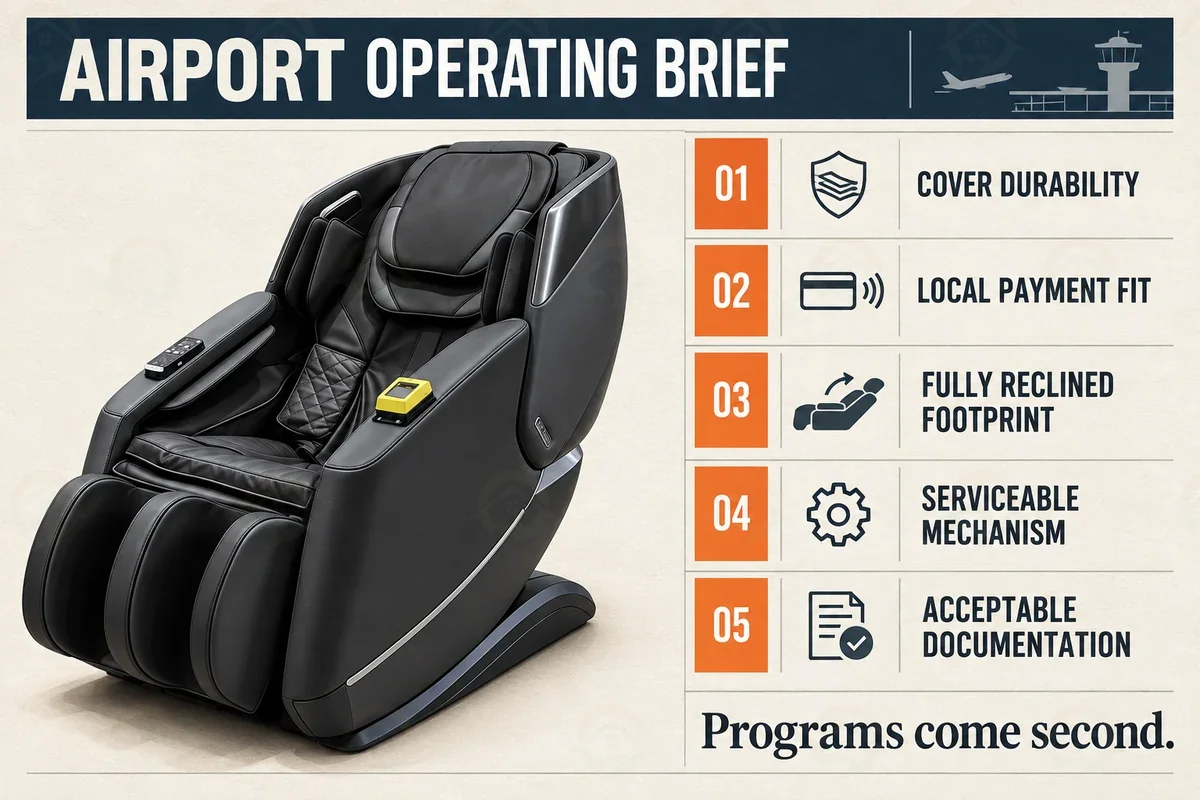
How an airport differs from other locations
A shopping-mall placement and an airport gate are not interchangeable. Travelers at a gate may be tired, carrying bags, short on time, and paying with an unfamiliar card. Staff need to wipe down the surface repeatedly, while the operator needs the chair ready for the next user.
Those conditions expose weak covers, awkward payments and service delays faster than a showroom demonstration will.
That changes what matters. A chair with an impressive program list but a cover that turns sticky after a year is a poor airport chair.
Upholstery: prove it can survive repeated cleaning
Sweat, skin oils, hand sanitizer and disinfectant wipes all end up on the same panel, every day, for years. In a hot or humid terminal the surface takes even more punishment. When a cover fails, it may not tear. It can turn tacky, then flake or peel in patches even while the mechanism still runs.
One possible failure mechanism is hydrolysis: heat and moisture can degrade some polyurethane coatings. A solvent-free PU process and hydrolysis resistance are different claims; do not assume one proves the other.
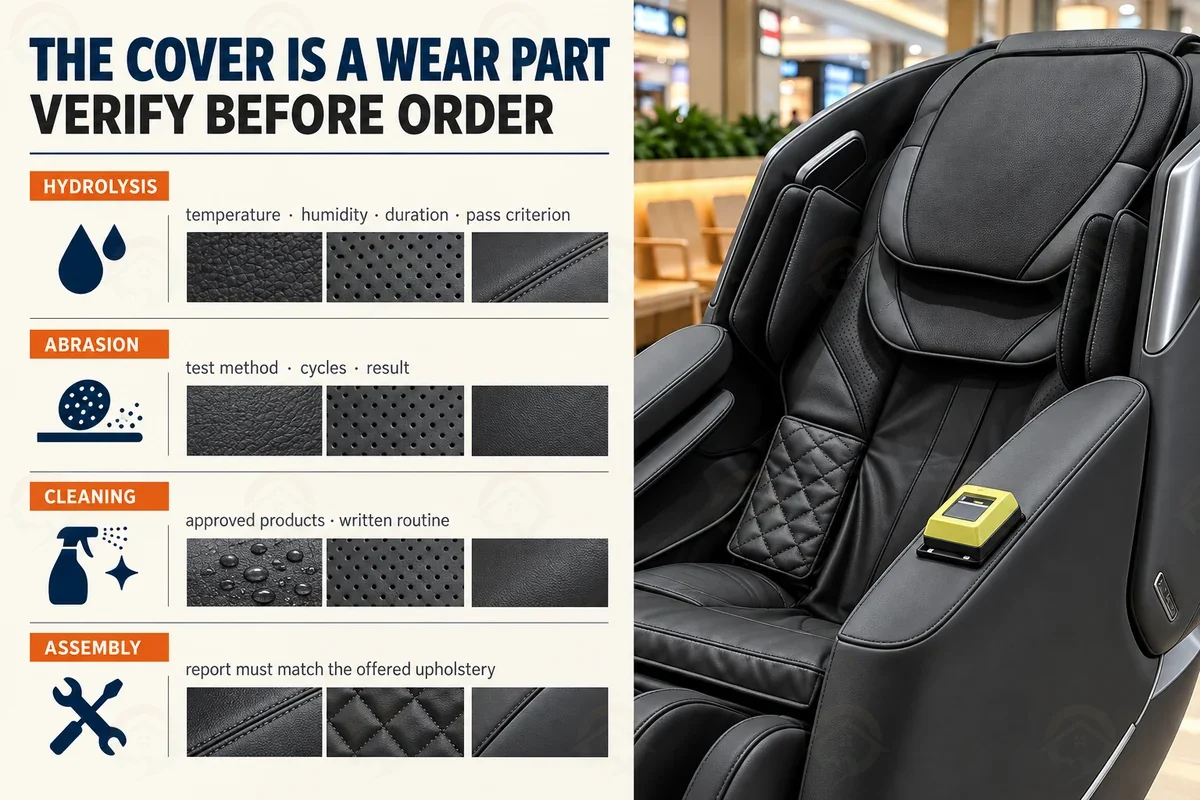
Ask for a test report for the proposed cover under stated temperature, humidity, duration and acceptance criteria. Our article on solvent-free PU leather explains how the process works, and the leather types guide covers how to check a supplier's claims.
A more durable cover may cost more up front. Compare that premium with the cost of recovering the chair, cleaning labor and time out of a paid location rather than assuming the cheaper cover wins.
Verify the cover, not just the swatch
Two things are worth asking for before you order:
- A hydrolysis test report, with the conditions. Temperature, humidity, test duration and the pass criterion all matter. A report that only says "passed" tells you very little.
- Abrasion data. Two covers can look identical in a showroom and wear very differently. Our abrasion test breakdown shows what the numbers mean.
Public-space fire and electrical requirements vary by country, airport and installation. EN 1021-1 and EN 1021-2 address ignition resistance of upholstered furniture using a smouldering cigarette and a match-flame equivalent.
Make cleaning part of the specification
Cleaning matters too. Ask the supplier which cleaning products they approve for the cover, and give your cleaning staff that list. Our cleaning and maintenance guide is a useful handout.
Payment has to work for strangers
Nobody at a gate wants to hunt for the right coins. A Nayax VPOS Media 4 Mini is one option for an unattended chair, but terminal compatibility is not automatic: Nayax lists Pulse, Marshall and Cloud support for the Mini, not MDB.
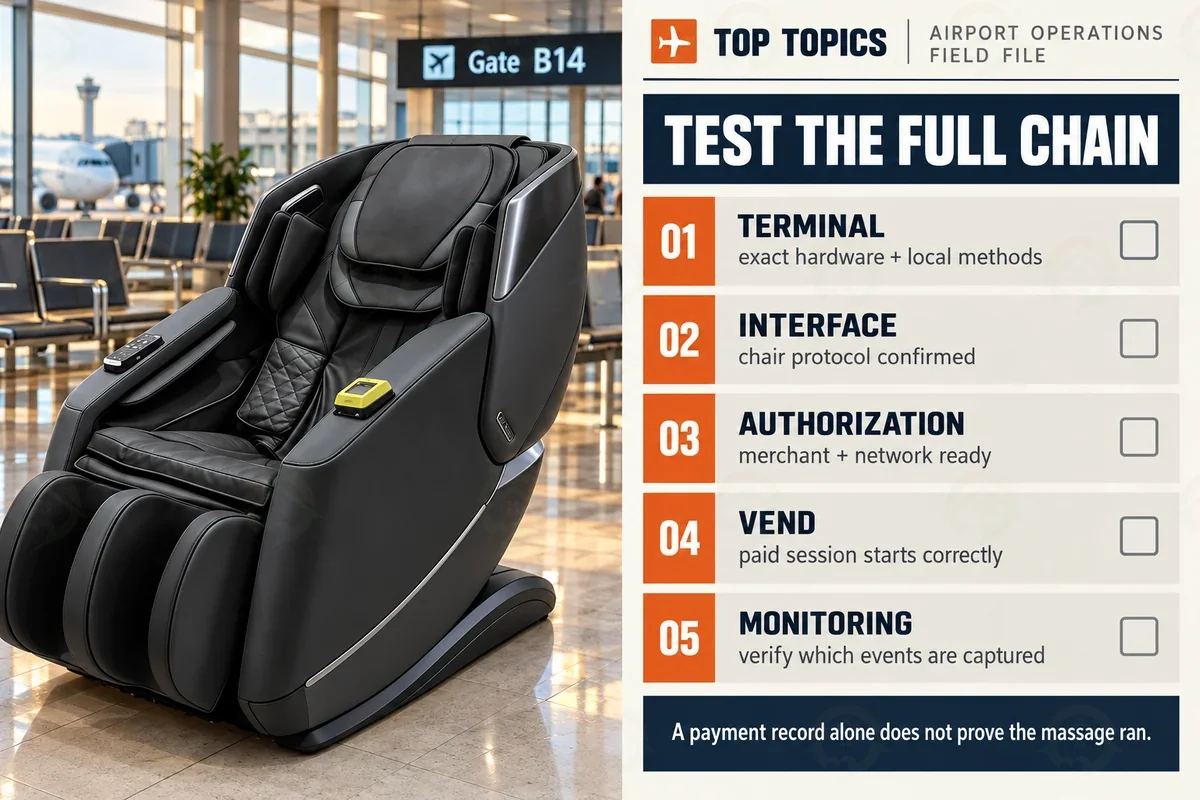
Confirm the exact hardware version, chair interface, destination-country payment methods, merchant onboarding, connectivity and transaction fees before the order. Request an end-to-end payment-to-massage test for the selected configuration before shipment.
An operator reported an approved card payment that did not trigger a vend on a different type of machine; it is a reminder to test the complete handshake, not evidence of a fault in any particular chair. Our cashless payment FAQ covers setup and common questions.
If you want a cash option as well, the cash box FAQ explains the banknote side.
Test the full payment-to-massage chain
An airport location is rarely next door to your workshop, so ask which payment and device events the selected system can report remotely, and which faults still require a site visit. The remote monitoring FAQ explains available transaction and connection views.
A payment record alone does not prove that a massage session started or completed; verify which chair-side events are actually captured.
Mechanism: 2D or 3D
On models equipped with body scanning, confirm how the chair locates the user before a paid session starts. The 2D-versus-3D mechanism difference is roller depth, not the number of advertised programs. A 3D mechanism adds adjustable roller projection beyond the 2D travel path.
The drive mechanism and service procedure depend on the selected model; request its engineering drawing and replacement instructions.
For a shared chair used by people of every size and preference, adjustable depth is a real advantage. A 2D option can reduce configuration cost and complexity; compare actual quotations rather than assuming a fixed price difference.
Which one makes sense depends on your price per session and how many chairs you plan to place. You will also see "4D" and "5D" on some spec sheets. Those terms are often marketing labels for control variations rather than a universal mechanism standard.
We build 2D and 3D, and our mechanism guide explains the difference.
Footprint and power
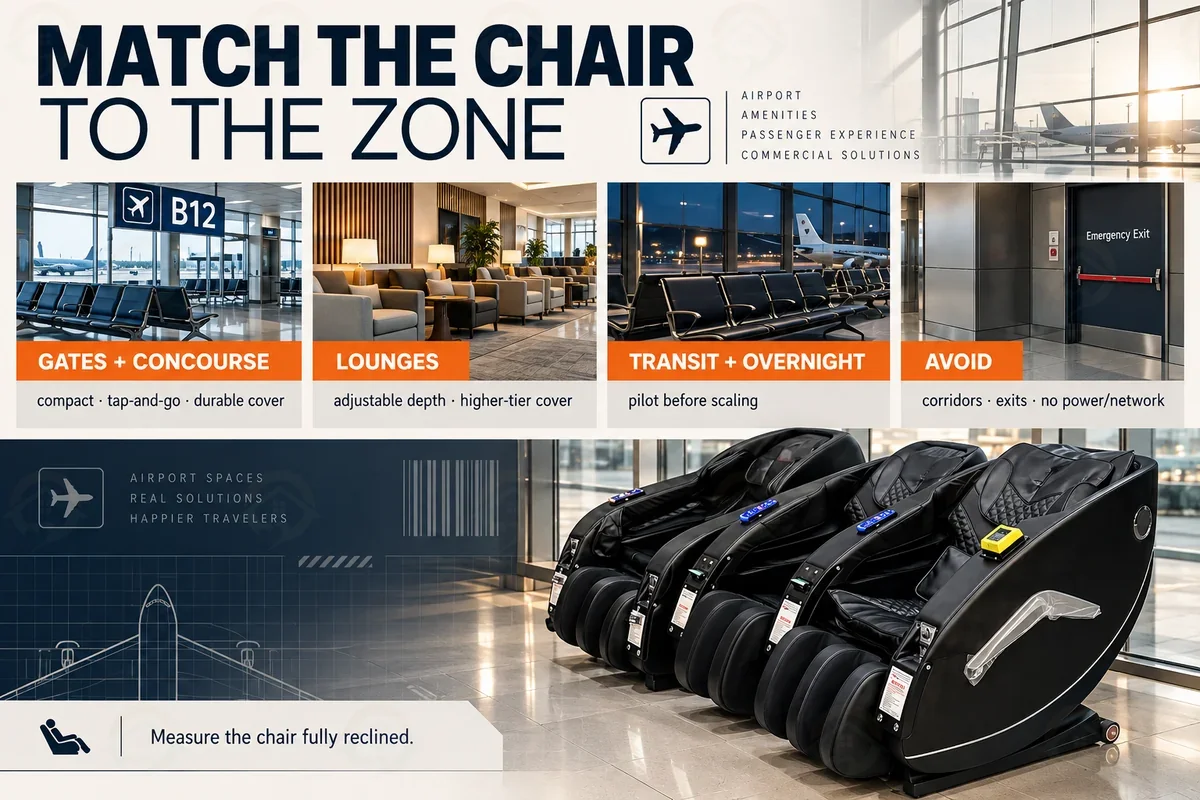
A reclining chair needs more floor than it appears to when upright. Measure it fully reclined, add room for a person to get in and out, and keep it clear of walkways and emergency routes.
The chair needs mains power, and the payment terminal and remote monitoring need a network connection, so check outlets and signal at the exact spot before you commit. Our installation space and clearance guide lists what to measure.
Before you reserve a gate-space lease
Send your venue's clearance, payment, cleaning and safety checklist. We can compare it against a model-specific configuration before you commit to hardware.
Review a commercial chair specificationServicing and spare parts
Ask for the selected model's replaceable-part list, mechanism replacement procedure, parts pricing and a written post-discontinuation supply plan. Do not turn a component test rating into a promise of chair service life.
Plan the schedule as well. Work backwards from the terminal opening date rather than relying on a generic shipping number.
Matching chairs to airport zones
- Gates and main concourse. High traffic, short stays. Prioritize a compact footprint, tap-and-go payment and a durable cover.
- Lounges. Longer stays and a quieter setting. Adjustable depth is easier to justify here, and so is a higher-tier cover.
- Transit and overnight areas. Passengers with long layovers may have more time for a session; do not assume repeat usage without a site pilot.
- Places to avoid. Narrow corridors, emergency exit routes, spots next to fire equipment, and any location without reliable power and network.
Counting the cost as an operator
Operators often ask us for a payback figure. We cannot give a reliable one without your price per session, the location terms and observed usage, and anyone who quotes a figure without those is guessing.
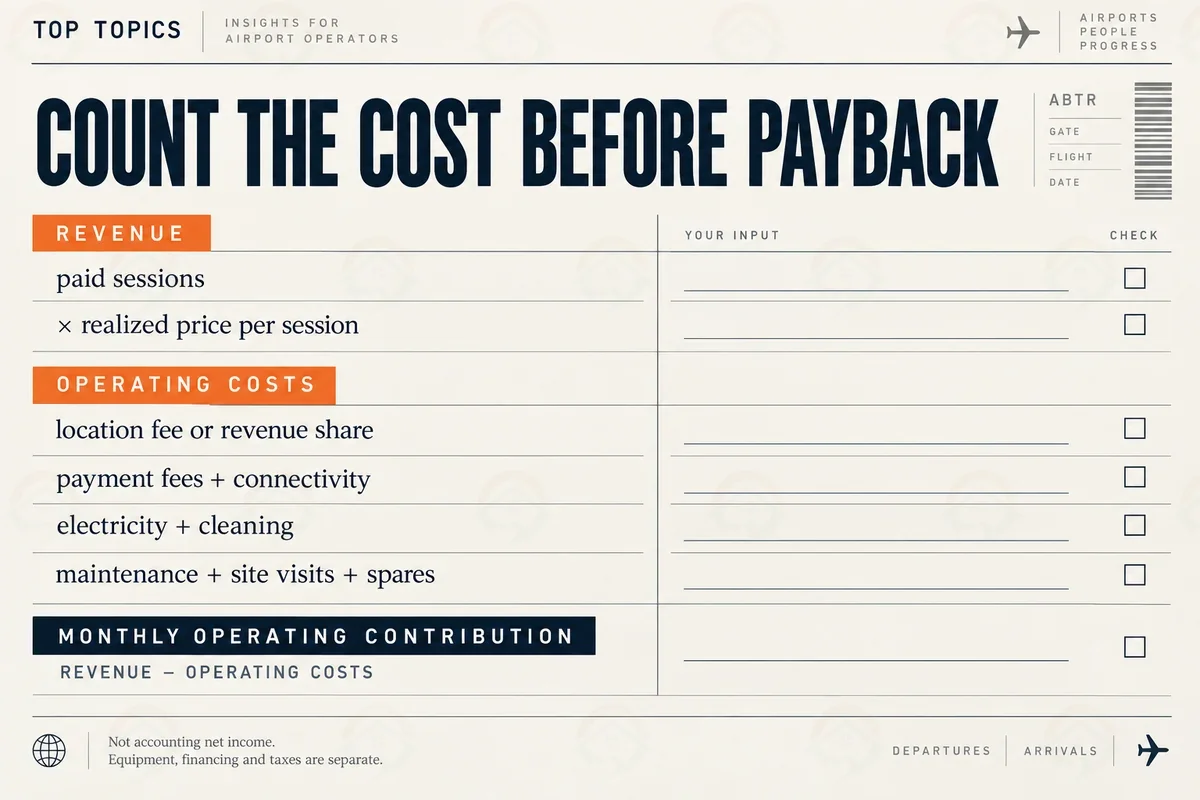
First calculate operating contribution, then compare it with the landed chair, installation and financing costs. The operating calculation is:
Monthly operating contribution = paid sessions × realized price per session − (location fee or revenue share + payment fees + connectivity + electricity + cleaning + maintenance, service visits and spares)
The common planning blind spots are the cost side: buying on the chair price alone, omitting cleaning labor, payment and location fees, connectivity and site visits, or failing to budget for spares at a hard-to-reach terminal.
Operating contribution is not accounting net income: it excludes equipment depreciation, financing and taxes.
Questions to ask the factory before you order
- Can you show a hydrolysis test report with the test conditions?
- What abrasion data do you have for the cover?
- Which fire test reports can you provide, and do they match the airport's requirements?
- Which payment terminal is installed, and is it tested before shipment?
- Which mechanism does the chair use, and how is it replaced if it fails?
- How long are spare parts kept after a model is discontinued?
FAQ
Do airport massage chairs need special certification?
It depends on the country and the airport operator.
Ask the operator early, then request exact-model test reports and acceptance criteria from the supplier.
Can one chair take both card and cash payments?
A cashless terminal and a banknote acceptor may be specified together on a compatible commercial configuration. Confirm the terminal, cash-box mounting, local settlement and combined factory test for the exact model; our cash box FAQ explains the banknote option.
Why does the cover matter more than extra massage programs?
Because the cover is what travelers see and touch, even a mechanically sound chair can look neglected when its upholstery peels. Ask for both surface test data and a replaceable-cover plan.
Can the chairs carry an operator or airport brand?
Yes. We offer OEM options for commercial chairs, including branded appearance. Send us your requirements and we will tell you what is possible.
How long do the chairs last in daily use?
There is no defensible universal service-life number. Actual life depends on usage, climate, maintenance, replaceable-part availability and the exact model. Request model-specific component ratings and written parts support rather than a blanket lifespan promise.
Next step
Tell us the airport, the number of chairs, the payment setup and any branding you need, and we will suggest a configuration. You can browse our vending massage chairs or contact us directly.
Prepared by Sweet Home Technical Team
Joe Fan
Manufacturing & Product Development Manager · Sweet Home
Sweet Home has manufactured OEM massage chairs since 2013 and develops products for commercial buyers. Joe reviews configuration, materials and export-order requirements for commercial buyers.
Disclosure: Sweet Home manufactures massage chairs and may supply commercial configurations discussed in this guide.
Quick audit: will your airport chair survive the operating brief?
Confirm cover tests, terminal clearance, local payment acceptance, service access and the venue's approval documents.
Two or more items unresolved? Send us the airport, proposed location, chair quantity and payment requirements.
Related product pages
Cashless Payment Vending Massage ChairOEM Commercial Vending Massage Chair