
A commercial massage chair mechanism is not a single upgrade ladder. Track reach, roller depth, air compression and recline answer different questions. For a paid-use venue, ask what each quoted model actually does, how the motion can be demonstrated, and which assemblies your service plan covers.
What is the difference between L-track and SL-track?
Both names describe roller-track designs that can continue beneath the seat. The SL label generally emphasizes a spine-contoured upper path combined with a longer lower path; an L-track can also reach the glutes and upper hamstrings. Neither label guarantees a particular travel distance or body fit.
What should a buyer compare instead of the label?
Request the rail diagram, the roller travel endpoints and a sample demonstration with users of different heights. Osaki’s track explanation describes both L and SL designs as extending beneath the seat, while Infinity’s mechanism guide groups them as L/SL tracks.
These are supplier explanations, not independent test results or proof of our models’ reach.
| Check | L-track | SL-track |
|---|---|---|
| Under-seat travel | Possible; verify endpoint | Possible; verify endpoint |
| Upper-back contour | Check actual rail profile | Name commonly emphasizes spinal contour |
| Procurement evidence | Diagram and sample fit test | Diagram and sample fit test |
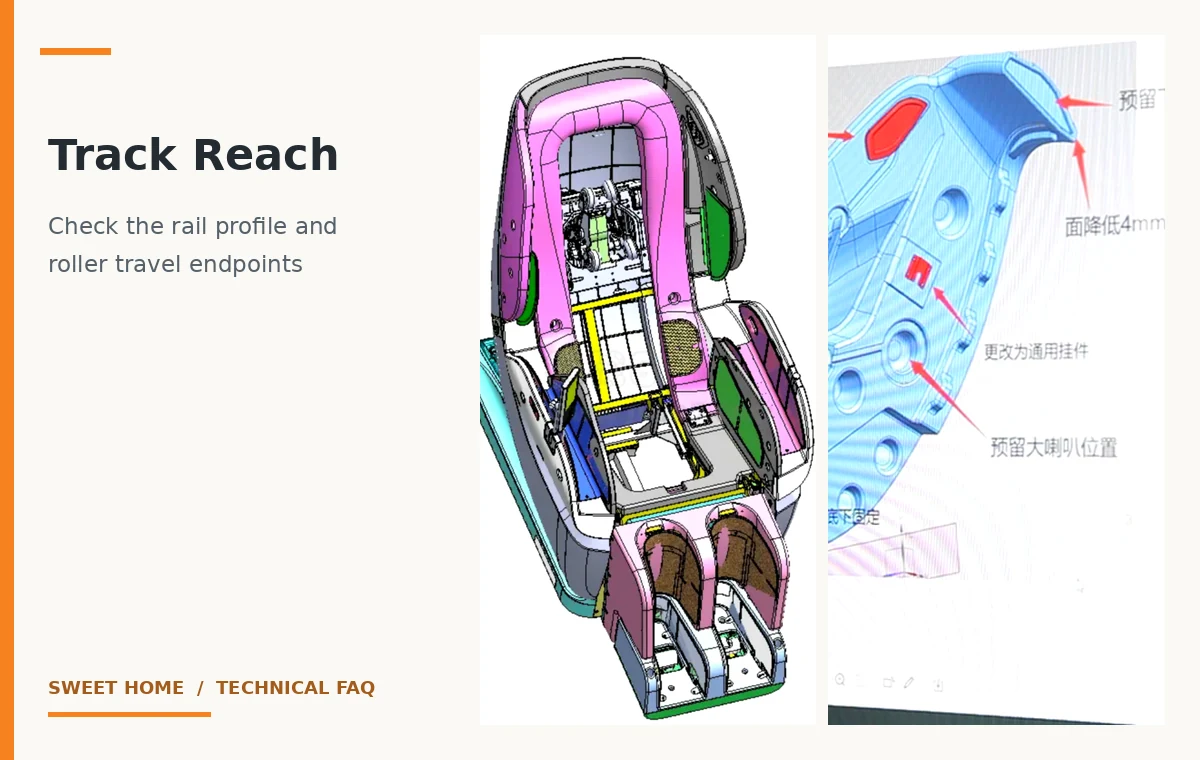
No track name establishes a service-life advantage. Ask for model-specific inspection instructions and compatible carriage/rail parts before planning a high-use installation.
Do commercial chairs use 2D or 3D rollers?
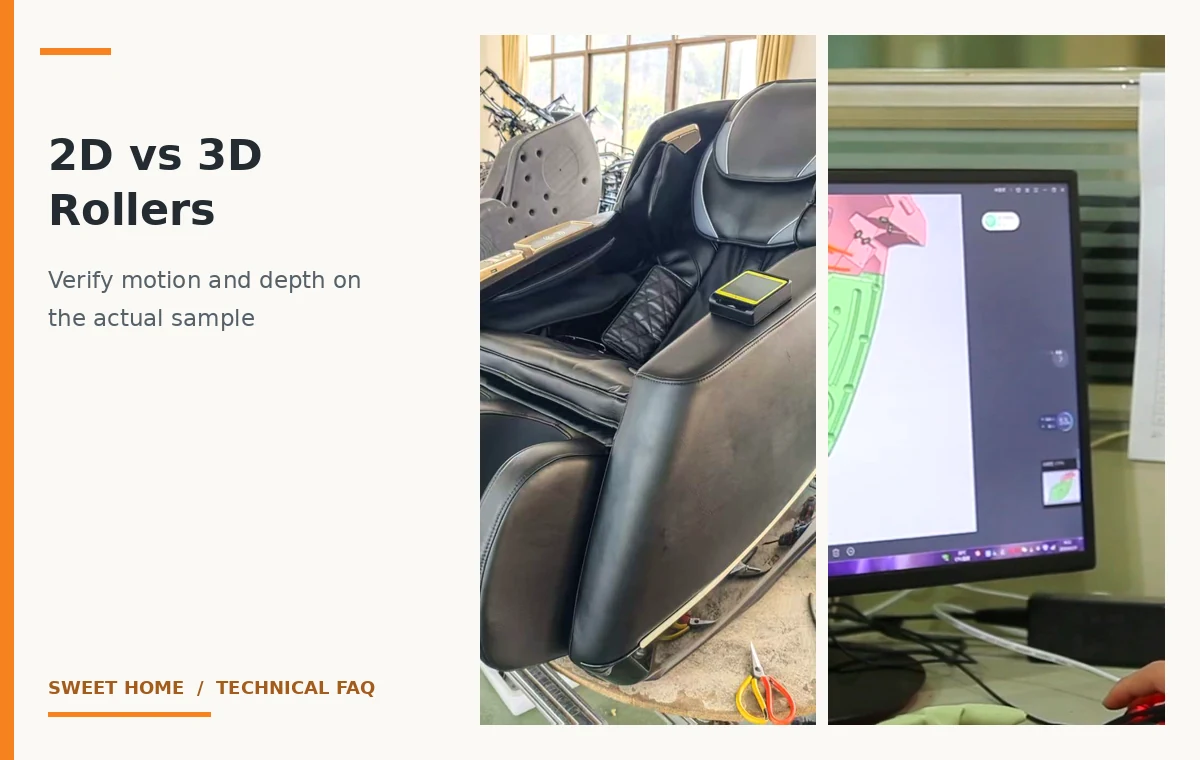
Both are possible. In the usual back-mechanism terminology, 2D refers to vertical carriage travel plus lateral roller movement; 3D adds controllable in-and-out roller projection. The track sets where the carriage travels; depth adjustment changes how the rollers engage the back.
How can the extra depth control be checked?
Ask the supplier to show the depth-adjustment mechanism, its documented range and a live change of setting on the offered sample. In our published 2D/3D teardown, the two compared units share a carriage and guide-rail platform, while the 3D version adds adjustable protrusion.
That observation is limited to those units; it is not proof that every 3D chair uses the same drive or that 2D chairs have a predictable failure rate.
“4D” is not a standardized fourth physical axis. It may describe variable speed or rhythm alongside roller movement, but supplier definitions differ. Compare demonstrated movement and controls, not the dimension count on a quotation.
Which areas do airbags cover, and how is pressure controlled?
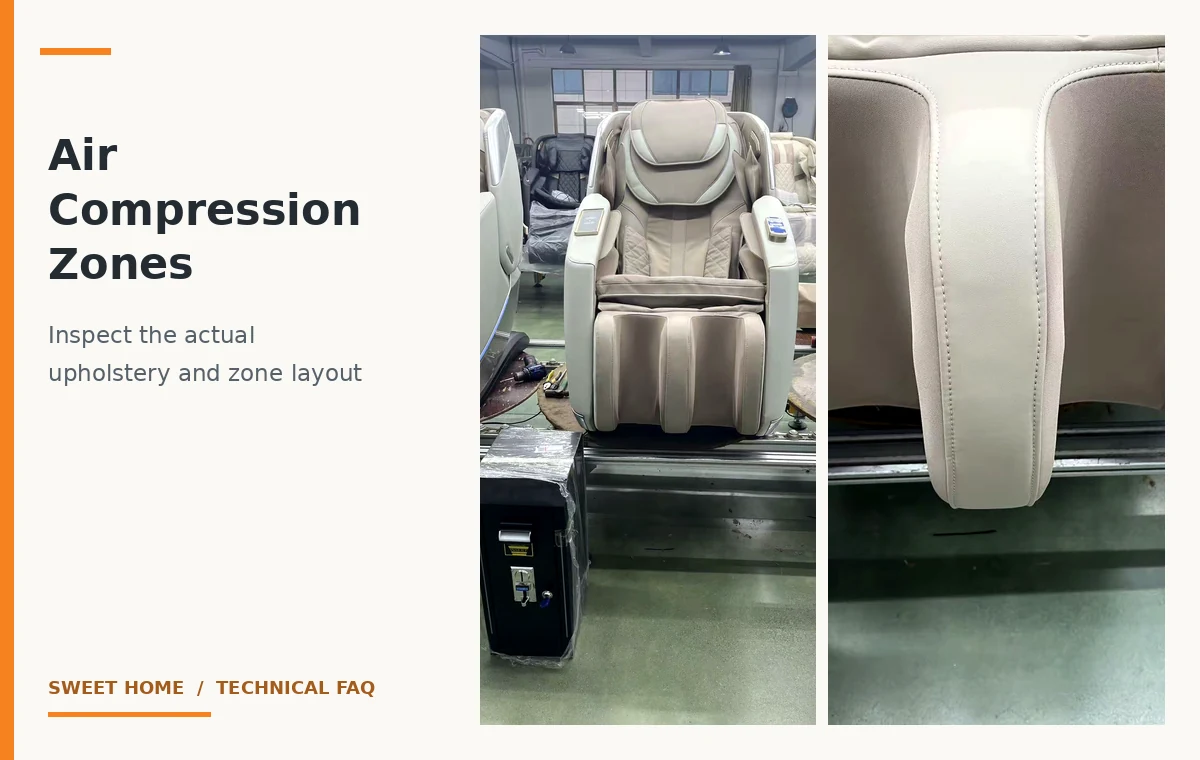
Depending on configuration, airbags may act on the shoulders, arms, hands, hips, calves or feet. A pump supplies air through tubing and valves; the controller opens and closes the relevant paths to inflate or release the bags.
Zone count and independently controlled groups depend on the actual air circuit, not the printed number of bags or valves alone.
What should an operator request?
Ask for an air-circuit or zone diagram, the available intensity settings, an in-person sequence demonstration, and the service part numbers for the pump, valves, tubing and bags.
What does zero gravity mean in a commercial chair?
In chair marketing, “zero gravity” describes a reclined posture with the legs raised and the body supported by the backrest and leg rest. It is not weightlessness, and it does not require every user’s knees to align at one specified height.
NASA’s neutral-body-posture discussion describes a range of relaxed joint positions, not a universal massage-chair angle or a NASA approval of any chair.
Is a multi-stage recline the same as multiple actuators?
No assumption is safe from the stage count alone. The backrest and leg rest may move through a linked mechanism or separate actuators; labels such as “two-stage” and “three-stage” need interpretation against the actual model manual.
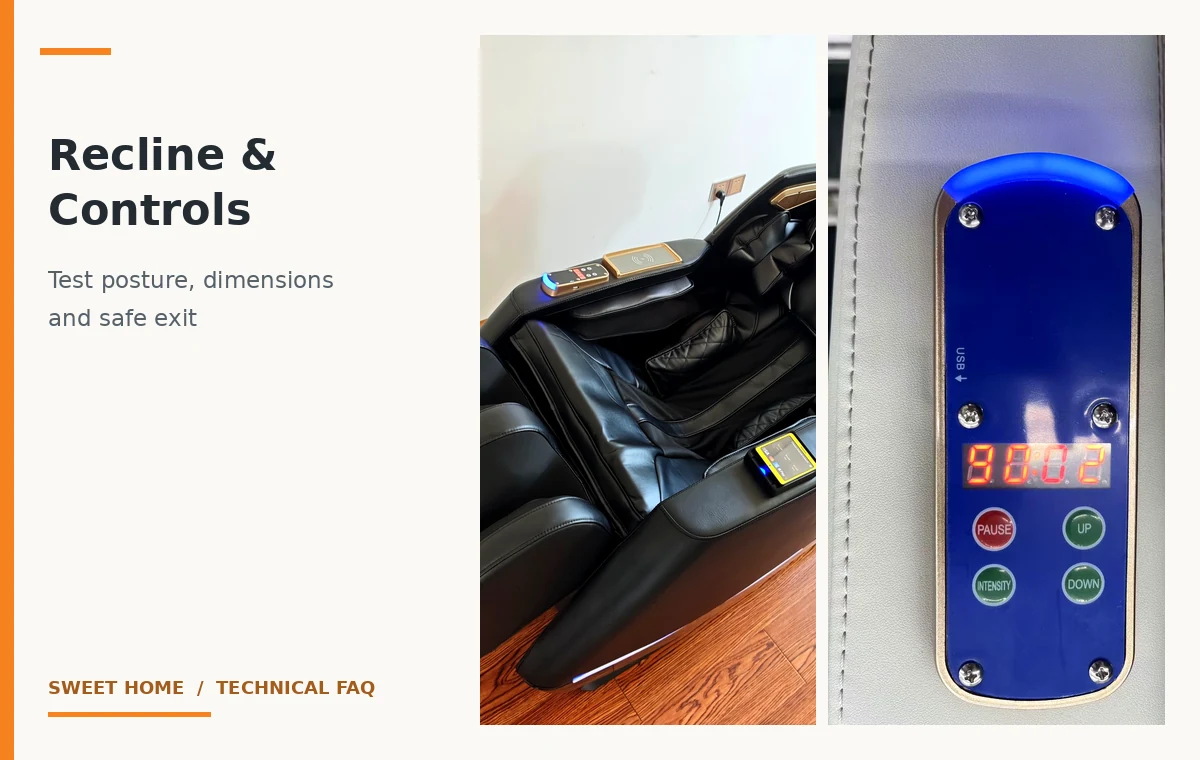
Request the reclined dimensions, actuator arrangement, positions and safe-exit procedure.
Zero gravity describes the posture. “Zero-wall” describes a space-saving recline design and the required rear clearance. Measure clearance separately using the exact chair drawing; see our size and zero-wall FAQ and recline mechanism deep dive.
How does calf massage work?
There is no universal calf mechanism. Some designs use air compression; others combine airbags with motorized rollers or oscillating kneading elements. Infinity describes one such combined design in a specific premium model—one model example, not a universal specification.
What should a sample test show?
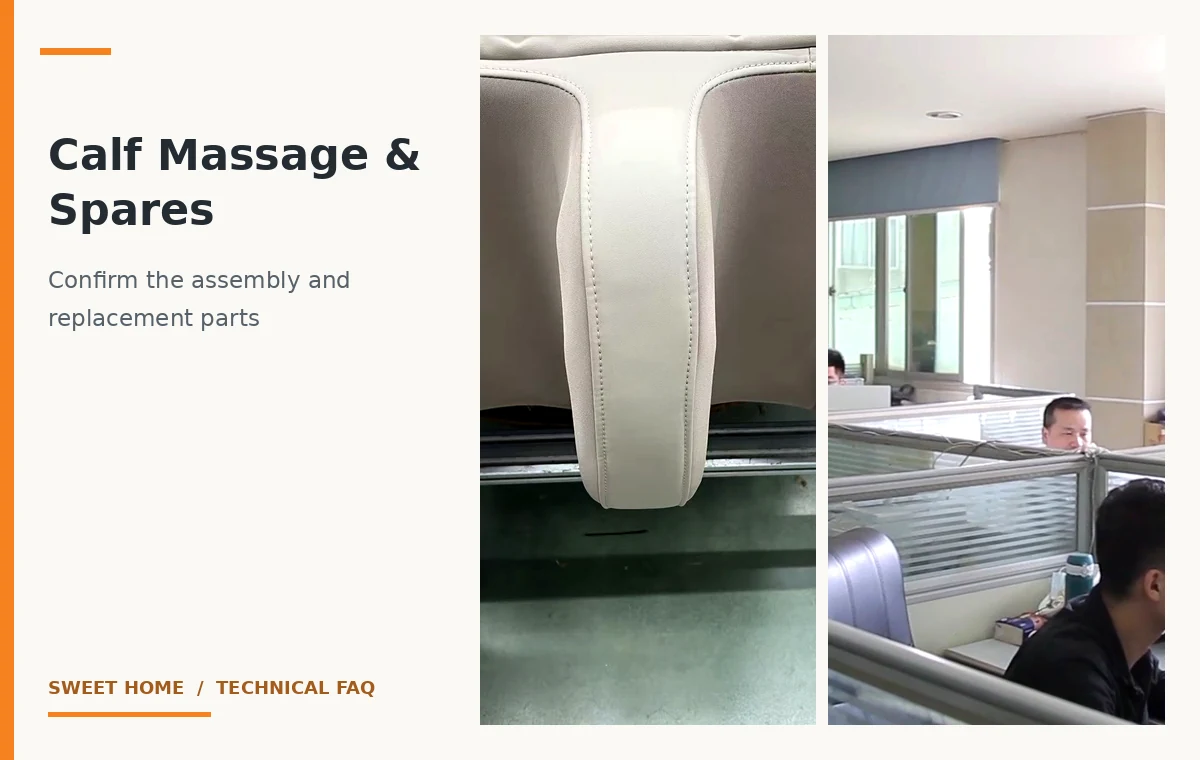
Check where the moving parts contact the calf, whether the motion is rolling or oscillating, how the air pressure adjusts, and whether the footrest accommodates the intended users. Ask for the calf assembly diagram and replaceable-part list.
Do not infer a travelling roller, fixed scraper or easier repair from the word “calf massage.”
Which configuration should a venue buy?
Start with the session model and the service arrangement—not a rule that every busy site needs L-track and 2D, or that a premium lounge always needs SL and 3D. Both are possible configurations.
Before you sign, ask for five pieces of evidence:
- Track diagram and actual roller travel endpoints.
- 2D/3D movement and depth-range demonstration.
- Air and calf-zone diagram for the quoted model.
- Reclined footprint and rear clearance drawing.
See where commercial chairs are used for placement considerations and our vending-chair range for model options. A technical comparison should end with written model-level evidence, not a promise about how many months a mechanism will last.
Prepared by Sweet Home Technical Team
Mia
Sweet Home Technical Team
Mia edits Sweet Home’s FAQ content for commercial operators, importers and distributors. Model-specific technical specifications require confirmation against the offered chair.
Disclosure: Sweet Home manufactures massage chairs and may supply products discussed here. The cited third-party manufacturer pages explain example technologies; they do not independently certify our models. Confirm each specification and commercial-use term in the order documents.
Compare mechanisms on the actual commercial model
Send the venue, expected use and destination market. Ask for the track drawing, depth demonstration, air-zone map, reclined footprint and model-specific spares list before you place the order.
Related product pages
898-C64 3D SL-Track Massage Chair for OEM BuyersCashless Payment Vending Massage Chair