
Why the Same Mechanism Gets Labeled 2D, 3D, 4D and 5D
Massage chair mechanism labels can be difficult to compare: similar-looking units may be sold as 2D, 3D or 4D. A label alone does not tell a buyer how a particular mechanism moves or which functions it supports.
Buyers ask us which number they should pay for. The useful comparison is the actual structure, control functions and verified performance of the offered sample, rather than the number alone.
This episode is written from the factory floor. We tear mechanisms apart on camera, bench-test them, and ship them inside our own OEM chairs. So we are going to describe only the mechanical structure we can actually photograph and measure, and leave the marketing vocabulary at the door.
On the Sweet Home platform shown here, the comparison is between a 2D configuration and a 3D configuration with adjustable roller protrusion. The observations below apply to this platform, not every manufacturer’s mechanisms or use of 4D and 5D labels.
The 2D Mechanism: The Real Basic Structure
Start with the 2D configuration shown here, which forms the basis of this platform comparison. In our teardown photos you can see the complete assembly. We will walk through it part by part, because these are the parts your customers will feel through a year of daily use.
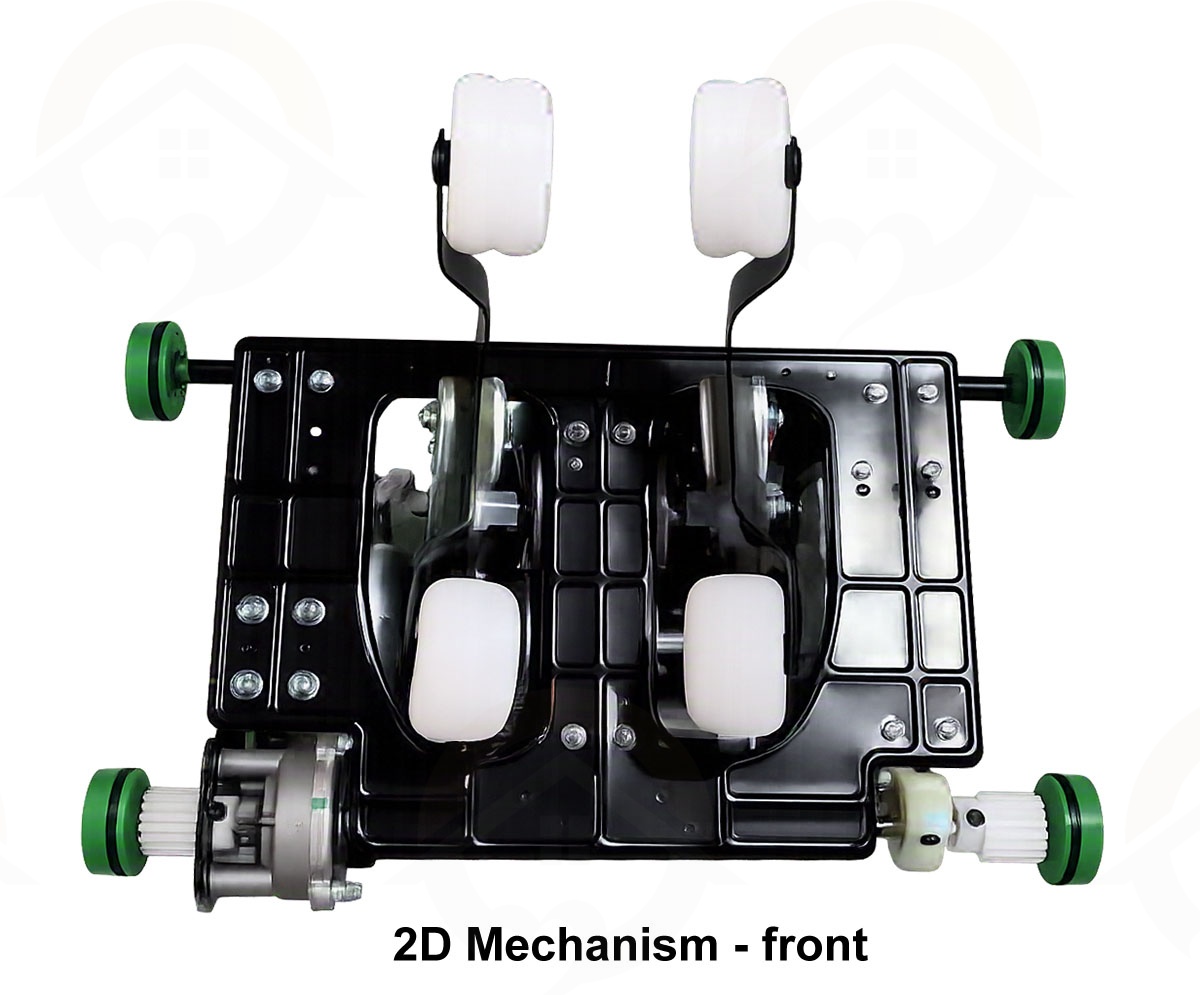
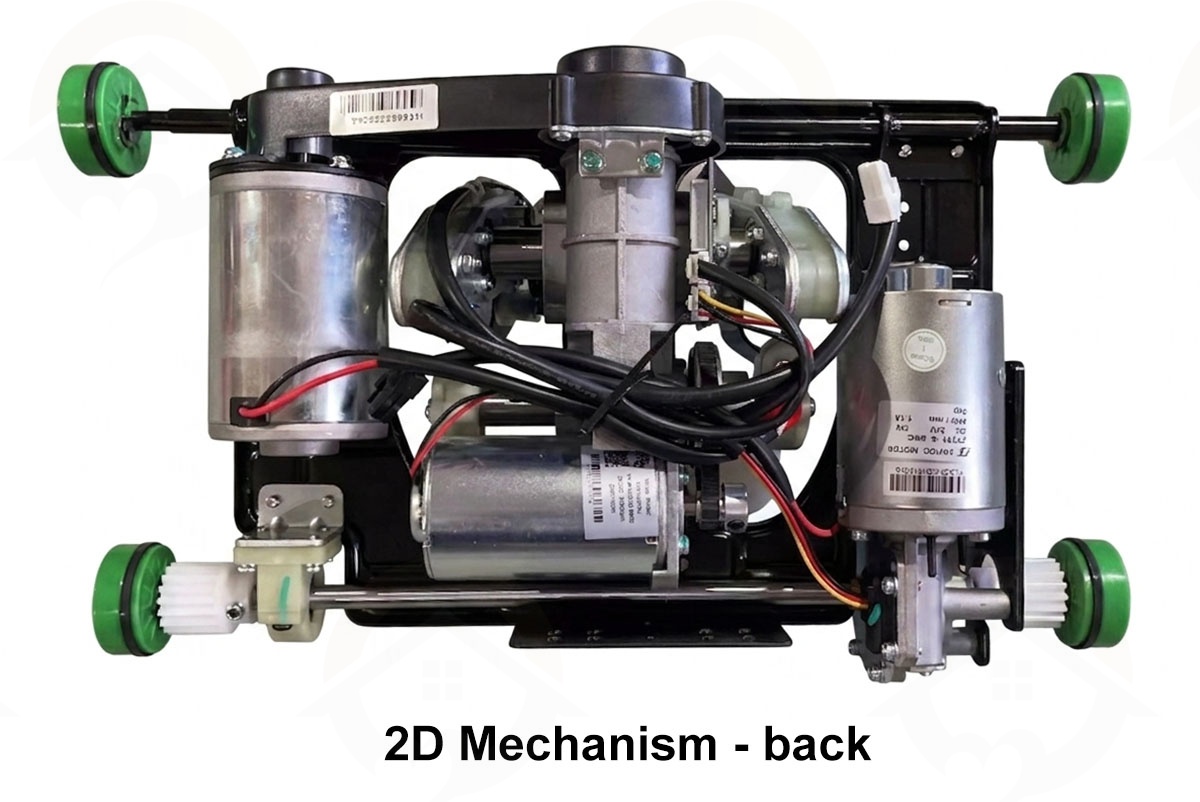
One Carriage, Four Guide Wheels, and an S-Shaped Dual Rail
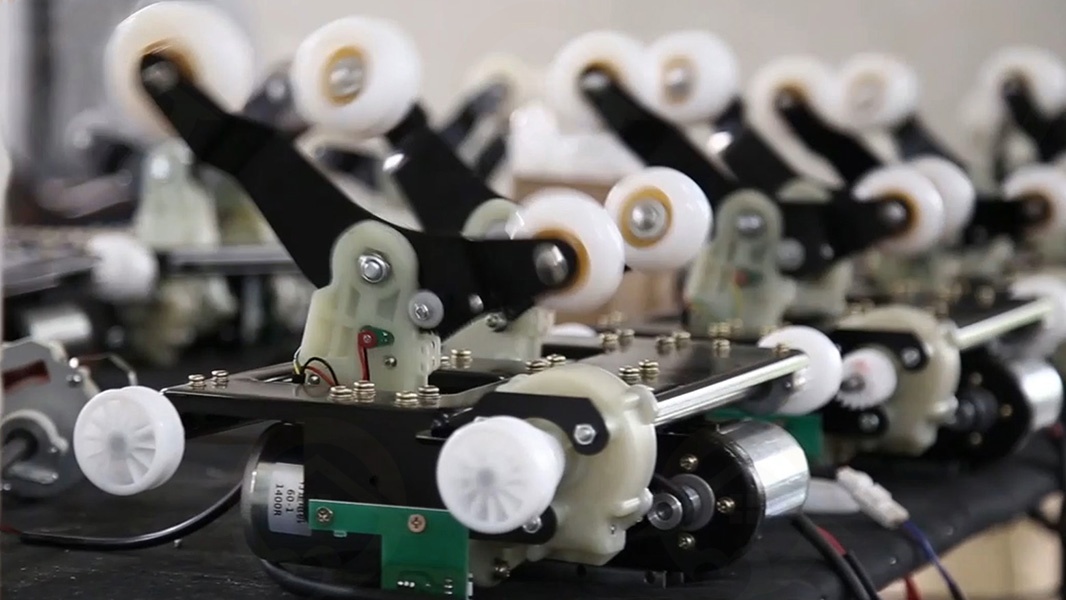
The heart of the mechanism is a single carriage that travels up and down the chair back. The carriage carries four green guide wheels, one at each corner, which ride inside an S-shaped dual-rail track.
The S curve matters: it lets the carriage follow the natural curve of a spine instead of a straight vertical line, so the rollers stay in contact with the back from the neck to the lumbar area.
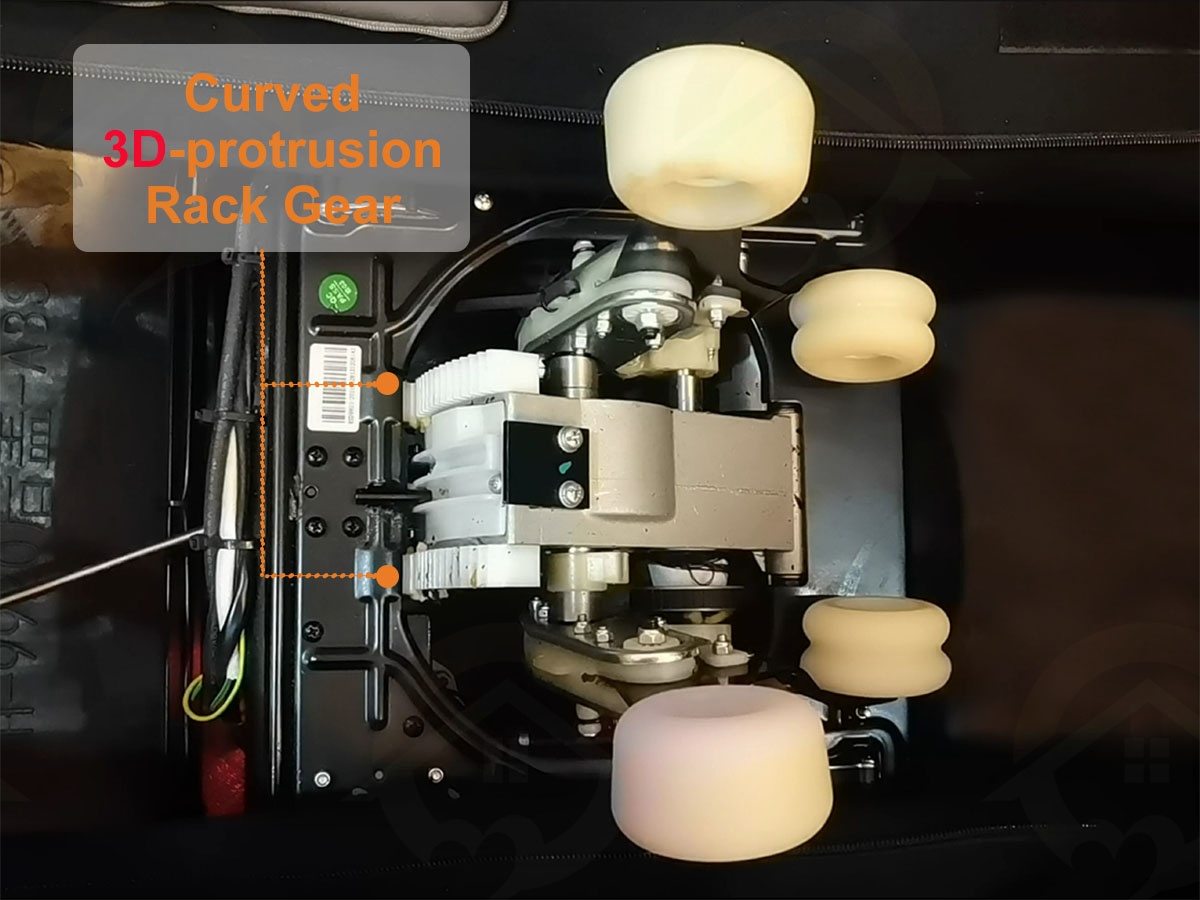
How does the carriage climb? A white gear on the carriage meshes with a rack (a toothed rail) fixed to the track. The gear spins, bites into the rack teeth one by one, and pulls the whole carriage up or down.
This gear-and-rack drive is simple, strong, and easy to inspect — when a buyer opens a chair and asks us to prove the track can climb, this is the part we point at.
It is also the first part we check when a chair comes back with a grinding complaint after a year of use:
in most of those cases the climb mechanism itself is still sound, and the noise traces back to guide-wheel wear or a rack that ran dry — a lubrication and material question, not a structural failure.
Swing Arms and Foam Rollers
Inside the carriage, several small DC motors drive two groups of swing arms — an upper group and a lower group. When the chair switches to a kneading or percussion program, the motors turn and the arms swing outward from the carriage in both directions, pressing against the back.
At the end of each arm sits an off-white foam roller, the only part that actually touches your customer's body. The foam compresses slightly on contact, which is what makes the massage feel like a hand rather than a hard plastic wheel.
On the platform shown here, the swing arms provide lateral movement alongside the carriage’s up-and-down track travel. These are the movements described as 2D in this comparison.
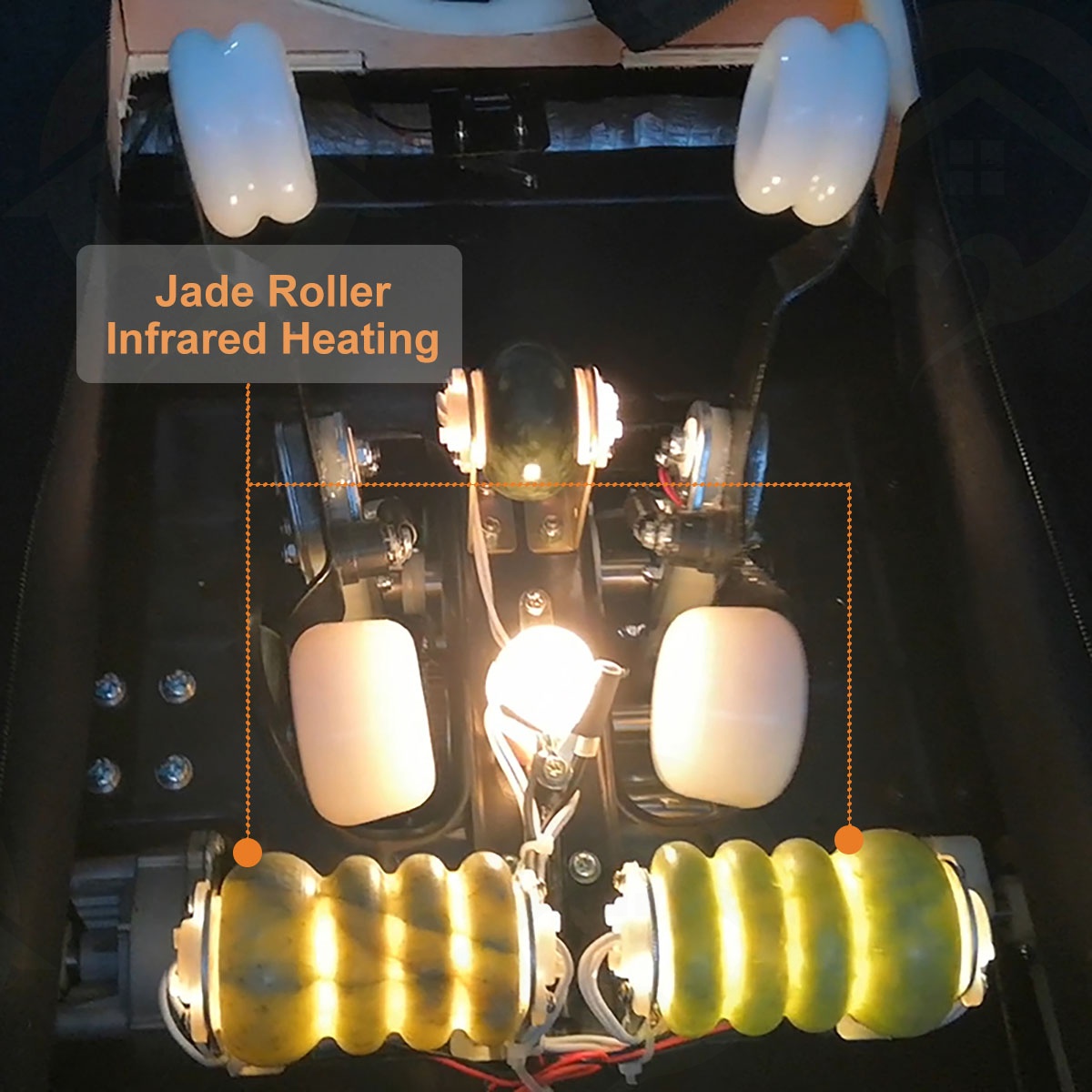
There is also a jade roller massage mechanism variant: the same swing-arm platform fitted with warm jade massage rollers, with infrared heat therapy running during the massage.
It is a popular option in markets where heat therapy is part of the buying decision — same 2D/3D structure, different roller material and a heating add-on.
Height and Back Scanning
Height and back scanning is another feature to verify on the offered configuration; it is not established by the 2D label alone. The carriage runs a quick calibration pass when the chair powers on, sensing where the user's shoulders and lower back sit, and uses that reading to set the starting position for the swing-arm programs.
This is a real feature worth asking about — not every mechanism has it, and it is the difference between a massage that starts in the right place and one that needs manual adjustment every session.
The 3D Configuration: Added Protrusion on This Platform
In the 2D and 3D units compared on our bench, the carriage, guide wheels, gear-and-rack drive and swing-arm platform are shared. The 3D configuration shown adds adjustable protrusion; other suppliers may use different structures.
Same Structure, One Extra Protrusion Mechanism
On the units compared here, the difference is at the end of the swing arms: the 3D version adds a small extend-and-retract mechanism that pushes the rollers toward the body and pulls them back. Everything else — the carriage, the rails, the gear, the rack, the arm geometry — is shared between the two tiers.
A different carriage or roller design is not, by itself, a reason to reject a supplier’s 3D description. Ask for the actual depth-adjustment structure, movement range and sample demonstration. On the platform shown here, protrusion is added to a shared base; costs depend on the quoted configuration.
What the Protrusion Actually Does
The protrusion mechanism controls pressing depth and force. A 50 kg user and a 90 kg user have very different back curvature and muscle depth; the same fixed-press 2D roller that feels great on one can feel hollow or harsh on the other.
On the 3D configuration shown, roller protrusion changes the depth of contact. Compare the adjustment range, control and feel on a verified sample; the label alone does not establish comfort or superiority.
Speed and Rhythm Control on the 3D Platform Shown
For the platform shown here, speed and rhythm adjustment use the existing 3D drive and controls. This observation does not define what every manufacturer means by 4D.
Here, the adjustable features are roller travel speed and the timing of tapping, rolling and kneading, controlled through the mechanism’s motors and controller. Ask suppliers which functions their 4D label describes and verify those functions on the offered sample.
On this platform, these speed and rhythm changes do not require a separate mechanical axis. From a service perspective this is good news: fewer moving parts means fewer things that can wear out, which is why our service records show far more gear-and-roller tickets than rhythm-program failures.
For a sample comparison, request demonstrations of a slow kneading pass, a faster percussion pass and a rolling sweep. Record which hardware and control settings the quoted configuration uses.
In this example, rhythm adjustment is a control feature of the shared platform. Other products must be assessed from their own structure and demonstrated functions.
Rhythm adjustment can be a useful comfort feature. Ask how wide the adjustable range is and compare its operation on the actual sample, together with depth control, scanning and the other functions offered.
Evaluating a "5D" Claim: Verify the Offered Functions
The Sweet Home platform illustrated here does not include a separate configuration identified as a 5D mechanism. That does not establish what other manufacturers build or how they use the label.
If a specification uses 5D, ask the supplier to identify the actual mechanical, sensing and control features. Verify any claimed feedback or automatic adjustment on the offered sample, rather than inferring functions or an extra movement axis from the name.
Treat the 5D label as a prompt for a detailed specification and sample check, not as proof of a particular structure or performance level.
| Label | Structure on the Platform Shown | Function to Verify |
|---|---|---|
| 2D | Carriage + guide wheels + gear-rack climb + swing arms + foam rollers | Up/down + lateral movement on the illustrated unit. |
| 3D | Same structure + protrusion mechanism at arm ends | Adds pressing-depth adjustment on the compared unit. |
| "4D" | Speed/rhythm adjustment on the shared 3D platform shown | Verify speed range, rhythm settings and operation on a sample. |
| "5D" | No separate 5D configuration illustrated here | Ask for the offered structure and functions; verify claims on a sample. |
What to Ask Instead of "Which D"
Here is the practical part. Drop the "which D" question and ask these four things instead. They separate real mechanisms from marketing labels faster than any number:
1. Does the Swing Arm Have an Independent Protrusion Mechanism?
On the platform compared here, adjustable protrusion distinguishes the shown 3D configuration. Ask the supplier for teardown evidence or a demonstration by qualified personnel, and verify the movement and depth-adjustment range on the offered sample. Other designs may implement depth control differently.
2. Does It Have Height and Back Scanning?
Scanning sets the starting position of every program. Without it, the massage may miss the shoulders or drift down the spine. Ask how the scan works and whether it runs on every power-on.
3. Are Speed and Rhythm Adjustable, and Over What Range?
These are the speed and rhythm functions discussed for the platform shown here. Ask how many speed levels the mechanism supports and whether tapping, kneading and rolling can be switched mid-program. A wide adjustable range is a real comfort advantage; a label is not.
4. Ask for Real Mechanism Photos and Videos, Not Marketing Materials
A factory that builds its own mechanisms can show you the carriage, the rails, the gear and the arms on camera in thirty seconds. Renderings and catalog screenshots prove nothing.
On massage chair forums, buyers repeatedly describe being burned by spec sheets that did not survive contact with the actual chair — ask for the bench test instead.
The mechanism itself is mechanical, but the motors and control wiring inside the carriage must still pass the same appliance-safety tests as the rest of the chair.
Spec Your Mechanism with the Factory That Builds It
Send us your target price and features — we will walk you through the 2D/3D structure on camera and quote the real mechanism.
Request Mechanism Teardown VideoSweet Home's OEM Options: 2D/3D Configuration
On the 2D and 3D platform shown here, shared components support configuration options. In our factory, buyers regularly adjust four things on the mechanism:
- Roller material — foam density and hardness tuned to your market's preference for firm vs. soft pressure.
- Swing-arm stroke — how far the arms travel, matched to the body profiles of your target region.
- Rhythm programs — the tapping, kneading and rolling sequences loaded into the controller, branded as your own.
- Scanning accuracy — calibration resolution, from basic shoulder detection up to finer body-profile mapping.
That is the standard we hold ourselves to, and the standard your end customers will judge you by after a year of daily use.
If you are sourcing a chair line and want to know exactly which mechanism you are paying for, start the conversation with a teardown video. Browse our product line or full-body massage chairs, and ask us to show you the inside before you ask the price.
Massage Chair Component Deep Dive Series
This is Episode 3. Read the other episodes:
Prepared by Sweet Home Technical Team
Joe Fan
Manufacturing & Product Development Manager · Sweet Home
Sweet Home has manufactured massage chairs since 2013, drawing on in-house R&D and quality control for massage chairs and wellness equipment, with deep expertise in SL track mechanisms, 4D massage systems and zero-gravity ergonomic design.
Disclosure: Sweet Home is the manufacturer behind these chairs, and the service data throughout this series comes from our own repair logs and production line — shared so buyers can recognize these failure patterns before they reach a container.
Quick audit: is your mechanism spec complete?
1. Roller type (2D/3D) confirmed in writing? 2. Mechanism bench-test data available? 3.
Two or more unchecked? Send us your current spec.