
Starting a vending massage chair business means placing self-service commercial massage chairs in busy venues and collecting revenue every time a customer pays for a session. No staff member has to be on site.
The setup comes down to six steps: understand the startup costs, choose the right locations, set up payment, connect the chairs, agree terms with the host venue, and plan daily operations.
This guide walks through each one, including the checks that decide whether a site makes money or quietly bleeds rent.
Is a Vending Massage Chair Business Right for You?
A vending massage chair is a commercial massage chair with a payment system built in. The customer pays on the spot, starts the session themselves, and walks away when the timer ends.
This model suits you if you want low labor cost and the freedom to place chairs across several venues at once.
If your goal is a staffed relaxation space — a spa, a dedicated massage lounge, or a hotel spa menu — a staff-managed setup with session booking usually fits better, because someone has to sell, guide and clean up after every session.
From our side of the line, the vending orders that go smoothly share one habit: the buyer starts with one or two chairs in their strongest location, watches the transaction data for a few weeks, and only then signs the next site.
Orders that open with ten chairs and no test location are the ones that come back as spare-part and support tickets.
If you are still deciding between a vending setup and a retail product, our breakdown of where commercial massage chairs are used covers where these chairs actually earn their keep.
Step 1: Understand Your Startup Costs
Startup cost depends on your country, your venues and the chair configuration, so plan by line item instead of chasing one headline number. These are the lines that show up in almost every vending project:
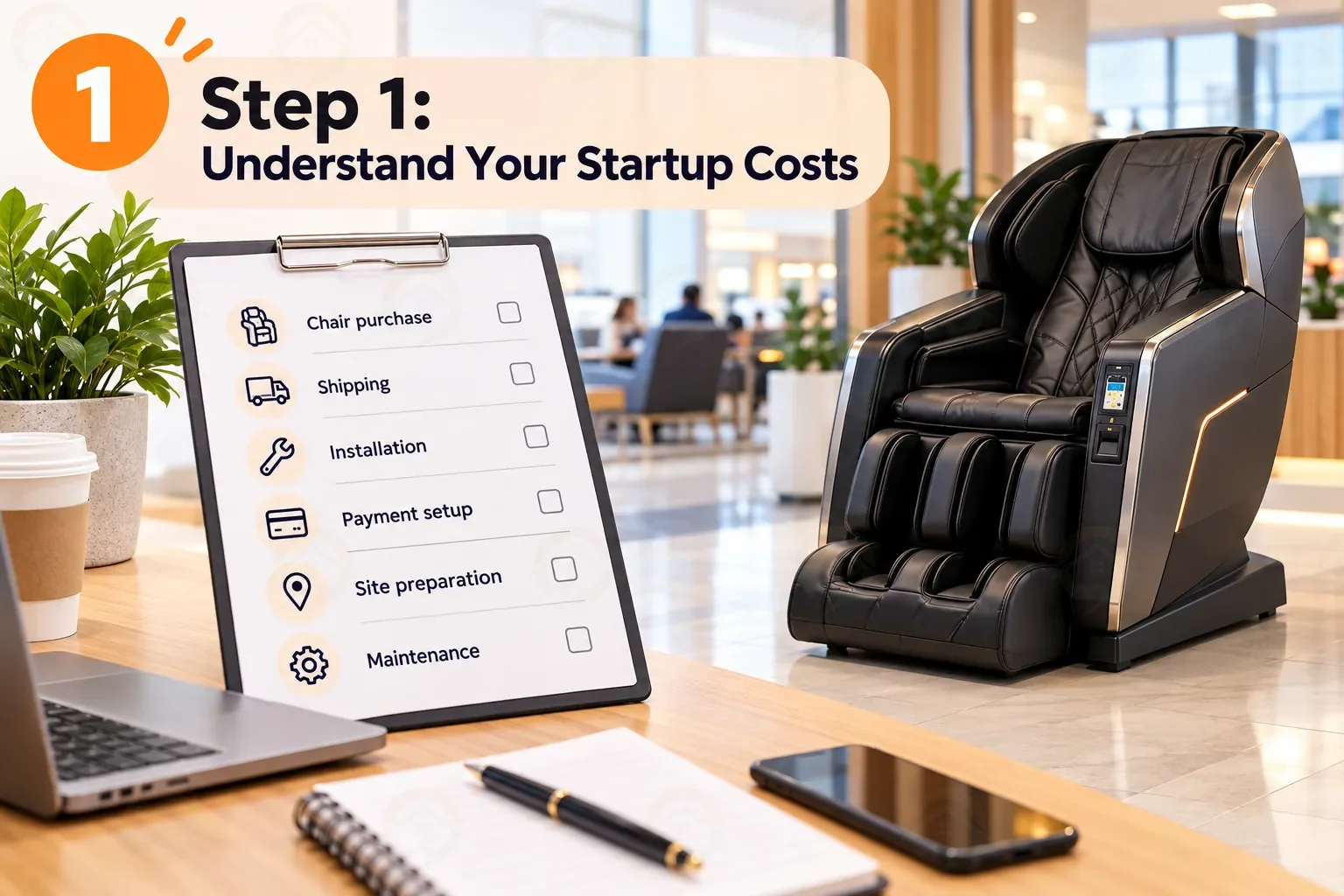
| Cost item | What to budget for |
|---|---|
| Chairs | Model, number of units, and payment configuration (cashless terminal, bill acceptor, or both) |
| Shipping and import | Freight, customs duty, and local taxes in your market |
| Installation | Delivery to site, placement, and a test run |
| Venue costs | Fixed rent or revenue share agreed with the host |
| Connectivity | SIM data plan or venue WiFi, plus any monitoring platform fee |
| Maintenance | Spare parts, repairs, and periodic cleaning |
Line items are typical for vending projects; exact amounts vary by market, model and configuration.
What to confirm with your supplier before you order
Four points are worth putting in writing:
- Which payment module the quoted price includes, and whether the terminal or bill acceptor is fitted at the factory or locally.
- Which certifications ship with the model for your market.
Step 2: Choose the Right Locations
Location decides more of your return than the chair model does. A good vending spot has steady foot traffic plus people with time to kill — waiting, walking long distances, or looking for a break.
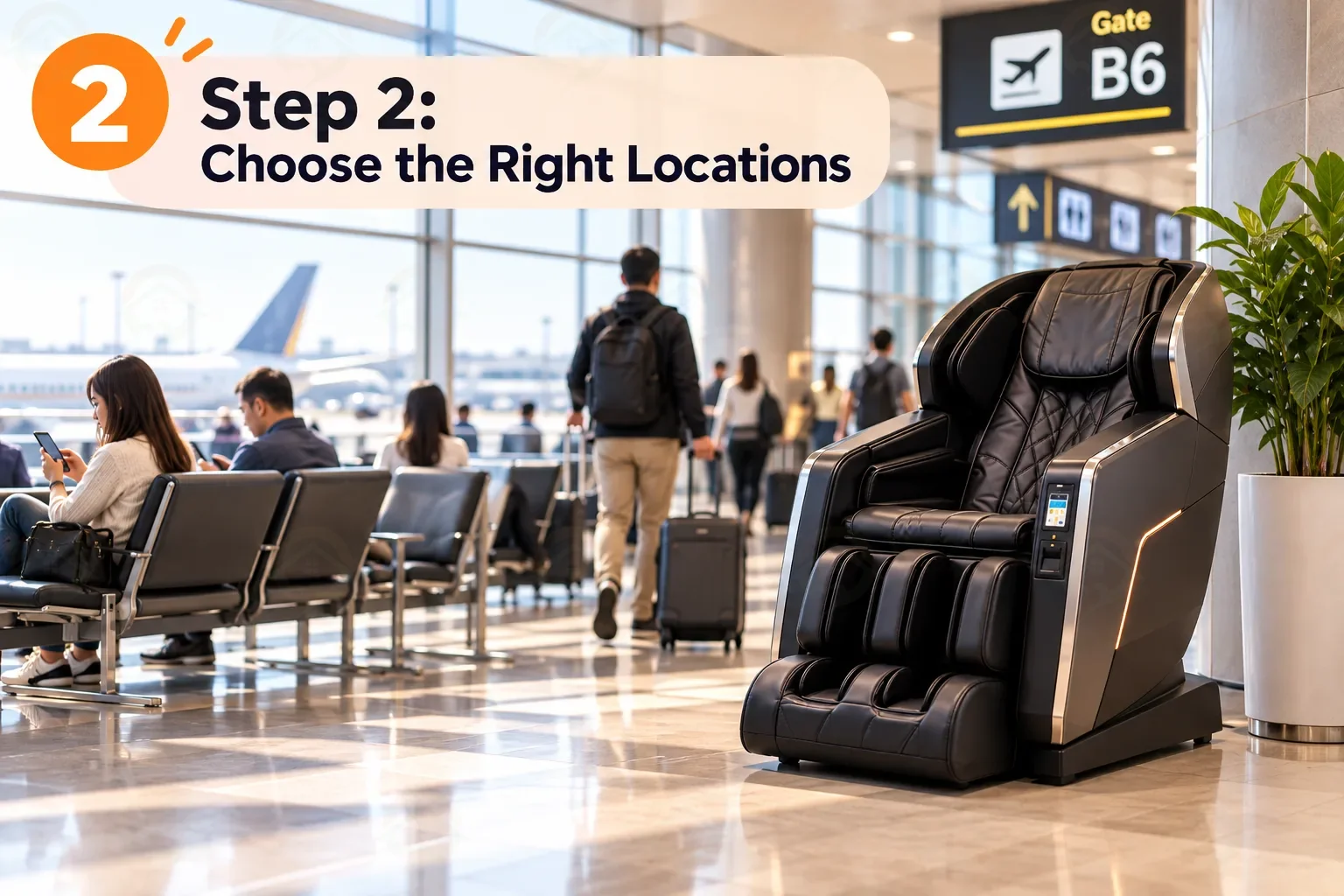
Dwell time is what converts; a corridor with heavy traffic but nobody stopping is worth less than a small lounge with ten bored people in it.
Venues that already have waiting customers
- Airports and train stations
- Shopping malls and retail centers
- Cinemas and entertainment venues
- Hotel lobbies
- Gyms and fitness centers
- Hospitals and clinic waiting areas
- Office buildings and business centers
- Spas, salons, and relaxation lounges
Five checks before you sign a site
- Foot traffic and dwell time. Watch the spot for an hour at the same time of day you expect your peak. People who wait or rest are the ones who try a session.
- Space. Measure the area for the upright position and the fully reclined position, and leave clearance behind the chair. Some models are designed to sit close to a wall, so confirm the dimensions of your chosen model first — see our vending chair size and zero-wall FAQ.
- Power. The chair needs an outlet within reach that meets the local voltage requirement, plus a safe route for the cable.
- Network coverage. If you use a SIM card, test signal strength at the exact spot. Indoor locations can be weak even where street coverage looks fine — see WiFi vs SIM for vending chairs.
- Visibility and safety. Place the chair where customers can see it and where venue staff or security can keep an eye on it.
Placement geometry is worth a second look before you commit: our massage chair installation and clearance guide covers the clearances that stop a chair from damaging a wall or trapping a customer.
Step 3: Set Up Payment
Match your payment setup to how customers in your market actually pay. Most operators run two options side by side, and let each venue tell them which one earns more.
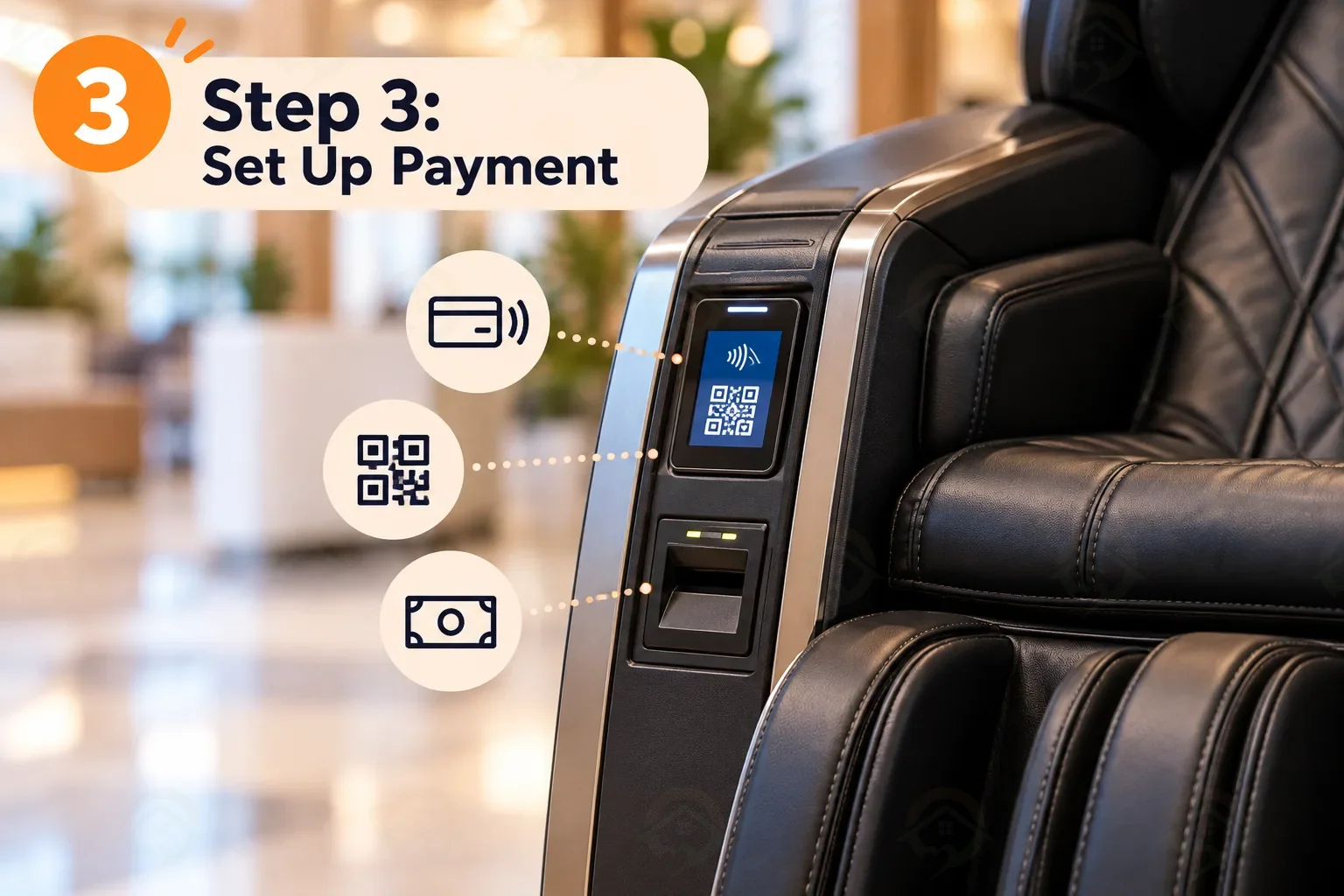
Cashless payment: card and QR terminals
A card or QR payment terminal lets customers pay without cash. It is the most convenient option in airports, malls and hotels, and it gives you a transaction record you can review remotely instead of guessing at the coin box.
Two things to settle before you order: whether the payment provider operates in your country, and what its fees are — a thin margin usually comes from fee structure, not from the chair price. We cover the setup in detail in our cashless payment terminal FAQ.
Cash payment: bill acceptor and cash box
A bill acceptor with a cash box still matters in markets and venues where cash is common. Most models use an external metal cash box; some offer an optional built-in bill acceptor in the armrest.
If you accept cash, decide who collects it and how often before the chair goes live — that single decision prevents most revenue disputes with a host venue. The hardware options are compared in our cash box and banknote acceptor FAQ.
Step 4: Connect the Chairs
Connectivity is what turns a chair into a managed asset. You want to see whether it is online, what it earned today, and the moment it stops working — without driving to the site to find out.
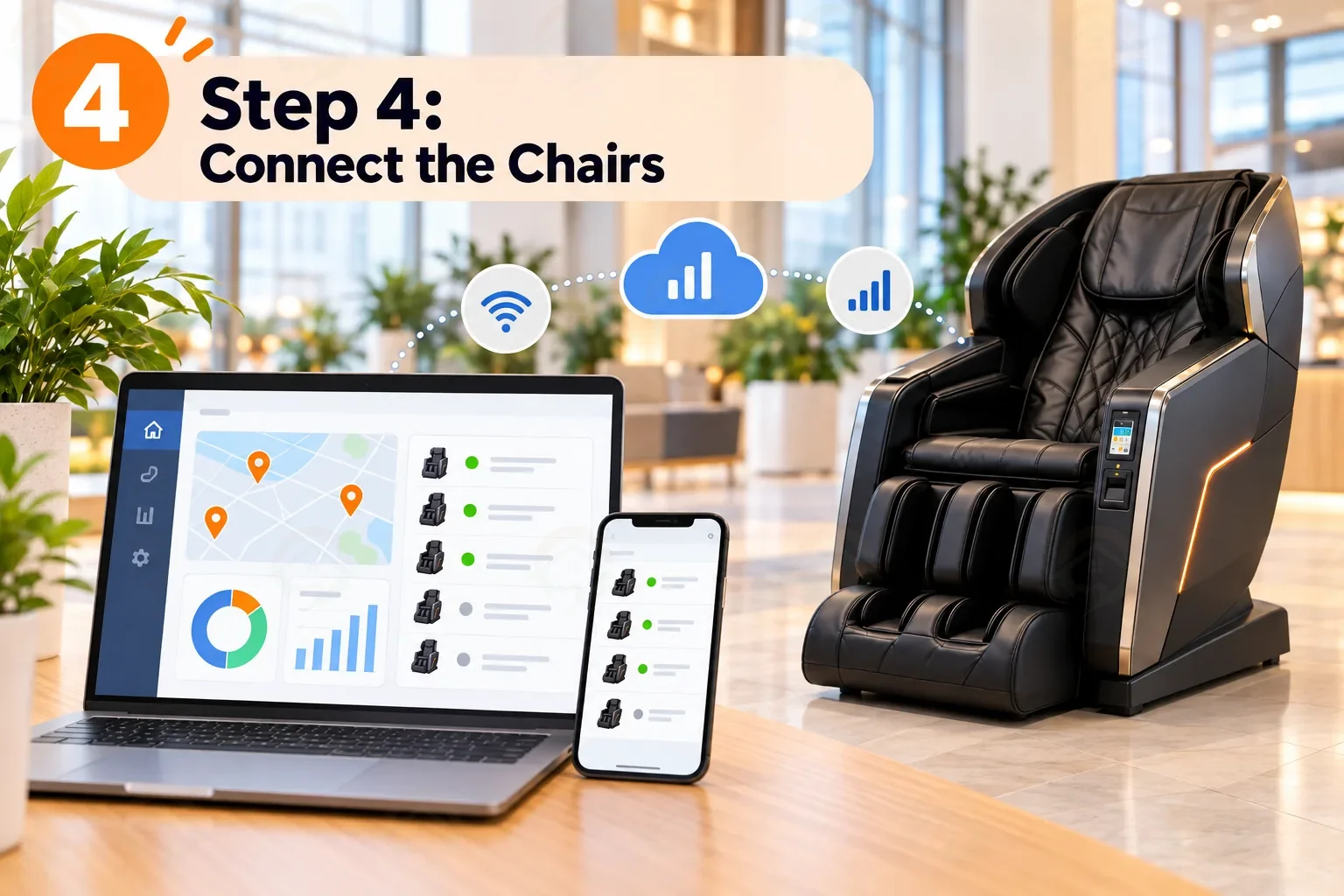
Network: SIM card or venue WiFi
A SIM card keeps the chair independent of the venue’s network and works in most indoor commercial spaces, but indoor signal varies enough that it is worth testing at the exact spot before you sign a lease.
Venue WiFi avoids the data plan entirely, at the cost of tying your uptime to somebody else’s router and password. The trade-offs are laid out in our WiFi vs SIM FAQ.
Remote monitoring and transaction records
Commercial vending chairs report device status and transactions to a platform or app. Treat that account as part of the installation, not an afterthought: set up user roles and alerts before the first chair goes live, so a failed transaction or an offline chair surfaces the same day.
Our guide to remote monitoring for vending chairs walks through what the dashboards show and which alerts are worth switching on.
Step 5: Agree Terms With the Host Venue
Most vending chairs sit on someone else’s property, so a clear written agreement protects both sides. Two structures are common:
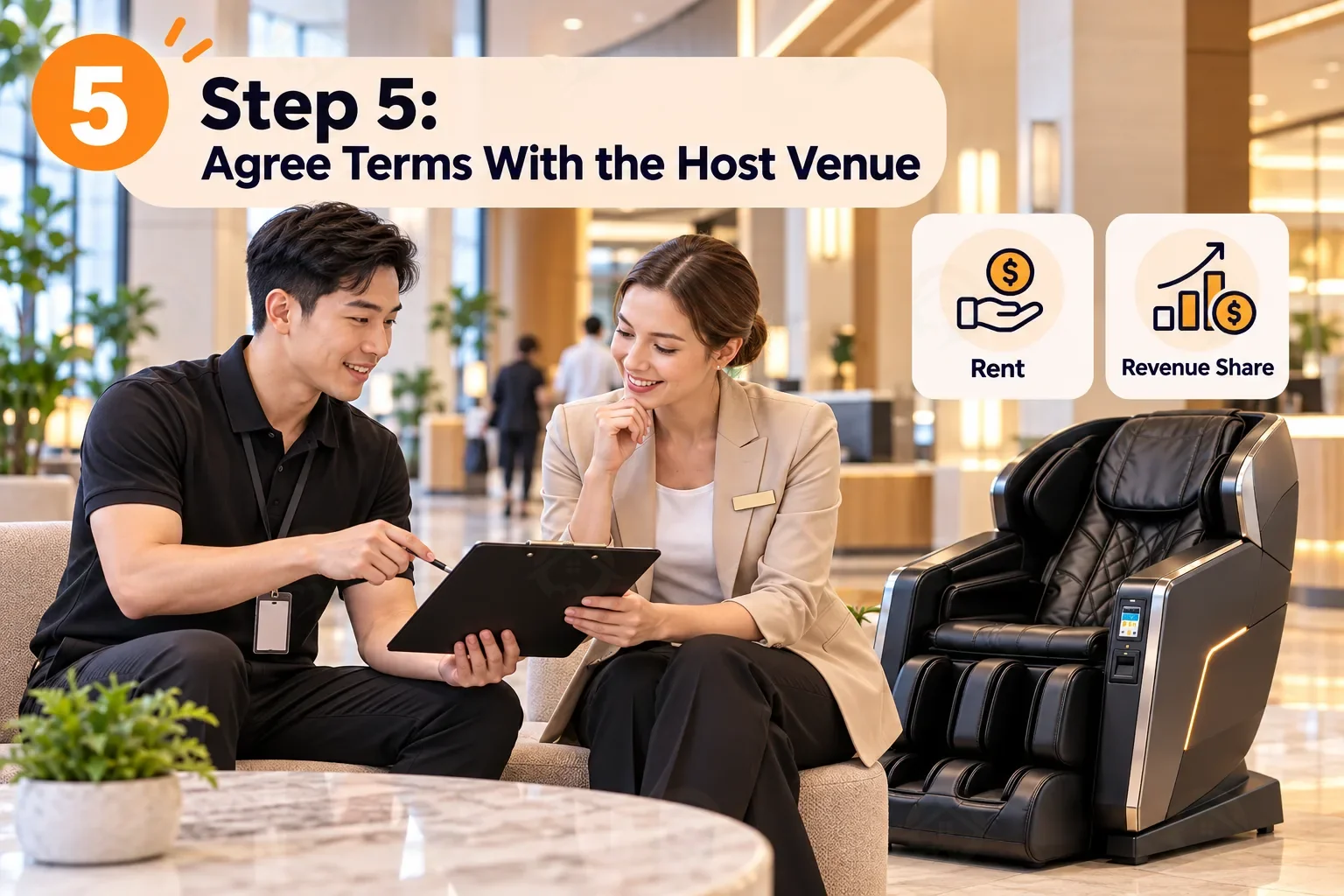
Fixed rent vs revenue share
| Structure | How it works | Best when |
|---|---|---|
| Fixed rent | You pay the venue a set amount for the space and keep everything above it | Traffic is proven and predictable, and you can forecast revenue with confidence |
| Revenue share | The venue receives a percentage of sales | The site is new or traffic is variable, and the venue has a reason to promote the chair |
Most operators start with one structure per venue and revisit it after a few months of real transaction data.
Five points to put in writing
- The exact placement, including footprint and the reclined position.
- The agreement length, plus renewal and exit terms.
- Who pays for electricity.
- Who cleans the chair and the surrounding area.
- What happens if the chair needs repair, relocation or removal.
Step 6: Plan Daily Operations and Maintenance
Vending chairs need very little hands-on time, but a short routine is what keeps them earning instead of sitting offline.
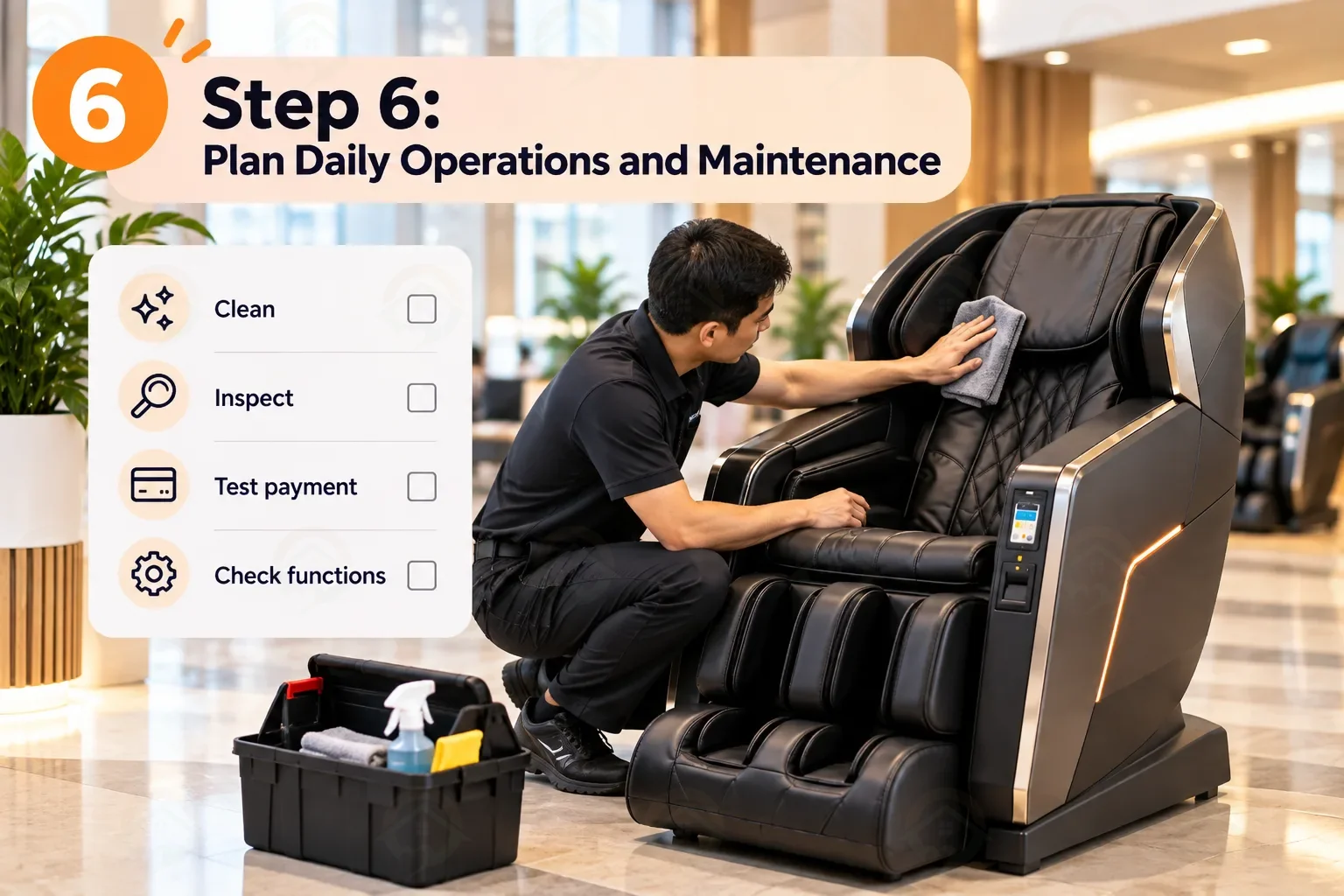
The routine that keeps a chair earning
- Check status remotely. Review device status and transactions regularly, and chase failed transactions the same day.
- Clean the chair. Wipe the upholstery and the surrounding area on a fixed schedule, more often in high-traffic venues.
- Collect cash. Empty the cash box at a set interval if the chair takes notes.
- Inspect the chair. Look for unusual noise, loose parts or worn covers during site visits, and fix small faults before they take the chair offline.
- Keep spare parts within reach. Agree with your supplier how spare parts are supplied and how overseas repairs are handled, so downtime stays short.
Most of the service calls we see trace back to the same two causes: upholstery that was never cleaned on schedule, and a small mechanical fault that was left alone until it stopped the chair. Our guide to cleaning and maintaining a massage chair covers the routine that prevents both.
What Repeats Across the Vending Orders We Handle
A last set of observations, from the vending projects that pass through our export orders:
- The chair is rarely the reason a site fails. Signal dead zones, a missing outlet or a clearance measured in the upright position are the usual causes — all three are checked before ordering, not after.
- Buyers who put the payment configuration in writing get a chair that works on day one. Buyers who assume “payment included” without naming the module often need a local terminal after the chair lands.
- Sites that scale are proven small first. One chair, a few weeks of real transaction data, then the next venue on the list.
Start With the Right Chair
A vending massage chair business comes down to three things: locations where people are already waiting, a payment setup that matches how those people pay, and chairs built for daily commercial use rather than occasional home use.
Budget by line item, prove one site before signing the next, and expand on transaction data rather than optimism.
As a factory, we build commercial massage chairs with vending payment options and can help you match a model and configuration to your market. Send us your target venues and country, and we will recommend a setup that fits.
Tommy
Sweet Home Technical Team
Part of Sweet Home’s in-house technical team. Tommy writes our How-To guides for importers and distributors — factory checklists, sourcing steps, and order-time pitfalls — built on our export order data and after-sales records.
Disclosure: Sweet Home is the manufacturer behind the chairs discussed in this guide, and the vending and after-sales patterns come from our own orders and service records — shared so operators can plan a site before they order a container.
Quick audit: is your vending site ready for a chair?
1. Signal tested at the exact spot? 2. Outlet within reach, and clearance measured fully reclined? 3. Payment method matched to how that venue’s customers actually pay?
Two or more unchecked? Send us your venue type and country, and we’ll tell you which configuration ships without surprises.
Related product pages
Cashless Payment Vending Massage ChairOEM Commercial Vending Massage Chair