
1. Why the Leather Usually Dies Before the Motor Does
The most expensive massage chair leather failure we get asked about is not a tear. It is a cover that goes sticky in year two, then flakes, then peels away in patches — on a chair whose mechanism, motors and control board are all still inside their rated life.
Upholstery is the one part of a chair every buyer touches before they read a single line of the spec sheet, and the part that most often fails first in the field.
The first explanation buyers reach for is “cheap leather,” or a factory that cut corners on the cover. In most of the units we have opened, it is neither. It is a material that has been breathing out solvent since the day it was made.
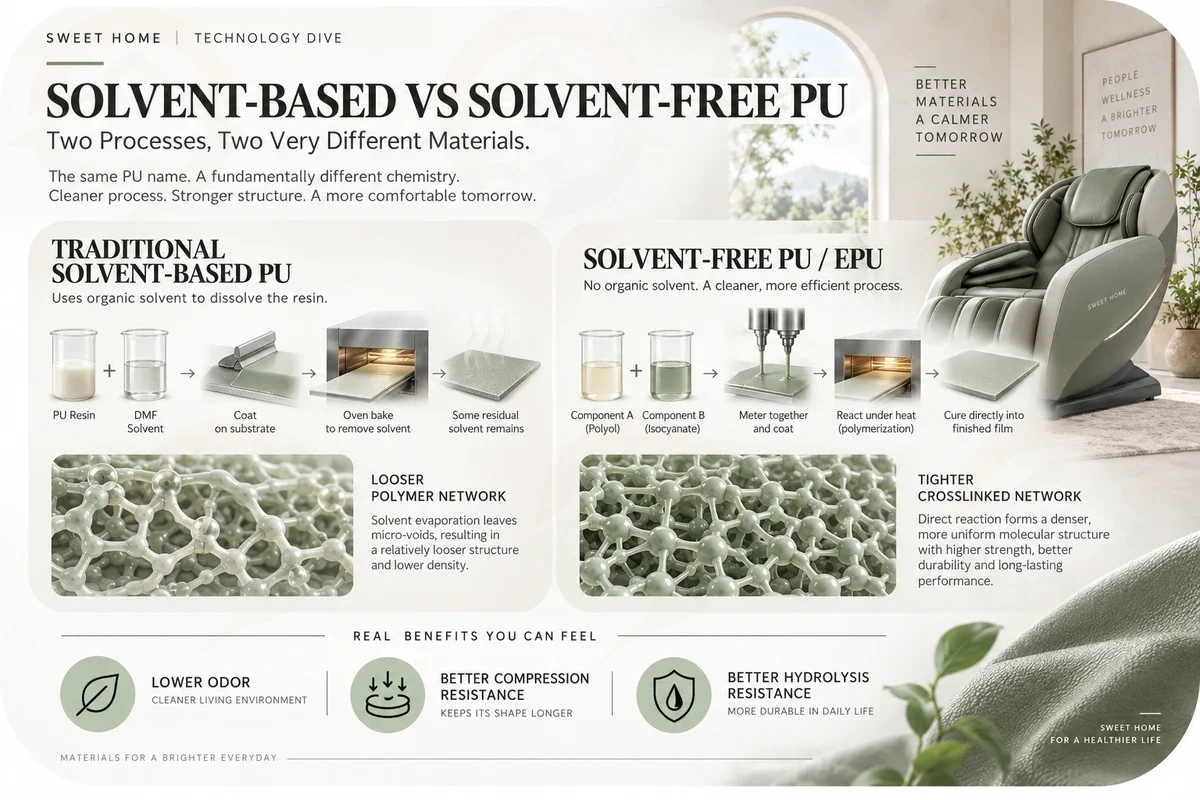
Traditional solvent-based PU leather is produced by dissolving PU resin in an organic solvent — DMF is the usual one — coating the liquid onto a base fabric, then baking the solvent off. The bake is never perfect.
A small amount of solvent stays behind, and over the following months it migrates out of the film.
What is left is a looser polymer network than the one the spec sheet described: exactly the structure that fatigues, powders and hydrolyses first under a chair that kneads, stretches and heats the same panel every day.
2. What “Solvent-Free PU” Actually Means — and What It Does Not
In a sourcing conversation, the phrase “new process” usually triggers the right question: is this a real change, or a nicer name for the same material?
The honest answer is that it is still polyurethane. The PU family itself has not changed — what changed is how the film is built.
Two Processes, Two Very Different Materials
The traditional route works a little like mixing mud and waiting for it to dry. DMF dissolves the PU resin into a coatable liquid; the liquid is coated onto the base fabric; heat drives the solvent out. The material that remains is shaped by what evaporates, not by what reacts.
The solvent-free route skips the dissolving step entirely. Component A (polyol) and Component B (isocyanate) are metered together and reacted under heat, curing directly into the finished film. No DMF, no organic solvent, nothing to evaporate out and leave a gap behind.
It is a chemical reaction rather than a physical drying process — which is why the trade also calls it EPU, eco-polyurethane.
What That Changes in the Finished Material
Because the film is formed by A/B components reacting and curing in place, it reaches a higher crosslink density — in plain terms, a tighter molecular network, with far less unreacted material inside it.
The effect of network density on how a polyurethane film behaves under load and moisture is well documented in the polymer literature; this peer-reviewed study of polymer blend mechanical behaviour is a reasonable starting point if you want the data behind the claim.
Three things follow from it, and all three matter on a massage chair:
- Lower odor — less residual solvent means less of the sharp “new suitcase” smell in the carton.
- Resistance to repeated compression — the surface fatigues and powders later than a solvent-based PU under the same cycle count.
- Hydrolysis resistance — a tighter network is slower to break down under heat plus humidity.
3. Why a Massage Chair Is a Brutal Test for Any Upholstery
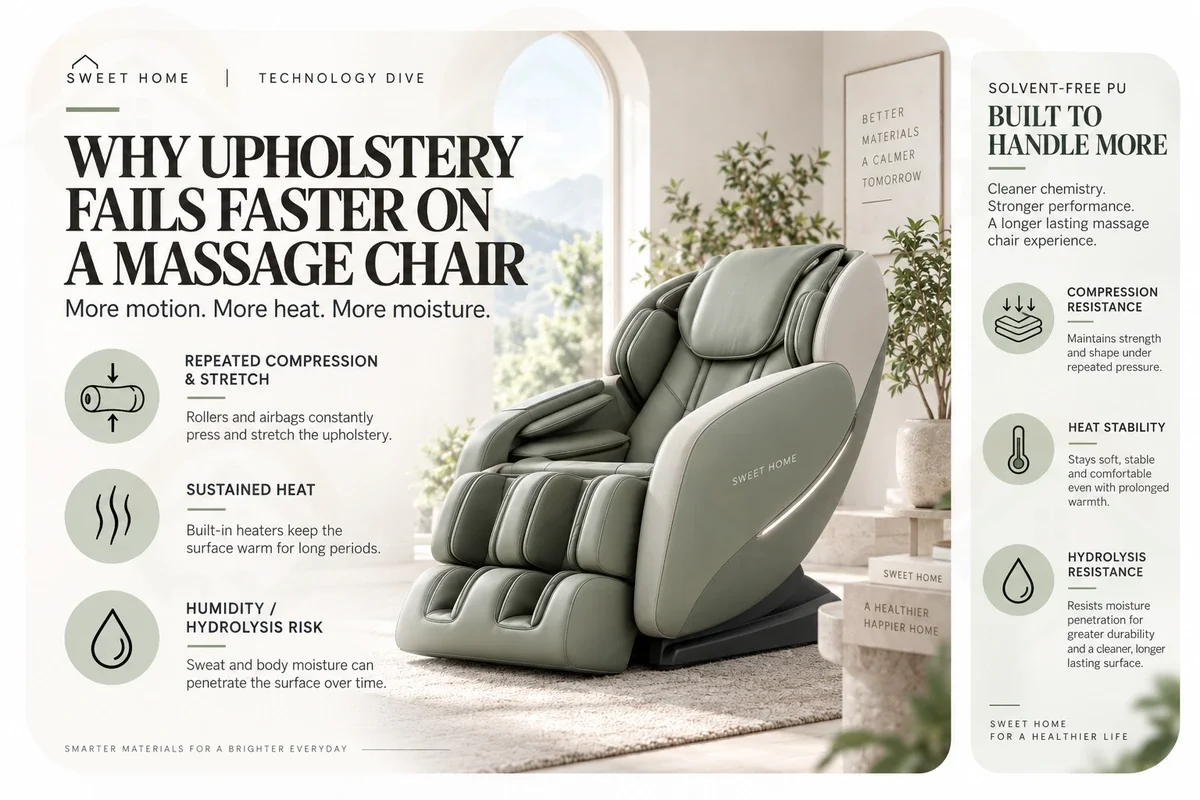
Leather on a sofa mostly holds still. Leather on a massage chair does not. Three loads act on the cover at the same time:
- Repeated compression and stretch — the mechanism kneads and stretches the same panel for 20–40 minutes per session, thousands of times a year.
- Sustained heat — heated-seat models keep a film of PU sitting on top of a warming element for hours.
- Humidity — in Southeast Asia, southern China and any coastal market, hydrolysis is the single most common cause of premature upholstery failure.
Those three loads map almost exactly onto the three properties the solvent-free process improves: compression resistance, heat stability and hydrolysis resistance.
That overlap is the reason the material has moved from “nice upgrade” to something closer to the default in massage chair upholstery specifications.
4. Inside the Cover: The Layers Buyers Rarely Ask About
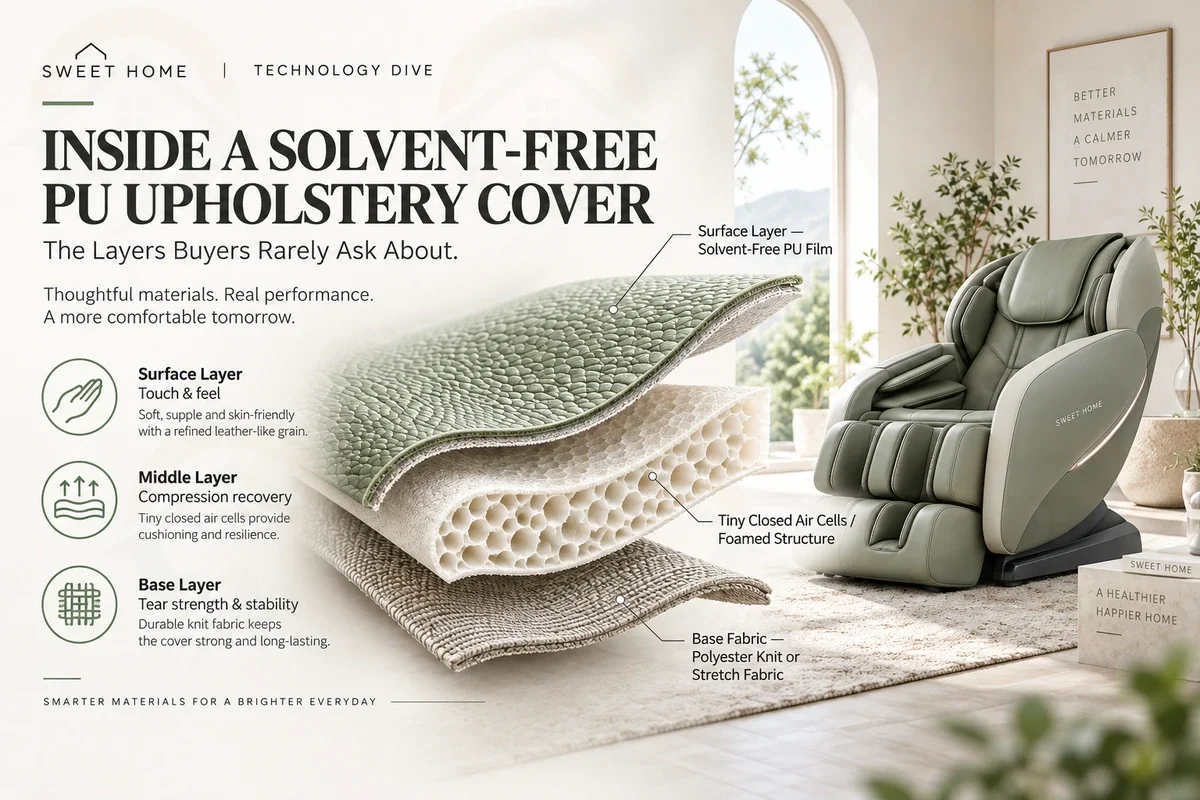
On a finished full-body massage chair, the “leather” is a two-layer system, and the two layers do different jobs.
The Surface Layer
This is the solvent-free PU film. Because Components A and B are reacted under heat, the process can also produce a foamed film with tiny closed air cells — which is what gives the cover its fleshy, elastic feel.
The bubbles are not cosmetic: they are what allows the face to compress and recover thousands of times without going flat.
The Base Fabric
Under the film sits a polyester knit or stretch fabric. It is the mechanical backbone of the cover: tear strength, dimensional stability and the reason a seam does not open when the roller passes under it. The surface layer decides how the cover feels; the base fabric decides how long it survives.
Our abrasion test breakdown is the fastest way to see the difference between two covers that look identical in a showroom.
The Step-Up Variant — and One Caveat Worth Flagging
There is a second generation on the market: semi-silicone solvent-free leather, which takes the same solvent-free PU base and adds a silicone top coat. The silicone layer lifts stain resistance and pushes hydrolysis resistance further, which is why it usually appears on the higher-priced programs.
The caveat: pure silicone leather is not solvent-free PU. It is an entirely different material system, and some suppliers describe both under the same “solvent-free leather” heading.
If a supplier cannot tell you plainly whether the base is PU or silicone, that is a fair reason to slow the order down and ask again.
5. What Solvent-Free PU Does Not Solve
A supply-chain breakdown that only lists advantages is a sales sheet, not a briefing. Three limitations belong in the same conversation:
- It costs more. A better-controlled reaction line is a more expensive line, and the film price reflects it. That is the trade-off, and it is cheaper to accept it at quotation stage than to discover it mid-project.
- It still ages. It removes the solvent-residue problem and slows hydrolysis, but it is still a polymer. Continuous direct sunlight and repeated oil penetration from skin and hair will accelerate aging on any PU film ever made.
- The market has shortcuts. Ordinary solvent-based PU with a sprayed silicone top coat is sometimes sold as “solvent-free leather.” The label gets borrowed; the process does not get copied.
The verification route is unglamorous but effective: ask for a test report that confirms the production process, and check the material against a recognised textile and leather testing programme such as OEKO-TEX STANDARD 100, which screens for substances that should not be present in a consumer contact material in the first place.
6. Three Terms That Get Mixed Up in Sourcing
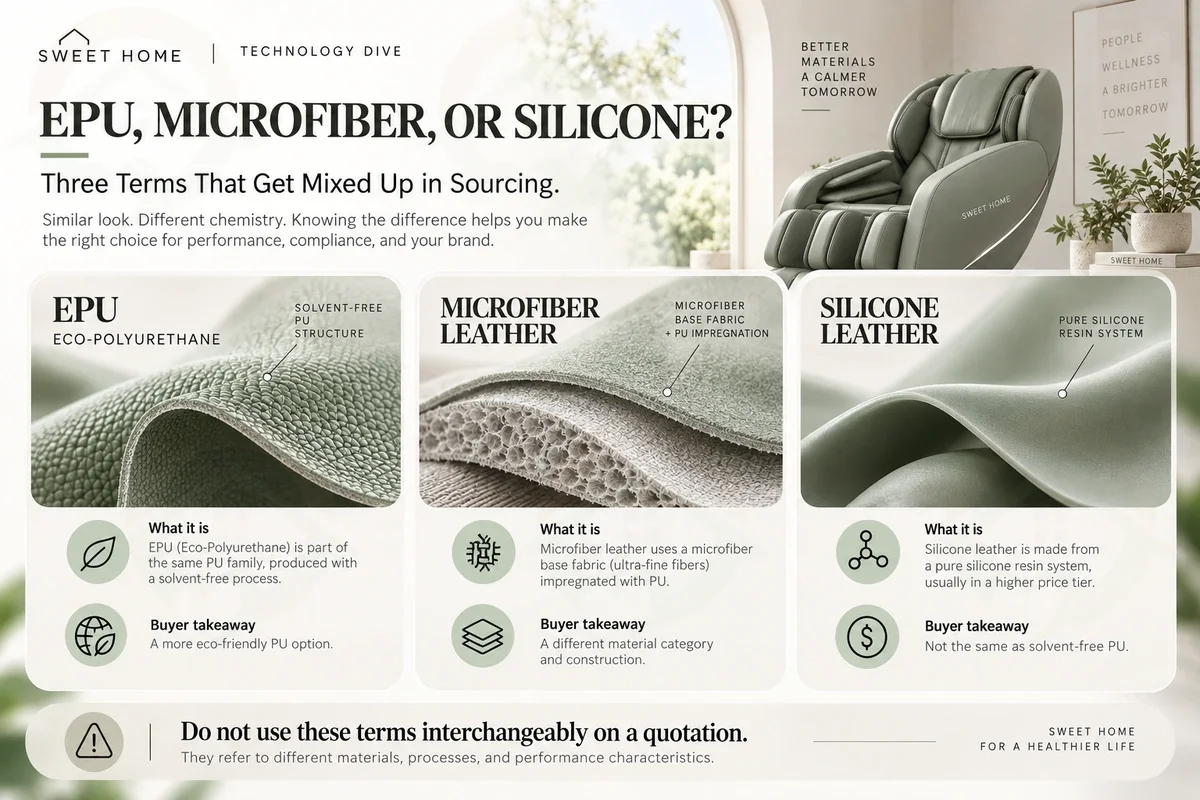
EPU, microfiber leather and silicone leather appear in the same quotation sheets and mean three different things. Mixing them up is how a buyer pays a premium for a rename — or specifies the wrong material entirely.
| Term | What it actually is | What it means on a quotation |
|---|---|---|
| EPU / eco-polyurethane | Trade name for solvent-free PU — same polymer family, reacted without DMF | The material this article is about. Ask for the process confirmation, not just the name |
| Microfiber leather | A microfiber base fabric impregnated with PU; a different category of synthetic leather | Compare it on its own abrasion and tear data — it is not automatically better or worse |
| Silicone leather | A pure silicone resin system, outside the PU family, usually a higher price tier | Not a synonym for solvent-free PU. If the quotation uses the terms interchangeably, verify the base |
One line in the PO closes most of that gap: specify the material by process and by supplier code, exactly the way we write it in our own OEM files, rather than by colour name alone. That is also what keeps container two matching the sample you approved in the first place.
7. How to Verify It Before You Order
The Question That Replaces Ten Minutes of Touching Samples
“Does this feel like real leather?” tells you almost nothing about service life in the field. “Is this solvent-free PU or solvent-based PU, and which components cure the film?” tells you most of what you need.
A supplier who can answer that second question without calling the mill has already demonstrated that they know their own upholstery line.
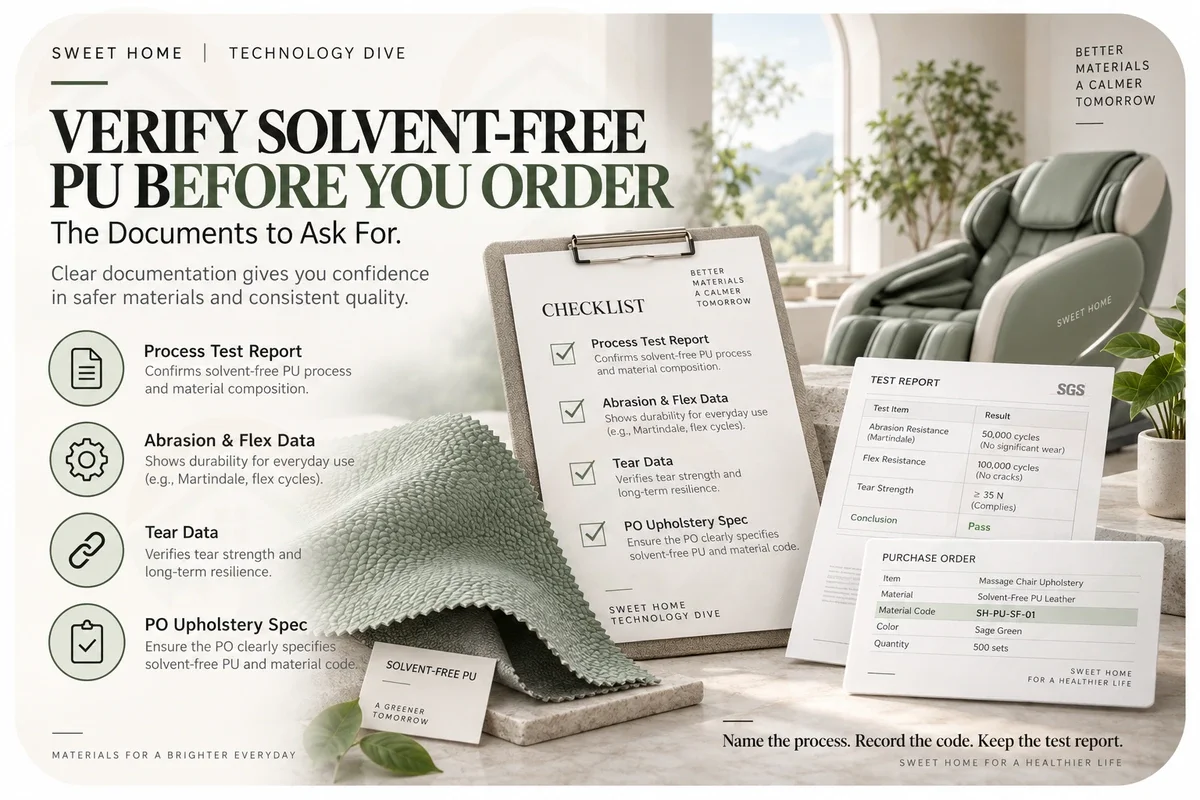
The Documents to Ask For
- A process test report for the specific film, not a generic catalogue certificate
- Abrasion and flex data for the surface layer, plus tear data for the base fabric
- The upholstery spec written into the PO by material code, so repeat orders cannot drift
Upholstery selection and electrical compliance are separate decisions — but they are reviewed by the same importer, usually in the same week.
8. Quick Answers for Sourcing Teams
Q: Is solvent-free PU noticeably more expensive?
Yes, and the gap is best treated as a material decision rather than a negotiating position. The process uses a controlled reaction line instead of a solvent bake line, and the film is priced accordingly.
Q: Does it feel different from the PU I have been buying?
Usually slightly denser and softer, because the foamed film keeps its cell structure instead of collapsing as the solvent leaves. The difference is small on a new sample and much larger after six months of daily use — which is why the honest comparison is cycle data, not a first impression.
Q: If a cover does flake, is it repairable?
Surface flaking on a solvent-based film is a material end-of-life event, not a maintenance problem — there is no coating that restores a network that has already broken down.
What does change the timeline is care: keeping the cover off direct sun, out of oil build-up and away from harsh cleaners. Our distributor care guide covers the routine we hand to owners.
Q: Which chairs actually ship with it?
On growth programs, usually the mid and upper tiers first, because that is where the buyer is already competing on durability.
If you are specifying a new model, the practical way in is to ask for solvent-free PU on the main contact panels — seat, backrest and armrests — before you extend it to secondary surfaces.
9. Bottom Line
“Solvent-free” sounds like marketing language until you look at what the process removes: the residual solvent, the loose network, and the loose ends of service life that follow both.
On a massage chair the three properties it improves — repeated compression, heat and hydrolysis — are the three things the chair does to its own upholstery every single day.
So the next time you evaluate a cover, skip the hand-feel test and ask the process question: solvent-free PU, or solvent-based PU? Then ask for the report behind the answer.
Joe Fan
Manufacturing & Product Development Manager · Sweet Home
Sweet Home has manufactured massage chairs since 2013, drawing on in-house R&D and quality control for massage chairs and wellness equipment, with deep expertise in SL track mechanisms, 4D massage systems and zero-gravity ergonomic design.
Disclosure: Sweet Home is the manufacturer behind these chairs, and the service data throughout this series comes from our own repair logs and production line — shared so buyers can recognize these failure patterns before they reach a container.
Quick audit: does your upholstery spec name the process, not just the colour?
1. Is the cover solvent-free PU or solvent-based PU? 2. Surface layer — film process and supplier code on the PO? 3. Base fabric — knit type and tear spec? 4. Abrasion / flex test report on file? 5. Written into the PO so the second container matches the sample?
Missing more than one? Send us your current upholstery spec and we’ll mark it up against the material files we build from.
Related Reading
More on massage chair materials, upholstery and the components that decide service life: