
Most massage chair fit failures are decided long before the chair is plugged in. This guide covers how much space a massage chair needs — wall clearance, reclined depth, doorway width, ceiling height and front clearance — and how to measure the room before an order is booked.
The failure mode is always the same. The chair is delivered, the backrest tilts back, and it stops short of full recline because the wall is 8 inches away instead of 15.
Full zero-gravity never happens. The owner’s first impression of the product is that it does not work — not that the room is too small. On the retail or fleet side, that impression arrives as a return, a service call or a discount.
Clearance is a specification. Like every other specification in this category, it should be confirmed in writing before the order is placed, not discovered on delivery day. New to the category? Start with what a massage chair actually is and which parts move.
How Much Space Does a Massage Chair Need?
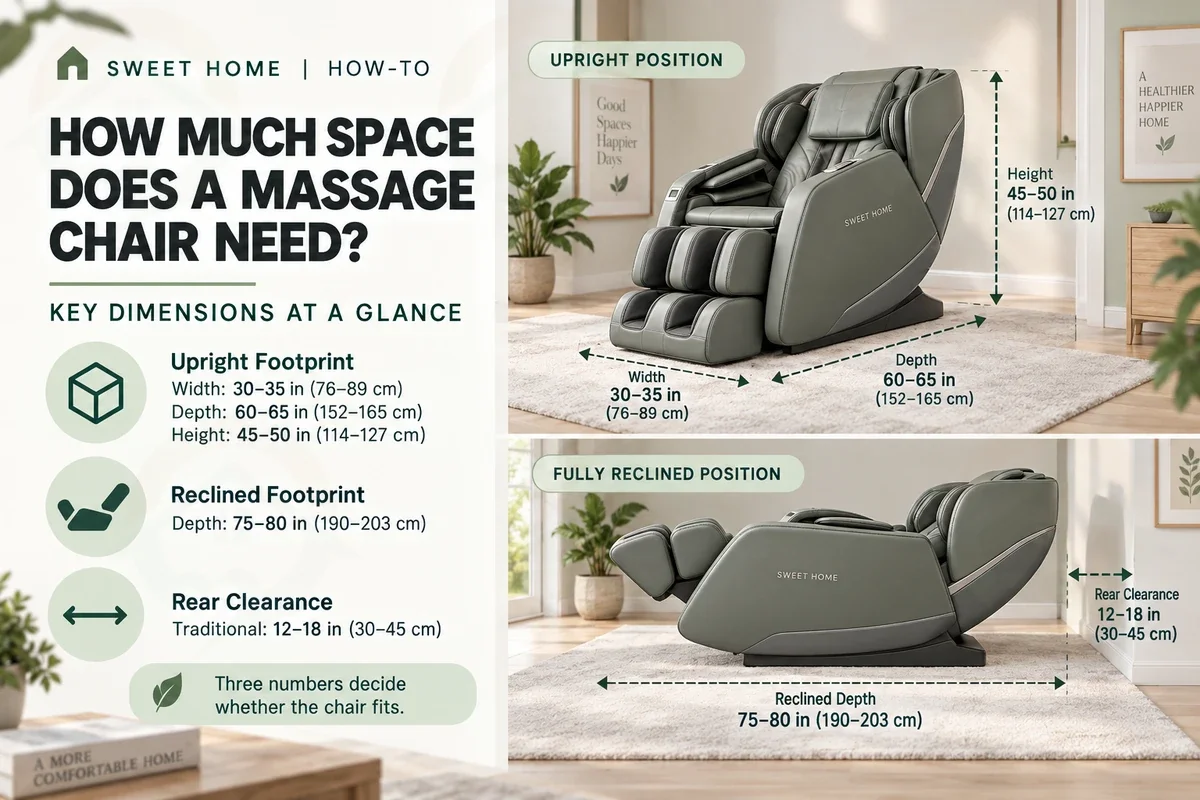
Three numbers decide whether a chair fits: the upright footprint, the reclined footprint, and the clearance gap behind the backrest.
Standard Upright Footprint: Width, Depth, Height
Most full-size models sit in a predictable band: roughly 30–35 in (76–89 cm) wide, 60–65 in (152–165 cm) deep, and 45–50 in (114–127 cm) tall.
Width is fairly stable, because it is set by the armrests and the shoulder air bags. Depth is the number that moves, and where orders go wrong.
Reclined Depth: Where the Space Actually Goes
On a traditional chair the backrest travels backward as it reclines. Depth grows from around 60–65 in upright to 75–80 in (190–203 cm) or more at full recline.
Zero-gravity is the most space-demanding position in the cycle, because the backrest keeps travelling past the point where the user’s knees rise above chest height.
The posture itself is not new. It follows the neutral body posture work NASA formalised for crew seating and later applied to massage chair design. Comfort comes from the angle; the clearance requirement comes from how far the backrest has to swing.
The mechanism behind that travel is covered in detail in EP10.0: the zero-gravity recline mechanism.
The Quick Space Checklist
| Requirement | Traditional Recline | Wall-Hugger / Zero-Wall |
|---|---|---|
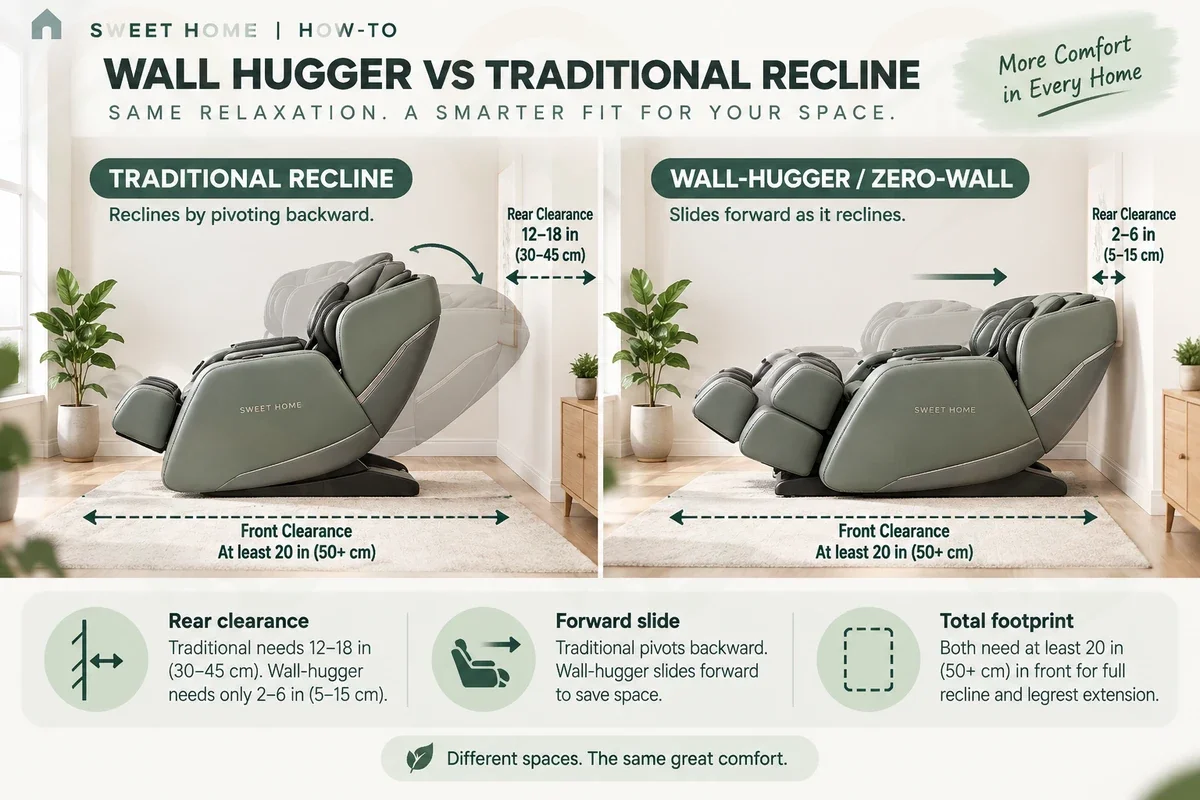
| Wall clearance at full recline | 12–18 in (30–45 cm) | 2–6 in (5–15 cm) |
| Front clearance (footrest + forward slide) | 20+ in (50+ cm) | 20+ in (50+ cm) |
| Minimum doorway width | 30–32 in (76–81 cm) | 30–32 in (76–81 cm) |
| Ceiling height at full recline | 50+ in (127+ cm) | 50+ in (127+ cm) |
Published clearance figures across the category cluster into two groups, and the ranges above are typical rather than fixed. Treat any catalogue number as a starting point and confirm it against the spec sheet for the exact model you are shipping.
Front clearance is the one buyers forget. Even wall-huggers slide the seat forward, so a coffee table, a display rack or a plant standing 12 inches in front of the chair becomes an obstruction the moment someone presses recline.
One house rule worth copying: never quote a chair’s recline capability without the clearance figure that belongs to it. “Full zero-gravity recline” and “15 in rear clearance” belong on the same line of the same document.
Wall Hugger vs Traditional Recline
What Wall Clearance Actually Is
Wall clearance is the empty distance the backrest needs behind the chair to complete its recline stroke. It is not a comfort margin and it is not optional. It is the physical travel of the mechanism.
How a Zero-Wall Chair Buys That Space Back
A traditional recliner pivots the backrest backward. The seat stays put, the back goes down and out, and the space behind the chair has to stay empty.
A wall-hugger — also sold as zero-wall or space-saving — changes the geometry. The base slides forward on a track while the backrest reclines, so the chair moves away from the wall instead of into it. Rear clearance drops to roughly 2–6 in (5–15 cm).
“Space-saving” is used loosely in this category. Some designs only reduce clearance partially; others are true wall-huggers. Ask for three numbers instead of a label.
- Rear clearance at full recline
- Forward travel of the base at full recline
- Total footprint at full recline, armrests included
Recline travel, forward slide and footrest extension each need their own space. Missing one of the three is enough to cause a failure. If you are choosing between configurations for a market, our track selection guide covers how the guide rail inside the chair limits the travel you can specify.
What Goes Wrong When the Clearance Is Short
- The chair hits the wall mid-recline. The mechanism reaches its travel limit early, and on some units the drive strains or aborts the stroke. Full zero-gravity is never reached.
- Walls, skirting and picture frames take the load. A backrest pressing into drywall marks or cracks it over a few weeks of daily use.
- The recline feels stuck. Motion stops while the motor is still running, which is how a fit problem gets reported as a defective chair — the most expensive kind of ticket, because nothing is broken.
- Placement drifts. A chair pulled away from the wall to gain room can end up on an uneven patch of floor, and a chair that rocks is a chair the owner stops using.
How to Measure a Room Before the Chair Arrives
Whether you are checking a customer’s living room, a hotel suite, a spa treatment room or a showroom bay, the routine is the same. Take the numbers, write them down, then compare them to the spec sheet before you commit the space.
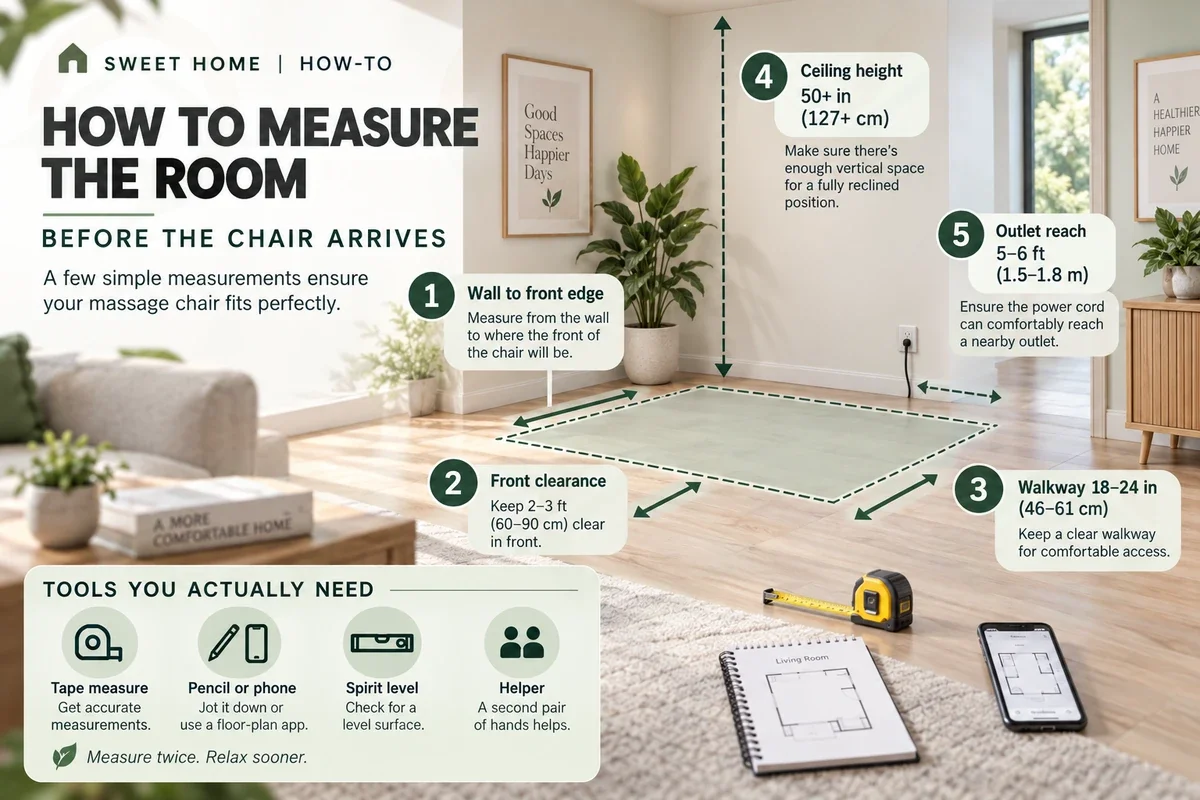
Tools You Actually Need
- Tape measure, 25 ft or longer for room dimensions
- Pencil and paper, or a phone with a floor plan app
- Spirit level, to check how flat the floor actually is
- A helper for long spans and awkward corners
The Five Numbers to Take
- Wall to front edge. Measure from the wall where the chair will sit to the front edge of the space it will occupy. This is your maximum depth.
- Front clearance. From the front of the chair’s position to the nearest obstacle — coffee table, TV unit, retail rack. You need 20+ in (50+ cm).
- Walkway. Leave 18–24 in (46–61 cm) beside the chair. In a showroom that is also the space a customer needs to walk around a reclined chair.
- Ceiling height. 50+ in (127+ cm) at full recline, watching for ceiling fans, low bulkheads and pendant lights.
- Outlet reach. You need a socket within 5–6 ft (1.5–1.8 m) of the chair. A commercial install should not run on an extension cord.
Then subtract. If the chair needs 15 in of wall clearance and the space offers 70 in of depth, the usable upright depth is 55 in — and the reclined depth still has to fit inside the same 70 in.
Doorways and the Route In
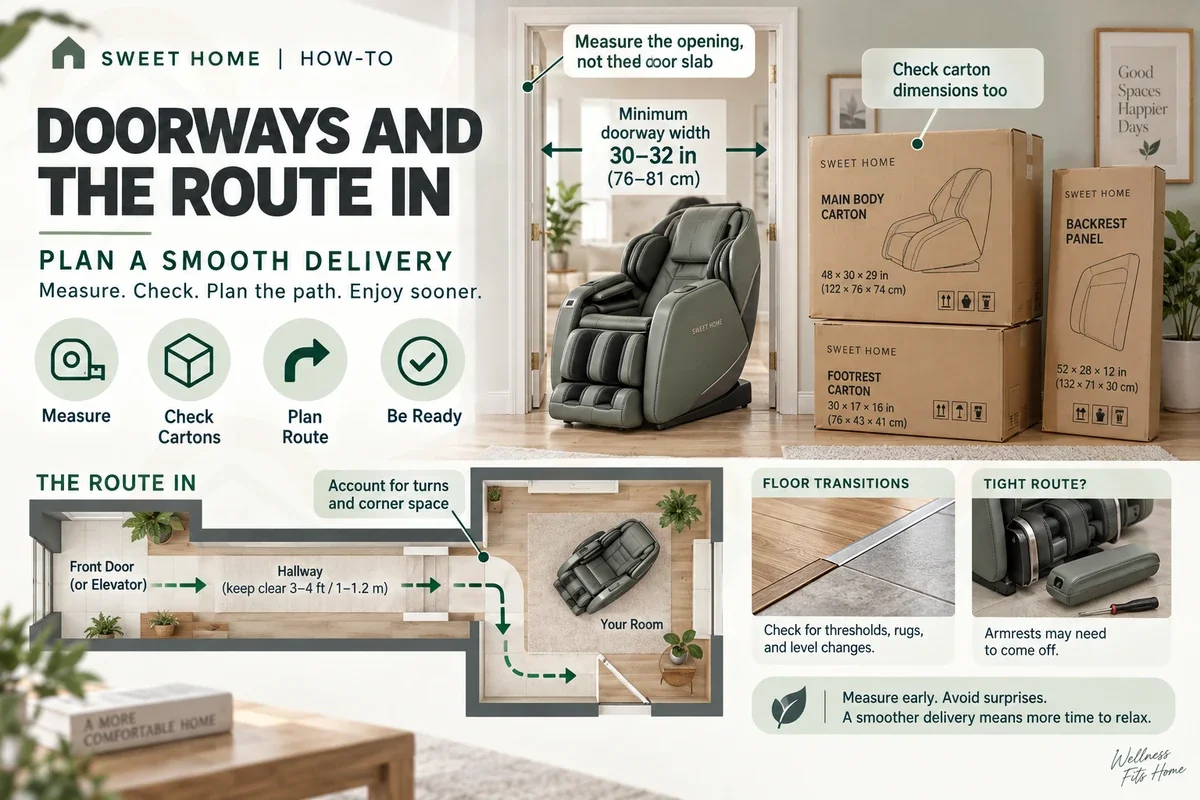
Measure the narrowest point of every doorway on the delivery route, and measure the opening rather than the door slab. Standard interior doors are 30–32 in, which means a 30 in opening is narrower than a 31 in chair.
Most chairs ship in two cartons with the backrest separate, so check the carton dimensions as well as the assembled width. Where the opening is tight, armrests may have to come off for the final approach.
Five Measuring Mistakes
- Forgetting the footrest. It extends forward well past the seat, so seat depth alone will always come up short.
- Ignoring the recline arc. Traditional chairs need room behind; wall-huggers need room in front.
- Not accounting for the power cord. The socket has to be reachable without stringing a cord across a walkway.
- Assuming a standard door means the chair fits. Measure the actual opening at its narrowest point.
- Overlooking floor transitions. A step, a thick carpet edge or a raised threshold makes a 150+ lb chair much harder to move than the measurements suggest.
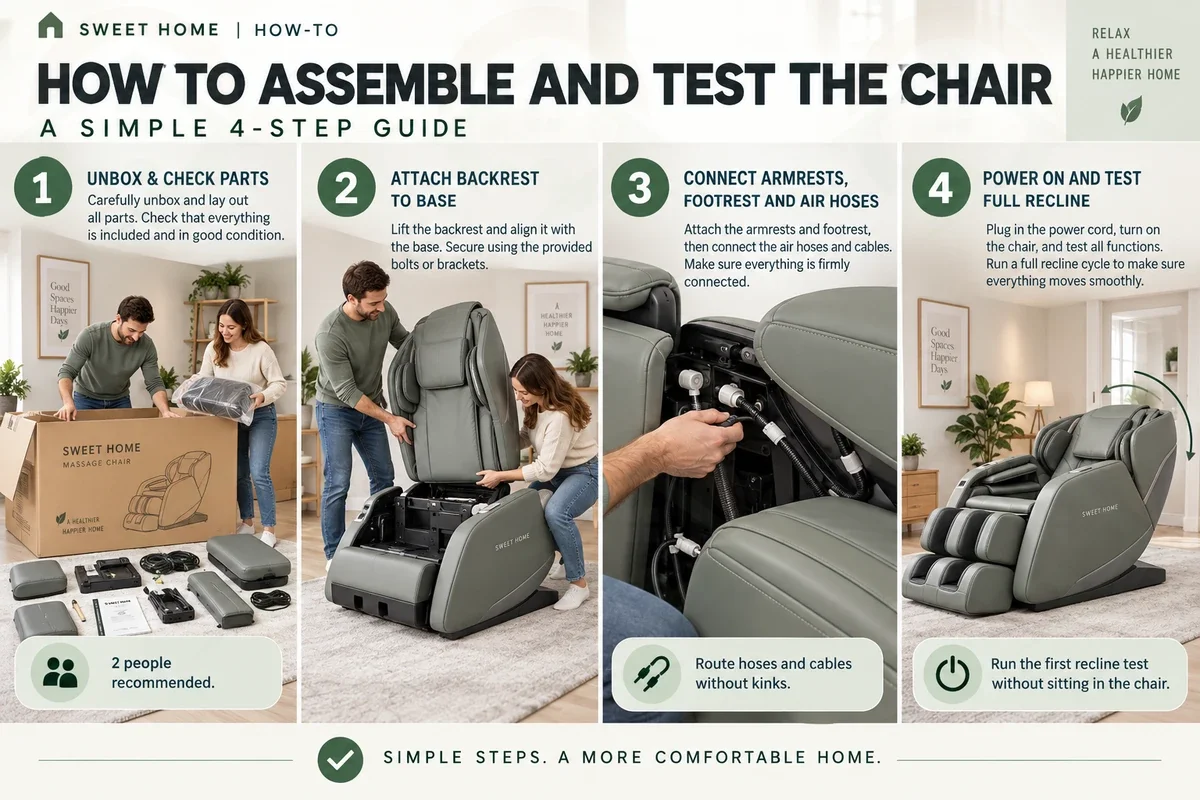
How to Assemble and Test the Chair
Assembly follows the same sequence on most models: base and backrest first, then armrests and footrest, then power, then a full recline test. With two people, a straightforward model takes 20–30 minutes.
Models with separate arm and shoulder panels and several air-hose connections take 45–60 minutes. Assemble on a hard, flat surface, then move the finished chair into position.
Step 1: Unbox and Check the Parts
Lay the components out and check them against the parts list before you start. A typical shipment contains the chair base with seat and footrest, the backrest, left and right arm panels, the remote and power cord, and a screw pack with bolts, washers and an Allen key.
Keep the packaging until assembly is complete.
Step 2: Attach the Backrest to the Base
Two people, every time. The backrest is the heaviest single component in the carton.
On slide-lock designs, one person holds the backrest upright while the other aligns the metal arms with the slots on the base, then pushes down until it locks. On bolt-on designs, remove the pre-installed screws, align the mounting holes, start every bolt by hand, then tighten them in sequence.
Check that the backrest is fully seated before moving on. A partially engaged backrest can slip the first time the chair reclines with weight in it.
Step 3: Armrests, Footrest and Air Hoses
Armrests attach by zipper, screw or slide-in rail. On zipper designs, open the bottom zip, connect the air hoses and wiring, then close it again properly.
Some models add shoulder panels after the armrests. These carry air bags, and the hoses are numbered to match the ports on the chair body. Mismatched hoses produce weak or missing massage modes rather than an obvious fault.
Route every hose and cable without kinks or pinches.
Step 4: Power and Cable Routing
The power port sits on the back or underside of the base.
Before switching on: every connector seated, no cable trapped under the base, and the power switch in the off position.
Step 5: Test the Full Recline Cycle
Switch on and let the chair run its self-check. Do not sit in it during that first cycle.
Then press recline or zero-gravity and watch the whole range of motion: the backrest reaching full recline without touching anything, the footrest extending fully, the cables staying slack, and the chair returning upright smoothly.
Listen as well. Grinding, clicking or a change in motor pitch points at a connection or a clearance problem rather than a component failure, and both are quick to check at this stage and expensive to check after the chair is in a customer’s home.
Assembly Mistakes to Avoid
- Leaving protective film, foam or zip ties in place. They bind moving parts and load the motors.
- Assembling on carpet or an uneven floor. The chair will not sit level, and the recline drive carries the difference.
- Skipping the level check after final placement. The assembly spot and the final spot are rarely the same surface.
- Ignoring the numbered air hoses. Crossed lines give weak massage modes, which get reported as software faults.
- Assuming the cord reaches. A socket that needs an extension cord is a socket in the wrong place.
- Skipping the rock test. Gently rock the finished chair; if it moves, something is still loose.
- Assuming it fits through the door. Measure the route before delivery day, not on it.
What to Confirm Before You Book the Order
Four lines belong on the spec sheet you send to your supplier, and four lines belong on the one you send back to your customer.
- Rear clearance at full recline, in writing, next to the reclined depth
- Total footprint at full recline, including armrests and footrest extension
- Entry route: narrowest door opening and the shipping carton dimensions
- Front clearance and outlet position at the install site
Fit is a specification, not a sales conversation. If a supplier cannot put a clearance figure on the same page as the reclined dimensions, that is a gap in the specification — not a detail.
FAQ
How much wall clearance does a massage chair need?
A traditional recline chair needs roughly 12–18 in (30–45 cm) behind the backrest. A wall-hugger or zero-wall model needs only about 2–6 in (5–15 cm), because the base slides forward as it reclines. Always check the figure for the specific model in your catalogue.
Can a massage chair be placed against the wall?
Only if it is a wall-hugger. A traditional chair cannot sit flush, because the backrest needs to travel backward. A wall-hugger sits close to the wall and moves away from it during recline, which is why it needs its front clearance kept clear instead.
How long does it take to assemble a massage chair?
Most models take 20–30 minutes for two people. Chairs with separate arm and shoulder panels, or with several air-hose connections, take 45–60 minutes. The tools are basic: an Allen key and a screwdriver.
Do I need two people to assemble a massage chair?
For most full-size models, yes. The base and backrest are heavy and awkward to align, and many manufacturers state two adults in the manual. Compact and recliner-style chairs are the exception and can usually be assembled by one person.
What if the room cannot take a full recline?
Three options, in order of preference: specify a wall-hugger model for that market; accept a partial recline if the chair allows it without contact; or reconfigure the space. If zero-gravity is the selling point, measure first and sell second.
Should a distributor standardise on wall-hugger models?
Not as a blanket rule — a mixed line-up covers more floor plans. But the models that generate fit complaints are usually the ones where the clearance was never published, not the ones with the largest footprint.
Get the Clearance Figures Before Your Next Order
Once the chair is installed, the work shifts to keeping it in service — our cleaning and maintenance routine for distributors is written to be handed to the end customer.
Send us the room dimensions or the showroom bay you are working with, and we will return the reclined footprint and clearance figure for the models you are considering — the same numbers that go on the spec sheet.
Sweet Home is a massage chair manufacturer in Fujian, China, supplying importers, distributors and commercial operators with OEM programmes.
Tommy
Sweet Home Technical Team
Part of Sweet Home’s in-house technical team. Tommy writes our How-To guides for importers and distributors — installation, floor planning and after-sales checklists — built on our export order data and after-sales records.
Disclosure: Sweet Home is the manufacturer behind the chairs discussed in this guide, and the installation and fit patterns come from our own export orders and service records — shared so buyers can specify clearance correctly before a container is booked.
Quick audit: will the chair you are quoting actually fit the room?
1. Rear clearance at full recline confirmed in writing? 2. Total reclined footprint including footrest? 3. Door opening and carton size checked?
Two or more unchecked? Send us the space and the model — we will return the fit numbers.