
Part 1 — Cashless Payment System
Part 2 — Cash Box & Banknotes
Part 3 — Remote Monitoring
Part 4 — Internet & SIM Connectivity
Part 5 — Model Selection and Size Parameters
Part 6 — Spare Parts & Upholstery
A vending massage chair cash box is not just a lockable container. Its location, banknote acceptor, change behaviour and reporting connection determine how often an operator must visit the site — and which customer complaints reach the front desk first.
This FAQ separates what cash hardware can potentially do from what the chair configuration in your order will actually do.
Confirm the chair model, payment components and software settings in writing. A feature available on a third-party validator or dashboard is not automatically included on a Sweet Home chair.
Where Does the Cash Box Go?
Is an external metal cash box standard on every model?
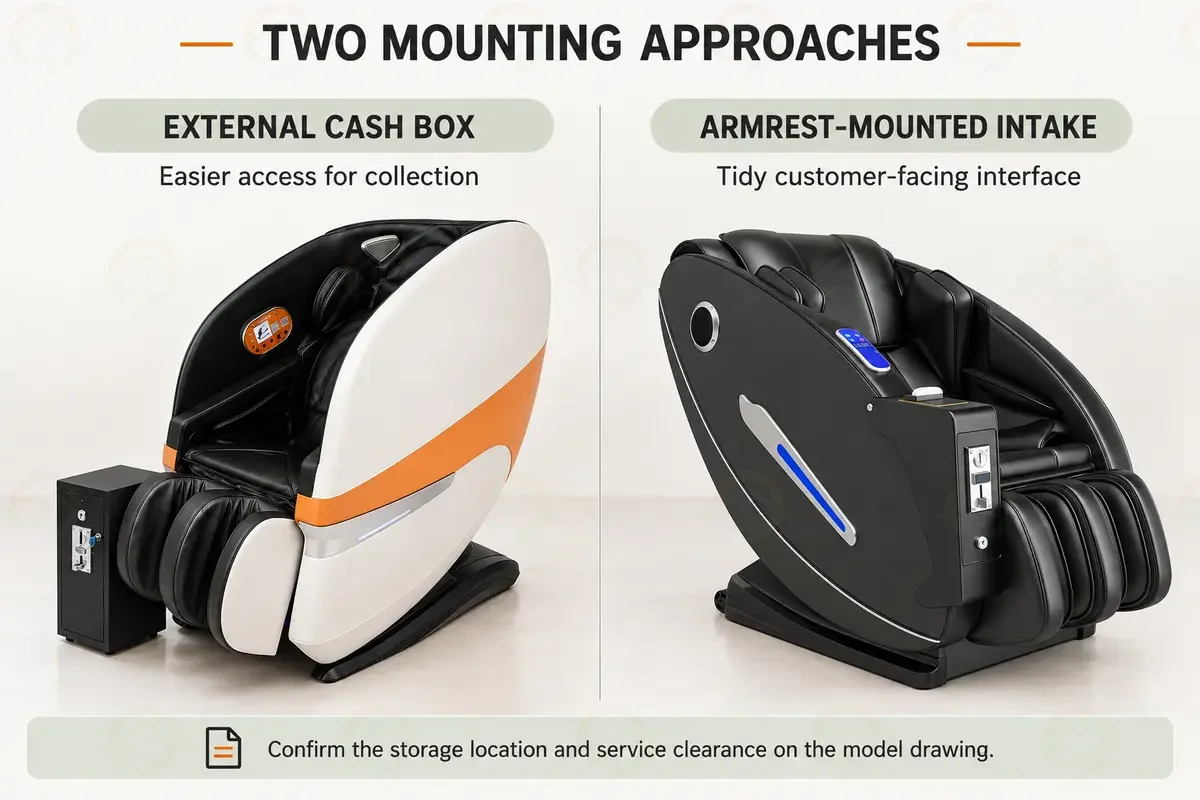
No single mounting arrangement should be assumed for every vending massage chair. An externally accessible metal box may make route collection easier, but its position, dimensions, fastening and lock depend on the chair frame and the quoted acceptor.
For the vending massage chair range, ask for a model-specific installation photo or drawing, not a generic image of a payment box.
Why might an operator choose an external box?
If the door is accessible without removing upholstery or reaching into the electronics, the collector may be able to empty and reseal it more simply.
That is an installation advantage, not a universal capacity claim: a larger box is possible only if the specified chair and validator accommodate it. Check service clearance at the actual venue before ordering.
Can the banknote acceptor be built into the armrest?
An armrest-mounted acceptor is model-dependent. It may offer a tidier customer-facing interface but can narrow the available chair and validator combinations.
Do not infer that the notes are stored inside the armrest merely because the intake is there: the intake and the storage location must be confirmed separately on a drawing. Ask whether the chosen model supports that mount and where the stacker can be opened.
Our own banknote demonstration footage shows one chair with the note intake below its armrest control panel. That is direct visual evidence of an armrest-mounted intake on the chair filmed, not proof that every model uses this layout or that the cash storage sits inside the armrest.
Capacity and Accepted Banknotes
How many banknotes will the box hold?
There is no reliable universal number for a vending massage chair cash box. Capacity depends on the validator and stacker part numbers as well as the notes and service setup.
As an illustration of component variation, CPI lists 200-note and 600-note cash-box options for its R900 validator. These are CPI component specifications, not specifications for our chairs.
Request the exact configuration's rated note count and a practical collection interval based on your site's expected traffic.
Which currencies and denominations can be accepted?
Support is specific to the installed validator, its banknote program and the notes in the destination market. USD, EUR or any local currency must not be assumed from the chair model alone. Send the country, current note series and denominations you intend to accept.
Have the quoted validator and firmware checked against that list and ask for a sample-note acceptance test before shipment, particularly where banknote designs have recently changed.
In a separate Sweet Home demonstration filmed with a U.S. one-dollar note, the note is shown at the chair-mounted intake.
That demonstrates the filmed setup, not support for other note series, all denominations or a given customer's delivered chair. A buyer should request the matching note test for their own order.
Can the same chair be moved between countries without changes?
Not necessarily. Power, the validator's currency program, note widths and local payment rules may change between markets. State both destinations on the order annex and ask which components or programs would need replacement or retesting before relocation.
Change-Making and Overpayment
Does a cash payment return change?
A bill acceptor and a lockable cash box are not, by themselves, a change dispenser. If a change mechanism is not included in the quoted setup, do not promise a refund of excess cash.
Whether an overpayment is rejected, held as credit or applied to additional massage time depends on the acceptor and chair control program. Test the exact payment sequence and disclose the result on the price sign.
CPI's cash-device configuration guide documents that coin handling, denomination restrictions and remaining credit can be separately configured; it does not establish our chair's behaviour.
What should an operator do if change is not available?
Use a price that customers can make with the enabled denominations, explain the no-change rule beside the acceptor and provide staff help where practical.
An "exact amount only" sign is useful only after confirming that the machine actually accepts those notes or coins and how it handles an incorrect amount. If change-making is non-negotiable, specify that requirement before the acceptor and chair controller are selected.
Would adding a card reader solve the cash problem?
A compatible cashless terminal can give customers another way to pay without needing cash change; it does not make the cash path dispense change or prevent a full cash box.
Check the electrical interface, power supply, pricing logic and payment-to-session activation test before treating a hybrid setup as available.
Nayax describes pulse-operated and parallel payment setups for supported integrations. Our Part 1 cashless payment FAQ covers the separate terminal questions.
Security and Cash Collection
How secure is an external cash box?
A keyed lock and a fixed mounting point can limit casual access, but "tamper-proof" is not a specification. Confirm the lock type, key control, mounting fasteners, opening clearance and who holds spare keys for the actual chair.
Ask for an installation photo and the service procedure if the venue requires an anti-theft assessment. Do not assume a particular box has been independently tested against prying or bill fishing.
How often should the box be emptied?
Start with a conservative visit interval, then adjust it from recorded session demand and cash counted at each visit. Separate the number of paid sessions from the number and value of notes: a single session may involve more than one note, and card sales do not occupy the cash box.
Record the collection date, notes by denomination, discrepancies and any validator rejection or jam before lengthening the route interval.
The handoff matters when someone else empties the box. An operator of vending machines asked how to control employee cash collection across multiple locations. That is an individual operator's question, not Sweet Home field data.
Have the collector and verifier sign the count and record any variance before comparing it with the dashboard.
Remote Cash Data: What Is Actually Visible?
Can the operator see cash sales remotely?
Possibly, but only if the quoted controller, cash interface, wiring and telemetry service send compatible cash-event data. A basic card-reader installation may report card transactions yet say nothing about notes in the box.
Other integrations can report cash counts or estimated cash sales. Nayax describes a Pulse IN Counter option and DEX transaction reporting.
These third-party capabilities do not verify that they are enabled on any specific Sweet Home chair.
Ask for a screenshot of the actual quoted dashboard field and a cash-transaction test.
Why insist on the screenshot? In a vending operator's archived report, the reader handled card purchases while the app displayed only card sales, not cash or coin levels.
That report describes one machine, not a universal Nayax limitation. It is precisely the mismatch the sample cash transaction should catch before delivery.
Is a remote cash figure the same as the money in the box?
No. Telemetry can describe events or estimated takings, while physical cash requires counting and reconciliation. Denomination, rejected notes, credits, test transactions and any missed signals can affect the comparison.
Ask exactly which event is counted, whether note value is captured and whether offline events are synchronized later; record those answers in the order annex rather than assuming that all dashboard figures are banknotes in hand.
How can a buyer prove that cash data reaches the dashboard?
| Run this test on the quoted chair | What it can verify | What it cannot prove |
|---|---|---|
| Insert one accepted note and start one paid session | The tested cash input starts the session | Other note series and denominations work |
| Read the same session in the actual operator dashboard | A cash event is reported by this tested integration | The physical cash total equals the dashboard figure |
| Trigger a validator full-state test and inspect controller status if supported | The full signal reaches the controller on this configuration | A remote notification is sent to the operator |
| Open and count the box at collection | The tested collection reconciles with the log | Future cash counts reconcile without visits |
Test cases, not universal Sweet Home specifications. Record the chair model, validator part number, wiring, connectivity and dashboard settings alongside the results.
Full-Box Alerts and Failure Response
Will the chair send a cash-box-full alert?
Do not assume one. For the specific chair in your quotation, verify whether the validator detects a full stacker, whether the controller reads that state and whether the connected platform sends an operator notification.
Some third-party systems describe cash-box status alerts, including Nayax machine-level alert settings. That does not mean this chair has the necessary integration.
Until the complete chain is demonstrated, plan collection without relying on an automatic alert. Ask to see the validator's full state, the same event on the controller or dashboard, and a notification delivered to the named recipient.
Test a note-path jam separately: CPI's validator manual distinguishes a full cashbox from a stacker or mechanical jam. It does not specify the chair's installed validator.
What if the box fills or bills are rejected?
A rejected bill is a symptom, not proof the box is full; a dirty or jammed note path, wrong denomination or validator fault can look similar. Put a venue contact and a service response into the site plan.
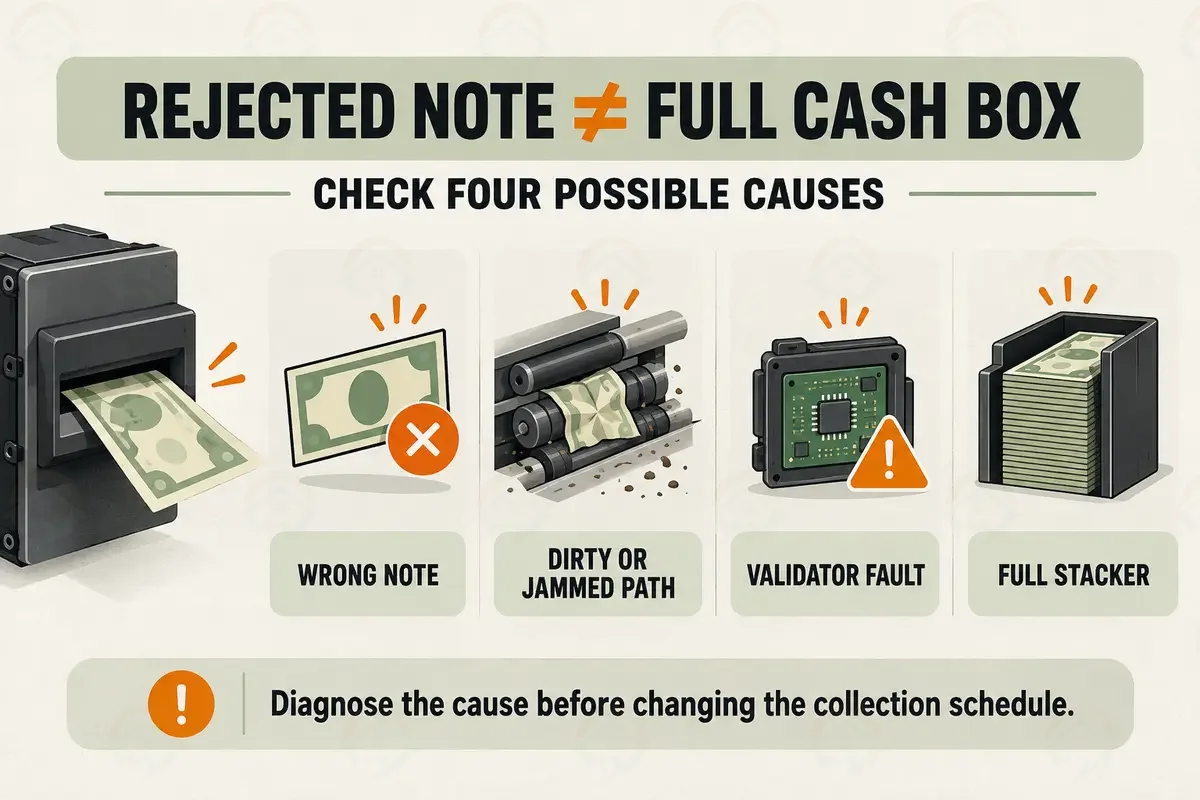
If the full-box signal has not been verified, set a collection schedule with margin below the specified stacker capacity and shorten it after any rejection incident. A tested hybrid cashless option may keep card-paying customers served, but it does not restore the cash channel.
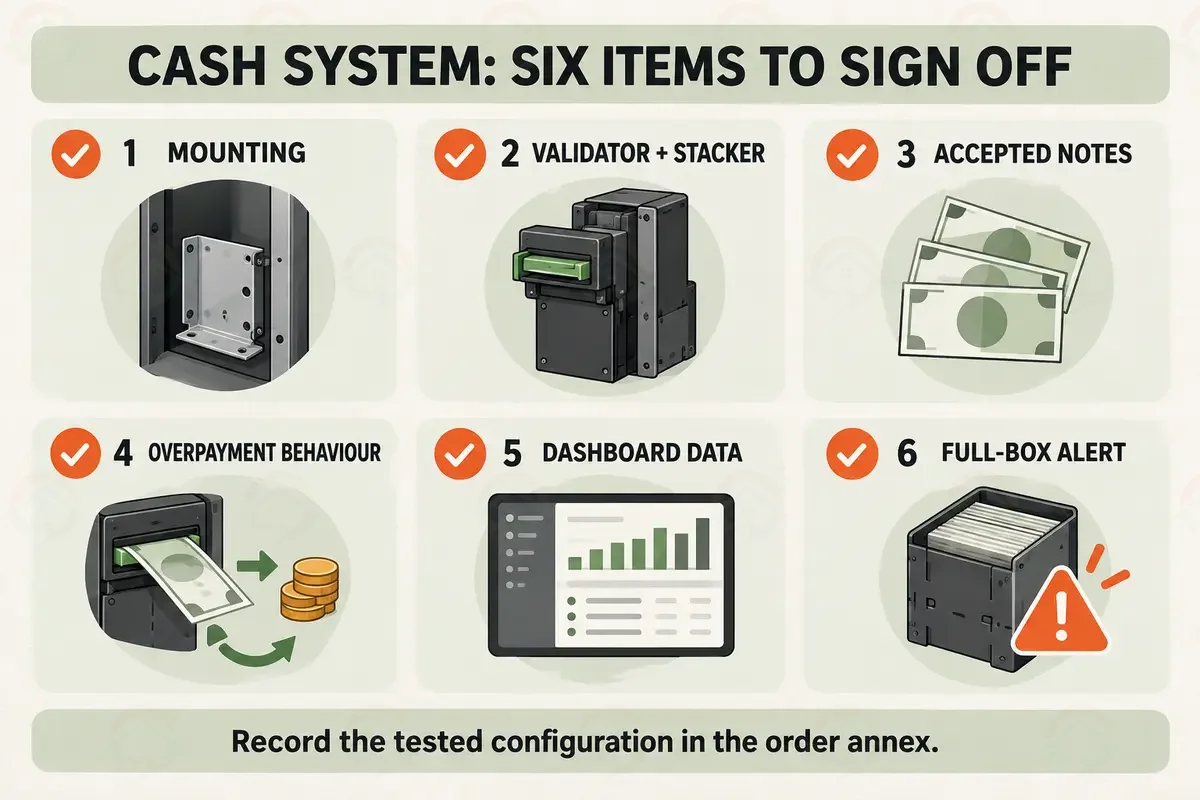
Quick audit: six cash-box decisions to sign off
Before placing an order, confirm the mounting, validator and stacker part numbers, rated capacity, accepted notes, overpayment behaviour, dashboard fields, and whether a full-box notification has been demonstrated.
Name the person who collects the cash, set the first collection interval, and attach the acceptance-test results to the order annex. A full-box status on a validator is not proof of an operator alert.
Mia
Sweet Home Technical Team
Part of Sweet Home’s in-house technical team. Mia writes our FAQ content — the questions importers, distributors and private-label brands send us, answered with the numbers our production, export and after-sales records use.
Disclosure: Sweet Home is the manufacturer behind the products discussed here. The commercial and field practice described on this page comes from our own order documents and after-sales records, published so buyers can evaluate us before booking a container — where a figure is not yet fixed, this page says so instead of quoting a number we cannot sign.
Know what your cash setup will actually do?
Send us the chair model, destination country, accepted notes and collection plan. Ask for the acceptor, mounting, change behaviour and reporting fields on one written order annex.
Related product pages
Cashless Payment Vending Massage ChairOEM Commercial Vending Massage Chair