
Part 1 — Cashless Payment System
Part 2 — Cash Box & Banknotes
Part 3 — Remote Monitoring
Part 4 — Internet & SIM Connectivity
Part 5 — Model Selection and Size Parameters
Part 6 — Spare Parts & Upholstery
A vending massage chair earns only what its cashless payment system lets it collect. That is why the payment terminal — not the massage program — usually decides whether a venue pays for itself.
These are the questions operators actually send us about that hardware, answered with the terminal families we fit and the rates we quote.
Sweet Home is a massage chair manufacturer in Fujian, China. We build coin-operated and cashless vending massage chairs for operators, distributors and private-label brands, and we quote the payment terminal together with the chair rather than as an accessory you sort out after the container lands.
Every figure below is labelled as fixed, quoted per order, or open, so nothing here reads as a specification we cannot sign.
One thing this page does not cover: which payment mix a venue needs, and what the market data says about cash against contactless — that is our payment methods market-share analysis. This page stays on the terminal itself.
What the Cashless Payment System Includes
What hardware is included in a cashless payment system?
Four parts on the chair, plus one account behind it: the tariff display board the customer reads, the contactless or scan reader that takes the payment, and the wiring harness that connects both to the chair.
The interface on the chair's main control board is the fourth part, and the cloud account the terminal reports into is the fifth.
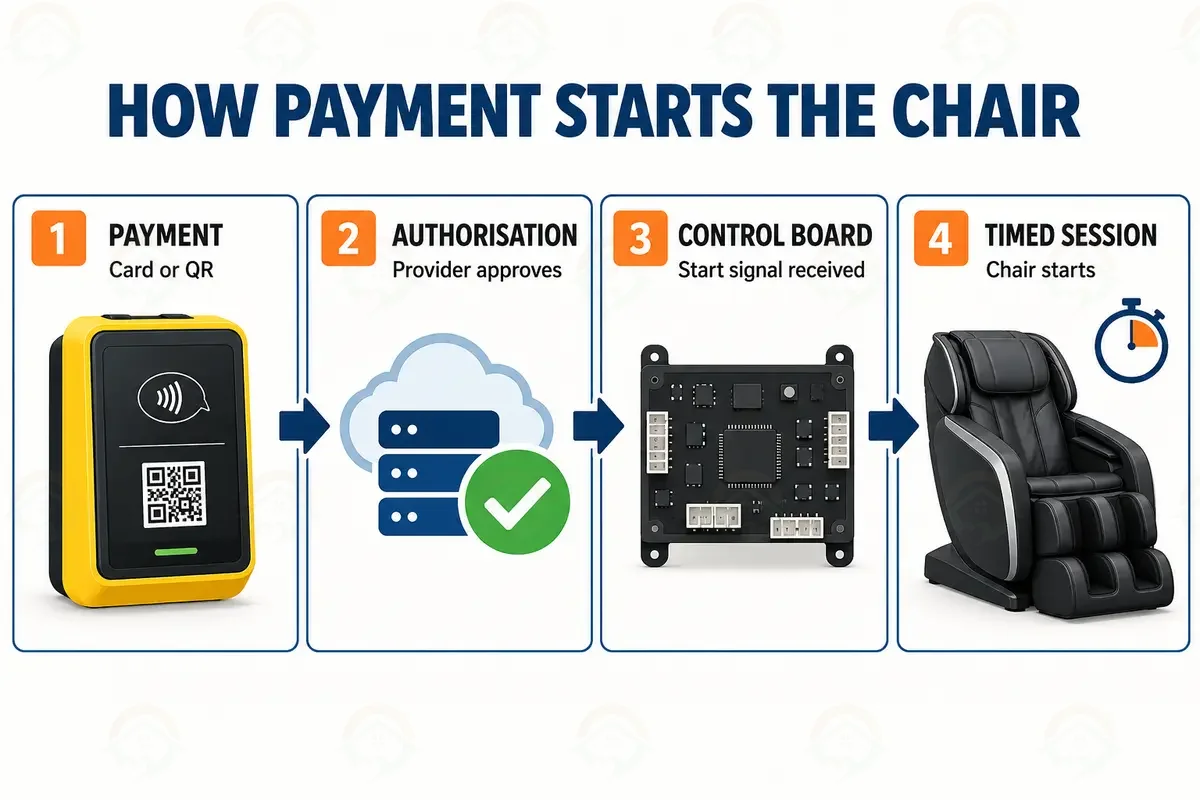
The board interface is the part that matters. On an integrated unit there is no separate start button for the customer to find: the payment signal goes to the main control board and the chair starts.
If a supplier cannot explain how a payment reaches that board, the unit is a bolt-on, not a cashless payment system.
Which terminal suppliers do you work with?
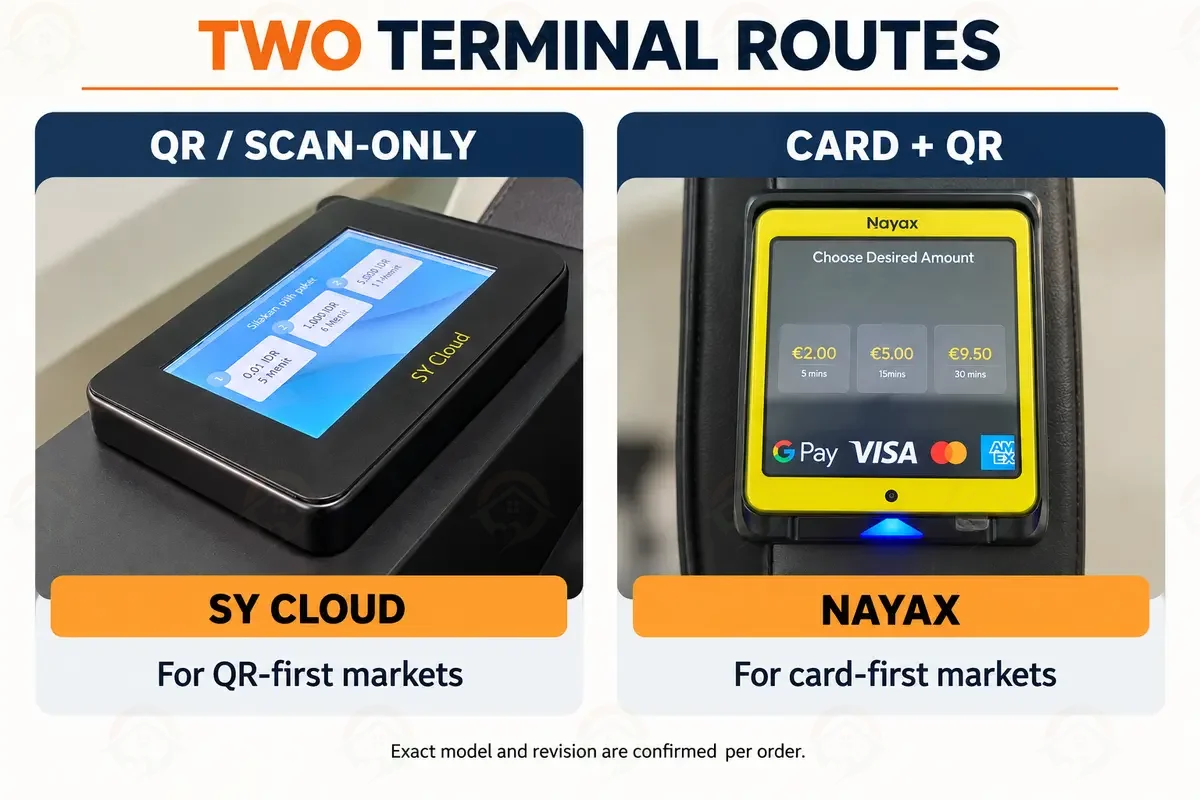
Two families. For QR-code and scan-to-pay markets we can fit compact scan terminals from SY Cloud or StarThing — two separate suppliers, both of which build scan-code payment hardware for self-service equipment.
SY Cloud's operator app is published on the App Store and Google Play under its own name, so the platform can be checked independently of us. For markets where card acceptance is expected we fit Nayax all-in-one terminals, which take contactless cards alongside QR.
The exact model and supplier are named in your quotation, with a photo of the unit that ships.
We do not print model numbers on this page on purpose. The revision that ships depends on the card schemes and the acquiring agreement you sign in your own country, and a model number on a marketing page is worth nothing if the box that arrives is a different revision.
Which terminal family fits which market?
| Terminal family | Typical market fit | What it needs on your side | Ongoing cost |
|---|---|---|---|
| QR / scan-only — SY Cloud or StarThing | Markets where mobile QR wallets are the everyday payment method | A local QR acquirer or aggregator, plus the SIM we supply | Annual service charge per chair + your provider's transaction rate |
| Card + QR — Nayax | Europe, North America and other card-first markets | Certified card schemes and a merchant (acquiring) agreement | Annual service charge per chair + your provider's transaction rate |
Terminal families we fit on vending massage chair orders. Availability, exact model and revision are confirmed per order; specifications vary by supplier and by market.
How does a payment actually start the chair?
The reader authorises the transaction, then passes a start signal to the main control board, which runs the session and the timer.
In the field issues we handle, the fault that costs operators most is not a declined card — it is an approved payment that never reached the board. That is why we test the authorisation-to-start loop before a unit leaves the factory.
What It Costs to Run
Are there monthly fees?
Two cost lines sit behind a cashless payment terminal: the annual service charge and the transaction fee your provider charges. Take the annual line first.
It is an annual line per chair rather than a monthly subscription, and it works out below two dollars a month — roughly the price of a single paid session.
That charge is what keeps the chair online, and being online is what makes remote pricing and monitoring work at all. Treat it as a cost of the business model, not as an optional extra.
What is the transaction fee?
The rate we currently work with is 0.15% per transaction. That rate belongs to the payment provider you contract with rather than to the chair manufacturer, so use 0.15% as the figure to compare against.
Confirm your own transaction fee in your acquiring agreement before you model revenue.
The published merchant fee schedules of the card schemes are the neutral reference point for that comparison: Visa's merchant regulations and fees page sets out what a card payment costs a merchant, and your acquirer's rate sits on top of that structure.
What happens in year two if the service charge is not renewed?
A lapsed SIM behaves like any other loss of connectivity: the chair still runs, but no new card payments can be taken and remote pricing, monitoring and reporting stop until the connection comes back.
If you are signing a three-year site contract, put the annual service charge in the operating budget from day one instead of discovering it in month thirteen.
Managing It Without a Site Visit
Can I manage the system from a phone, or do I need a laptop?
Either. Payments and revenue are managed from a web dashboard, and operators on our projects run it from a phone browser as often as from a laptop. Pricing, monitoring and reporting are all reachable without installing software on a venue PC.
Can I change prices and session lengths remotely?
Yes. Price tiers and session duration are set from the dashboard, so a seasonal rate, a weekend price or a correction to a badly judged tariff does not need a site visit.
For an operator running chairs in different venues, this is the feature that stops a pricing mistake from costing a month.
Does the system support remote monitoring?
Yes, at status level. Device status and payment activity are visible remotely, and when a terminal drops offline the status shows in the system instead of waiting for a complaint from the venue.
Cash box mounting, banknote acceptance, collection and the limits of cash reporting are covered in Part 2 of this series. Remote monitoring and failed-session refunds follow in Part 3.
Are error messages and technical faults visible?
Yes. Fault messages raised by the device are visible in the system, and the card terminal reports its own error state on its display — which is what lets a venue manager read the fault out to you over the phone instead of describing the symptom.
Payment Methods, QR Codes and the Fine Print
Does the terminal support the payment methods my market uses?
Yes, as long as two things line up: the terminal is certified for the card schemes used in your market, and your acquiring provider supports the local payment rails.
The method list is quoted per destination rather than assumed from the chair specification. On our European quotes it has included iDEAL, Trustly, Klarna, Apple Pay and Google Pay alongside international cards; for any other destination the equivalent list is confirmed in writing before the deposit.
Which mix a given venue should offer is a different question, and it depends on location type and customer habits rather than on the vending massage chair itself. Our payment methods market-share analysis covers that side.
Does QR support on a card terminal mean every local wallet will work?
No, and this is where payment specifications get overstated. On Nayax terminals, QR payments run through social wallets such as Bluecode, Alipay and WeChat Pay alongside contactless card schemes — the vendor's own published wording, not a promise that any QR code will be accepted.
A local wallet outside that list is a separate certification question for your market.
So treat "supports QR" as a starting point, not an answer. Ask which wallets are certified for your country, and get the list in writing before the deposit — the Nayax cashless payment FAQ is the reference we point buyers to for the vendor's own wording.
Is card data security our problem or the terminal provider's?
It sits with the payment chain you contract into, not with the chair. The terminal and the gateway behind it should be certified to the PCI Security Standards Council framework.
The practical question for you is a paper one: who holds that certification, and can they show it in the order documents?
How do I know the contactless reader is properly approved?
Contactless payment is built on EMVCo's specifications and kernel approvals, so ask for the approval reference rather than a general statement about "contactless support".
A supplier who can name the EMVCo specification the reader is approved against has done this before; one who cannot is guessing.
The Order Annex: Six Lines to Settle in Writing
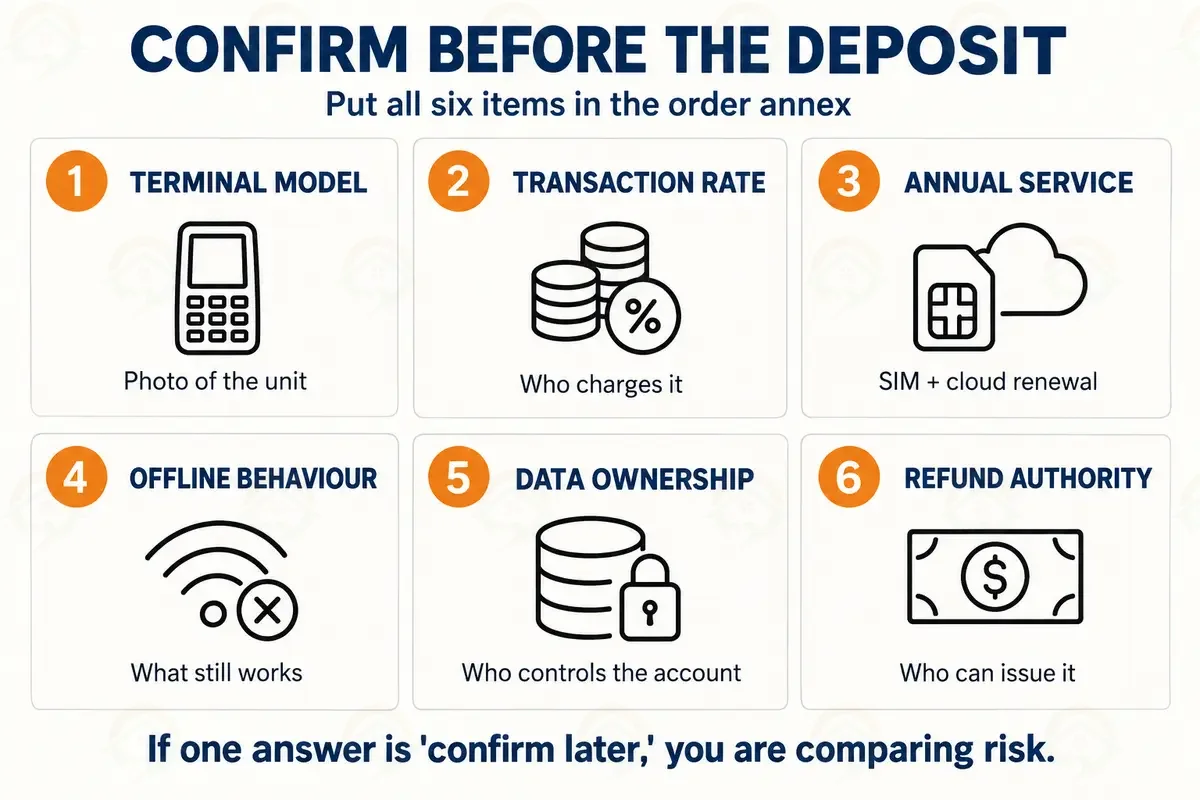
Which payment items belong in the order annex before you pay a deposit?
Six, and all six are cheap to ask now and expensive to argue about later. The transaction rate, and who holds the acquiring contract. The annual SIM and cloud charge per chair, and who renews it.
The terminal model, with a photo of the unit that ships. What the chair does when connectivity drops. Which account the dashboard data belongs to. And who can issue a refund, and how.
The last two are the ones buyers forget, and they are the two a supplier can quietly leave undefined. We would rather you settle them in the order than read a marketing page that pretends they do not exist — if a supplier will not answer them in writing, that is your answer.
Quick audit: is your payment hardware specified, or assumed?
Send the same six lines as one written list before the deposit: the terminal model and a photo, the transaction rate, the annual service charge per chair, and what the chair does when connectivity drops.
Then the two that get forgotten: which account the dashboard data belongs to, and who can issue a refund. If any one of the six comes back as "we will confirm later", you are no longer comparing hardware — you are comparing risk.
Mia
Sweet Home Technical Team
Part of Sweet Home’s in-house technical team. Mia writes our FAQ content — the questions importers, distributors and private-label brands send us, answered with the numbers our production, export and after-sales records use.
Disclosure: Sweet Home is the manufacturer behind the products discussed here. The commercial and field practice described on this page comes from our own order documents and after-sales records, published so buyers can evaluate us before booking a container — where a figure is not yet fixed, this page says so instead of quoting a number we cannot sign.
Want the payment spec before you compare suppliers?
Send us your destination market and the venues you have in mind. We will return the terminal reference, the annual service charge per chair and the dashboard access model in writing, so you can put a number on your monthly cost.
Related product pages
Cashless Payment Vending Massage ChairOEM Commercial Vending Massage Chair