
This is Episode 9.0 of our Massage Chair Component Deep Dive series. Every chair has a kneading motor and a gearbox; the question is not what they are made of, but how well they were specified.
The kneading motor and gearbox are the two parts of a massage chair that buyers never see and feel every single session. They are also the two places where a factory can cut corners that a spec sheet will never reveal.
The Question That Exposes a Bad Supplier
Ask a factory what drives the kneading rollers, and you will hear a marketing answer: "4D mechanism," "intelligent massage program." Ask what motor is inside, what gear material, and how the drive train is protected, and the factories that copy a design go quiet.
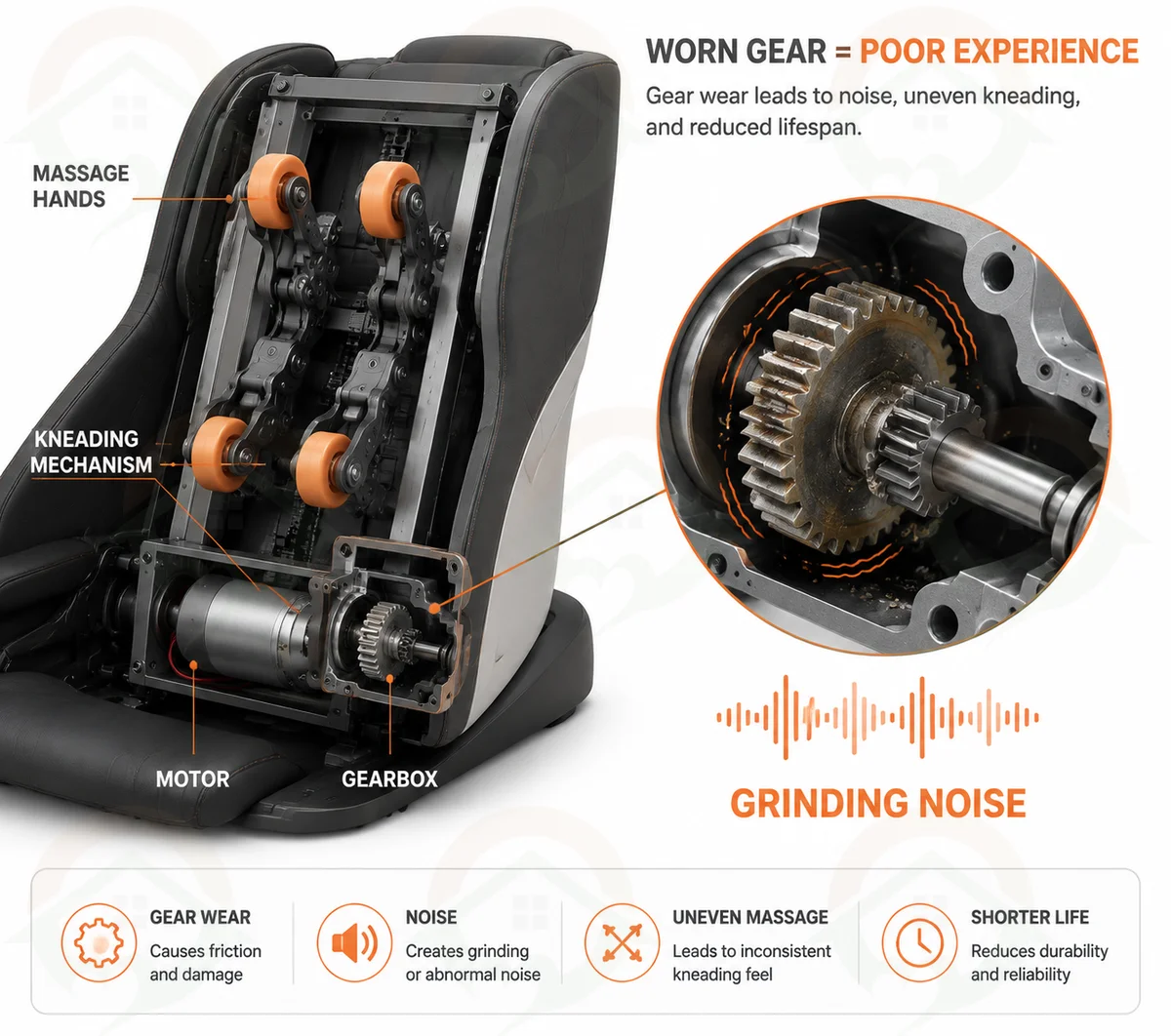
We hear the results of those copied drives in field service. The most common mechanical complaint in our repair logs — and in owner forums — is not "the massage is weak." It is grinding noise.
When a chair comes back with a noisy mechanism, the diagnosis rarely lives in the control board: worn gear teeth, a roller out of alignment, or a gearbox specified for lighter duty than the massage program demands. The mechanism announces the failure in sound long before it fails in function.
None of those failures started on day one. They started with a motor and a gearbox sized and specified for a different product — and that is the story of this episode.
1. The Drive Train: Motor, Gearbox, Rollers
The kneading rollers you feel on your back are the end of a three-stage chain: a small DC motor spins fast, a planetary gearbox reduces that speed and multiplies torque, and an eccentric mechanism converts rotation into the circular motion of the rollers.
Kneading is circular motion. Tapping is vertical impact. Both come from the same motor through different mechanism paths.
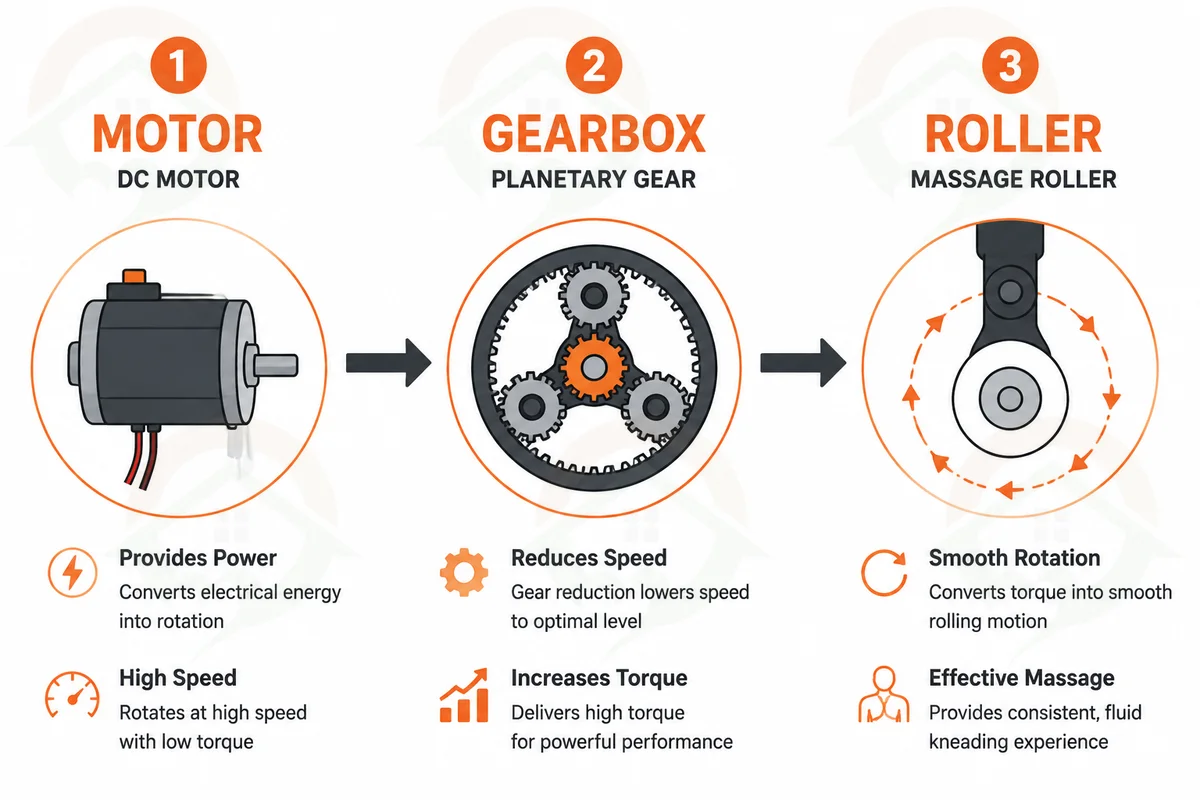
On the motor side, the load profile matters more than the nameplate: a massage program runs 15 to 30 minutes with motors starting, stopping, and reversing hundreds of times — not continuous duty like a fan or a pump. That is why brushed DC is the industry standard for massage chair mechanisms.
It is not a cost shortcut; it is a load-matching decision. Brush wear follows a predictable curve (brush life), the drive reverses with two switching devices and no commutation electronics, and every field technician knows how to test and replace one.
Brushless motors exist as an industrial-grade option for premium programs — they cost two to three times more, and on an intermittent cycle that money buys longevity the mechanism rarely consumes.
2. Why Almost Every Kneading Gearbox Uses Nylon (Not Metal)
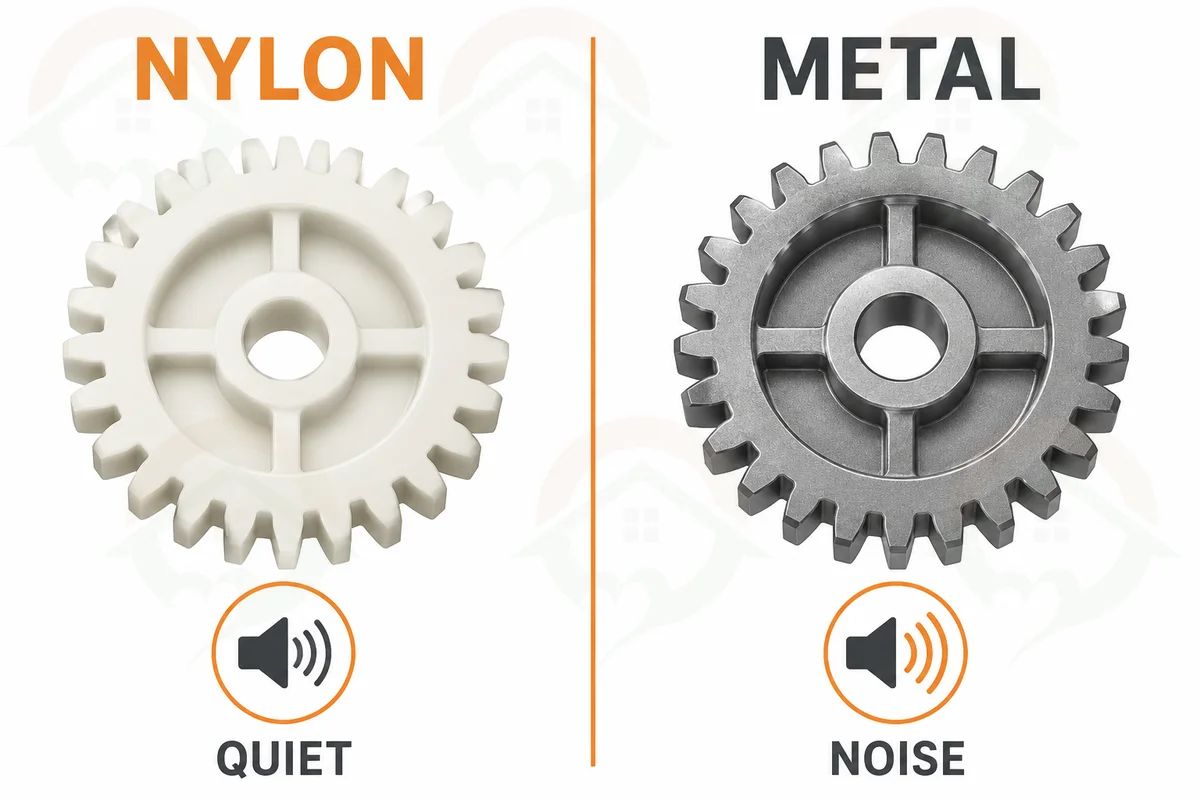
Buyers who have only seen metal gears in automotive ask the same question: "why not metal?" In a kneading mechanism, the honest answer is that metal is the wrong tool — and the industry's mainstream choice is deliberate.
Nylon and POM (polyoxymethylene, the same family as Delrin) gears run self-lubricated, they are quiet, and they absorb shock loads that would chip or crack a metal tooth on an intermittent, impact-heavy drive like kneading.
Metal gears bring their own costs: they need grease that migrates, they transmit more noise into the frame, they are heavier, and for a medium-load mechanism they are over-engineered.
So the real question is never "nylon or metal." It is which nylon, and how well it was made. That is where the engineering happens.
The Real Question: Which Nylon Grade?
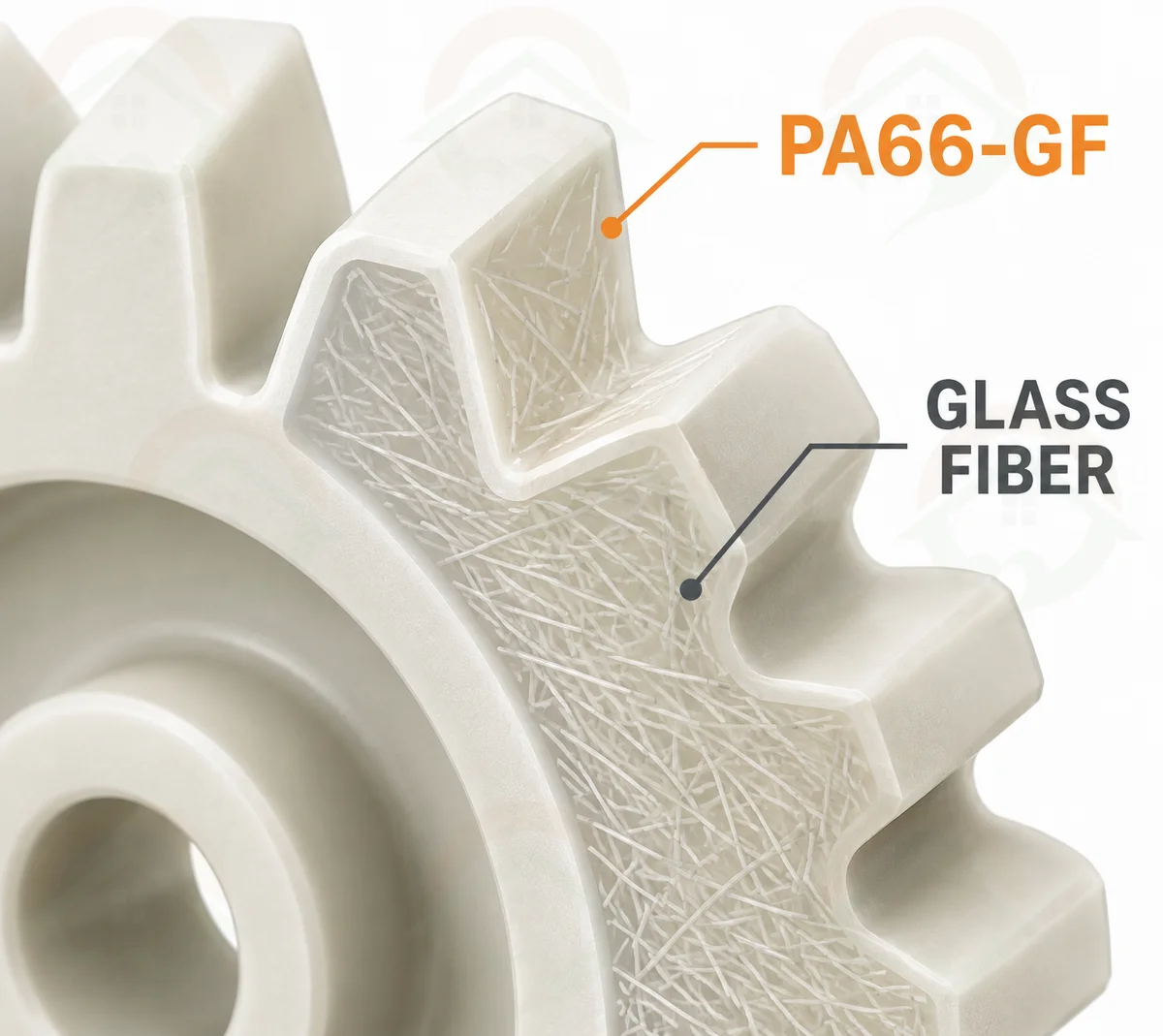
Glass-filled vs plain nylon. PA66 with glass fiber, or POM with the right reinforcement, resists wear and creep far longer than an unfilled nylon. A cheap unfilled gear with a sharp root fails early; the same tooth design in glass-filled PA66 outlasts the chair's rated life.
Molding tolerance. A gear is only as quiet as its tooth form. Loose injection tolerance means tooth profiles that mesh unevenly — and uneven meshing is the root cause of the grinding and clicking buyers report.
Precision molding, verified by inspection, is what separates a quiet gear from a noisy one.
Wear and lubrication formulation. Internal lubricant packages and wear additives extend gear life without maintenance. The resin grade and the drawing are the spec; a factory that cannot show either is buying gears from a catalog by price.
The Failure Chain: Noise First, Slipping Second, Overload Third
Gear wear never fails silently. The first symptom is a change in sound — grinding, clicking, or a pitch that shifts mid-program. Next the rollers hesitate or skip, because worn teeth slip. Finally the stalled load pulls excess current and the motor overheats or trips protection.
Field reports match this order exactly. The "grinding noise" threads on repair forums are gear wear. The "motor burnt out" stories are almost always the last chapter of a gear story that started with noise months earlier.
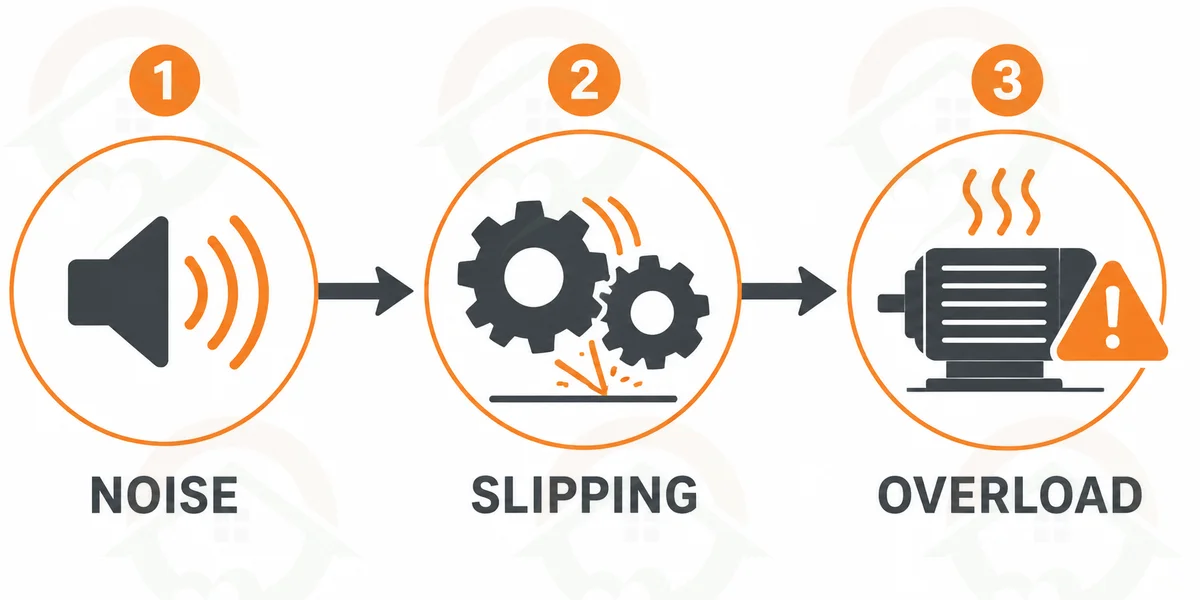
That is why our production line treats gear grade and motor protection as one system, not two components: a gearbox that wears slowly, plus a board that cuts power under overload.
The same protection logic applies to the power chain upstream — see Episode 6: Power Supply Protection and Episode 7.3: Sensing, Limits & Protection.
3. Rated Life Is a Test, Not a Promise
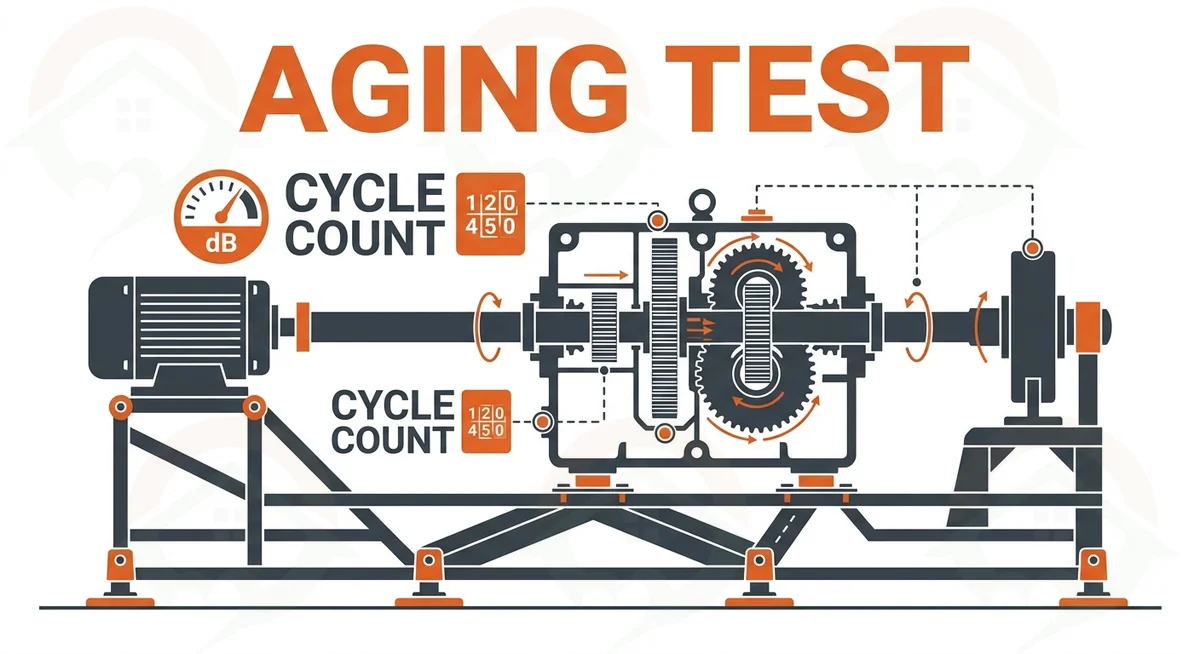
Every factory claims durability. Few can show the test. The industry standard practice is accelerated life testing: running the mechanism through a rated cycle count at elevated duty, then measuring wear, noise, and function against the acceptance limits.
Established brands describe the same approach for their own products.
| Component | What Determines Its Life | What to Ask For |
|---|---|---|
| Brushed motor | Brush grade, running hours, overload protection | Brush material + rated running hours |
| Nylon gear — standard POM | Resin grade, tooth design, load | Material data sheet + drawing |
| Nylon gear — PA66-GF | Fiber content, molding tolerance | Fiber % + drawing tolerance |
4. What to Specify When You Order
A mechanism spec for massage chair procurement should pin down three layers: the gearbox, the motor duty, and the test evidence.
Gearbox: exact nylon grade and whether it is glass-filled, tooth count and module, and the molding tolerance on the drawing.
Motor: duty cycle rating and overload and temperature protection — motor type is secondary once the drive is proven.
Test evidence: an aging cycle report, noise measured in dB, and the protection trip curve.
If a factory cannot produce the drawing and the data sheet for the gear resin, they are buying gears the same way a buyer would — from a catalog, by price. You can find the same quality signal across our full-body massage chair range.
5. FAQ: The Questions Buyers Actually Ask
How long does the gearbox last?
Ask for the aging report, not an estimate.
Isn't a nylon gear the cheap option?
In kneading mechanisms, nylon is the mainstream engineering answer: self-lubricating, quiet, and well matched to medium loads.
Metal is the exception, and it brings noise, grease maintenance, and weight for little benefit in this application. The material is not the shortcut — the grade and the molding are.
My chair started grinding. What does it mean?
It means the gear train is telling you something before it fails. Do not run a grinding mechanism repeatedly — the next stage is slipping, then motor overload.
Should I insist on brushless?
Not by default. Brushed DC is the standard for this load profile, with a predictable wear curve and mature field support.
Brushless makes sense on premium programs where the driver circuit and longer service interval are already budgeted. What matters more than the motor type is duty cycle rating and overload protection.
Why This Is a Sourcing Question, Not Just an Engineering One
None of this appears on the headline spec sheet. A chair with a low-grade gear and no protection will pass every incoming inspection and every showroom demo — and start talking in year two, as noise.
For a B2B buyer evaluating a manufacturing partner, these five questions are a more honest quality signal than a finished-unit demo, because they describe how the chair will behave after the first year of daily use.
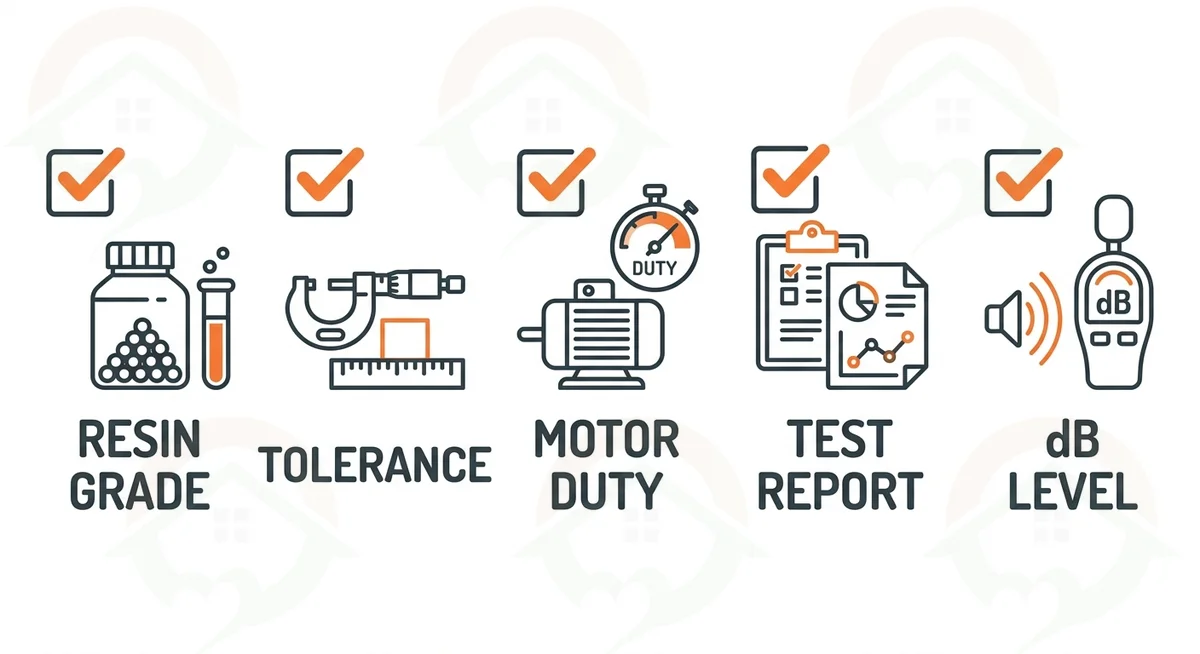
Five-Question Supplier Checklist
| Mechanism Detail | What to Ask a Supplier |
|---|---|
| Gear resin grade | Exact grade (POM, PA66-GF), fiber content, material data sheet |
| Tooth tolerance | Molding tolerance on the drawing, mold source, inspection report |
| Motor duty & protection | Duty cycle rating, overload and temperature cutoff — on motor or control board |
| Brush / rotor spec | Brush grade, commutator material, rated running hours |
| Test report | Aging cycle count, dB measurement, recorded failure modes |
Summary
Stop asking "brushed or brushless, nylon or metal." The questions that decide how long a chair keeps its day-one massage quality are: which nylon grade, what molding tolerance, and does the factory have the aging report to prove it.
Marketing sells the "4D." Engineering sells the grade.
Certification Worth Asking For
In China, the motors and gearboxes we use come from suppliers holding CCC (3C) certification for their motors and wire assemblies — and we ask the same of any mechanism vendor.
A supplier who can produce those certificates alongside an aging-cycle test report is giving you evidence, not adjectives.
Massage Chair Component Deep Dive Series
This is Episode 9.0, the second episode of the mechanism & motion chapter. Read the previous episodes:
Joe Fan
Manufacturing & Product Development Manager · Sweet Home
Sweet Home has manufactured massage chairs since 2013, drawing on in-house R&D and quality control for massage chairs and wellness equipment, with deep expertise in SL track mechanisms, 4D massage systems and zero-gravity ergonomic design.
Disclosure: Sweet Home is the manufacturer behind these chairs, and the service data throughout this series comes from our own repair logs and production line — shared so buyers can recognize these failure patterns before they reach a container.
Quick audit: does your mechanism spec cover the five points above?
1. Nylon grade & fiber content 2. Tooth tolerance 3. Motor duty cycle & overload protection 4. Aging test report 5. dB measurement
Missing more than one? Send us your current mechanism spec and we'll review it against our production line.