
This is Episode 7.4 of our Electrical System Deep Dive series. This one covers the connectors and signal lines that carry every command from the user to the board — previous episodes covered the power supply, control board, firmware, switching and sensing.
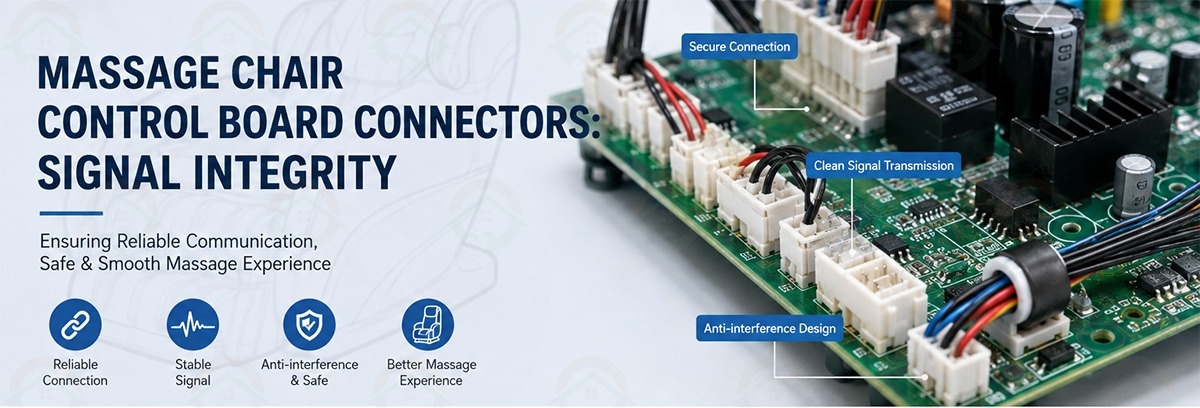
What Bothers Real Owners
A frequent pattern in field reports: the remote's display works, the voice module correctly recognizes a spoken command — a beep confirms it — but the chair only sometimes acts on either one. Replacing the remote doesn't fix it. Replacing the voice module doesn't either.
while a positively locked connector with a strain-relieved cable typically holds stable contact past 10,000 cycles.
Across the harnesses we have returned from field service, the three most common root causes are, in order: connectors not fully seated at assembly, signal lines running parallel to motor wires for more than about 150 mm, and unterminated shield or ferrite protection on long sensor runs.
Two honest qualifications belong next to those numbers.
First, the cycle figures are typical ranges, not guarantees: actual results shift with connector class, plating, and the vibration profile of each model, which is why we test every new harness build against IPC-A-610 acceptance criteria before it goes to production.
Second, the field-service ranking reflects the service log we keep on returned units, not an industry-wide study — it tells you where our own failures concentrated, and it has directly driven design changes in later harness generations.
A buyer who wants proof instead of claims should ask any shortlisted factory for two documents: their connector and harness test report (vibration, pull force, and contact resistance data), and their IPC-A-610 process-control records for the line that builds your model.
A factory that cannot produce either on request is asking you to take the reliability argument on faith — and for a chair that will fold, recline, and vibrate daily for years, faith is not a
specification.
for the line that builds your model. A factory that cannot produce either on request is asking you to take the reliability argument on faith — and for a chair that will fold, recline, and vibrate daily for years, faith is not a specification.The actual fault often isn't a component failure at all. It's a connector that's walked slightly loose from months of vibration and reclining motion, or a signal line running close enough to a motor or transformer that electrical noise is corrupting the command before it ever reaches the board.
What's Actually Inside
1. Connector Reliability Under Real Mechanical Stress
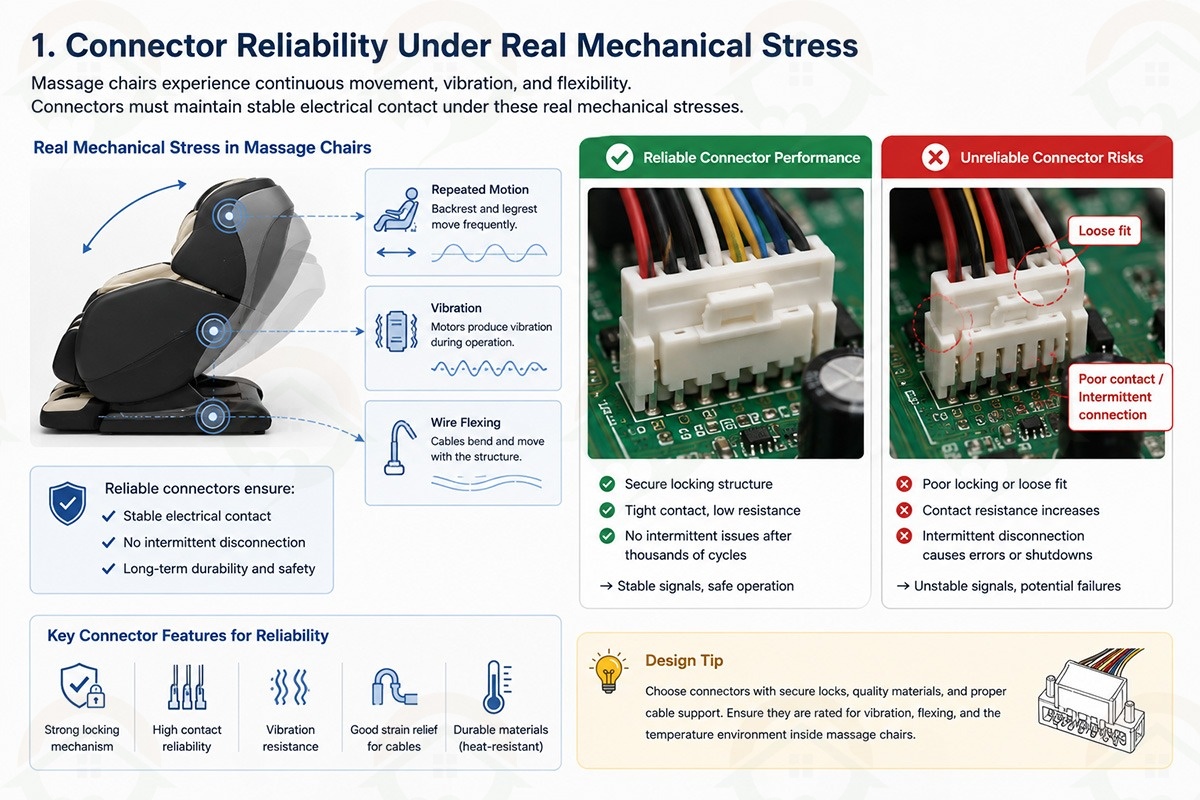
Every motor, sensor, and light in the chair plugs into the main board through a connector, and connector quality is one of the most overlooked cost-cutting points in a budget design. A simple friction-fit connector without a locking tab works perfectly on the day the chair is assembled.
It's the years of motor vibration and the repeated flexing every time the chair reclines and returns upright that gradually walk a friction-fit connector loose.
This is one detail worth specifying rather than assuming: locking connectors alone reduce the risk.
Locking plus a secondary fix — connectors seated into their locking tabs and then secured with adhesive during assembly — closes the gap that vibration alone can still open on a lock-only design over years of use.
The lock alone is a step up from friction fit; the adhesive is what closes the residual gap. The electronics industry's own acceptance criteria — see IPC-A-610 — treat connector seating as an inspectable quality point, not an assembly-time hope.
Months after assembly, a friction-fit-only harness shows up as “the calf massager works sometimes but not other times” — a symptom that tends to get blamed on the whole harness or the whole motor.
The actual fault is a connector that was never secured to survive sustained real-world vibration.
| Failure Mode | What You Observe in the Field | Design Countermeasure |
|---|---|---|
| Friction-fit connector walks loose | Remote works sometimes after months of reclining use; nothing fails outright | Locking connector with positive latch, secondary adhesive or clamp |
| Signal line routed beside power line | Voice command recognized (beep) but chair ignores it intermittently | Separate routing, ground plane or guard trace, ferrite bead on harness |
| Contact resistance rise from corrosion | Intermittent sensor values in humid climates; errors on position feedback | Gold-plated or tin-plated terminals rated for the environment; sealed housings |
| Wire fatigue at connector exit | Open circuit develops after thousands of flex cycles at backrest pivot | Strain relief, minimum bend radius, harness routing away from pivots |
2. Signal Lines vs. Power Lines: Why Layout Matters
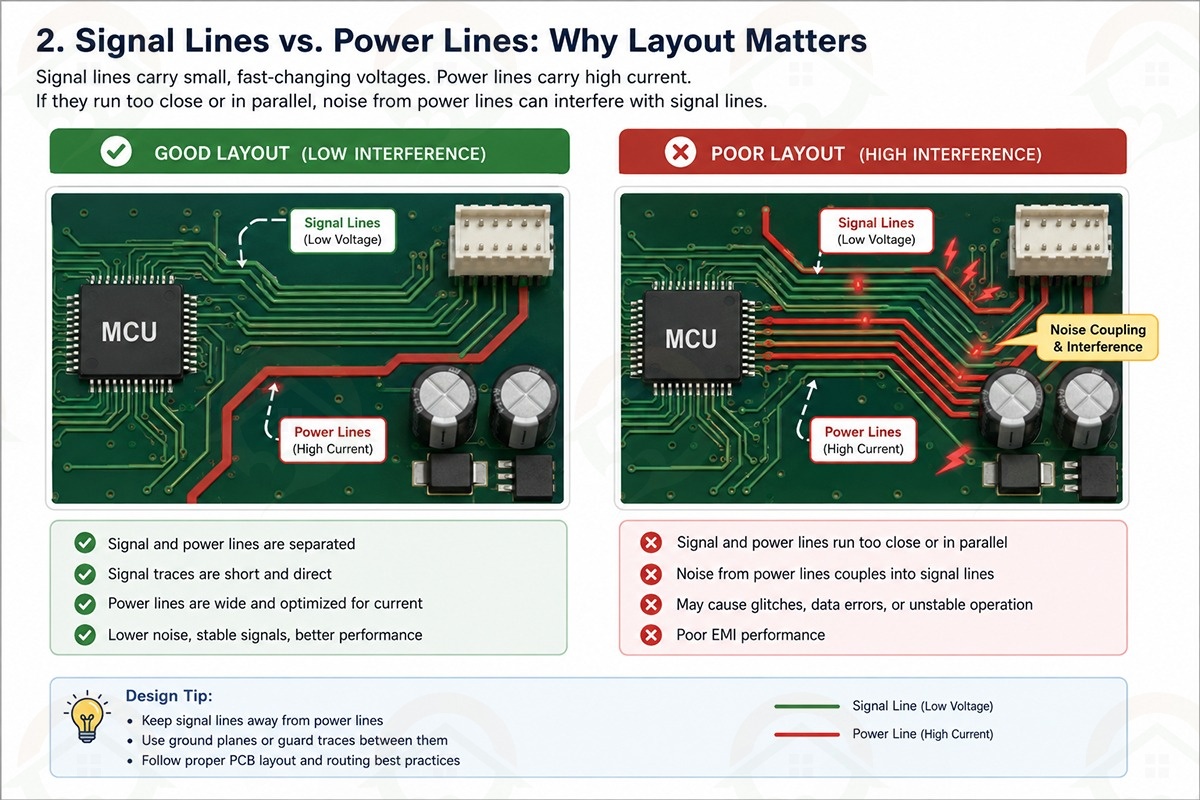
Low-voltage signal lines — carrying button presses, voice-module data, and sensor readings — are far more sensitive to electrical noise than the higher-voltage lines driving motors and heating elements.
When a signal line is routed too close to a motor drive line or the transformer, electromagnetic interference can corrupt or delay the signal reaching the MCU.
This is a layout decision made at the design stage, not something that can be fixed after the harness is already built.
Keeping low-voltage signal wiring physically separated from power and motor lines — rather than running them side by side to save space — is what keeps a command from getting corrupted in transit.
A design that skips this separation produces exactly the intermittent, hard-to-reproduce “sometimes doesn't respond” pattern that's difficult to diagnose after the fact, because the remote and the board both tested fine in isolation.
A harness built to that logic holds up to both safety review and noise immunity.
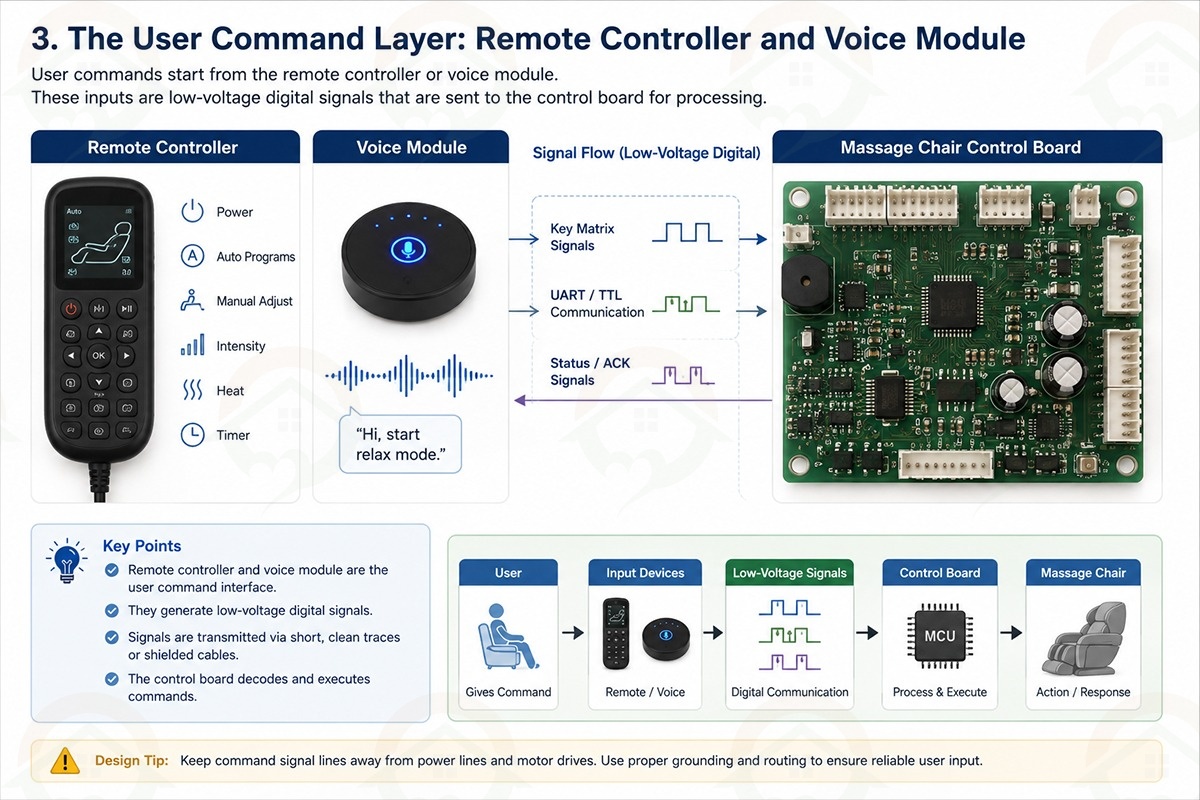
3. The User Command Layer: Remote Controller and Voice Module
Two different interfaces exist for the same purpose — turning a user's intent into a command the board acts on. The remote controller is the wired hand-held control most users reach for first.
The voice module is a separate subsystem that listens for spoken commands and, once it recognizes one, sends the board the same kind of command signal the remote would.
Because both ultimately feed the board through low-voltage signal lines, both are exposed to the same two risks described above: a connector that's worked loose, or a signal path running too close to a noise source.
This is why “the remote works but the chair doesn't always respond” and “the voice command was recognized but nothing happened” are, underneath, frequently the same failure showing up through two different interfaces.
How the voice module physically attaches also matters for the long run. A voice module connected through a standard signal-bus interface can typically be added, replaced, or upgraded later without touching the rest of the board design.
One that's wired in as a one-off addition tends to require a broader redesign the moment a buyer wants a different voice-recognition vendor or an added language.
Why This Matters More Once You're Exporting
4. Signal Integrity: What It Means in a Massage Chair
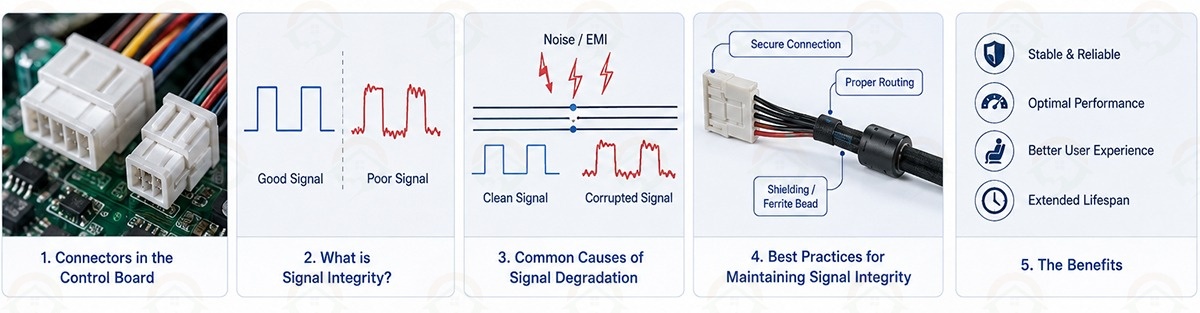
Signal integrity is how cleanly a command travels from the controller to the motor driver without noise, attenuation, or cross-talk corrupting it. In a massage chair control board, poor signal integrity shows up as a lagging roller, an intermittent voice command, or a motor that stutters under load.
It is rarely a dramatic failure — which is exactly why it is hard to catch in a showroom demo.
Two design choices decide most of it: keeping signal lines away from power lines (Section 2), and terminating connectors correctly at both ends. When we measure signal integrity during QC, we check the whole path — board trace, connector, harness, motor driver — not just one component.
| Consideration | Why It Matters for B2B Buyers |
|---|---|
| Locking connectors, secured after assembly | Prevents the “works sometimes” pattern that's expensive to diagnose once a chair is already with an end customer |
| Signal/power line separation | Determines how reliably the remote, voice module, and sensors report back, especially in units with higher-torque motors |
| Remote and voice as independent command paths | Both are exposed to the same connector and interference risks — worth confirming both were tested under the same conditions, not just the remote |
| Standardized voice-module interface | Lets a different voice vendor, added language, or upgraded module be swapped in later without a full board redesign |
Three Questions Every B2B Buyer Should Ask Their Supplier
- Are connectors on high-vibration circuits locking-type, and are they secured further (for example, with adhesive) after assembly — not just seated and left?
- How are signal lines physically separated or shielded from motor and power lines in the harness layout?
- Can the voice module be added, replaced, or upgraded independently of the main board, or does any change require a full redesign?
Pro tip: Copy these three questions into your next supplier email. Specific answers with real design detail — not general reassurance — tell you whether you're talking to an engineering team or a sales team relaying someone else's answers.
Summary
“The remote works, but the chair doesn't always respond” and its newer sibling, “the voice command was heard but nothing happened,” are among the most misdiagnosed complaints in this whole system, because the obvious suspects — the remote, the voice module — are usually fine.
The real cause sits in two places that are invisible from the outside: how securely a connector stays seated under years of vibration, and how well signal lines are protected from the electrical noise generated by the motors sitting right next to them.
Electrical System Deep Dive Series
Joe Fan
Manufacturing & Product Development Manager · Sweet Home
Sweet Home has manufactured massage chairs since 2013, drawing on in-house R&D and quality control for massage chairs and wellness equipment, with deep expertise in SL track mechanisms, 4D massage systems and zero-gravity ergonomic design.
Disclosure: Sweet Home is the manufacturer behind these chairs, and the service data throughout this series comes from our own repair logs and production line — shared so buyers can recognize these failure patterns before they reach a container.
Quick audit: is your connector spec complete?
1. Locking connectors, not friction-fit? 2. Signal lines separated from power lines? 3. Test data available on request?
Two or more unchecked? Send us your current spec.