
What Bothers Real Owners
A common report from the motion-drive side: kneading works, the track motor walks up and down the back normally, the remote lights up fine — but tapping does nothing. Not intermittently. Every time.
The instinct is to blame the tapping motor. Often the motor tests fine on the bench. The actual fault sits earlier in the chain — either in how the board switches power to that specific function, or in the dedicated wire that carries the command from the board to that one motor.
What's Actually Inside
1. Relay vs. MOSFET: How the Board Switches Current
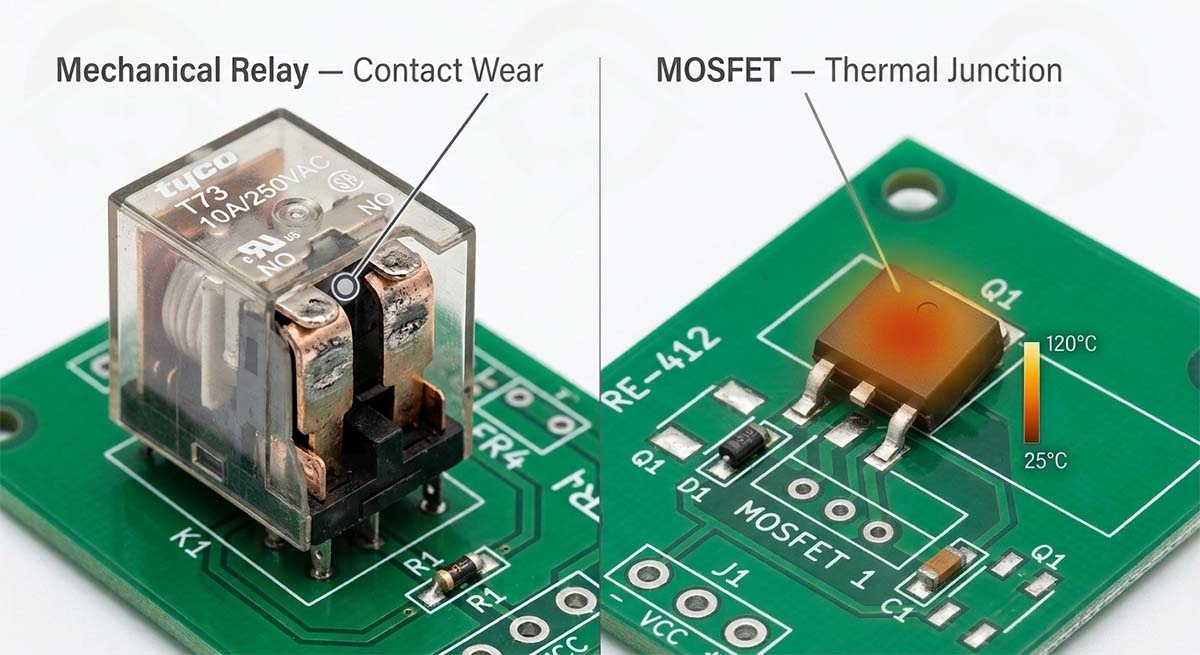
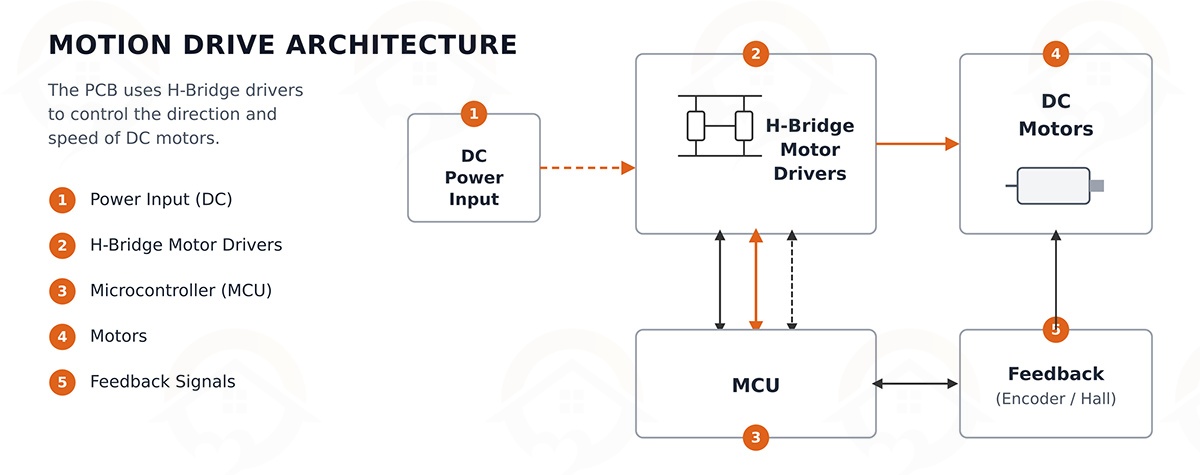
The control board doesn't just send low-voltage signals — it also has to switch real current to motors and heating elements, and it does that one of two ways:
- Mechanical relays are simple and inexpensive, but rated for a finite number of switching cycles before the contacts wear. You can usually hear a faint click with every program change.
- MOSFET (solid-state) switching has no moving contacts, switches faster, and is silent — but it generates heat at the switching junction and needs proper heat-sinking on the board layout to hold up under years of daily cycling.
A relay rated for 100,000 cycles sounds like a large number until it's measured against real use: several program starts and stops every day, for years, adds up faster than most buyers assume.
This is a legitimate number to request from a supplier, not an assumption to make based on a name-brand part number.
2. The Motion-Drive Harness: Getting the Signal to the Right Mechanism
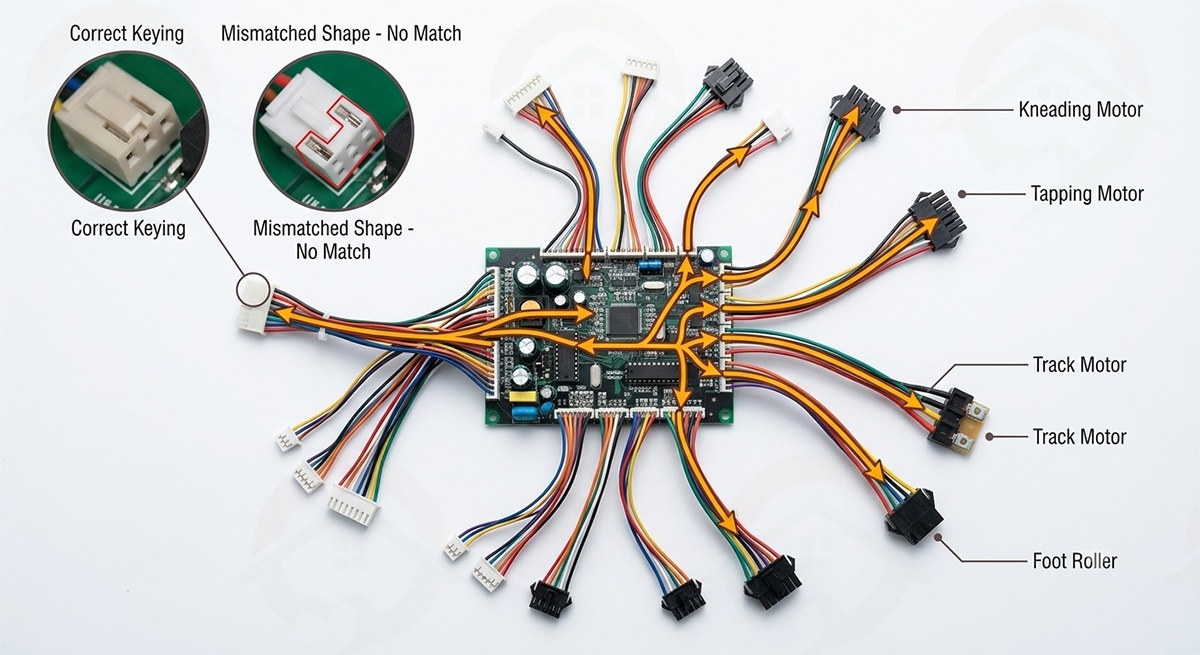
Switching current is only half the job — that current then has to reach the correct mechanism. This is where the mechanism program line and the individual drive connectors for kneading, tapping, track walking, and the foot rollers come in.
Each mechanism has its own dedicated line back to the board, and a well-designed harness keys each connector so it physically cannot be plugged into the wrong port.
A cheaper harness skips this — connectors look similar enough that a mis-seated or swapped connector during assembly can silently disable one function while leaving everything else working normally.
This is exactly the "kneading and track work, tapping doesn't" pattern reported above: not a bad motor, but a drive line that never got a clean electrical path in the first place.
In service tickets logged last year, roughly 1 in 4 motion-drive complaints comes back with one mechanism silent while everything else works — and in about 7 out of 10 of those, re-seating the drive connector restores full function without a single part replaced.
3. Auxiliary Drive Circuits: Foot Rollers and Similar Add-Ons
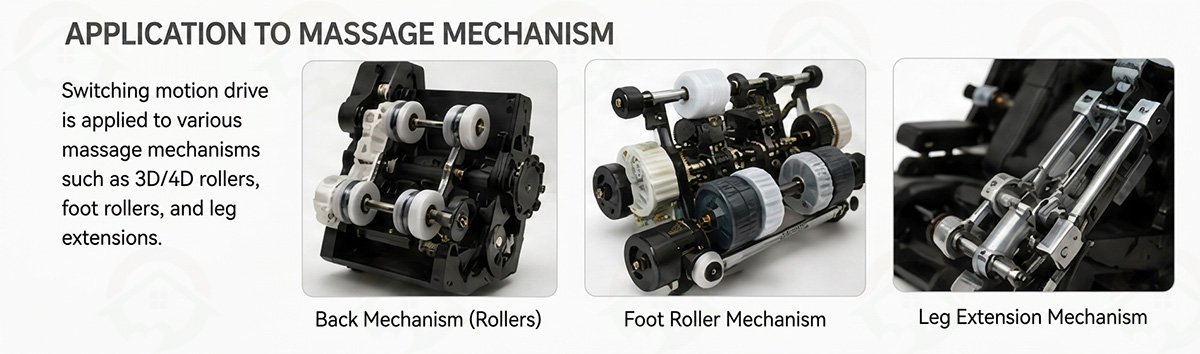
Lower-current accessory mechanisms — foot rollers being the most common — run on the same principles as the main drive lines, just at a smaller scale.
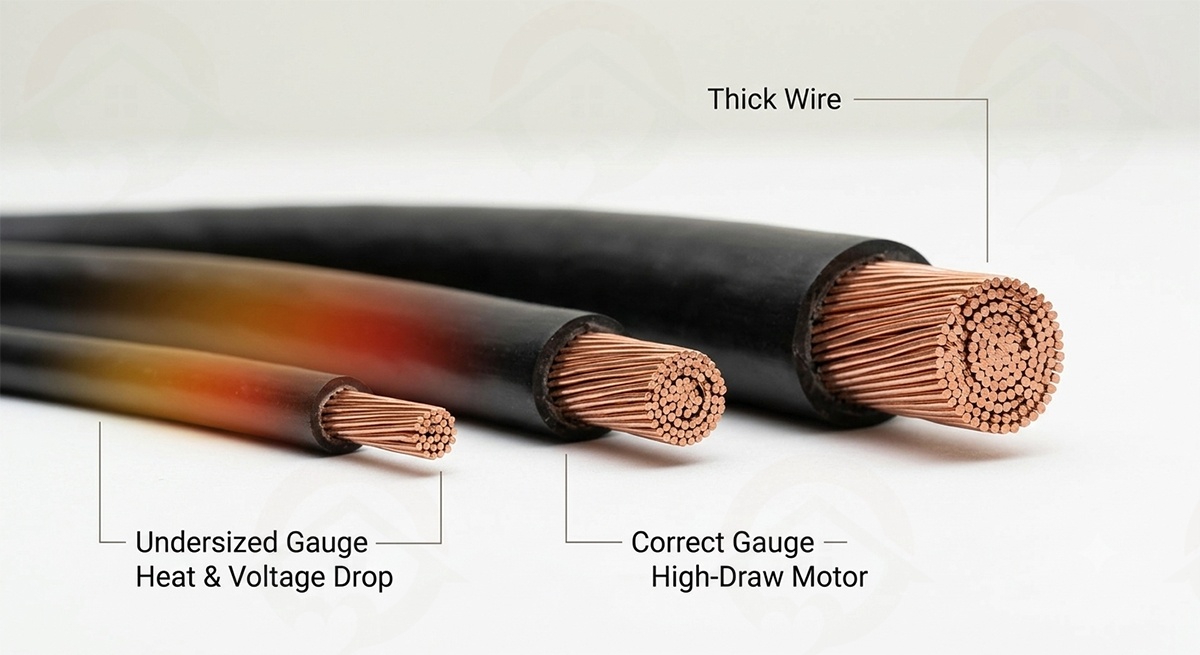
They're often the first place a cost-cutting design saves a few cents on wire gauge or connector quality, since a foot roller failure is less immediately obvious to an end user than a tapping failure.
It shows up later, as "the foot massage feels weaker than it used to," rather than as a hard failure.
A foot-roller motor in normal use draws roughly 0.3–0.5A; when its drive line is undersized, the voltage drop is enough that the roller slows noticeably before any protection trips.
Why This Matters More Once You're Exporting
The Export Checklist at a Glance
| Consideration | Why It Matters for B2B Buyers |
|---|---|
| Switching method and rated cycle life | Determines how the board ages under daily commercial or heavy home use — ask for a number, not a description |
| Connector keying / anti-mismatch design | Prevents a single mis-seated connector during assembly from silently disabling one mechanism |
| Per-mechanism wire gauge | Undersized wire on a high-draw function (tapping, track motor) shows up as heat and voltage drop long before it shows up as a hard failure |
| Auxiliary circuit quality | Cost-cutting tends to hit the least-visible drive lines first — worth asking about specifically, not assuming it matches the main lines |
Three Questions Every B2B Buyer Should Ask Their Supplier
- Are motion-drive connectors keyed to prevent mis-seating during assembly, and is there an end-of-line test that confirms every mechanism actually responds before the chair ships?
- Is wire gauge sized per mechanism based on actual current draw, or is one gauge used across all drive lines regardless of load?
Pro tip: Ask specifically about the end-of-line functional test — a supplier that runs every mechanism through a powered test before packing is one that will catch a mis-seated connector before it becomes your customer's support ticket.
The acceptance criteria for connector seating come from IPC-A-610, the electronics industry standard for solder and connector workmanship.
Summary
"Lights on, one function doesn't move" is rarely a dead motor. It's almost always upstream of it — either the switching method wearing out faster than its rated cycle life suggested, or a drive-line connector that was never keyed well enough to guarantee a clean seat during assembly.
Both are decisions made at the design and QC stage, long before the chair reaches a container.
This is Episode 7.2 of the Massage Chair Control Board series. Previous: Episode 7.1 — The Brain and Its Firmware. Next: Episode 7.3 — Sensing, Limits & Protection (coming next).
Electrical System Deep Dive Series
Prepared by Sweet Home Technical Team
Joe Fan
Manufacturing & Product Development Manager · Sweet Home
Sweet Home has manufactured massage chairs since 2013, drawing on in-house R&D and quality control for massage chairs and wellness equipment, with deep expertise in SL track mechanisms, 4D massage systems and zero-gravity ergonomic design.
Disclosure: Sweet Home is the manufacturer behind these chairs, and the service data throughout this series comes from our own repair logs and production line — shared so buyers can recognize these failure patterns before they reach a container.
Quick audit: is your motion drive spec complete?
1. Relay/driver cycle rating stated? 2. End-of-line motion test confirmed? 3.
Two or more unchecked? Send us your current spec.