
What Bothers Real Owners
A recurring pattern in our firmware service logs: a massage chair runs a full program normally for several minutes,
one roller briefly catches against a thicker cushion or a folded blanket, and then — the whole chair stops responding. Not just that one motor. The display freezes, the remote stops registering button presses, and the only fix is unplugging the chair and starting over.
The motor itself was never damaged. What actually happened is that the firmware didn't know how to handle a single unexpected input, and it took the rest of the board down with it.
We see this pattern often enough in our own service data that it has a name internally: a "lit-display freeze.
" Across control-board tickets logged last year, roughly 1 in 5 came back with the display still on but the chair unresponsive — and in about 8 out of 10 of those, the fix was a full power cycle, not a replacement part.
That ratio is the fingerprint of a firmware fault-handling gap: hardware was fine, software just didn't know how to recover.
What's Actually Inside
1. The MCU: A Simple Job, Executed Constantly
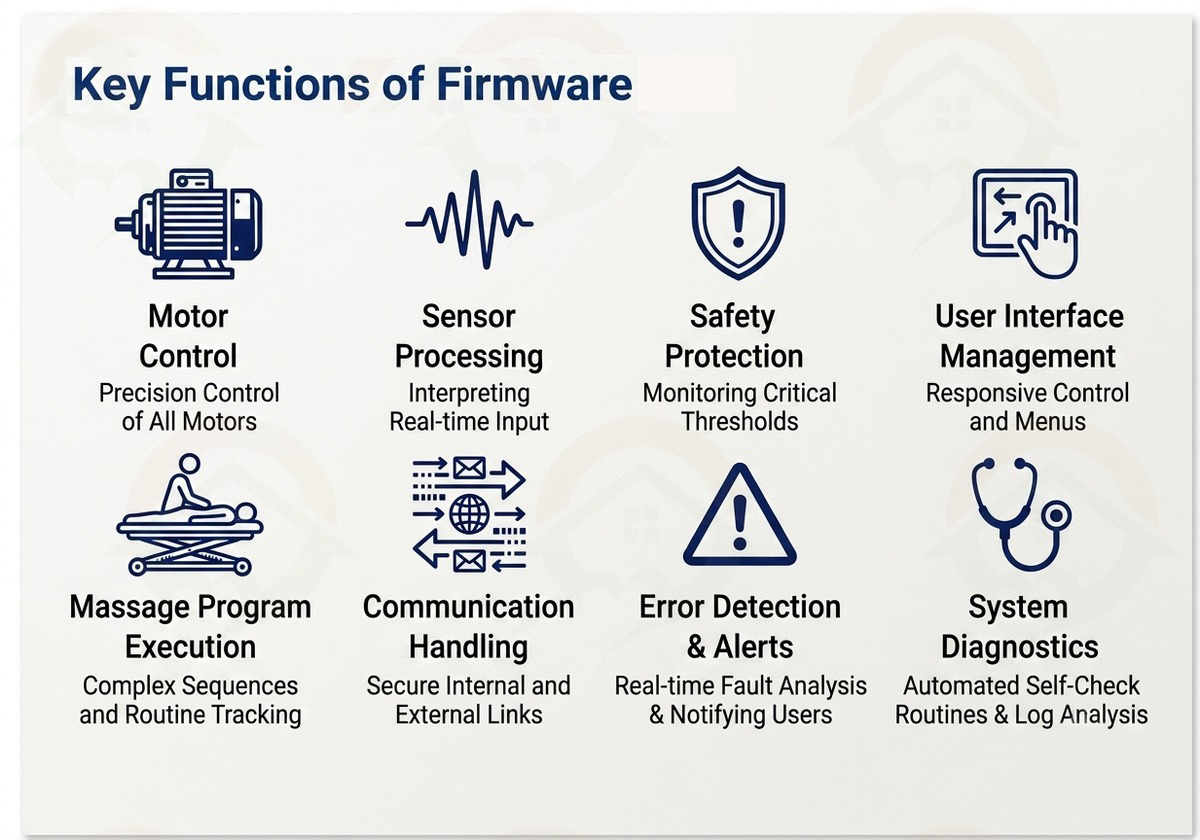
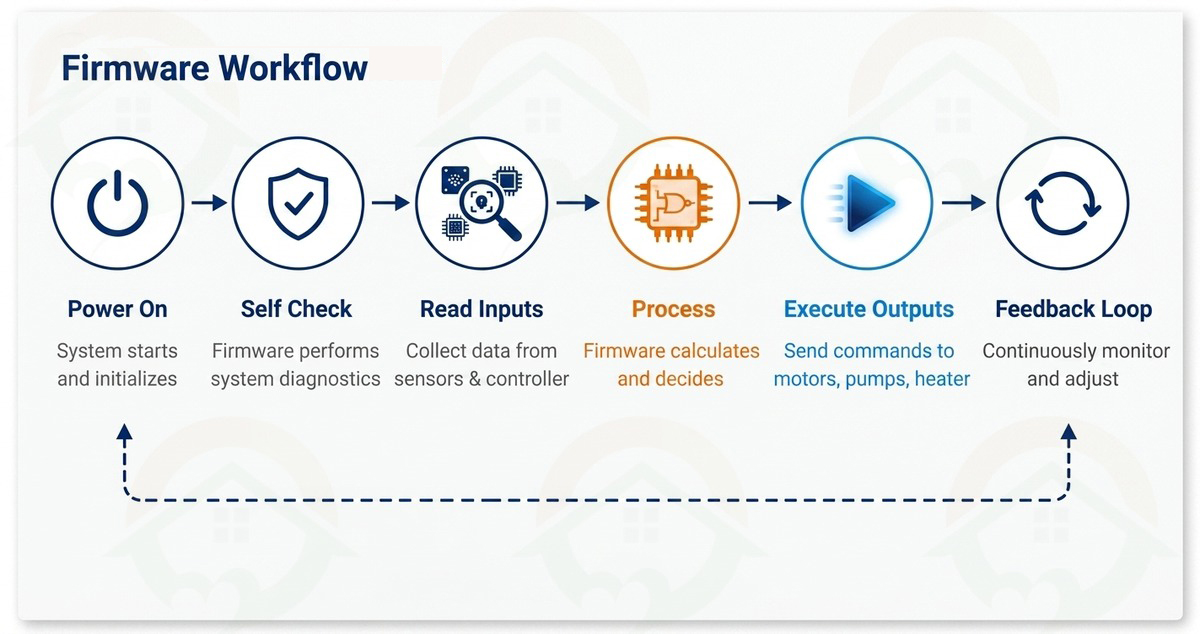
The microcontroller's job is not complicated to describe: read every button press, keep time on each stage of a massage program, and tell the right motor or airbag to fire at the right moment. It does this dozens of times per second, continuously, for as long as the chair is powered on.
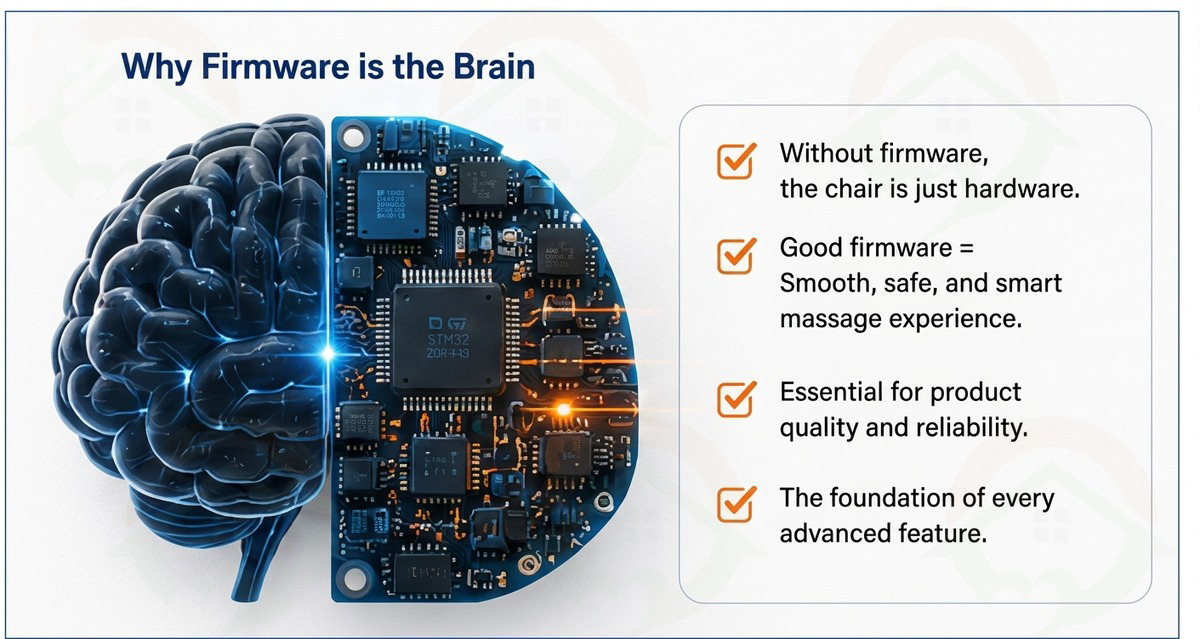
The chip itself is rarely the weak point in a design — MCUs from reputable suppliers — STMicroelectronics being a typical source are commodity parts with well-documented reliability. The firmware written for that chip is where quality actually diverges between suppliers.
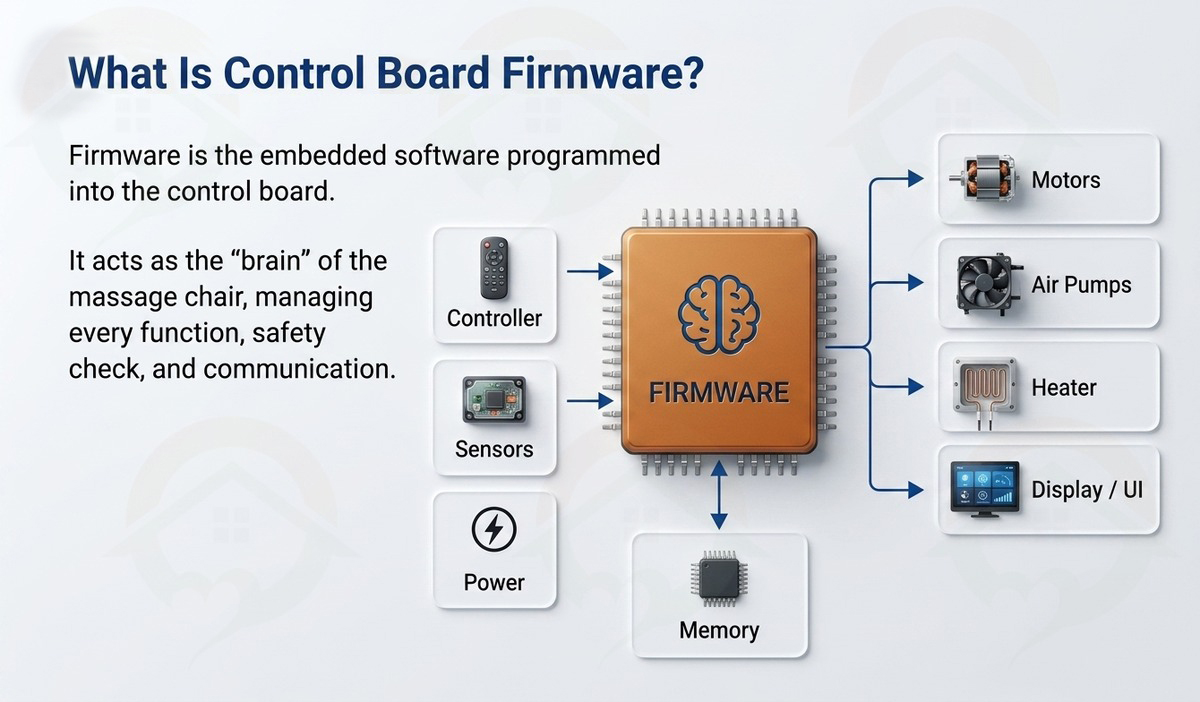
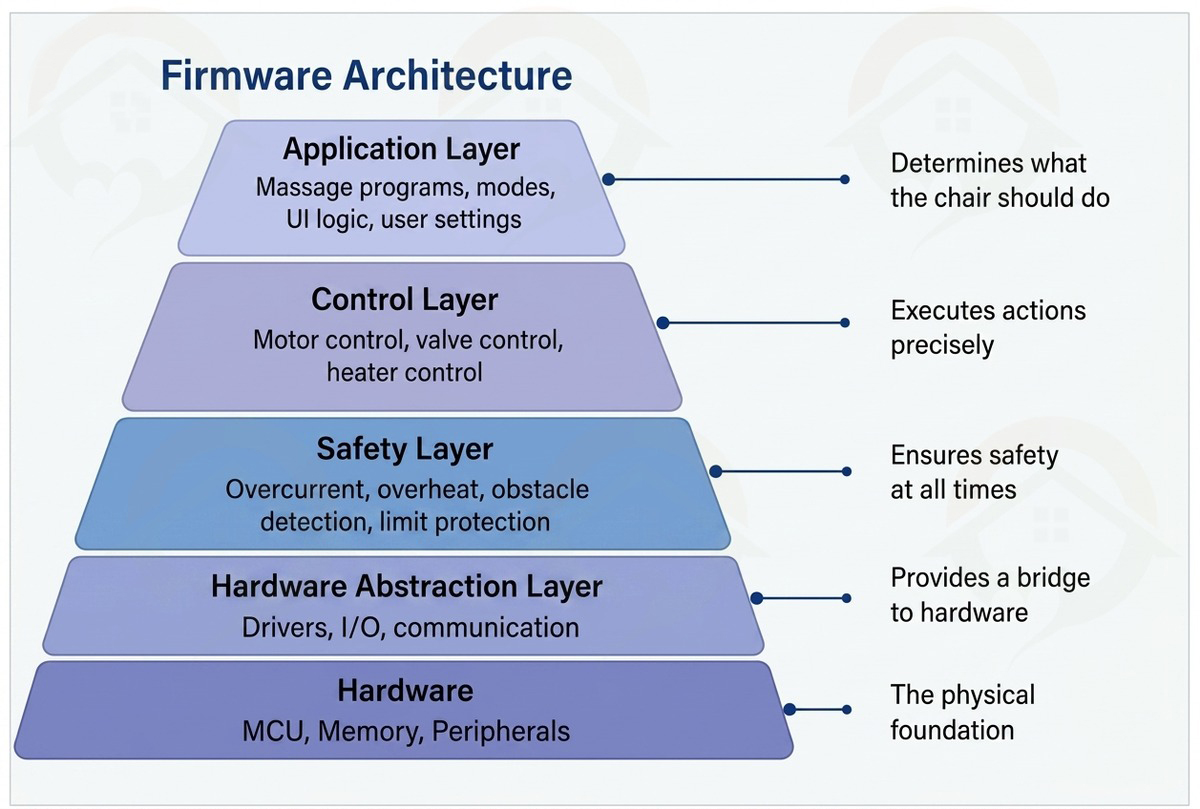
Firmware gets into that chip in one of three ways: UART flashing on the production line, a USB update for field service, or an OTA / app update on chairs with connectivity.
Which method a supplier supports matters more than it sounds — it decides how a firmware fix reaches chairs already sold under your label.
2. Fault Handling: The Difference Between "Logged" and "Locked Up"
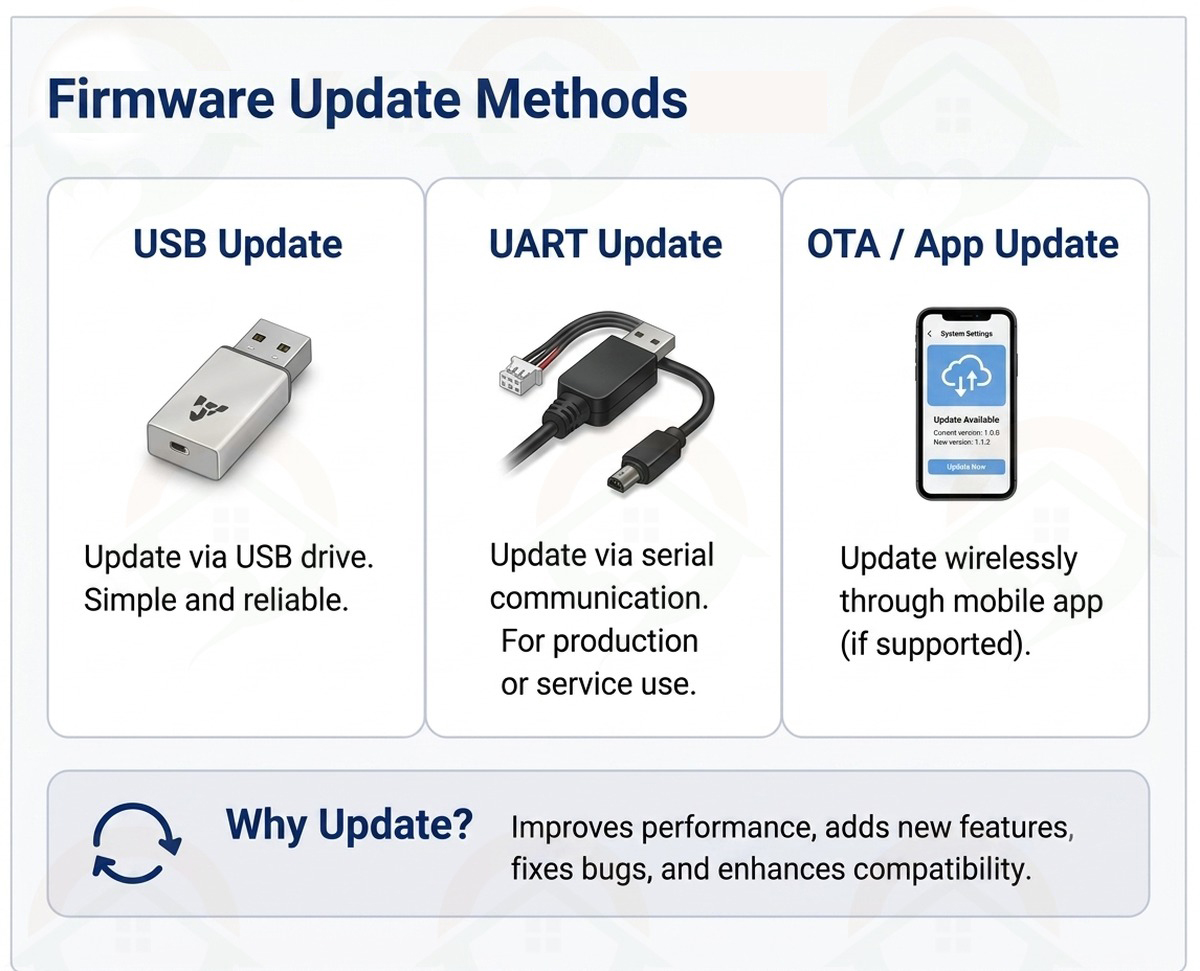
Every chair, in real use, eventually produces a small anomaly the engineers didn't originally plan for: a roller motor meets more resistance than expected, an airbag takes an extra second to reach pressure, a sensor briefly reports a reading outside its normal range.
Firmware that monitors current and backs off within that window logs the event and keeps the program running.
Firmware without current monitoring simply keeps commanding the motor — the supply sags, the MCU's control loop loses its timing, and the whole board locks up over what was a one-time mechanical snag.
Well-written firmware treats this as a data point — it logs the event, backs off or retries the affected component, and lets everything else keep running.
Firmware without exception handling has no such defense; a single unexpected value can cause the control loop to stall, and the owner experiences that as "the entire chair broke," when the actual failure was a few lines of missing exception-handling code.
This is the single biggest quality gap between a firmware build written by an experienced electronics team and one adapted quickly from a reference design.
3. Firmware as the OEM Customization Layer
For export buyers, firmware isn't only about reliability — it's also where private-label identity gets built in:
- Display language and on-screen text
- Remote control button labels and icon sets
- Program names and preset sequences
- Boot-up logo and startup sequence
It's far cheaper to plan for during the quoting stage than to request after tooling and firmware builds are already locked.
Why This Matters More Once You're Exporting
The Export Checklist at a Glance
| Consideration | Why It Matters for B2B Buyers |
|---|---|
| Fault-handling maturity | Determines whether a single stalled motor takes down the whole chair, or gets logged and bypassed automatically |
| Firmware localization | Display language, remote labeling, and program names need to match the destination market — a real request, not a checkbox |
| Boot logo & branding | Small cosmetic details that carry outsized weight in how "custom" a private-label chair actually feels to the end buyer |
| Version documentation | If firmware isn't documented and versioned, diagnosing a fault reported from the field months later becomes guesswork |
For export, firmware behavior sits inside the broader safety framework: the control board must keep the chair safe under abnormal conditions,
Three Questions Every B2B Buyer Should Ask Their Supplier
- How does the firmware handle an unexpected sensor reading or a stalled motor — does it log and continue, or does it require a full power cycle to recover?
- Is firmware version-tracked across production batches, so a fault reported from the field can be matched to a known build rather than diagnosed from scratch?
Pro tip: Ask for a short written answer to question 1 specifically. A supplier who can describe their fault-handling approach in concrete terms — not just "it's stable" — is one whose engineering team actually wrote the firmware rather than adapted it from an unmodified reference design.
Summary
A frozen display and a genuinely dead chair look similar to an end user, but they come from very different places. The MCU almost never fails on its own; the firmware running on it is what decides whether a small, normal glitch stays small, or takes the whole chair down with it.
It's also the layer where a supplier turns a generic reference design into something that actually carries a buyer's brand.
This is Episode 7.1 of the Massage Chair Control Board series. Start from Episode 7.0 — Overview for the full diagnostic map, or continue to Episode 7.2 — Switching & Motion Drive (coming next).
Electrical System Deep Dive Series
Prepared by Sweet Home Technical Team
Joe Fan
Manufacturing & Product Development Manager · Sweet Home
Sweet Home has manufactured massage chairs since 2013, drawing on in-house R&D and quality control for massage chairs and wellness equipment, with deep expertise in SL track mechanisms, 4D massage systems and zero-gravity ergonomic design.
Disclosure: Sweet Home is the manufacturer behind these chairs, and the service data throughout this series comes from our own repair logs and production line — shared so buyers can recognize these failure patterns before they reach a container.
Quick audit: is your firmware spec complete?
1. Firmware update path (USB/OTA) stated? 2. Field-updateable firmware? 3. Error logging and self-diagnostics supported?
Two or more unchecked? Send us your current spec.