
This is Episode 7.3 of our Electrical System Deep Dive series on sensing, limits and protection — the layer that turns raw sensor data into safe operation.
Previous episodes covered the power supply, the control board, firmware, and switching; this one covers the sensing layer — body scan, position limits, temperature monitoring, and the coating that protects all of it.
What Bothers Real Owners
Two complaints that look unrelated usually trace back to the same part of the board.
The first: "The massage never quite lands in the right place — the rollers hit my neck when they should be on my shoulders." The user assumes it's a bad program. Often, it's that the chair never actually measured their body in the first place.
The second: months into normal use, a track mechanism starts grinding faintly at the very top or bottom of its travel, right before it reverses direction. The user assumes the motor is wearing out.
Often, the motor is fine — the board simply never had a working cross-check between the two separate ways it's supposed to know where the mechanism is.
Both point to the same subsystem: the sensing and limit-detection wiring that tells the board what the mechanism is touching and where it's positioned, before the "brain" (Episode 7.1) decides what to do next.
What's Actually Inside
1. Body-Scan Sensing: The Detection Line
Before a program starts, a properly designed chair runs a quick vertical scan to find the user's shoulder and lower-back position — this is what the detection line actually carries: real-time signal from the body-scan sensor, not a generic "is everything plugged in" self-check.
This matters more than it sounds. A massage program is written assuming it knows where a back actually is. Feed it accurate body-scan data, and the same program lands correctly on a 165cm user and a 190cm user.
Feed it nothing — because the board skipped the scan or the detection line isn't wired to a real sensor — and the chair falls back to a fixed, one-size-average program that lands correctly on whoever the factory used to test it, and slightly wrong on everyone else.
This is very often the real cause behind "the massage feels off," long before anyone questions the mechanism itself.
Not every board actually does this. Some economy designs advertise "auto body scan" in the spec sheet while running a fixed-position program underneath — the detection line either isn't present or isn't feeding a real sensor.
It's a genuinely useful thing for a buyer to verify rather than assume from marketing copy. 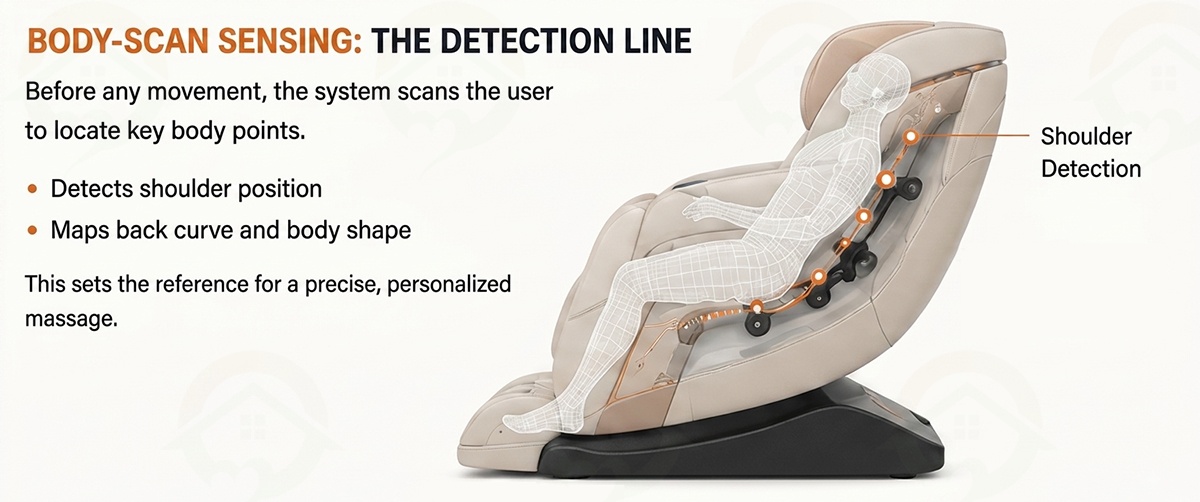
2. Position Control: Two Systems That Back Each Other Up
Once a program is running, the board needs to know where the mechanism sits on the track — and a well-designed board gets this from two independent sources, not one:
- The signal line is a rotation counter on the mechanism's up/down drive motor — every revolution the motor turns is counted, and the board converts that count into the mechanism's position, the same way an odometer converts wheel rotations into distance. In practice this is reliably accurate: it doesn't build up meaningful error over the course of normal use, and it's reset to zero every time the chair power-cycles, so nothing carries over between sessions.
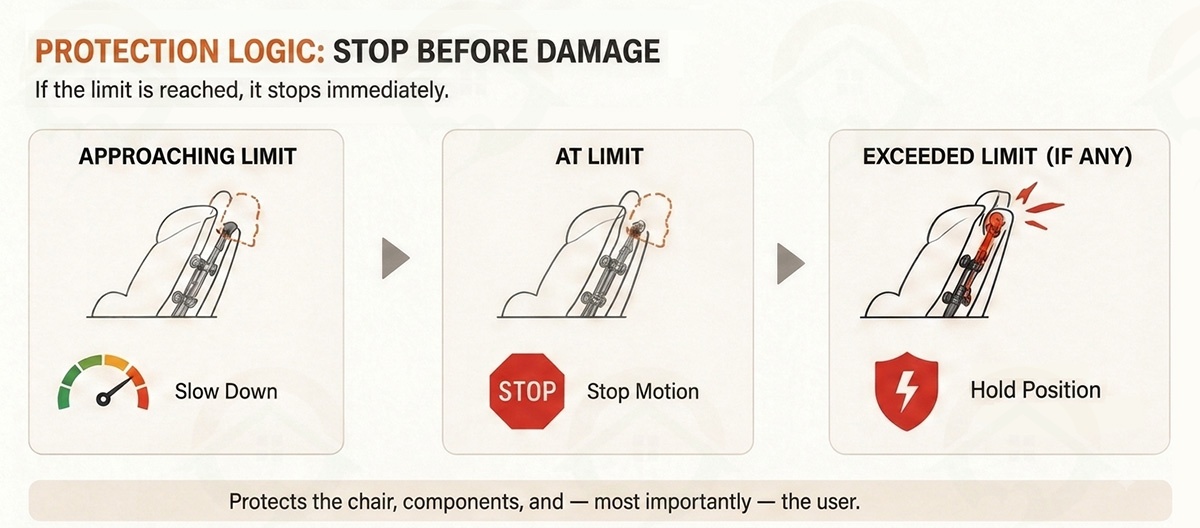
- The process line is the two physical limit switches, one at the top of the track and one at the bottom. Their main job is to give the board a known reference point for exactly where the upper and lower physical bounds are — and, at the same time, to act as a hard stop if anything else goes wrong.
The reason both exist isn't that one is a "backup for drift" in the other — in normal operation, rotation counting is accurate enough on its own. The real reason is that each one covers the other's failure mode:
- If a limit switch loses contact or fails, the board still has an accurate position from the rotation count, and can use that alone to stop the mechanism short of its own hard stop.
- If the rotation count is ever off for any reason within a session, the limit switches are still there as an independent, physical last line of defense — they don't care what the counter currently believes.
Either signal on its own is usually good enough to keep a mechanism safely inside its range.
The grinding-at-the-top symptom described above shows up when a design doesn't actually take advantage of that mutual backup — for example, firmware that reads only the limit-switch state and never cross-checks it against the rotation count.
The day that one switch's contact wears out or its spring fatigues, that firmware has no fallback at all. In the position-related service tickets we log, end-of-travel grinding shows up far more often on boards that read only one position source than on boards that cross-check two.
Two working sensing paths that never talk to each other behave, in practice, like one. 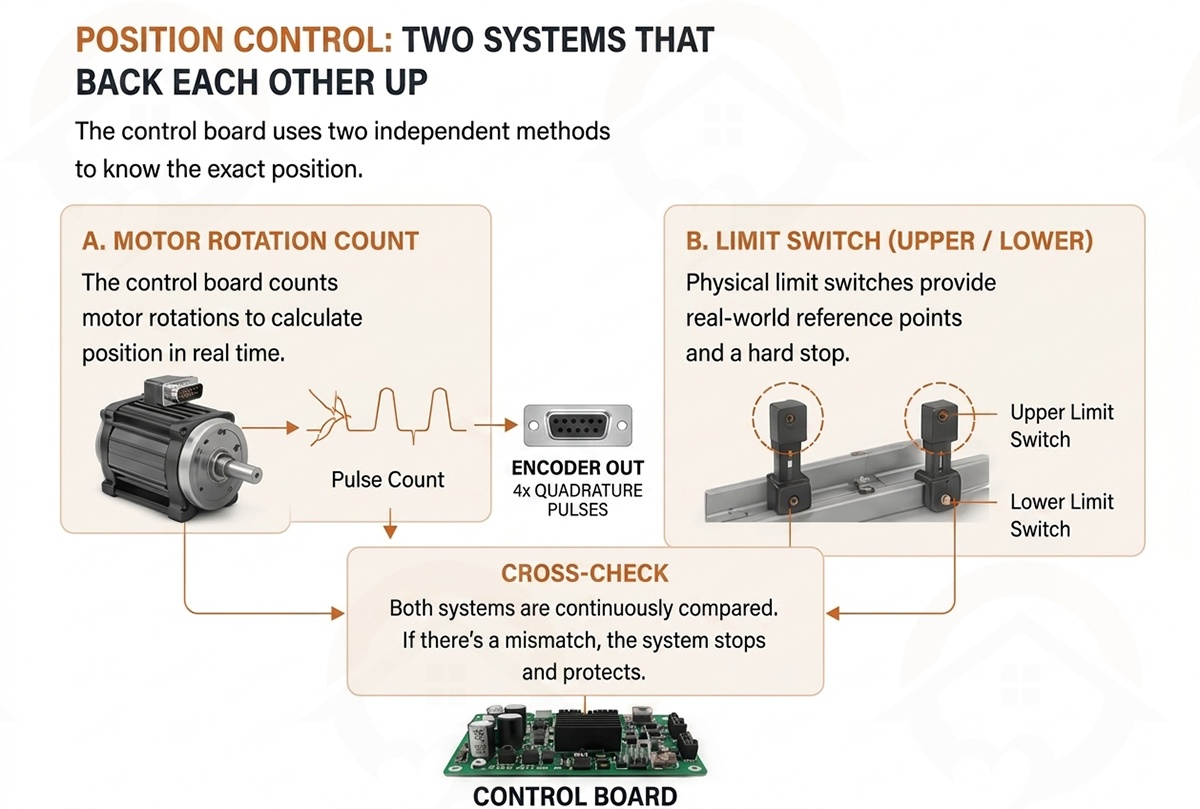
Before you lock a board spec, ask your supplier: does the firmware cross-check both position sources, and is conformal coating standard?
Send us your control-board spec sheet and we will point out where sensing, limits and protection actually live — no obligation.
3. Temperature Sensing: Turning Heating Into a Monitored Function
Separate from position, the temperature-sensing line feeds the board real-time readings from the heating pad.
This is what turns heating from an open-loop feature — just on or off, running on a timer and hoping for the best — into a closed-loop one the board can actively limit based on actual temperature.
On the pad itself, the sensing element is an NTC thermistor — the most common grade across the industry is the MF52B-103-3950: 10kΩ at 25°C, B-value 3950K (25/50°C), typically ±1% or ±2% tolerance, an epoxy-coated black-lead bead NTC.
The B-constant is what converts a resistance change into a temperature reading; the tighter the tolerance, the closer the board’s estimate is to the real pad temperature.
When you spec a chair, ask for the thermistor’s B-constant and tolerance on the bill of materials — a ±5% part at the same setpoint can trip thermal protection noticeably earlier or later than a ±1% part.
Without a working thermal-sensing connection, "heating" stops being something the board monitors and becomes a guess based on elapsed time, which behaves very differently in a 15°C showroom than in a 35°C warehouse. 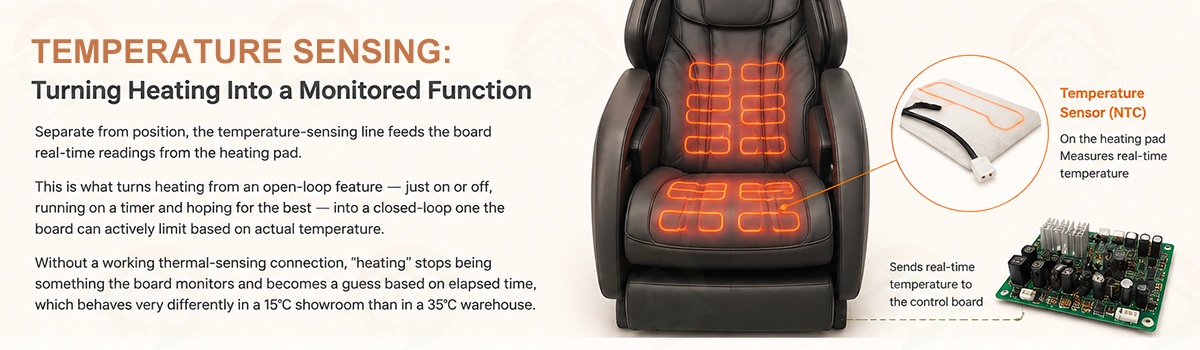
4. Protecting the Sensors Themselves: Conformal Coating
All of the sensing described above depends on clean electrical contact — which is exactly what humidity, dust, and the occasional spill degrade over time.
Conformal coating, a thin protective layer applied over the board's components, is inexpensive to apply and easy to quietly leave off a lower-cost quote.
The cost of skipping it doesn't show up at the factory; it shows up a year or two later, in a humid climate, as the same intermittent sensing faults described above — on an uncoated board sitting right next to a coated one that's still reading correctly. 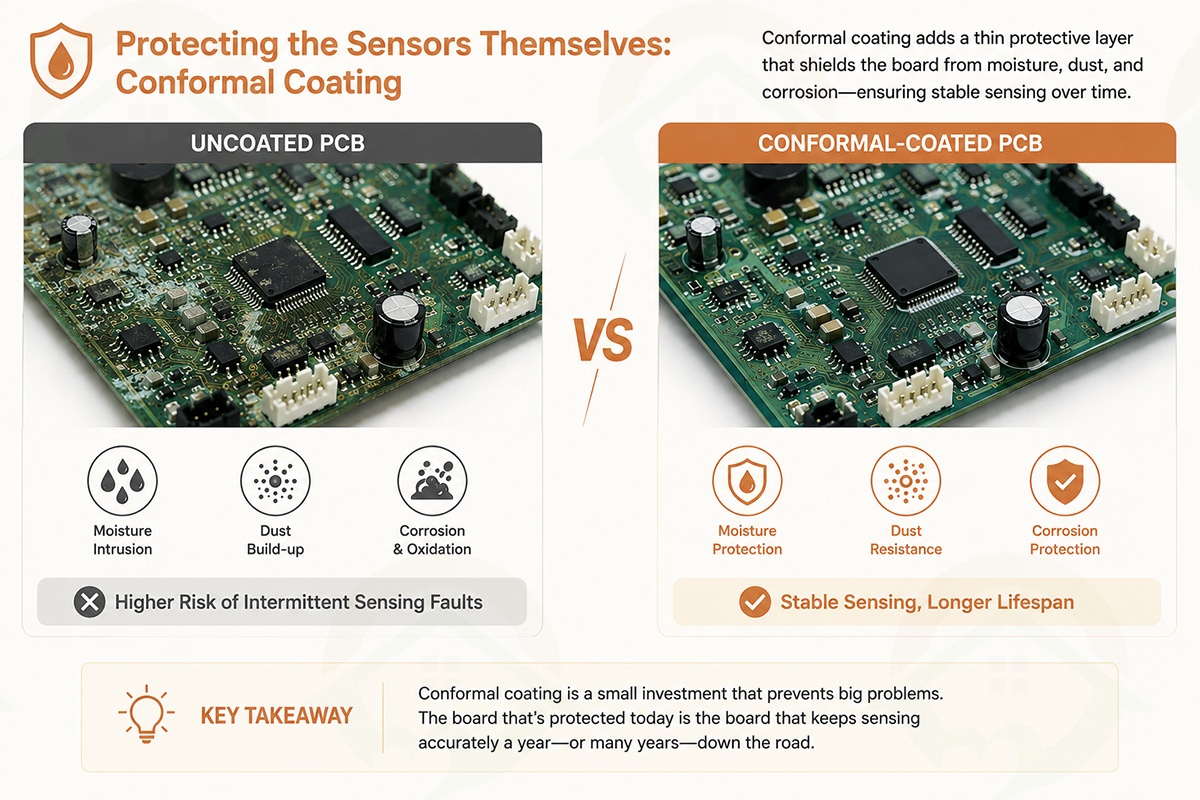
Why This Matters More Once You're Exporting
| Consideration | Why It Matters for B2B Buyers |
|---|---|
| Real body-scan hardware vs. marketing language | Determines whether "auto-fit" is a genuine sensor feature or a fixed program with a scan-sounding name |
| Mutual backup between rotation counting and limit switches | Each covers the other's failure mode — worth confirming the firmware actually cross-checks both rather than trusting only one as the source of truth |
| Thermal protection logic | Determines whether a heating fault results in the pad shutting off safely, or running past its intended limit on a timer |
| Climate-appropriate coating | Humid or coastal destination markets need conformal coating as standard, protecting the sensing layer itself, not just the board |
* Typical performance under normal use. Exact durability and failure behaviour vary with usage intensity, climate and maintenance.
— which is exactly what coating and sensing protect.
Three Questions Every B2B Buyer Should Ask Their Supplier
1. Is the body-scan feature backed by an actual detection sensor and line, or is it a fixed-position program marketed as auto-fit?
2. Does the track mechanism have independent limit switches in addition to motor rotation counting — and what happens if the counted position and the physical limit disagree?
3. Is heating pad temperature actively monitored and limited by the board, or run on a fixed timer without real-time feedback?
Pro tip: Ask question 2 specifically and listen for whether the answer distinguishes rotation counting from limit-switching as two separate systems. A supplier who conflates the two — or only mentions one — likely hasn't tested for what happens when they disagree.
Summary
"The massage doesn't match my body" and "the track grinds at the top" sound like two different complaints, but they come from the same place: the sensing layer that tells the board what it's touching and where it actually is.
Body-scan sensing decides whether a program fits the user in the first place; the counting-plus-limit-switch pair decides whether the mechanism stays inside its safe range for years of daily use rather than months.
None of this is visible in a showroom demo — it's entirely about whether the chair still behaves correctly after the sensors have done their job a few thousand times.
Electrical System Deep Dive Series
Joe Fan
Manufacturing & Product Development Manager · Sweet Home
Sweet Home has manufactured massage chairs since 2013, drawing on in-house R&D and quality control for massage chairs and wellness equipment, with deep expertise in SL track mechanisms, 4D massage systems and zero-gravity ergonomic design.
Disclosure: Sweet Home is the manufacturer behind these chairs, and the service data throughout this series comes from our own repair logs and production line — shared so buyers can recognize these failure patterns before they reach a container.
Quick audit: is your sensing spec complete?
1. Body-scan claims verified by data? 2. Limit switch type disclosed? 3. Board protection (thermal/coating) stated?
Two or more unchecked? Send us your current spec.