
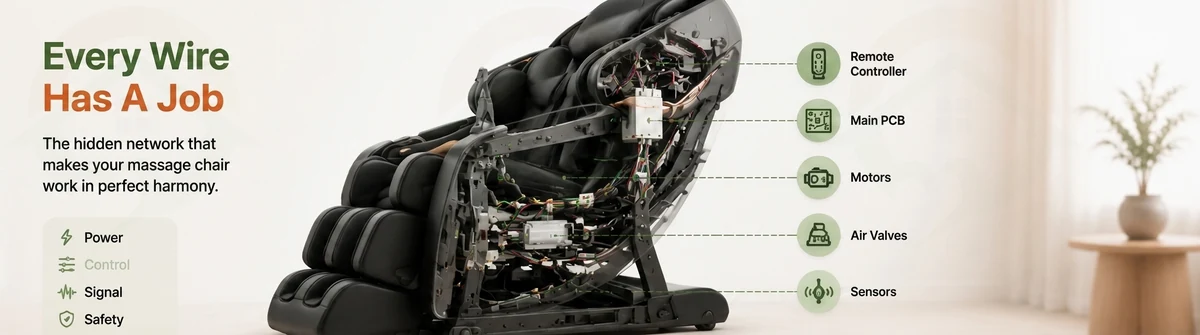
This is Episode 8.0 of our Massage Chair Component Deep Dive series. Every chair has a wire harness; the question is whether that harness is engineered for a mechanism that moves — or copied from an appliance that sits still.
This episode is about the six decisions that separate the two, and what to check before you lock a harness supplier.
The Question That Exposes a Bad Supplier
Ask any massage chair factory what their wire harness is made of, and most will answer with one word: "copper." Ask a factory that actually understands the mechanism, and you get a different answer — because the real question isn't what the wire is made of.
It's what happens to that wire after it has bent back and forth 300,000 times inside a moving mechanism, sitting six millimeters from a motor that switches on and off every few seconds.
A massage chair mechanism harness is not a static wire run like the one behind your refrigerator. It lives on a carriage that travels up and down a rail, thousands of times over the chair's service life, carrying both motor power and delicate sensor signals through the same tight space.
This is the checklist a harness engineer actually works through, in the order the decisions get made on a real production line.
1. Conductor Material: Why "Copper vs. Brass" Is the Wrong Question
The two metals aren't competing for the same job, and a supplier who conflates them is telling you they haven't thought about it carefully. The conductor — the wire core carrying current — is essentially always pure copper (bare or tinned).
Copper's conductivity is roughly four times that of brass, and brass is too brittle to survive repeated flexing. Brass belongs somewhere else entirely: in the terminal, the small metal contact that mates inside the connector housing.
That's a different engineering problem — spring force and mating cycles, not current-carrying capacity — and it's covered in Section 5.
Wire gauge is chosen by current load, not by habit. Motor power lines — driving kneading, tapping, and reclining motors — typically run 18–22 AWG depending on motor power.
Signal and sensor lines — body-scan sensors, limit switches, Hall sensors — carry negligible current and can run as fine as 20–26 AWG; here the priority shifts from current capacity to noise immunity, which is Section 3.
2. Multi-Strand Soft Copper: The One Decision That Determines Whether the Harness Survives
This is the detail that separates a harness built for a mechanism from a harness built for a stationary appliance, and it's the one worth spending the most time explaining to a buyer who hasn't seen inside a chair mechanism.
Solid copper work-hardens at the bend point and eventually cracks internally — the insulation looks fine, but the conductor inside has snapped, and the fault is nearly impossible to find without cutting the wire open.
The correct answer is fine-strand, soft-annealed copper — multiple thin copper filaments twisted together (per our production line spec: 7×0.12mm, 12×0.12mm, or 19×0.16mm depending on required flex life and current).
More strands and finer filament diameter mean better flex fatigue resistance, at a higher material and processing cost.
The stranding spec should be chosen against the mechanism's rated travel cycles — a chair rated for a 10-year service life needs a harness validated against that many flex cycles, not against a number someone picked because it sounded reasonable.
How to Validate the Stranding Spec
What to ask a supplier: what stranding count and filament diameter is used on the moving section of harness, and has it been flex-tested to a cycle count that matches the mechanism's rated life.
3. Power and Signal, Kept Physically Apart
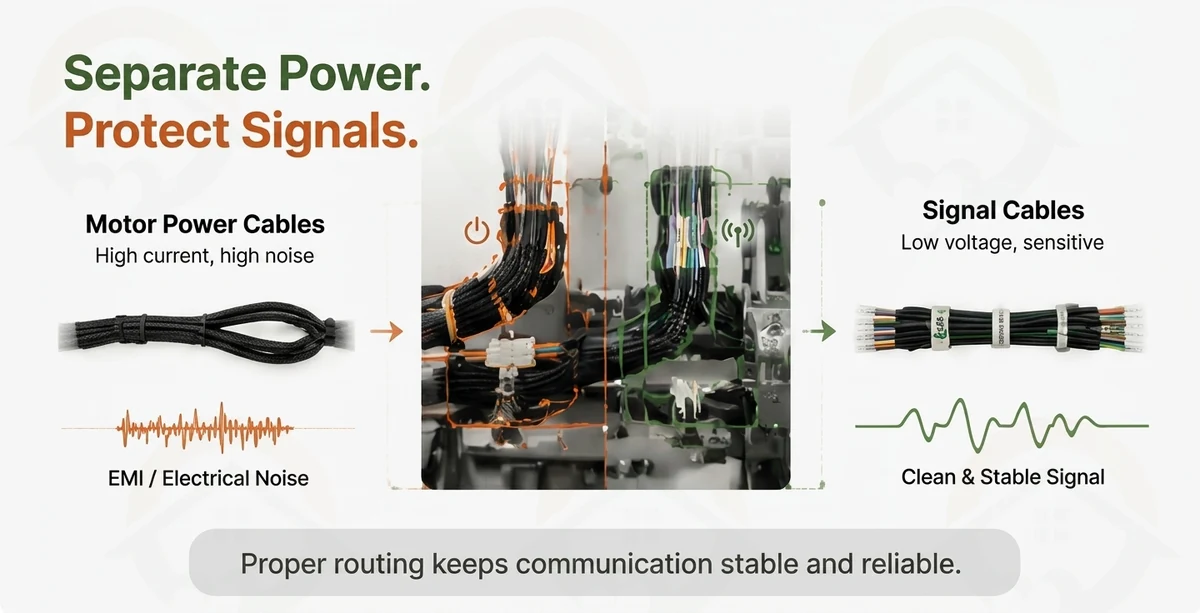
Inside the same mechanism, you have two very different kinds of electrical traffic sharing tight quarters: motor power lines switching high current on and off, and sensor lines carrying tiny signals that a body-position or pressure sensor depends on being read accurately.
Run them in the same bundle, and the motor's switching noise couples into the signal lines — the practical symptom is a sensor that reads correctly on the bench and misbehaves once it's inside a working chair with the motors running.
The fix is routing discipline, not exotic components: separate power and signal into different bundles wherever the layout allows, keep them physically apart rather than twisted together, and give each a dedicated path back to the control board.
It costs a few extra minutes of harness design and a bit more connector real estate on the mainboard — and it's far cheaper than debugging phantom sensor faults after the product has shipped.
4. Length and Tolerance: Designed Around the Mechanism's Full Travel
Harness length isn't measured from a drawing in isolation — it's measured against the mechanism's full mechanical travel, with margin at both ends.
Cut the harness to the minimum needed for the carriage's resting position, and the first time the mechanism reaches the far end of its rail, the harness gets pulled taut — repeated tension at the termination point is exactly what causes a wire to pull out of its crimp, or a solder joint to fatigue and crack.
In practice, length is validated at prototype stage by physically running the mechanism to both travel extremes and checking that the harness has slack without excess bunching that could snag or chafe.
Length tolerance then needs to be specified explicitly for mass production — typically within a few millimeters — because a tolerance that's too loose either wastes material at scale or, worse, occasionally ships a harness that's too short for the actual travel.
5. Fixation and Protection: The Detail That Separates a Massage Chair Harness From an Ordinary Appliance Harness
This is where a massage chair mechanism differs most visibly from a washing machine or a rice cooker — because a meaningful section of the harness has to move continuously with the mechanism, not just sit fixed in a chassis.
Protective Sleeving on Moving Sections
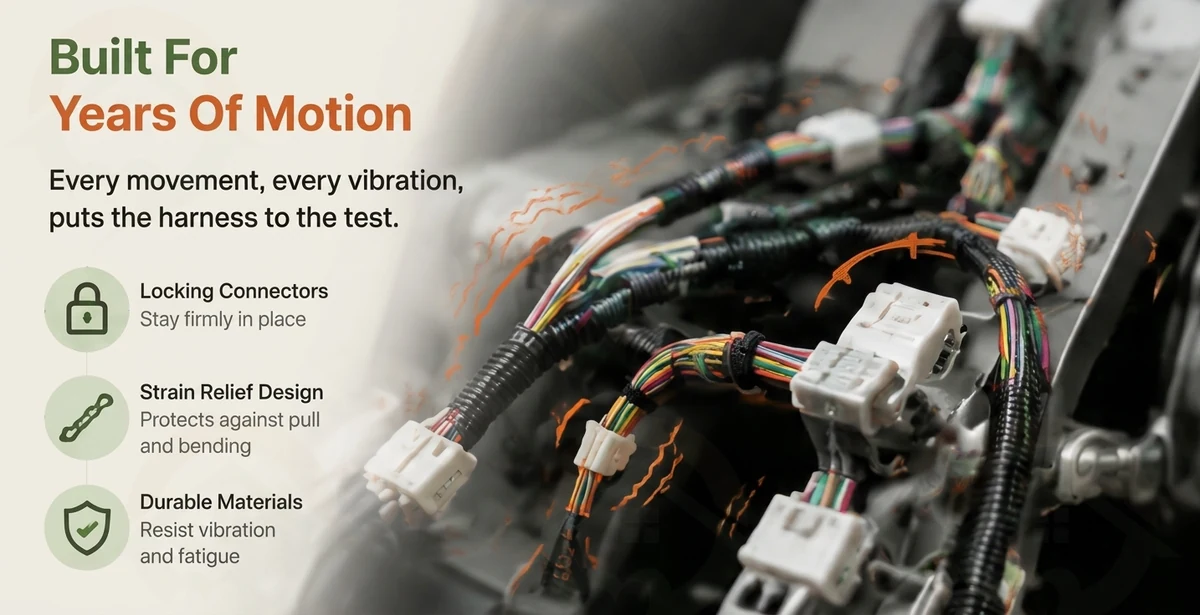
Protective sleeving on moving sections. The harness running to the back-massage carriage is typically routed through a corrugated conduit (bellows tube), which protects against abrasion while flexing naturally with the mechanism's motion.
Lower-traffic sections sometimes use a fabric sleeve instead — lower cost, somewhat less abrasion resistance.
Which one is used where is a real design decision, not an afterthought, and a supplier who can explain why they chose one over another for a specific section is a supplier who has actually engineered the harness rather than copied a layout.
Strain Relief at Every Termination
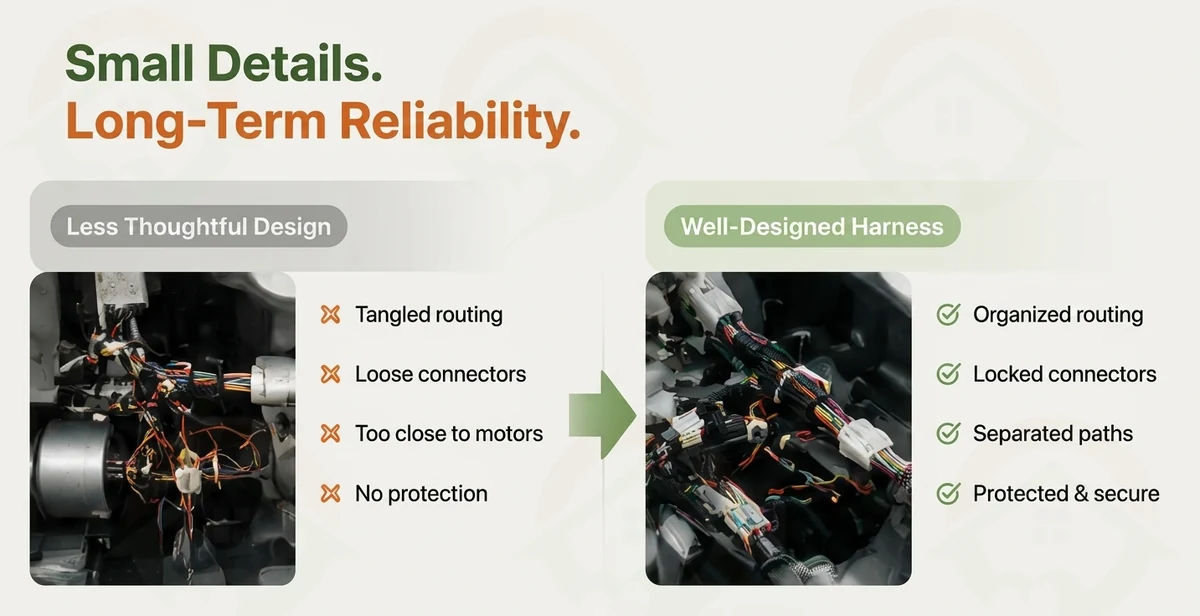
Strain relief at every termination. The harness itself needs to stay flexible along its length, but the point where it meets a terminal or connector needs to be effectively rigid — heat-shrink, potting compound, or a molded crimp are the common methods.
Strain relief exists specifically to absorb the tension and bending force at that junction, so the repeated motion of the mechanism doesn't translate into stress on the crimp or solder joint itself.
Routing Away from Wear Points
Routing away from wear points. Static sections are routed clear of rail sliding surfaces, gear and belt drives, and sharp metal edges — any of which can wear through insulation over thousands of cycles and cause an intermittent short that's very hard to trace after the fact.
6. Connector and Terminal Selection
This is where the brass-vs-copper question from Section 1 actually belongs. The terminal — the small metal contact inside a connector housing — is a spring-and-wear problem, not a conductivity problem, and the material choice reflects that:
Brass terminals are lower cost and machine well, but have middling spring retention and fatigue resistance over repeated mating cycles.
Phosphor bronze terminals hold their spring force better and tolerate far more insertion cycles — the right choice for any connector that gets mated and unmated repeatedly, such as a service or maintenance connector.
Surface plating matters just as much as the base metal: tin plating is the economical default; nickel plating adds wear and corrosion resistance; gold plating is reserved for low-signal contacts — sensor and signal pins — where minimizing contact resistance actually matters.
Two more details worth specifying explicitly rather than leaving to the connector catalog default: keyed / polarized housings so a connector physically cannot be mated backwards on the production line or during field service.
Locking connectors belong on any joint exposed to the mechanism's vibration, so it doesn't work itself loose over the chair's service life.
Why This Is a Sourcing Question, Not Just an Engineering One
None of these six items shows up on a spec sheet headline.
A harness that uses solid-core wire on a moving section, mixes power and signal in one bundle, or skips strain relief at the terminal will pass every incoming inspection and every initial function test.
For a B2B buyer evaluating a manufacturing partner, these six points are a more honest quality signal than a finished-unit demo, because they're the decisions that determine whether the chair still works the same way in year three as it did in month one.
Six-Question Supplier Checklist
| Harness Detail | What to Ask a Supplier |
|---|---|
| Conductor | Confirm pure copper strand, and ask where (if anywhere) brass is actually used — it should only be in terminals |
| Stranding on moving sections | Filament count/diameter, and flex-cycle test data matched to the mechanism's rated service life |
| Power/signal routing | Are power and signal bundled separately, with dedicated paths to the mainboard? |
| Length & tolerance | Validated at both travel extremes on a real mechanism, with a stated production tolerance |
| Protection on moving harness | Corrugated conduit vs. fabric sleeve — and why each is used where it's used |
| Terminal & connector | Brass vs. phosphor bronze, plating type, keyed/polarized housings, locking on vibration-exposed joints |
Summary
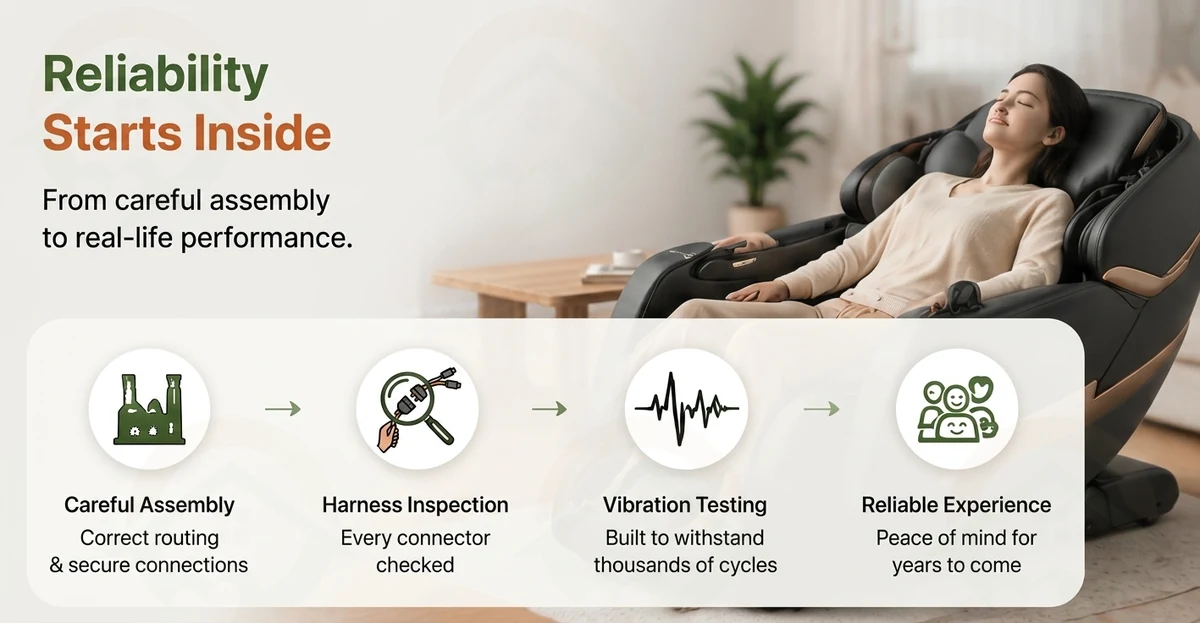
A wire harness is one of the least glamorous parts of a massage chair mechanism, and one of the most reliable predictors of how the chair will hold up after the first year of daily use.
The difference between a harness that survives 300,000 flex cycles and one that doesn't isn't visible in a spec sheet or a showroom demo — it's in the stranding count, the routing discipline, the strain relief, and the terminal material.
For a buyer sourcing massage chairs, asking about these six details is a faster way to separate a serious manufacturing partner from one that's assembling from a catalog.
Certification Worth Asking For
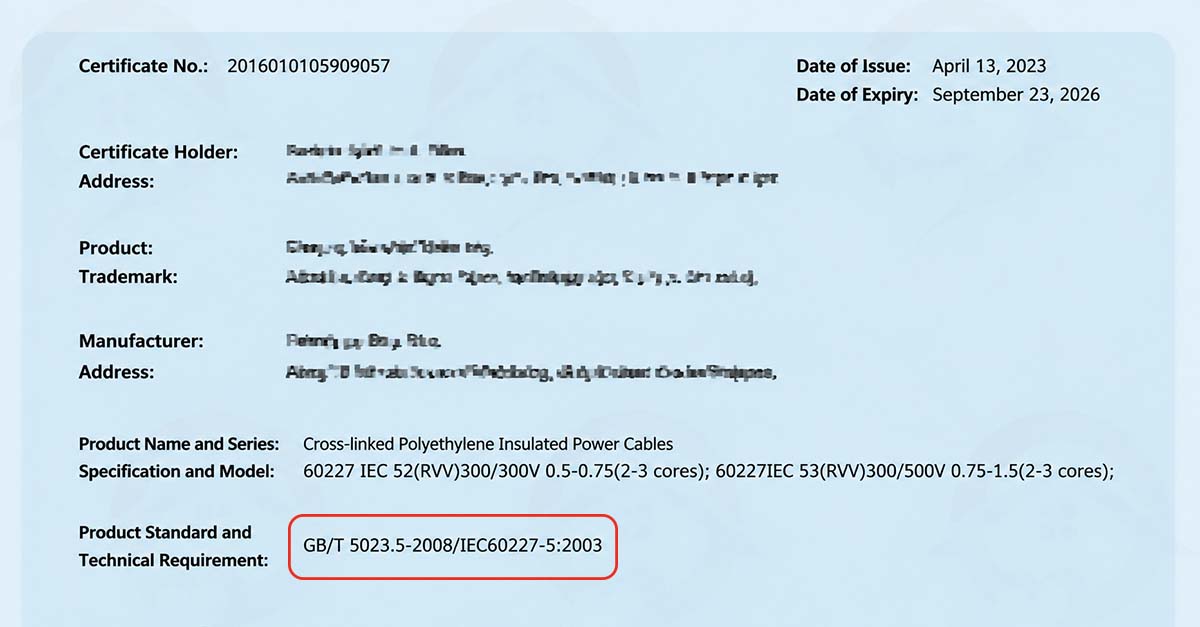
In China, the wire and cable assemblies we use are produced by suppliers holding CCC (3C) / IEC60227-5 certification for their wire, wire assemblies, and national-standard three-pin plugs — and we ask the same of any harness vendor.
Massage Chair Component Deep Dive Series
This is Episode 8.0, the first episode of the mechanism & motion chapter. Read the earlier electrical-system episodes:
Joe Fan
Manufacturing & Product Development Manager · Sweet Home
Sweet Home has manufactured massage chairs since 2013, drawing on in-house R&D and quality control for massage chairs and wellness equipment, with deep expertise in SL track mechanisms, 4D massage systems and zero-gravity ergonomic design.
Disclosure: Sweet Home is the manufacturer behind these chairs, and the service data throughout this series comes from our own repair logs and production line — shared so buyers can recognize these failure patterns before they reach a container.
Quick audit: does your harness spec cover the six points above?
1. Conductor & stranding on moving sections 2. Power/signal separation 3. Length validated at full travel 4. Conduit vs. sleeve 5. Strain relief 6. Terminal & connector plating
Missing more than one? Send us your current harness spec and we'll review it against our production line.