
This is Episode 10.0 of our Massage Chair Component Deep Dive series. Every chair advertises a zero-gravity position; very few buyers ever see the push rods that make it move.
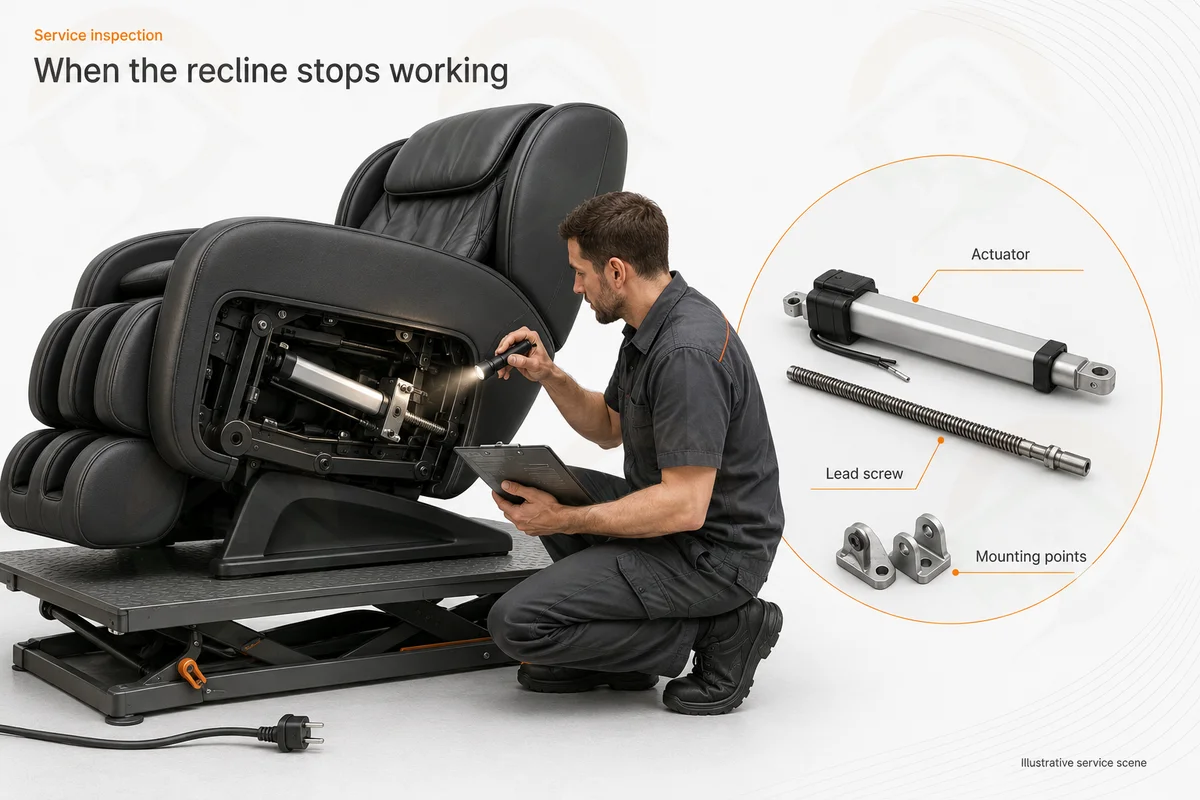
The most common recline complaint in our service logs is not about the massage. It is that a zero gravity massage chair squeaks when it unfolds, stalls halfway down, or sends the leg rest back up only when it feels like it.
Run the diagnosis on those units and the massage mechanism is usually fine. The trouble lives in the drive chain nobody sees: the push-rod actuator, the screw, and the limit devices that tell the chair when to stop.
The name comes from NASA. Measurements of astronauts in microgravity showed the body settling into a neutral, relaxed posture, and the same research has shaped car-seat design for decades.
Massage chairs translate it into an angle — roughly 128 degrees, varying by model — that spreads body weight across the backrest and leg rest. Marketing sells the posture.
This episode is about the hardware that actually holds it.
That hardware is where chairs separate: a cheap recline drive works on day one and talks back in year two, as noise, creep, or a stuck leg rest. Here is what happens inside, the order it fails in, and the four things a factory does to make it not fail.
1. How the Zero Gravity Recline Actually Works
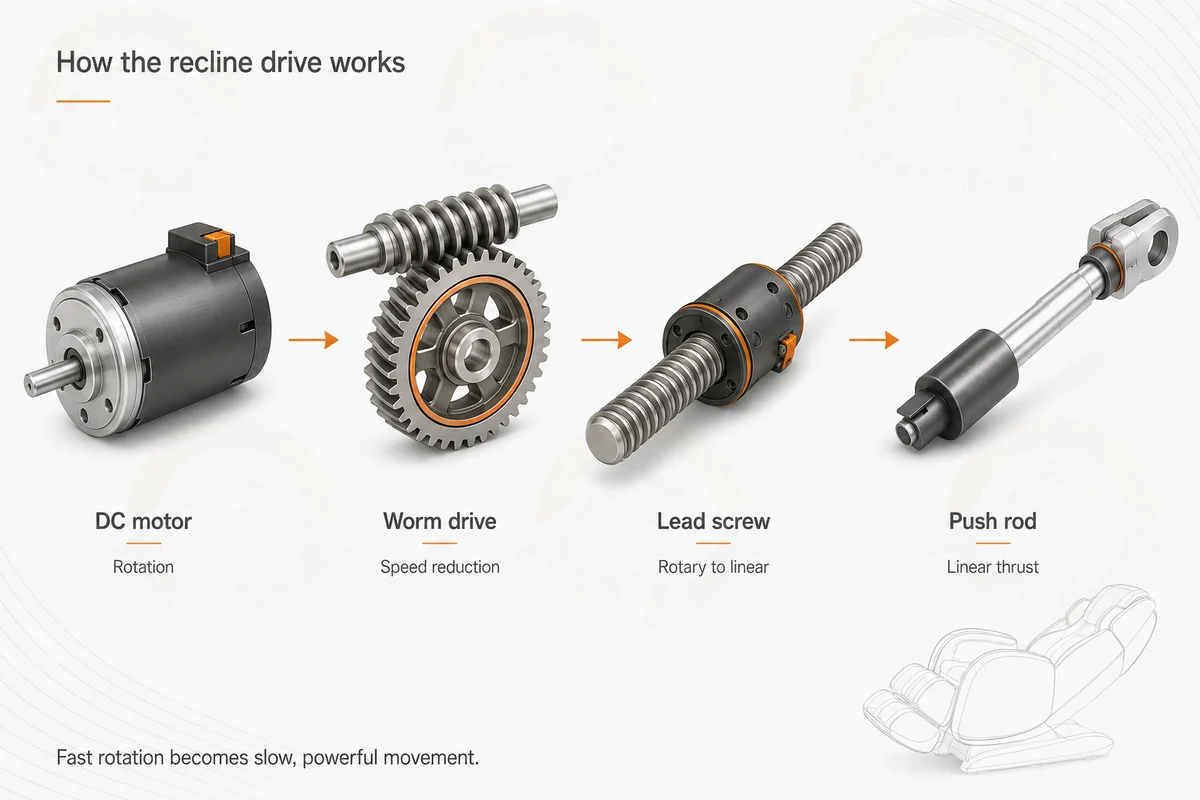
If you have ever adjusted a car seat electrically, you already understand the recline drive. It is the same technology family: a small DC motor spins fast, a screw mechanism slows it down, and the result is a slow, powerful push that nobody has to crank by hand.
The Drive Chain: Motor, Worm, Screw, Push Rod
That speed is useless for pushing a backrest, so a worm and screw convert it: rotation becomes linear motion, speed drops, and thrust multiplies.
The worm screw in our actuator spec is a Φ8 × 118 mm worm, and the actuator is rated at 4,000 N of thrust — about 400 kg — per the supplier spec sheet.
Worm drives have a useful side effect: they are self-locking. The screw can push the load, but the load cannot push the screw back. When the motor stops, the backrest stays where it is. That is why a well-made chair does not slowly collapse on its own — geometry, not firmware.
Two Actuators, Two Jobs
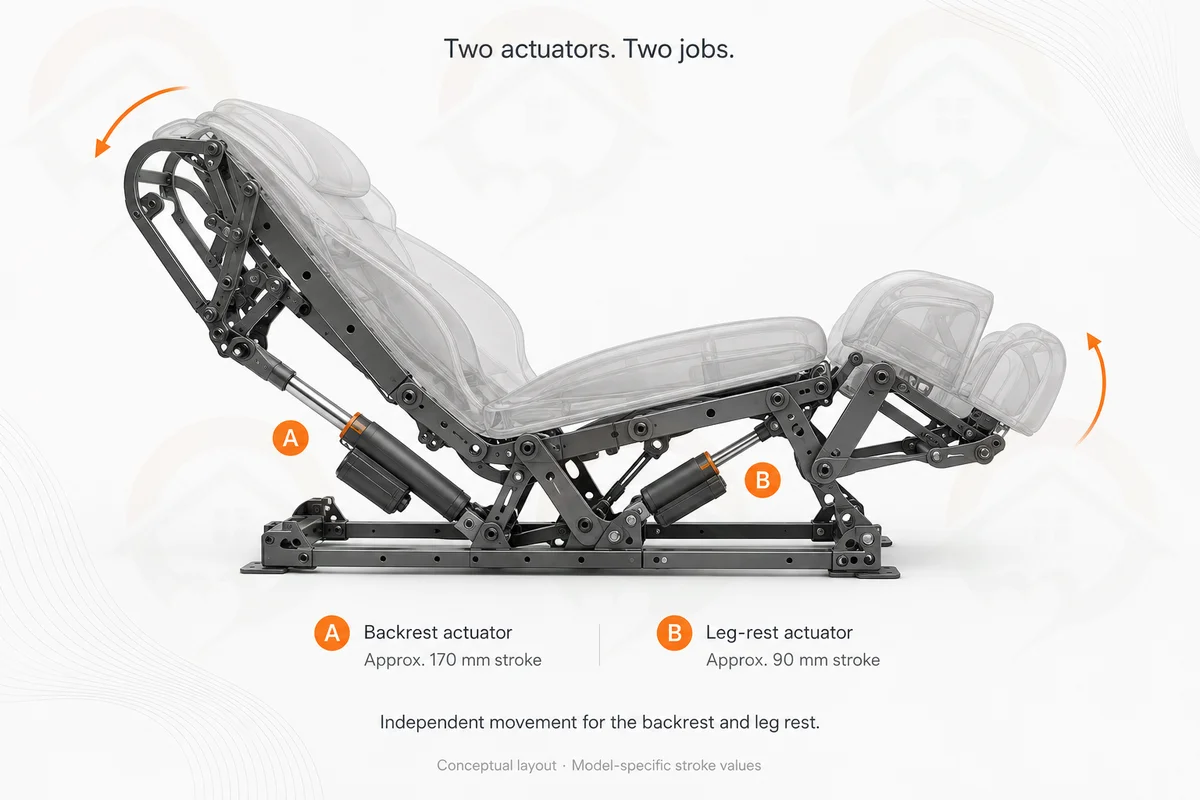
A zero-gravity recline moves two things: the backrest and the leg rest.
Our current drive uses two actuator variants built to the same motor core — one with about 170 mm of stroke for the backrest, one with about 90 mm for the leg rest (the 63TG390-170 and 63TG260-90 spec sheets we build against).
Some chairs drive both from a single motor through a linkage; two actuators give the control board independent movement and simpler geometry. Both designs work; what matters is how each one is protected.
How the Controls Decide When to Stop
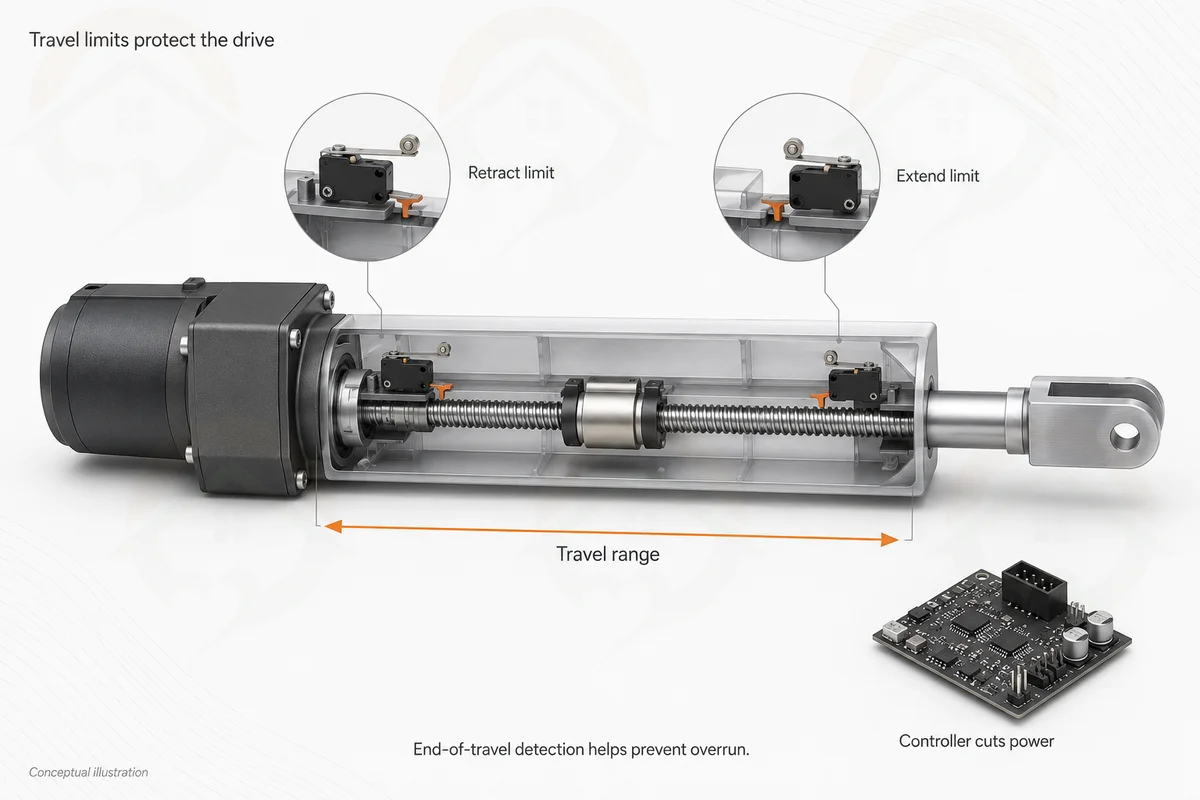
The control board does three things with each actuator: power it forward, reverse it, and cut the power. The interesting part is knowing when to cut.
The board does not guess — it listens to travel limits, current draw, and end switches, and each of those signals maps to a failure mode in the next section.
2. Why Reclines Fail
The four failure patterns below are the ones that show up in service logs and repair forums, in roughly this order. They are listed as pathology only — the prevention comes in the next section, one cure per disease.
Screw Wear → Backrest Creep
The screw and its nut carry the full load of the body on every cycle. Over years, the thread wears and the clearance grows.
The first symptom is not noise — it is creep: the backrest slowly settles back after reaching position, as if the chair is deflating. In the fit complaints we log, users describe it as the chair dropping them.
Running Past the End → Stall and Gear Slippage
If the chair keeps sending power after the actuator has hit the end of its stroke, the motor stalls.
A stalled DC motor draws rising current and heats up fast; repeated stalls wear the gear teeth and can eventually shear them or burn the motor. This is the failure behind the chair-stopped-moving stories that actually began with an over-run.
The Leg Rest Traps a Leg
The leg rest is a pinch point by design. If it folds up while a foot or calf is in the way — and the drive has no way to feel the resistance — the motor simply keeps pushing. In the worst case the user is trapped until the power is cut.
Electronics Dead → Over-Travel and Frame Damage
If the control board crashes or a limit device fails, nothing tells the actuator where the end of travel is. The push rod keeps going, the mechanism over-travels, and the backrest slams into the frame stop — bending the structure or the actuator mount.
This is the only failure on the list that is structural, not just annoying.
3. How Good Factories Prevent These Failures
Every prevention below is aimed at one of the four failure modes above, in the same order — so you can match the disease to the cure without flipping back.
Load Redundancy Stops Backrest Creep
Creep is a load problem: the screw wears because it is working at its limit. A factory prevents it at the design stage by sizing the actuator with a safety margin instead of just-enough.
A rated 4,000 N actuator is not chosen because the backrest needs 4,000 N; it is chosen so the screw works far below its limit under a normal body. Elevators do the same thing — rated for eight passengers, cables designed for sixteen.
Some factories add a second actuator so two drives share the load. Single or dual, the principle is the same: the rated load of the part should sit well above the load it will ever see in use.
Limit Switches Stop Over-Travel
A limit switch is a physical switch at each end of travel. When the actuator reaches the end, the switch trips and the controller cuts power before the motor can stall. It is the same logic as an elevator door that stops pushing the moment it closes.
Without it, every full recline would end in a stall — and every stall is a small step toward gear damage.
Current-Sensing Anti-Pinch Catches a Trapped Leg
Current is a load sensor. When the leg rest meets resistance — a calf, a shoe, a child’s toy — the motor draws more current, and the control board can detect the spike and reverse or stop within milliseconds. Car windows use the same principle to stop closing on a hand.
Our motor spec tolerates a brief stall — 3 seconds — before damage becomes a risk, which gives the anti-pinch logic a working window: enough time to react to a trapped leg, not enough time to burn the motor.
Mechanical Stops Catch the Rest
Electronics can fail. The final layer is a mechanical stop — a physical block in the frame that limits travel even if every switch and the control board are dead.
Elevators have the same philosophy: buffers under the car for the case where all electrical control is lost. If a chair has a metal end-stop in the recline frame, an over-travel failure cannot bend the structure.
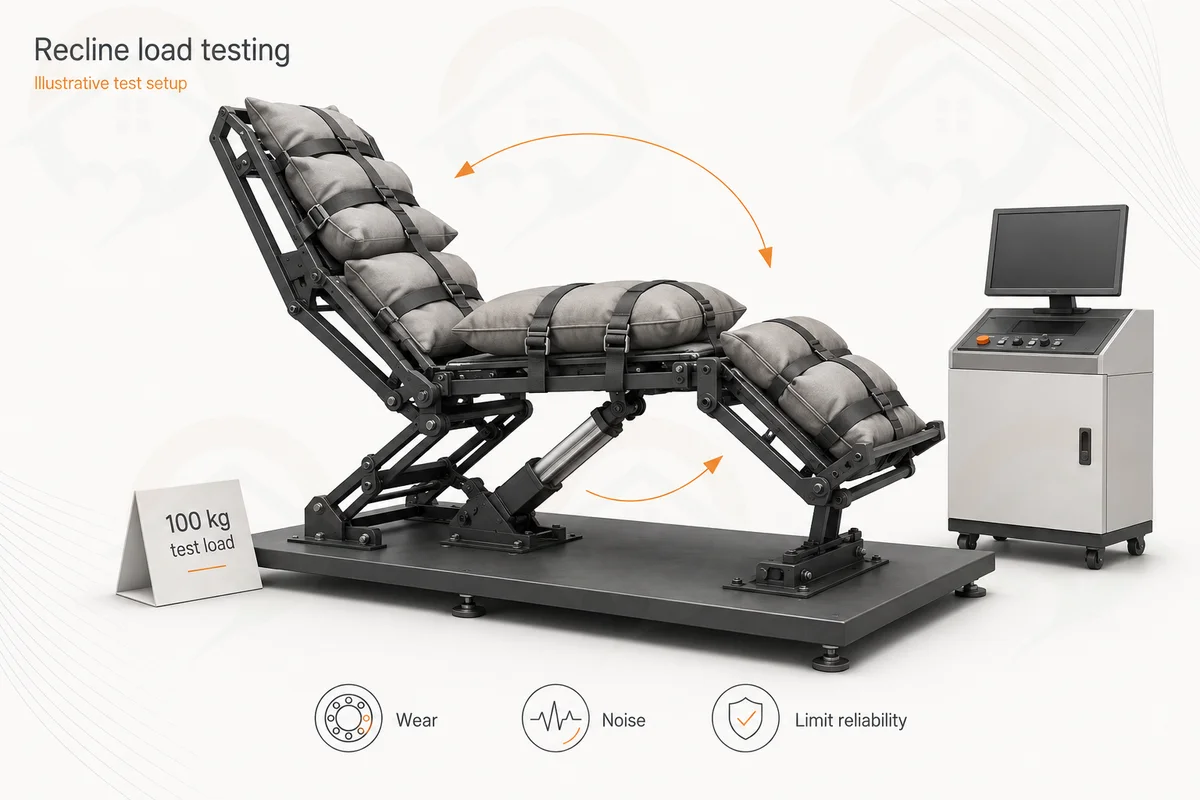
Then the factory proves it. On our test benches, mechanisms run 100 kg sandbag loads for over 1,000 hours of continuous cycling, with 200 kg loads still running normally in our test records; the recline drive is validated with the same discipline.
A cycle report is the difference between “the actuator is rated for it” and “we watched it survive it.”
4. What Determines Recline Lifespan
Three things decide how many years a recline drive keeps working: how far above its real load the actuator is rated, what the screw is made of and how it is driven, and whether the factory can show a test that matches the claim.
| Component | What Determines Its Life | Spec We Build Against |
|---|---|---|
| Actuator thrust | Rated load vs. the load it will actually see | 4,000 N rated thrust (≈400 kg), per supplier spec sheet |
| Worm screw | Material, diameter, surface finish | Φ8 × 118 mm worm screw, 6063A-T5 aluminum housing |
| Heat & noise | Temperature rise, acoustic level | 63 ℃ temperature rise, 45 dB(A) motor noise, per spec |
| Test evidence | Load and cycle testing the factory actually runs | 100 kg sandbag, >1,000 h mechanism load test (our test records) |
Read a spec sheet the way you would read a promise: the numbers are test values, not guarantees. Rated life above 1,000 hours means a sample survived that long on a bench under rated conditions.
What protects the buyer is the margin between the rating and the real use — and the factory’s willingness to show the test.
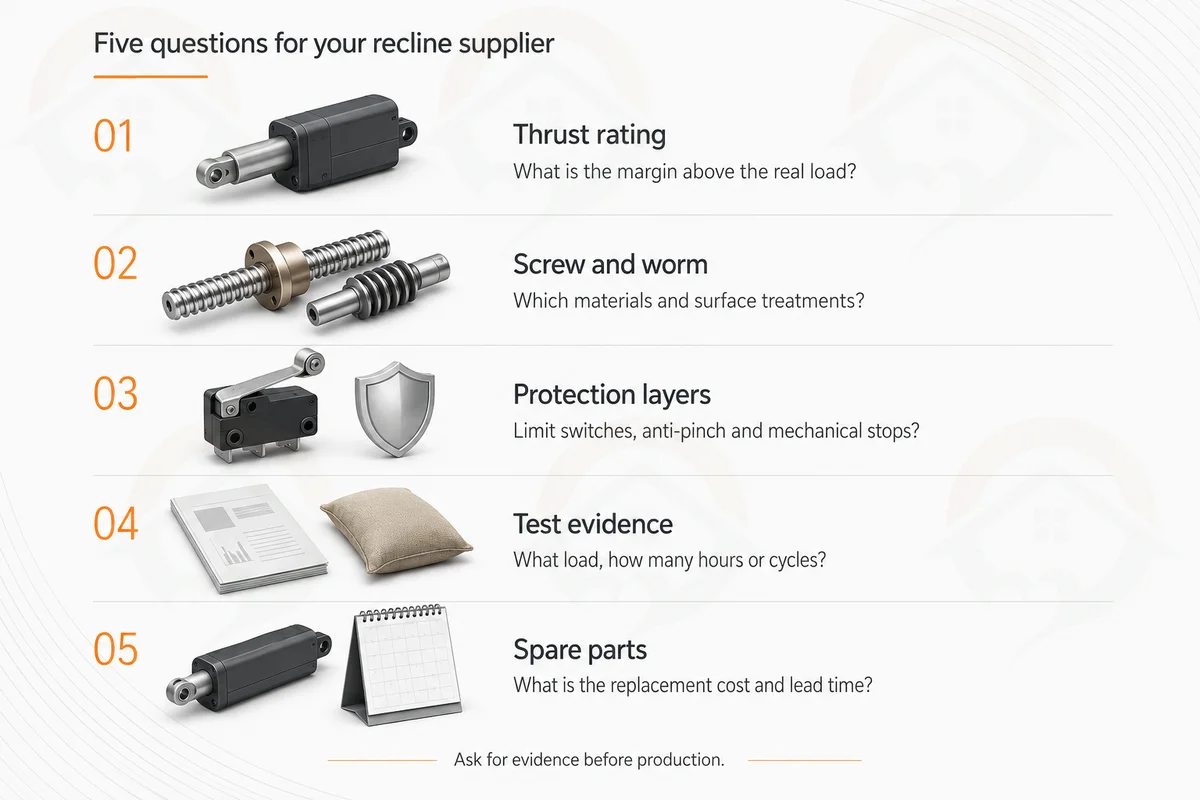
5. Five-Question Supplier Checklist
Turn the table into questions. These five answers tell you more about a recline drive than any showroom demo — because they describe how the chair will behave after the first year of daily use.
| Recline Detail | What to Ask a Supplier |
|---|---|
| Actuator thrust rating | Show me the actuator spec sheet and the rated load — how much margin above the heaviest expected user? |
| Screw / worm material | What is the screw material and worm size? Machined or stamped? Any surface treatment? |
| Limit & anti-pinch redundancy | How many layers stop over-travel — limit switches, current-sensing anti-pinch, mechanical end stops? Which ones? |
| Cycle / load test evidence | Do you have a cycle or load test report? What load, and how many hours or cycles? |
| Spare parts & replacement | Is the actuator a standard part? |
A supplier who can produce the actuator spec sheet, name the screw material, and show a load test report is giving you evidence. A supplier who answers with adjectives is selling you the demo.
6. FAQ: The Questions Buyers Actually Ask
Is zero gravity good or bad for your back?
Spreading body weight across the backrest and leg rest can reduce pressure on the spine and joints — the same neutral-body reasoning NASA documented for crew comfort and that car-seat designers have used for decades.
Can is the operative word: a recline position is a comfort feature, not a medical treatment, and anyone with a spinal condition should ask a clinician first.
Why does my chair squeak when it reclines?
A new chair makes some mechanism noise — at motor level our spec is 45 dB(A), a normal level for a moving drive.
The complete chair measures higher — our mechanism spec lists under 56 dB(A) — which is expected for a full unit with rollers, airbags and the recline drive.
Squeaking that appears after months, or grows louder, usually means the screw or worm needs attention, or the load is higher than the drive was sized for. Creep, hesitation, or a leg rest that sticks are stronger signals: those point to wear, not lubrication.
Can the backrest collapse on its own?
A worm-driven actuator is self-locking: the load cannot drive the screw backward, so a healthy chair holds position with the motor off.
If a backrest slowly settles anyway, the screw is worn — that is the creep failure from earlier. It is repairable, and it is exactly the kind of thing a load-tested drive is designed to avoid.
Is zero gravity safe for heavier users?
Weight capacity comes from the actuator rating and the frame. The actuator we spec is rated at 4,000 N — about 400 kg — with headroom above the heaviest expected user; the leg rest and frame are the parts to check on any specific model.
Ask the supplier for the load test report; that is the number that matters, not the brochure.
Summary
Marketing sells the 128-degree angle. Engineering sells the actuator rating, the screw material, and the layers that stop the drive from hurting itself.
For a B2B buyer, the five questions above are a more honest quality signal than a finished-unit demo, because they describe how a chair behaves after the first year of daily use — the year most complaints actually arrive. The same drive logic runs through our full-body massage chair range.
Certification Worth Asking For
In China, the motors we use come from suppliers holding CCC (3C) certification, and we ask the same of any actuator vendor.
A supplier who can produce those certificates alongside a load test report is giving you evidence, not adjectives.
Massage Chair Component Deep Dive Series
This is Episode 10.0, the third episode of the mechanism & motion chapter. Read the previous episodes:
Joe Fan
Manufacturing & Product Development Manager · Sweet Home
Sweet Home has manufactured massage chairs since 2013, drawing on in-house R&D and quality control for massage chairs and wellness equipment, with deep expertise in SL track mechanisms, 4D massage systems and zero-gravity ergonomic design.
Disclosure: Sweet Home is the manufacturer behind these chairs, and the service data throughout this series comes from our own repair logs and production line — shared so buyers can recognize these failure patterns before they reach a container.
Quick audit: does your recline spec cover the five points above?
1. Actuator thrust rating & spec sheet 2. Screw / worm material 3. Limit switch + anti-pinch + mechanical stop 4. Cycle / load test report 5.
Missing more than one? Send us your current recline spec and we’ll review it against our production line.
Related product pages