
This is Episode 7.5 of our Electrical System Deep Dive series. Every chair can claim AI voice control — this episode is about why the experience differs so much, and what to check before you lock a voice module.
What Bothers Real Owners
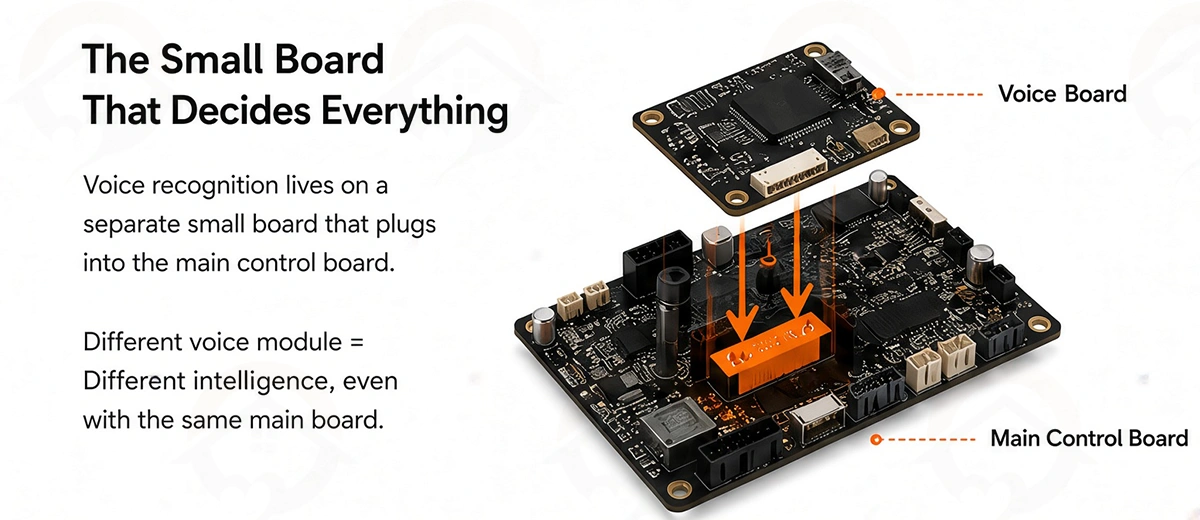
Pull the cover off a massage chair control board and the obvious parts show up first: motor connectors, air-valve outputs, a heater line. Tucked between them is one small white connector, often labelled "Voice small board".
It drives nothing, it controls no airbag, and the chair runs perfectly fine if you unplug it.
That small board is a bolt-on module, not a built-in capability. The voice-recognition and Bluetooth circuitry lives on its own little board that plugs into the main board through a dedicated connector — one more peripheral branch beside the mechanism, air-valve, and heating interfaces.
That single design decision shapes everything downstream: voice quality is largely locked in by the module supplier's solution from day one, and switching voice solutions means swapping the small board and updating the communication protocol — not redesigning the main board.
The same main board can therefore ship with very different "intelligence" depending on which voice module is paired with it, and the same AI voice control feature can feel night-and-day different between two chairs that look identical on paper.
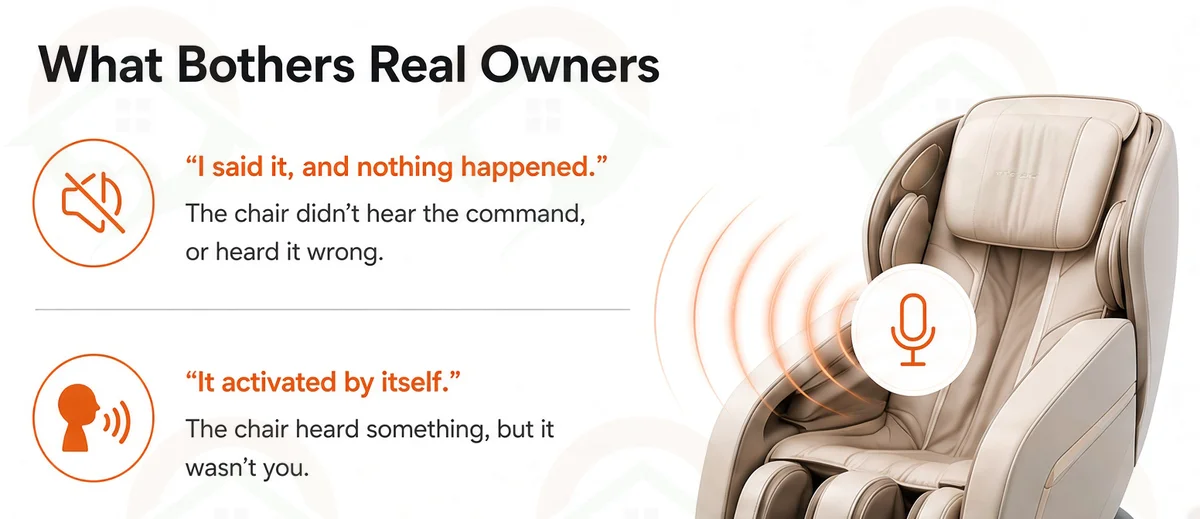
That is why voice control is an independent supplier-selection decision — and why this little board decides the two complaints users make most often about "smart" chairs:
1. "I said it, and nothing happened." The chair did not hear the command, or heard it wrong. The user repeats it, louder, and the chair still does nothing. Whatever the marketing sheet says about "XX voice commands" and "95% recognition", this is the experience the user remembers.
2. "I didn't say anything, and it started moving." The chair is off, a conversation is happening across the room, and suddenly the rollers start. False triggering feels worse than a missed command, because it looks like the product is acting on its own.
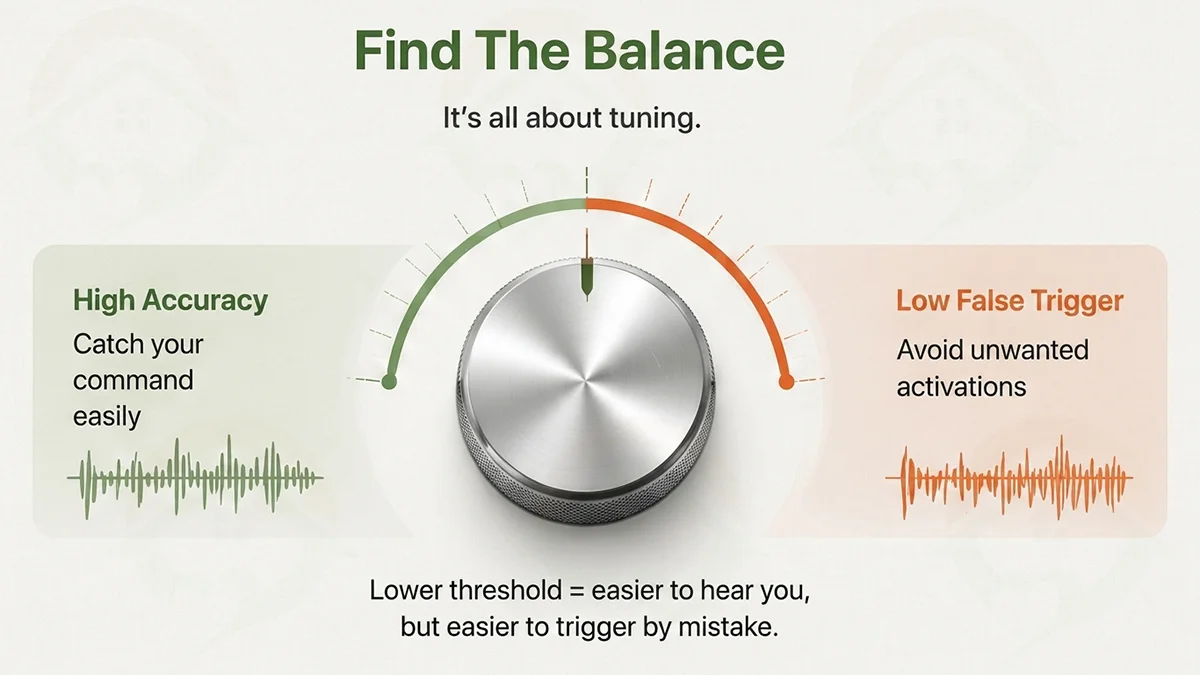
The two complaints look opposite, but they are the same coin. To hear quiet commands reliably, the recognition threshold has to sit low. The lower it goes, the more likely background noise, a TV, or a nearby conversation gets mistaken for a command.
Raise the threshold to kill false triggers, and a soft "stop" from a relaxed user gets ignored. Every voice module is tuned somewhere on this line — the question is where, and whether the tuning matches the product's real environment.
In the voice-control complaints we log across our own service tickets, the split is roughly even between the two: missed commands slightly more often, false triggers slightly angrier. When a missed command happens, the customer retries, and the chair usually responds on the second or third try.
When a false trigger happens, the chair moves on its own — that is the complaint that escalates fastest and the one we see flagged for return most often.
Two Metrics, Defined Separately
"AI voice control works" means two completely different things, and the industry judges them separately:
Recognition accuracy. The user says a command, and the device correctly understands it. Missed commands, misheard words, and commands that need to be repeated all drag this number down.
False triggering (false wake / misrecognition). The user says nothing — or says something completely unrelated — and the device decides it heard a command and acts on it. This is the number that makes a chair "move on its own".
| Metric | Common Industry Target |
|---|---|
| Wake-up rate | >98% |
| False wake-up rate | <1 time per 24 hours (general voice devices, ideal target) |
| Recognition accuracy | >95% |
| End-to-end latency | <500 ms |
The "95% recognition" on a vendor's spec sheet is almost always measured in a quiet lab. The gap between that number and real use — motors running, family members talking, music playing — is exactly where the complaints come from.
Why a Massage Chair Is One of the Harder Voice Environments
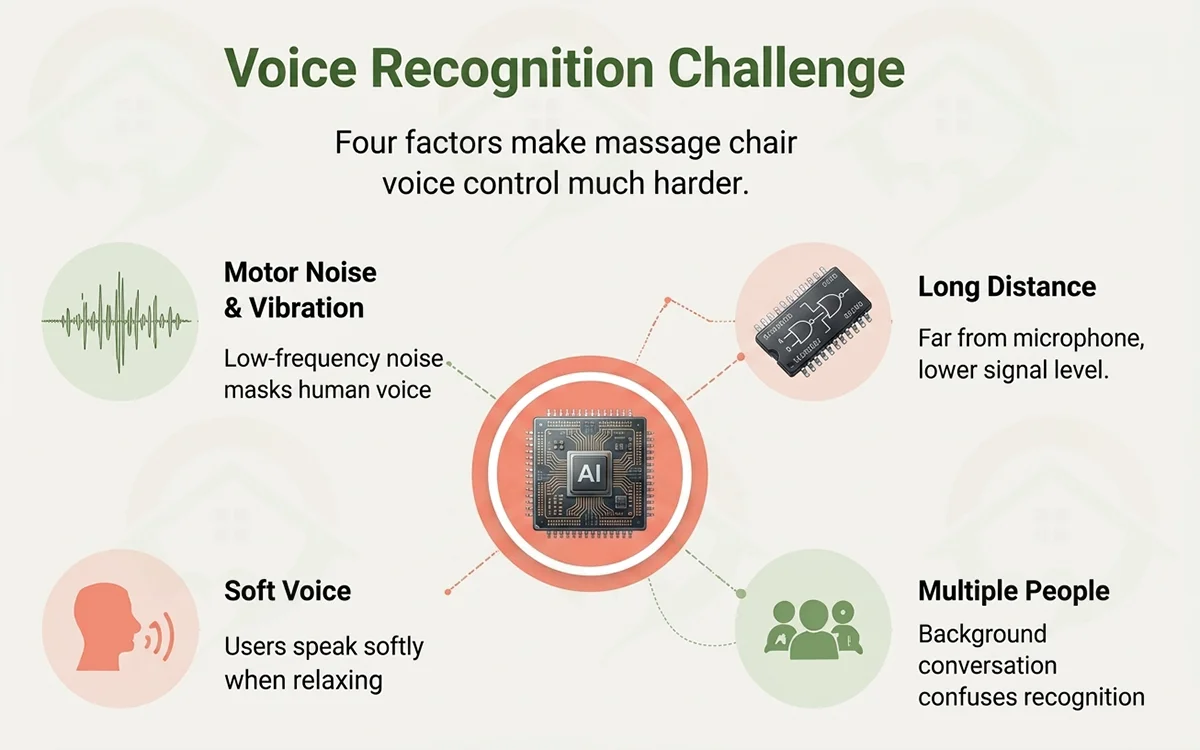
This is not scaremongering. The product shape itself stacks the deck against voice recognition, in four specific ways:
1. The noise source is bolted to the same frame as the microphone. Motor whine, airbag inflation, and the mechanical knock of kneading and tapping mechanisms sit closer to the mic than the user's mouth does.
This is near-field strong noise — a different league from the ambient noise a smart speaker faces.
A smart speaker can move away from the noise; a massage chair generates its own.
2. The pickup distance works against you by design. The user is reclined in the chair; the microphone lives in the headrest or side panel; the body, cushions, and upholstery absorb and block sound along the way.
The effective pickup range required is far longer than on a hand-held device — and there is no way to shorten it.
3. Relaxed users speak softly. Many people close their eyes and murmur "start" or "stop" at low sound pressure — 40–45 dB is typical, close to the ambient noise floor of a quiet room.
A conventional fixed-threshold VAD (voice activity detection) sits right in this dead zone: set the threshold low and a faint breath triggers a false wake; raise it and the whispered command is lost. This is the threshold dilemma, and a massage chair is one of its worst-case environments.
4. Multiple people, multiple voices. Home use means family members talking while someone is in the chair; commercial use means passers-by. Non-target speech is a constant source of false triggers.
What Actually Drags Accuracy Down: A Short Checklist
Beyond the chair-specific problems above, four factors quietly lower accuracy on any voice product — and they compound each other on a massage chair:
Noise and signal-to-noise ratio (SNR). When background noise passes roughly 60 dB, recognition starts dropping measurably.
Industry measurements of speech recognition in noise show the same pattern: systems that hold roughly 95% accuracy in quiet rooms can drop below 70% once HVAC or street noise is present (noise vs. speech-accuracy analysis) — a swing of 25+ points from one environmental variable.
Accents and dialects. Non-standard pronunciation makes recognition models fail to match.
For an exported chair this is decisive: different English accents across markets, and even dialect differences within one market, need to be checked against the chip vendor's training corpus during module selection.
Microphone layout and consistency. Far-field recognition usually relies on a microphone array for sound-source localization and beamforming. That demands tight component consistency — and it raises material cost.
The classic trap: the lab prototype performs beautifully, but mass production drifts on mic or capacitor batches, and field recognition ends up noticeably worse than the tested value.
Offline compute limits. On-device recognition runs on a small local chip with bounded compute and storage, so its adaptability to new words and new accents is naturally weaker than a cloud solution, and it lacks continuous data updates.
How Engineering Handles False Triggers
This is the part that matters most to purchasing and R&D readers, because false triggers are the complaint that feels like the product has a mind of its own. The common causes and the engineering answers:
Common Causes: Words and Thresholds
1. Similar-sounding command words. A poorly designed command vocabulary makes words collide — in Chinese, the word for "start" (kaishi) and the word for "turn on the light" (kaideng) are dangerously close, and the same collision exists in every language if the word list is not reviewed.
Check the list during selection or custom vocabulary design, and confirm the words are distinguishable by the recognition engine — not just by a human reading them.
2. VAD threshold tuning. The speech_noise_threshold parameter sits right at the accuracy-vs-false-trigger line: a smaller value makes the system more sensitive and more noise gets treated as speech; a larger value makes it more conservative and real speech segments get discarded.
It is not a set-once parameter — it needs tuning against the actual use environment, and a supplier who can show you their tuning process for a noisy room is a supplier who has actually shipped these chairs.
In our own bench tests, moving speech_noise_threshold from the vendor default to a value tuned against a running massage chair changed false-trigger counts by an order of magnitude in a 12-hour soak — the parameter is not cosmetic.
The Fixes: Benchmarks and Echo
3. Know the commercial reference number.
For appliance-class products like a massage chair, the commonly quoted commercial false-wake requirement is 1–2 times per 12 hours — a more realistic benchmark than the <1/24h ideal target in the table above, which is quoted for general voice devices.
The voice-engine community publishes methodologies for measuring exactly this trade-off (see, for example, this wake-word benchmark methodology).
It is a useful negotiating benchmark when you talk specs with a supplier — it forces the conversation past "recognition 95%" and onto the number your customers will actually feel.
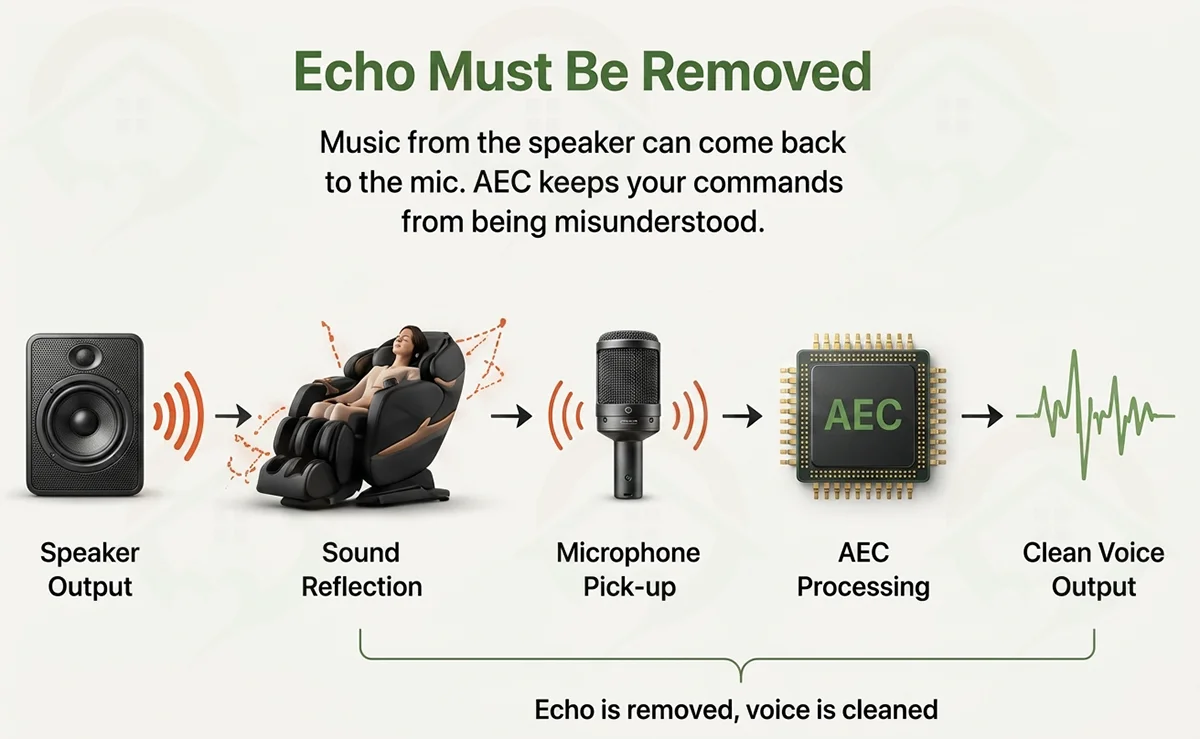
4. Acoustic echo cancellation (AEC), confirmed separately. If the chair plays voice prompts or Bluetooth music, the speaker output can be re-captured by the mic and mistaken for a command. Confirm AEC support explicitly during selection — "noise reduction" in a spec sheet does not include it.
AEC is a real, standardized discipline: the ITU-T G.167 recommendation defines echo-canceller performance requirements, and the WebRTC project documents the AEC implementations used in real-time audio — worth asking which one your supplier's module is tested against.
Why This Matters More Once You're Exporting
| Consideration | Why It Matters for B2B Buyers |
|---|---|
| Accuracy vs. false-trigger numbers reported separately | A single "95% recognition" figure can hide a bad false-trigger rate — the complaint that actually drives returns |
| Whole-chair testing vs. lab data | Recognition must be verified with motors running and upholstery in place, not on a bench |
| AEC on audio-prompt models | Missing echo cancellation turns every prompt or song into a possible false command |
| Command vocabulary & multi-language fit | Similar-sounding words collide; accent coverage varies by module vendor — verify against your actual market |
| Offline vocabulary size & upgrade path | On-device recognition is limited by local chip capability; adding new words later may need a module change |
Three Questions Every B2B Buyer Should Ask Their Supplier
1. Can you give me accuracy and false-trigger rates as two separate numbers, measured on a complete chair with the massage running — not from a component datasheet?
2. Does this model have voice prompts or Bluetooth music? If yes, confirm acoustic echo cancellation explicitly — do not accept "noise reduction" as a substitute.
3. What is the offline vocabulary size, and how do new commands or languages get added after the product ships?
Pro tip: Review the command word list before production. Words that sound alike in your target language will fight each other — "start" and a phonetically close word, for example — and the collision shows up as false triggers no firmware update fixes.
Summary
The small voice board tucked into the corner of the main board is easy to underestimate and easy to get wrong.
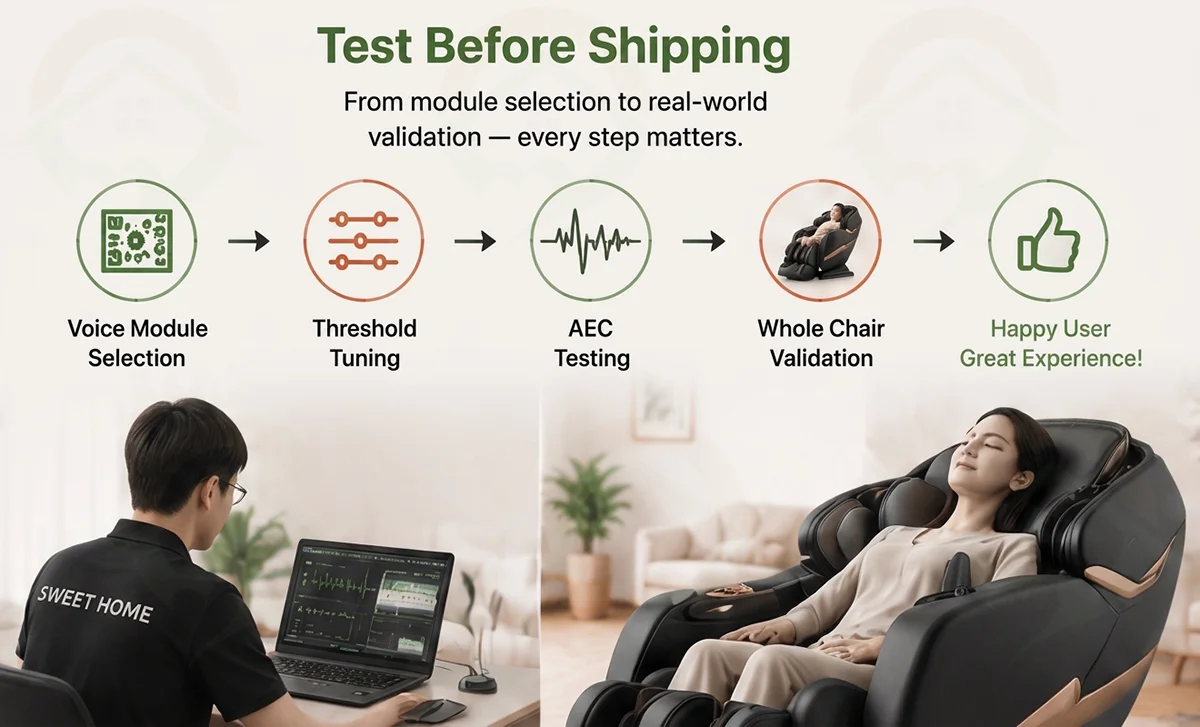
Every chair can claim "voice control"; the difference between "looks intelligent" and "actually works" sits in module selection, threshold tuning, echo cancellation, and testing in the real environment — with the massage running, people talking, and music playing.
Those are the details a buyer should verify before the container ships, not discover in the first customer complaint.
*This is Episode 7.5 of the Massage Chair Control Board series. Previous: Episode 7.4 — Connectors & Signal Integrity.*
Joe Fan
Manufacturing & Product Development Manager · Sweet Home
Sweet Home has manufactured massage chairs since 2013, with in-house R&D and quality-control experience, with deep expertise in SL-track mechanisms, 4D massage systems and OEM export project management.
Disclosure: Sweet Home is the manufacturer behind these chairs, and the service data throughout this series comes from our own repair logs and production line — shared so buyers can recognize these failure patterns before they reach a container.
Quick audit: is your voice control spec complete?
1. Accuracy and false-trigger rates reported separately? 2. Tested on a complete chair, motors running? 3. Echo cancellation confirmed on audio-prompt models?
Two or more unchecked? Send us your current spec.