
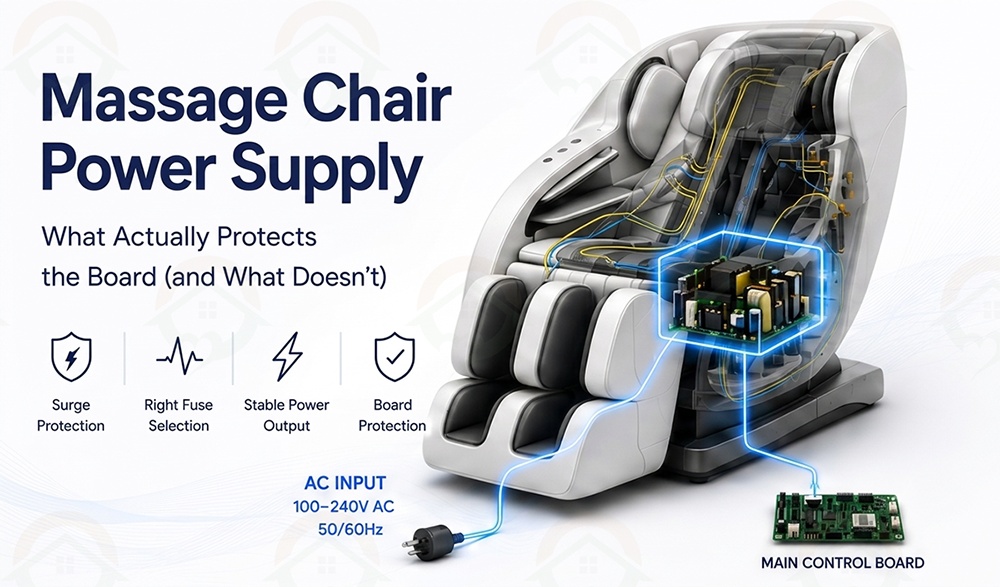
OEM Insights | Massage Chair Components | B2B Guide | Quality Sourcing
What Bothers Real Owners
Every massage chair power supply failure we trace in service starts the same way: the board is dead, but the real culprit sits upstream in the power supply.
In the service tickets we log, the same pattern shows up with used chairs bought at auction: plugged in, no power; pull the fuse and it is blown clean through, the glass blackened on the inside.
Replaced it with a matching fuse, flipped the switch, and it blew again, this time with a visible flash and a faint smell of burnt plastic. That's usually where an owner gives up and calls it "defective." This buyer kept going.
With the cover off and a multimeter in hand, the fault traced back to a component sitting right behind the power cord connector: a small yellow capacitor with a hole burned straight through it, discolored on one side.
Next to it sat another part that had failed first — a metal-oxide varistor (MOV), its body cracked and blackened, having shorted itself out before the capacitor took any damage.
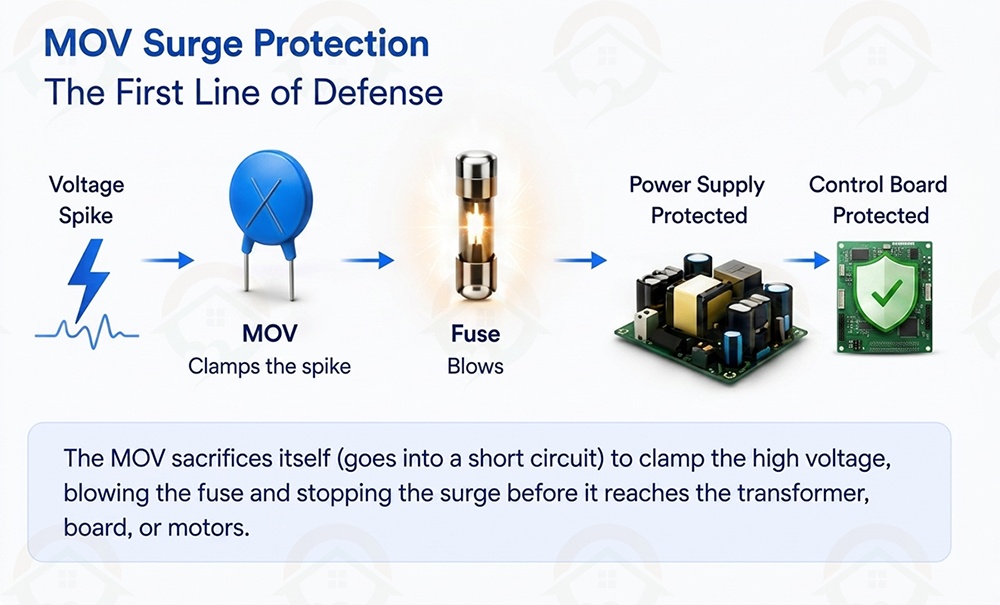
That MOV is designed to fail. It's a sacrificial part: when a voltage spike hits the circuit, it clamps the spike by going into a short circuit itself, which pulls enough current to blow the fuse and cut power before the surge reaches the transformer, the control board, or the motors.
The hole and the soot weren't a manufacturing accident — that's a component doing exactly the job it was built for, at exactly the moment it was built to do it.
Most owners never open the chair up far enough to see any of this — the chair either works or it doesn't, and when it doesn't, the assumption is always "cheap parts." For B2B buyers, though, the power supply is one of the least glamorous sections of a chair to spec, and one of the most
expensive places to get wrong once an order is already sitting in a container on its way to a market you don't get a second chance to test in.
What's Actually Inside a Massage Chair Power Supply
Strip the housing off and there are four decisions that determine whether the unit lasts eight years or eight months.
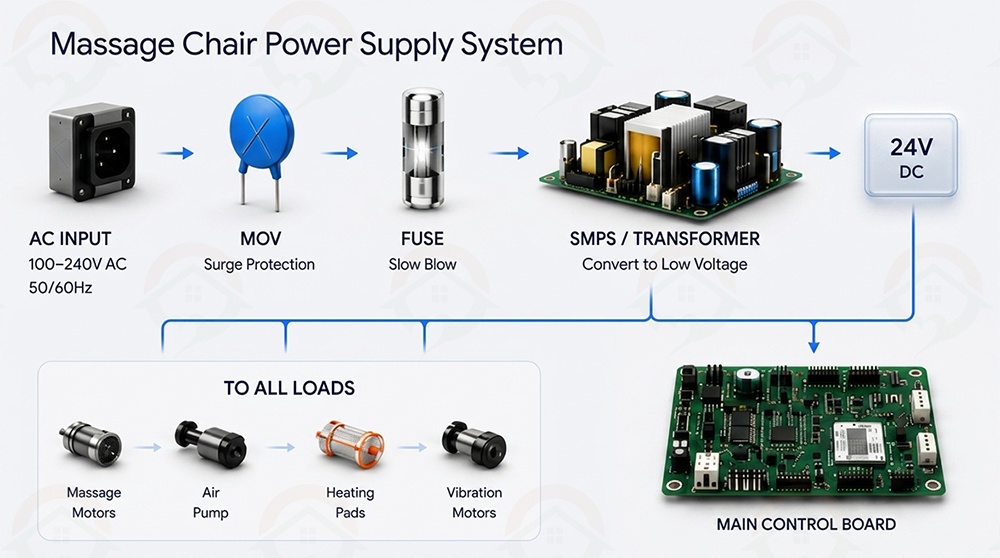
1. Transformer or Switching Power Supply (SMPS)
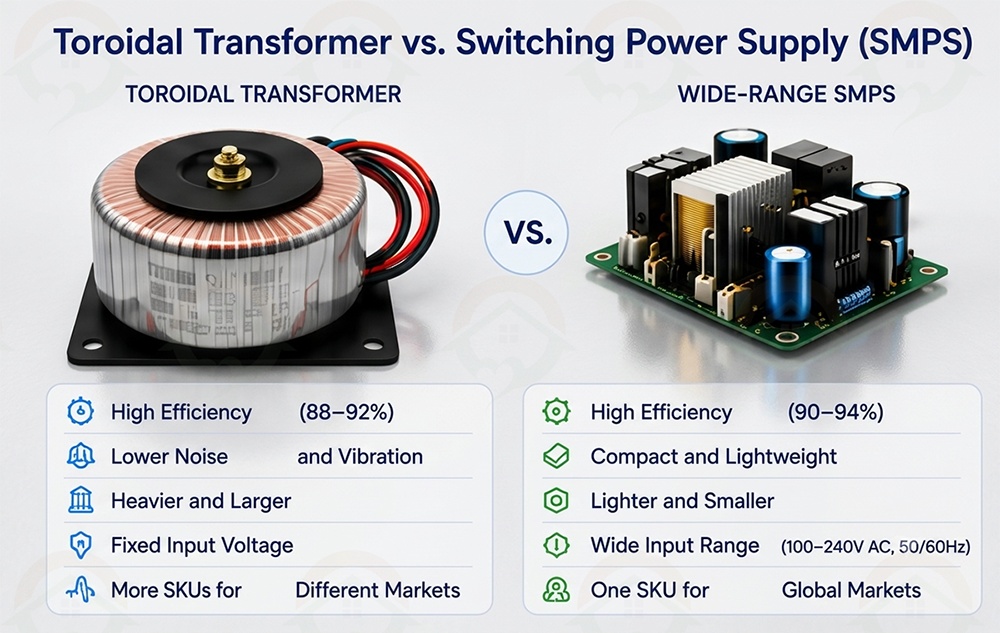
The difference is measurable on a real spec sheet.
That is the difference between one SKU for global markets and three fixed-voltage transformers.
When you're evaluating an OEM partner, ask this question directly: are they using SMPS or fixed-voltage transformers? The answer tells you whether they've thought about multi-market export at the component level.
2. Surge Protection (MOV)
The varistor from the story above.
Its clamping voltage has to sit above normal operating voltage — otherwise it nuisance-trips on ordinary grid fluctuation, which reads to a customer as "the chair keeps randomly cutting out" — but below what the downstream capacitors and control board can actually survive, or a real
surge gets through anyway.
The protection package matters just as much as the clamping number: our SEPS150 adds output over-current protection (trips above 11A), over-temperature protection (IC temperature 130–155°C, auto-recovery once ambient drops back inside range), and ≥10ms hold-up time so the board keeps
clean power through brief grid dips. None of this shows up in the wattage on the label.
It's not a detail most buyers think to ask about, but it's one your supplier should be able to answer with a joule rating and a clamping voltage, not a shrug.
3. Fuse Type and Rating
Motors draw a short spike of current — inrush current — at the moment they start up, several times higher than their steady running current.
A fast-blow fuse, selected only against the running current on the spec sheet, sees that startup spike and trips immediately: it does exactly what a fast fuse is built to do, and the chair "keeps cutting out" on every single power-on, which gets reported as a defect when the real cause is a
mismatched fuse curve.
On our own spec sheet, the SEPS150 input inrush current is rated ≤50A at 264V AC cold start, tested per ETSI EN300132-1.
That number is exactly why the fuse curve has to be chosen with headroom — not against the 2.5A maximum steady-state input current, but against the startup spike the motor and transformer draw for the first few milliseconds.
A slow-blow (time-delay) fuse is built to ride out that brief inrush spike without tripping — the standard approach for motor circuits, per Littelfuse fuse selection guidance, while still cutting power fast enough to protect the circuit against a genuine sustained overload or short.
Massage chair power supplies need this fuse type specifically — matched with headroom for the motor's actual startup current, not just its running load — or the chair fails its very first power-on in the customer's home, before anything is even wrong with it.

4. Total Load and Headroom
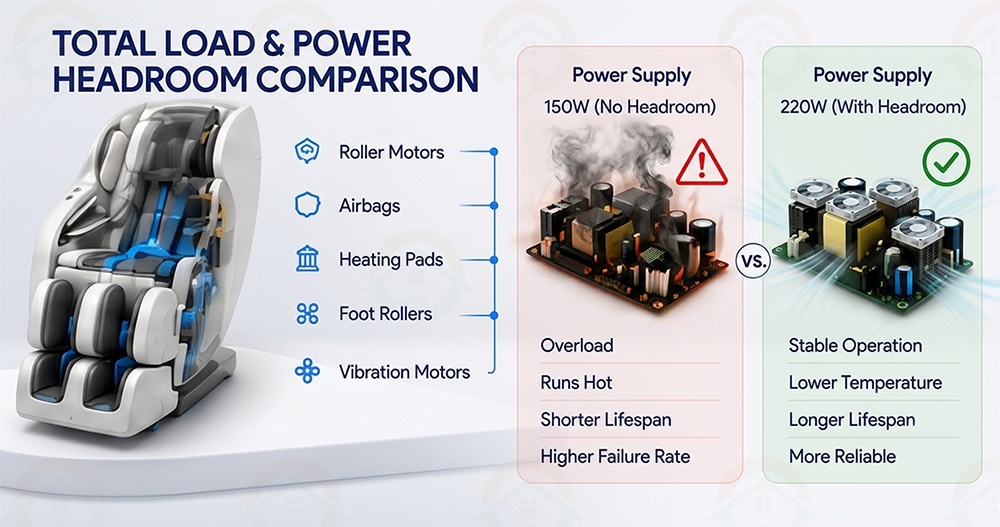
A full-body chair running rollers, airbags, heating pads, and vibration motors at the same time draws meaningfully more than any single function tested in isolation on a factory bench.
This is where headroom either exists or doesn't, and the difference is stark: a power supply rated at exactly the combined peak load — say, 150W with no margin — runs into overload territory the moment every function fires at once, runs hot, ages faster, and shows a measurably higher
long-term failure rate. Rate the same chair's power supply at 220W with real headroom above the peak combined draw, and the same components run at stable operating temperature, age normally, and hold a meaningfully lower failure rate over the same service life.
owners stop thinking about it.
Why This Matters More Once You're Exporting
Voltage standards and grid conditions are not the same everywhere, and a power supply that never gives a single owner trouble in one market can start failing early in another running the exact same hardware:
A power supply spec'd around one market's grid conditions can test perfectly in a showroom and still fail early once it's running on a less stable grid somewhere else.
If you're sourcing for multiple regions out of one factory, this is worth a specific, numbers-based conversation with your supplier — not something to assume is "the same everywhere" just because the wattage on the label matches across every unit in the container.

Three Questions Every B2B Buyer Should Ask Their Supplier
- Is the power supply a wide-range SMPS (100–240V, 50/60Hz), or a fixed-voltage transformer?
- What is the MOV's clamping voltage and joule rating, and has it been tested against the grid conditions of the destination market — not just against a lab bench with clean, stable power?
- Is the fuse a slow-blow type rated with headroom for the motor's inrush current, or a standard fuse rated only for steady-state load? This single answer predicts whether a batch of chairs will trip on their very first power-on.
Browse our product catalog to see how these specifications are implemented across our massage chair range.
Summary: What Actually Matters
Reliability is the part nobody photographs: our SEPS150 is rated MTBF ≥10,000 hours under Bellcore stress methodology (25°C, rated input, full load), with a failure rate target under 1% — and it is tested for low/high temperature storage, damp heat, temperature cycling, and random
vibration before it ever ships.
What decides whether a power supply survives normal grid fluctuation for a decade or dies six months into daily use is the transformer type and its efficiency, the surge protection margin and how it ages, the fuse curve matched against real inrush current, and whether genuine headroom was built in
for real combined load — not the wattage printed on the label or the country of the certification sticker.
Your customers won't ask about any of this before they buy.
They'll ask when the chair won't turn back on after a storm knocked the power out for ten minutes, or when it trips the breaker every morning for no obvious reason — and the difference between "it reset fine" and "the board is dead" was decided at the sourcing stage, long before it ever
became a problem in someone's living room.
Electrical System Deep Dive Series
This is Episode 6.0 — the first in our Electrical System series. Upcoming:
Joe Fan — Manufacturing & Product Development Manager
Sweet Home has manufactured massage chairs since 2013, with R&D, production, and export quality-control experience — including SL-track systems, 4D mechanisms, and zero-gravity engineering.
Disclosure: Sweet Home is the manufacturer behind these chairs, and the service data throughout this series comes from our own repair logs and production line — shared so buyers can recognize these failure patterns before they reach a container.
Quick audit: is your power spec complete?
1. Power supply type (transformer/SMPS) stated? 2. Voltage config matches your market? 3. Safety certifications available?
Two or more unchecked? Send us your current spec.
Coming up in EP7.0: The Control Board — The Brain That Ties It All Together
A clean power supply feeds the board. The control board interprets commands, coordinates motors, manages air pump timing, and reads body scan sensors — all while monitoring current consumption and fault states.
We'll break down what separates a board that survives voltage dips from one that bricks itself on a brownout.
Contact our team for a full component datasheet — not just a wattage number — or message us directly on WhatsApp or email. Factory visits welcome.