
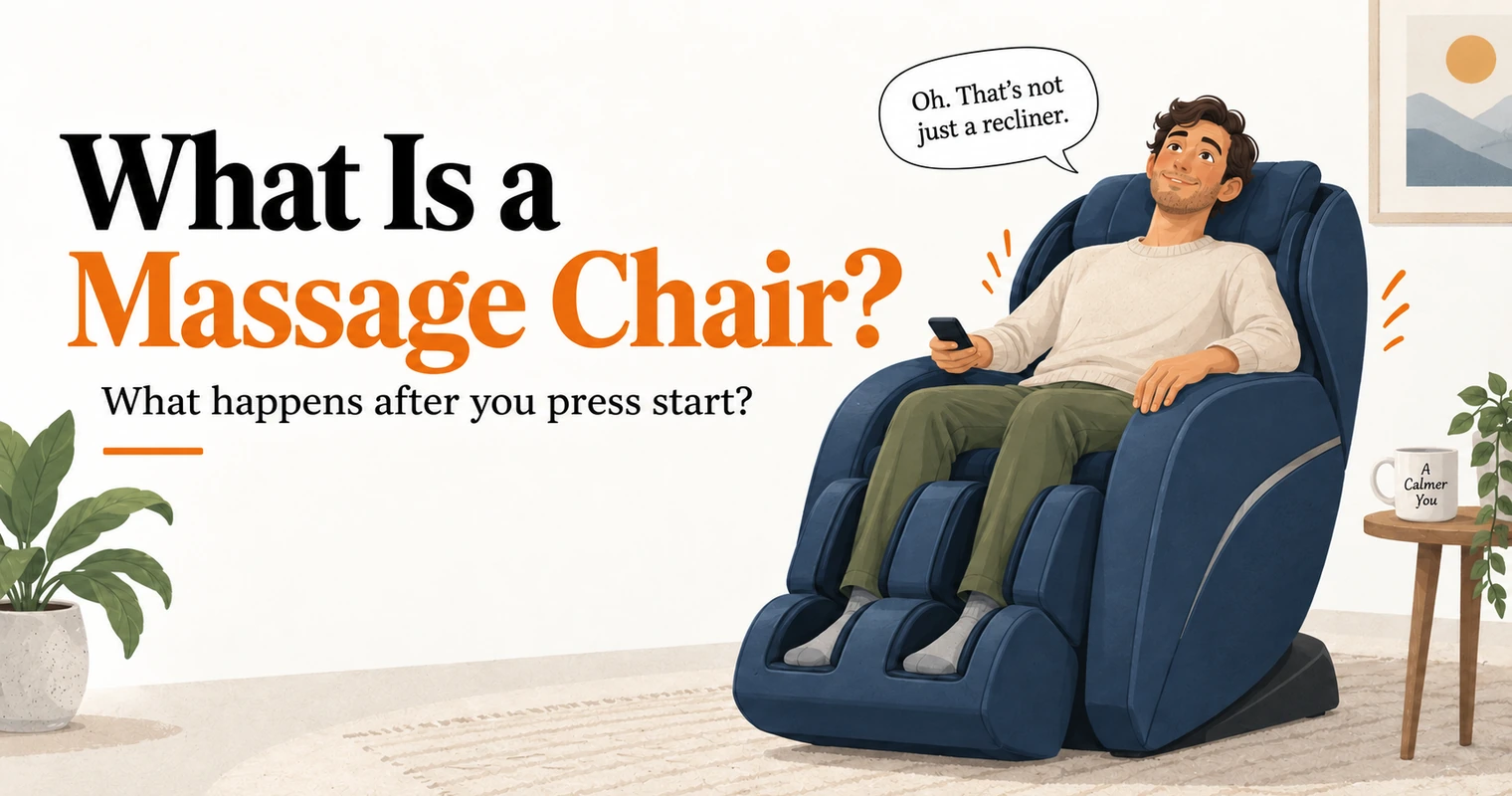
From across the room, a massage chair looks like a rather large recliner. Then you press Start, something begins kneading your back, and the padded sides give your calves a squeeze.
Right. Not just a recliner.
A massage chair uses powered rollers, air cushions or other moving parts to apply pressure to your body while you sit. Some concentrate on your back. Others add massage around your arms, calves and feet, along with reclining positions and optional heat.
That’s the basic idea. The interesting part is how those pieces work together—and why one chair can feel quite different from another.
What’s Doing the Massage?
That moving pressure behind your back usually comes from rollers hidden beneath the upholstery. Depending on the mechanism, they can knead, tap or roll along your back. The padding between you and the rollers helps shape how the pressure feels.
In chairs with a travelling mechanism, a track guides those rollers. Its shape and length help determine where they can reach. Other designs use massage heads that stay in fixed positions.
The squeezing around your arms or legs comes from airbags: soft chambers that inflate and release. They don’t knead like rollers. Think of a padded cuff gently tightening, then letting go.
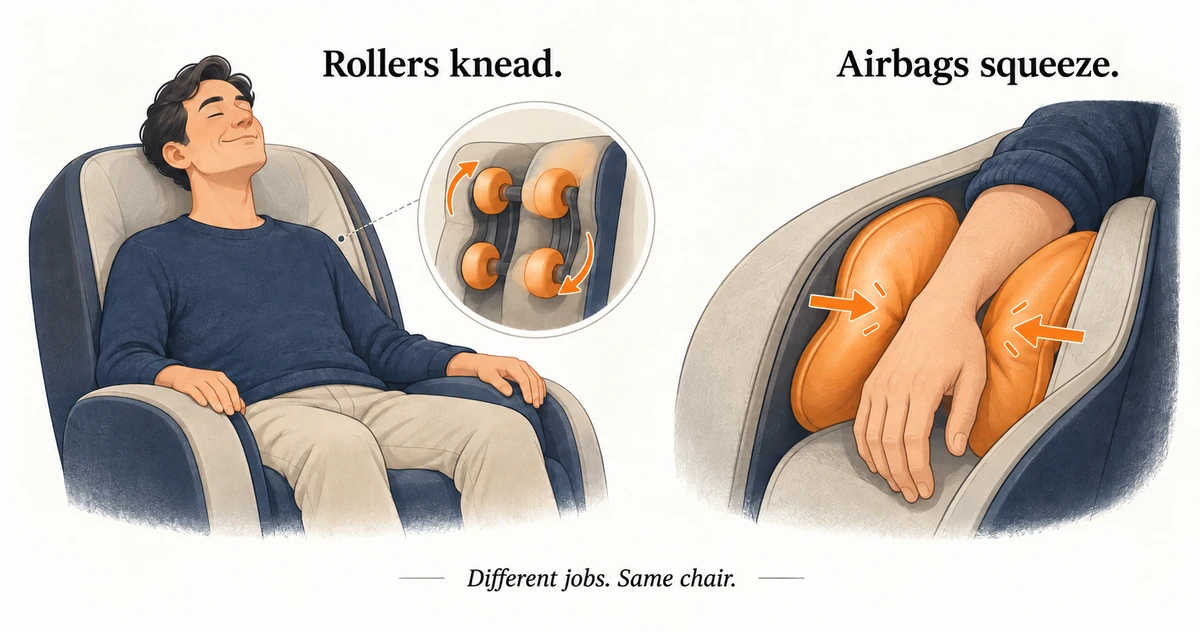
Rollers and airbags do different jobs. A “full-body” chair does not necessarily use rollers everywhere.
The control system puts these actions into a programme. It decides when the rollers move, when the airbags inflate, and how the sequence changes. Heat and vibration may be included too, depending on the model.
So that single button is really starting a series of small, coordinated actions.
Isn’t That Just a Recliner With Extras?
A regular recliner changes your sitting position and supports you while you rest. A massage chair adds moving pressure.
That difference becomes obvious when you sit in one. Leaning back is one sensation; feeling rollers work along your back is another.
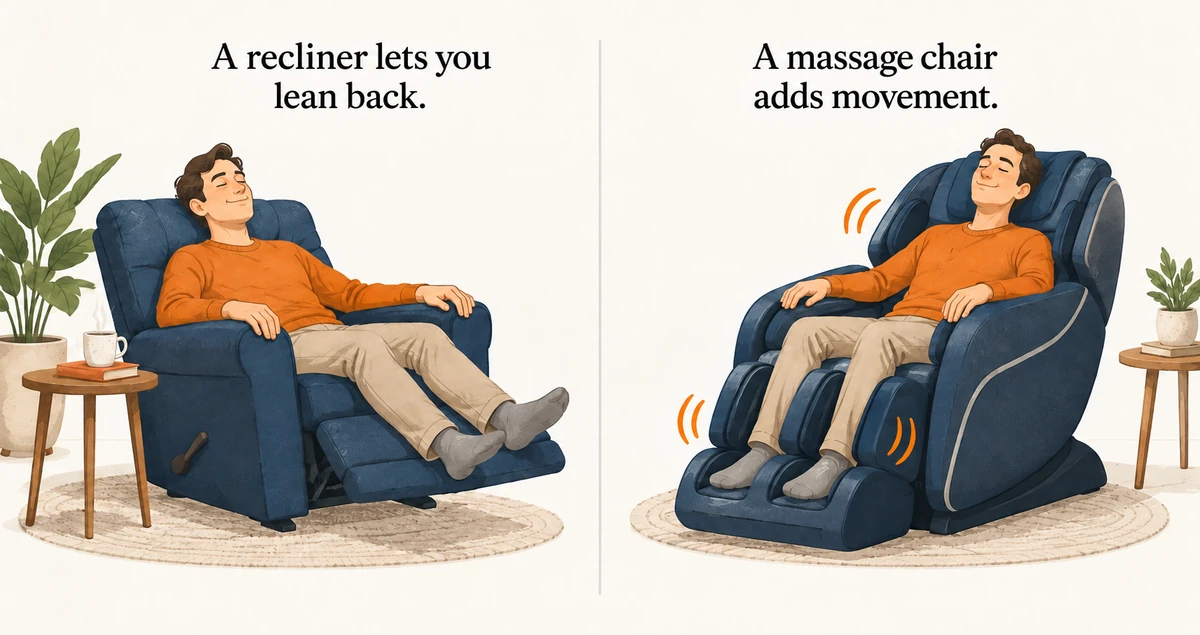
There is a trade-off, though. The contours and compartments that help position your body for massage may not be what you want for an entire evening watching television. A massage chair isn’t automatically a better everyday armchair.
Why Would Someone Want One at Home?
Often, it’s the convenience.
After a day at a desk or on your feet, having a chair ready in the next room can be appealing. No appointment to arrange. No journey home afterwards. Just a break that fits into your evening.
The appeal isn’t limited to a particular age group. One person wants a quiet pause after work; another simply enjoys the sensation of a massage. Not everyone wants the same pressure, either. Your favourite setting may be the one someone else immediately turns down.
A chair still isn’t a massage therapist. It follows programmes and adjustments; it cannot have a conversation about a sore spot or make a clinical judgement. Relaxation is a reasonable reason to use one. Diagnosing or treating a health problem is a different matter.
Why Can Two Chairs Feel So Different?
Because a feature list leaves a lot out.
Two models can both offer kneading and air compression, yet differ in roller movement, cushioning, airbag placement and programme timing. One may feel smooth and measured. Another may feel too abrupt for your taste.
Then there’s fit. Your shoulders, calves and feet need to sit where the chair is designed to work. A taller person and a shorter person can have quite different experiences in the same model.
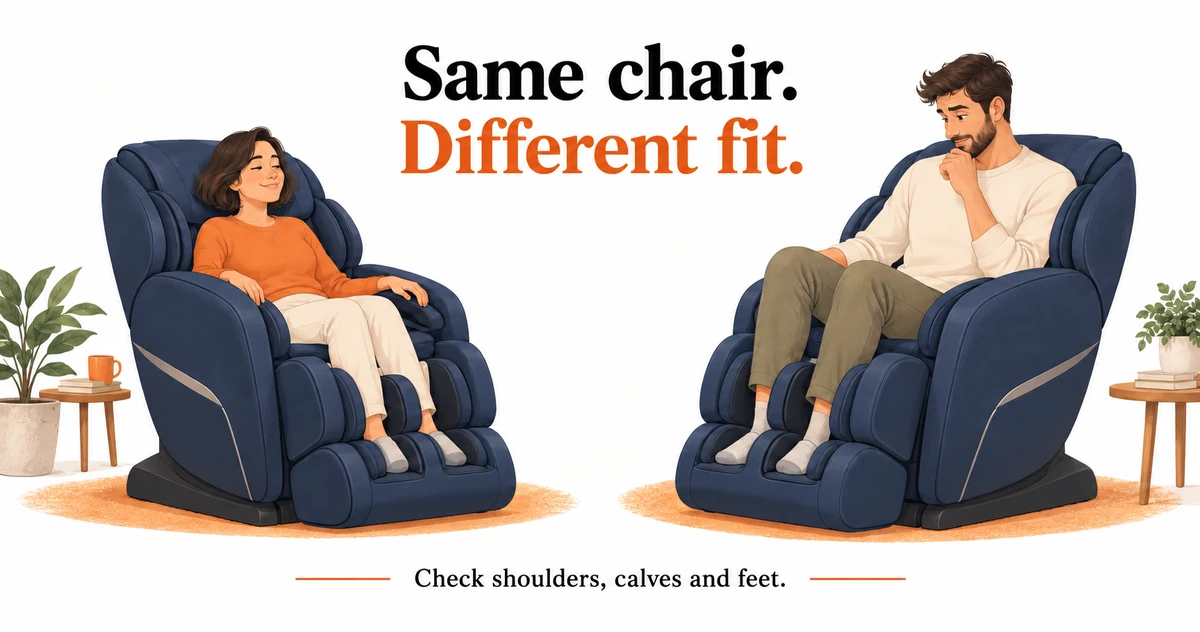
Check how your body fits the chair, not just how the chair fits the room.
If you try one, pay attention to a few ordinary things: Does the back massage reach the places you expected? Can you adjust the pressure comfortably? Does the leg rest accommodate your legs without making you feel cramped?
Those answers tell you more about your experience than a long list of programme names.
The Part Worth Remembering
A massage chair brings a repeatable massage routine into a seat. Rollers, airbags and controls do the work, but whether you enjoy it depends on how they work together—and how the chair fits you.
When you try one, don’t spend the whole session studying the remote. Put it down for a moment and notice how the chair feels.
Prepared by Sweet Home Technical Team
Cindy
Sweet Home Technical Team
Part of Sweet Home’s in-house technical team. Cindy writes our Knowledge content — how a massage chair works, what sits inside it, and what to check before you buy — built on our engineering documentation and after-sales records.
Disclosure: Sweet Home is the manufacturer behind the massage chairs described here, and the technical details in this article come from our own engineering and production experience.
Quick audit: is your massage chair spec complete?
1. Rollers plus airbags, not one or the other? 2. Fit checked for the people who will actually use it? 3. Test data available on request?
Two or more unchecked? Send us your current spec.