
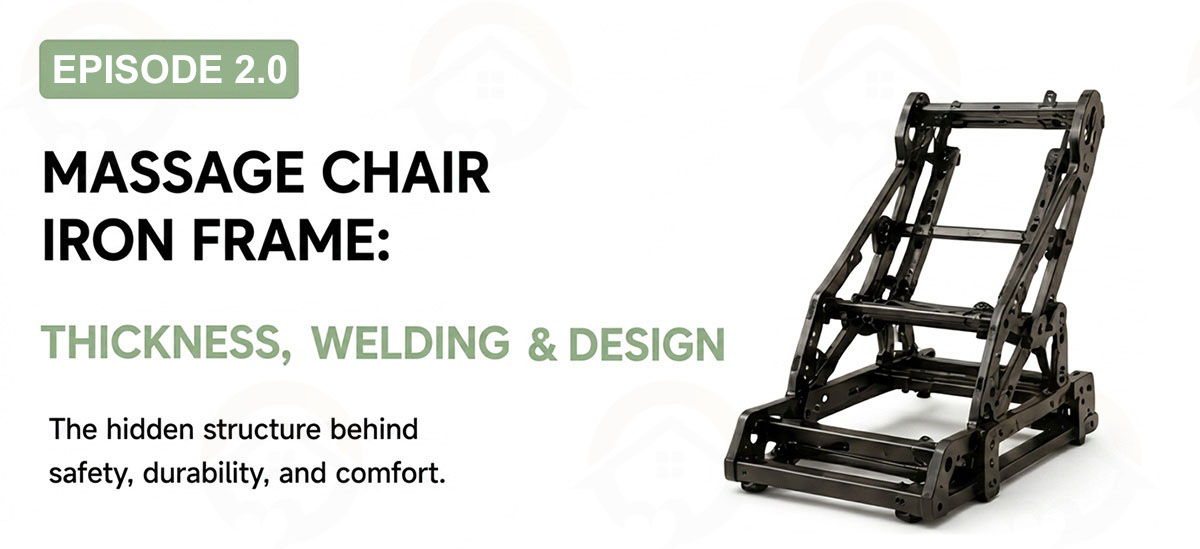
This is Episode 2 of our Frame & Structure Deep Dive series. In this guide we go deep on the iron frame — the component most importers overlook until it fails — covering steel thickness, welding process, and structural design.
Reality Check: It's Steel Tube or Wood-Hybrid — That's It
Here's the first thing you need to know: in reality, massage chair frames come in exactly two types.
- All-iron frame (steel tube frame): the entire load-bearing structure — backrest frame, seat frame, legrest frame, armrest supports, base — is constructed from welded steel tubing.
- Wood-iron hybrid: the base and some internal bracing are steel, but the side panels and seat platform are plywood with iron brackets connecting them.
Some sales reps will throw around terms like "reinforced alloy frame" or "multi-layer composite chassis." It's just steel tubing, welded into a frame. Don't let anyone confuse you with fancy names.
The distinction that actually matters is one word: cost. Hybrid frames are cheaper because wood side panels can be CNC-routed quickly and thinner-gauge steel can be used.
But they also introduce a failure mode that all-iron frames don't have: wood-to-metal joint loosening after repeated loading cycles.
Does that mean you should never buy a wood-hybrid frame? No. Plenty of mid-range chairs use them successfully. But you need to know the three dimensions that determine frame quality regardless of type.
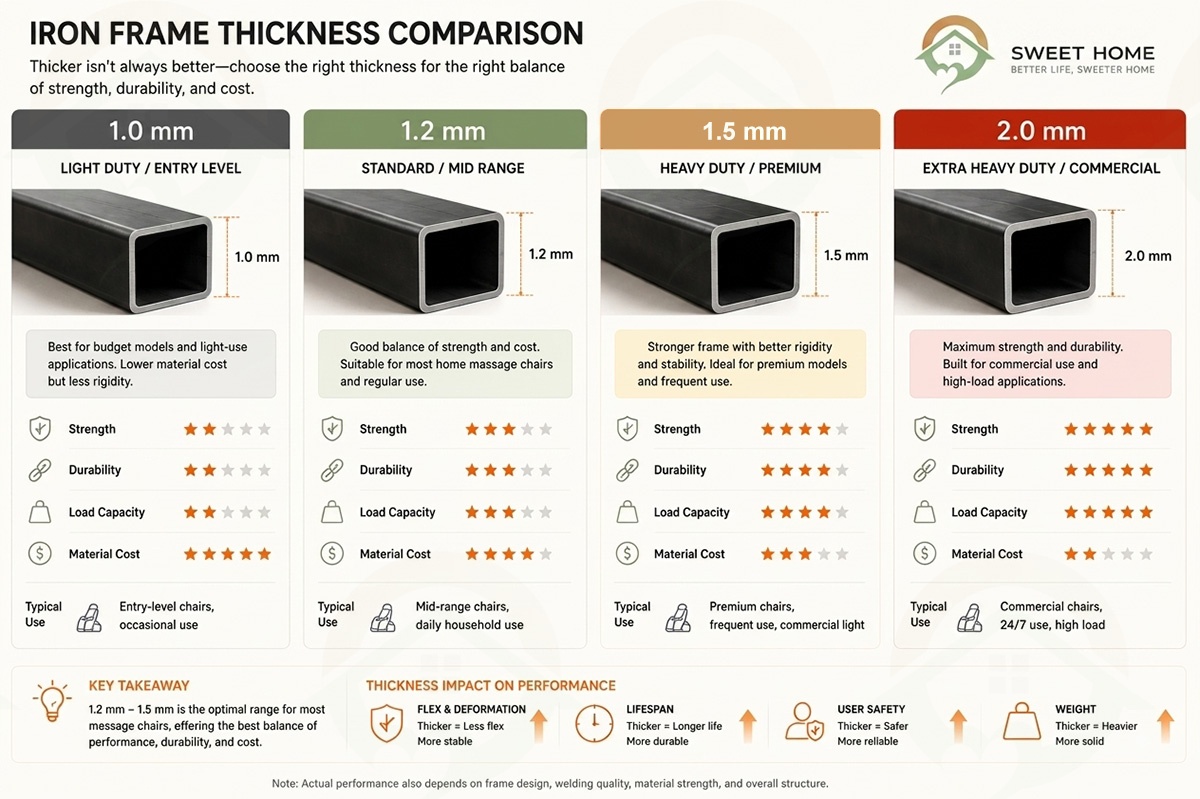
Dimension 1: Steel Thickness — The Number Nobody Volunteers
The single most important spec on any massage chair iron frame is the wall thickness of the steel tubing. And it's the one spec suppliers are least likely to volunteer unless you ask directly.
| Wall Thickness | What It Means | Typical Use Case | Durability |
|---|---|---|---|
| 1.0mm | Ultra-thin, minimal load | Ultra-budget, short-life | Low — bends under load |
| 1.2mm | Entry-level, moderate strength | Budget residential, light use | Fair — OK for home use |
| 1.5mm | Industry standard wall | Mid-range to premium residential | Good — standard for quality |
| 2.0mm | Heavy-duty reinforced | Premium commercial, high-traffic | Excellent — longest lifespan |
Here's the B2B takeaway: you don't need 2.0mm everywhere. That adds weight, shipping cost, and unnecessary material expense.
What you need is strategic heavy gauge at stress points — the legrest hinge tube, backrest pivot, and zero-gravity actuator mounts. A well-designed frame uses 2.0mm at those three points and 1.5mm everywhere else.
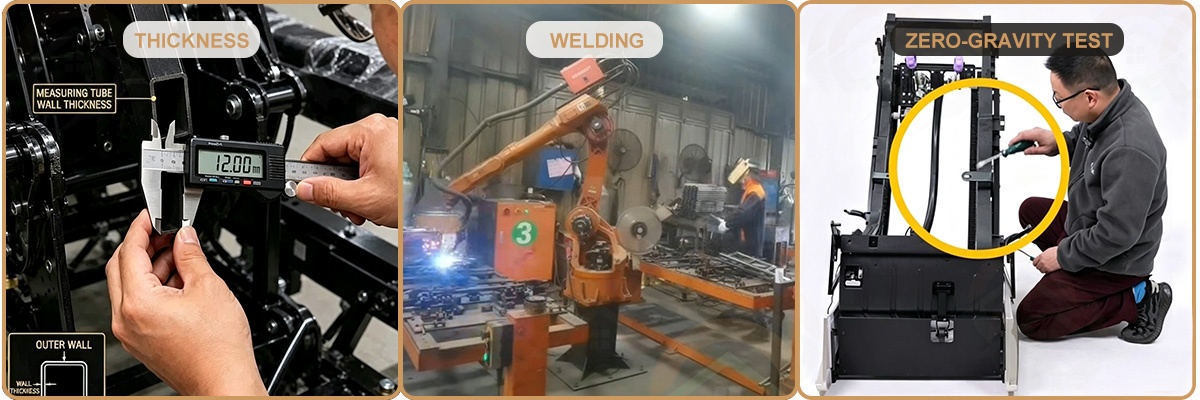
When evaluating samples, bring a caliper. Measure the tube wall thickness at open tube ends. If the supplier won't disclose gauge numbers, measure it yourself.
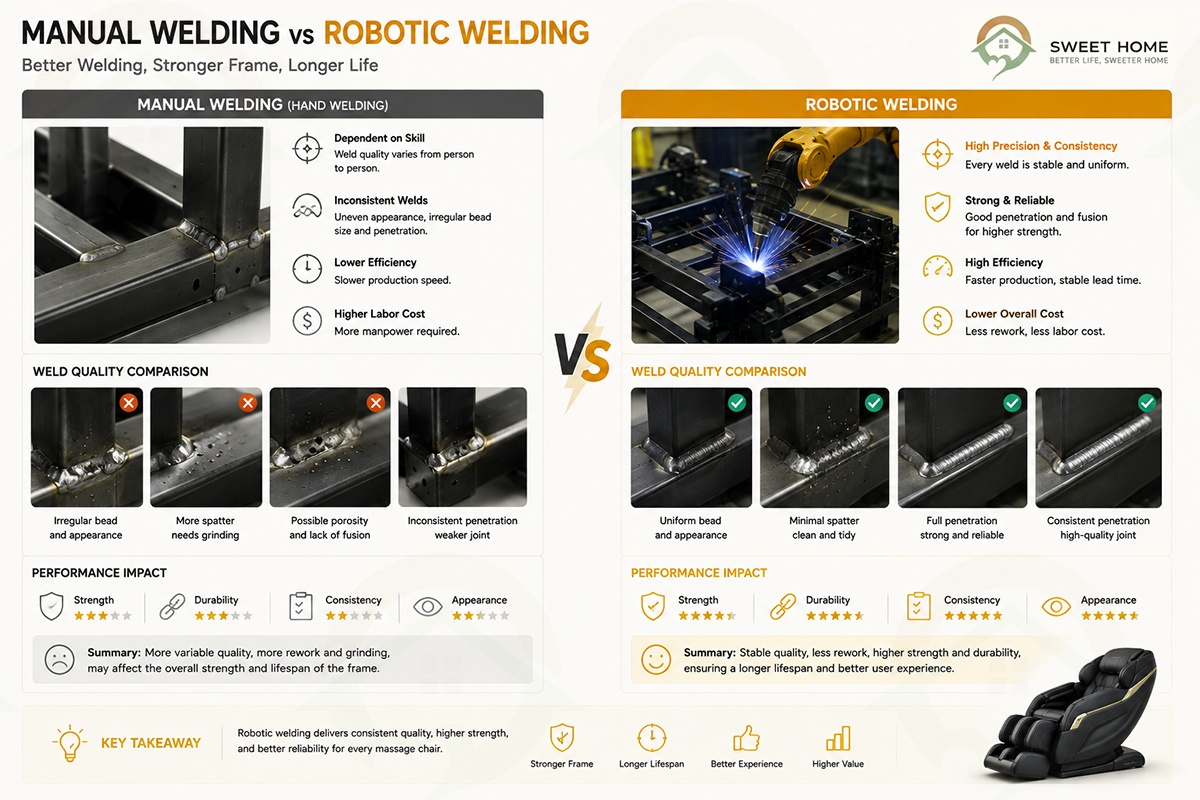
Dimension 2: Welding Process — Manual vs Robotic Arm Automatic Welding
Look at a massage chair iron frame failure photo again. The weld bead looks lumpy, irregular. The break occurred right through the weld itself. That's textbook manual welding — inconsistent penetration, likely done too cold, on a tube too thin for the load.
Manual Welding
- Penetration depth varies from weld to weld. A welder on hour seven of a shift is not as consistent as hour one.
- Heat input is inconsistent. Too little = cold lap (weak joint). Too much = burn-through (stress risers).
- Porosity and slag inclusions are common — tiny bubbles that act as crack initiation points.
Robotic Arm Automatic Welding
- A six-axis robotic arm follows a precise path at constant speed, maintaining consistent arc length and wire feed. Every weld on every frame is identical.
- Penetration depth is calibrated: for 1.5mm tube, typically 1.2-1.8mm penetration — full fusion without burn-through.
- The weld bead is uniform. No starts and stops mid-seam because the robot doesn't get tired or reposition.
- In our weld-QC records, robotic-line defect rates run roughly an order of magnitude below the manual baseline — across the last four production quarters, rework on robotic welds has stayed under 2%, while manual stations typically need 8-15% rework on the same joint types.
Why does this matter for you? They come from a weld joint cracking. And weld joint quality is a function of consistency, which is a function of process control.
Robotic welding gives you the same weld quality on batch 5,000 as batch 1.
Dimension 3: Structural Design — The Zero Gravity Test
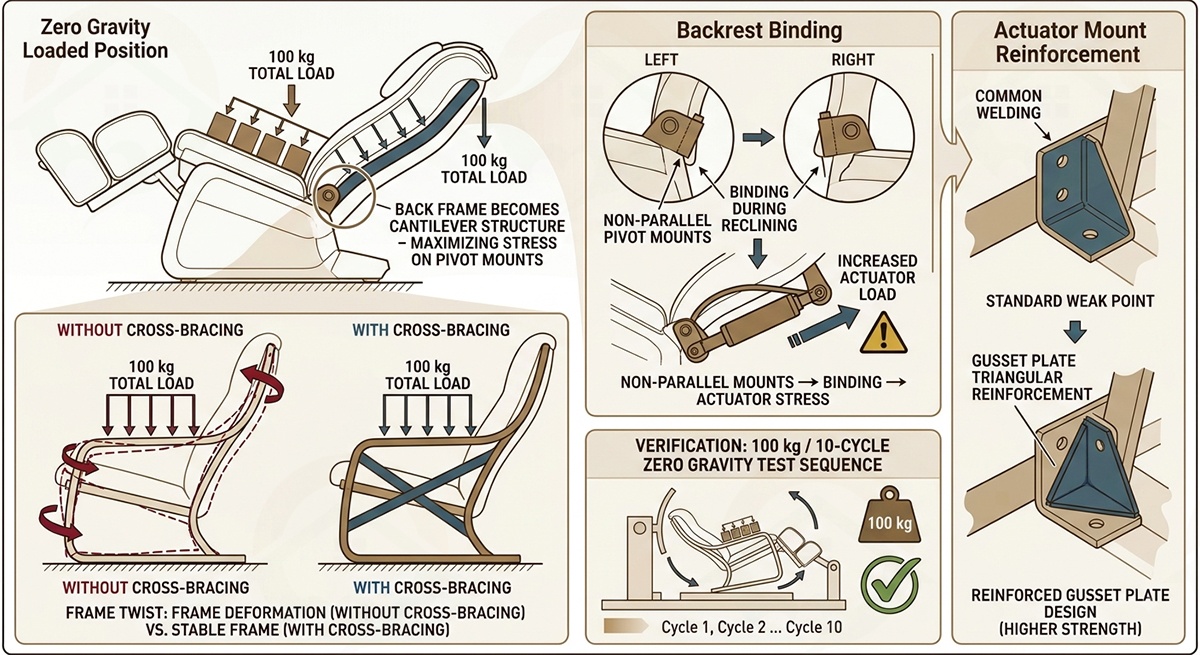
This is where design separates the engineers from the metal fabricators: how the frame handles the zero gravity position.
When a massage chair reclines into zero gravity, the entire load distribution changes. In our load-test measurements, the backrest frame acts as a cantilevered beam supporting roughly 60% of the user's body weight. This creates three mechanical challenges:
Frame Twist
If the frame lacks sufficient cross-bracing — horizontal tubes connecting left and right side rails — it twists under load. You feel this as a subtle wobble in full recline. Over time, this twist fatigues the welds at frame corners, eventually causing cracks.
Backrest Binding
If the pivot mounts are not perfectly parallel, or if the pivot tubes flex under load, the backrest binds during recline. The linear actuator has to push harder, which overheats the motor and strips the actuator screw.
Customers report "grinding noises when reclining" — that's binding, and it starts with frame design.
Actuator Mount Reinforcement
The reclining actuator exerts significant force through its mounting brackets. On a 1.0mm tube with a single manual weld bead, those brackets will tear out.
Proper design uses gusset plates — triangular steel reinforcements — at actuator mount points, distributing force across a larger area.
During your factory inspection, ask to see a chair cycle through zero gravity 10 times in a row while loaded with a 100 kg test weight. If there's any creaking, grinding, or visible frame movement at the pivot points, the structural design isn't there yet.
The Bottom Line for Importers
The massage chair market is saturated with brands that look identical on the outside — and the iron frame is what separates them in year three. The difference that determines whether your customers are happy in year three or posting on Reddit in year two is under the upholstery, in the frame.
1. Know your gauge. Specify minimum 1.5mm for load-bearing tubes, 2.0mm at pivot points. Put it in the PI contract.
2. Verify the welding process.
3. Test zero gravity. Not once. Twenty times. Loaded. If the frame binds or makes noise, walk away.
4. Don't overpay for 2.0mm everywhere. Strategic reinforcement beats uniform over-engineering.
The frame is the one component you can't easily fix after shipping. Get it right at the source.
Ask your supplier how they document weld inspection and load testing — the same process-discipline question a manufacturing standards audit would ask.
Frame & Structure Deep Dive Series
Joe Fan — Manufacturing & Product Development Manager
Sweet Home has manufactured massage chairs since 2013, with R&D, production, and export quality-control experience — including SL-track systems, 4D mechanisms, and zero-gravity engineering.
Disclosure: Sweet Home is the manufacturer behind these chairs, and the service data throughout this series comes from our own repair logs and production line — shared so buyers can recognize these failure patterns before they reach a container.
Quick audit: is your frame spec complete?
1. Frame material and welding process specified? 2. Zero-gravity structural test data available? 3.
Two or more unchecked? Send us your current spec.