
Heat therapy in a massage chair is a supporting function, not a treatment on its own — and that is exactly why it works. Warmth softens tissue before the rollers arrive, so the mechanical part of the massage meets less resistance.
That single idea answers most of what buyers ask us about heated models: whether the heat is strong enough, why a spec sheet lists heating zones at all, and why two chairs with the same roller system can feel completely different after twenty minutes.
This article covers how a massage chair produces heat, what the warmth actually contributes, which zones matter in real use, and what to write into a purchase order so the function you tested is the function that arrives.
How Heat Therapy Works Inside a Massage Chair
Warmth Is a Companion Function, Not the Main Event
The massage itself comes from a mechanism: rollers travelling a track along the back, plus airbags that compress the arms, hips and legs. Heat adds a second, slower layer of stimulation on top of that movement, and it never leads the program.
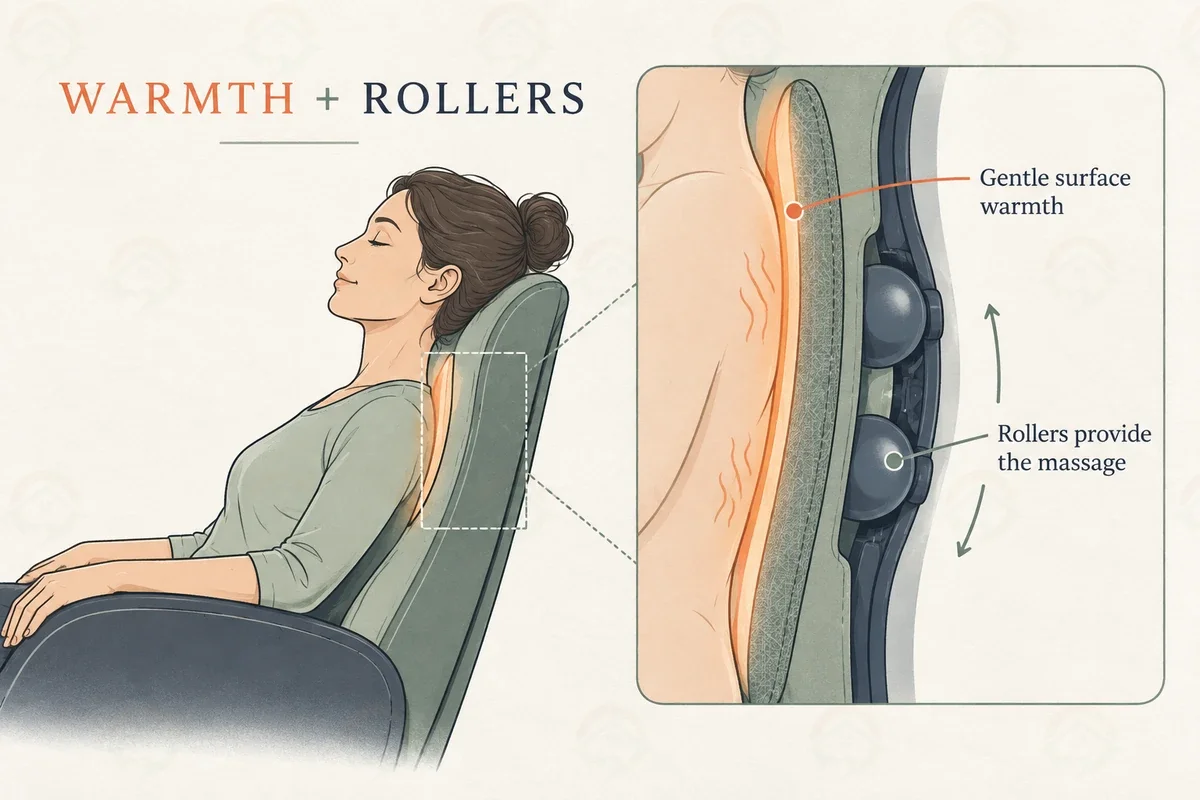
Warmth softens tissue before the rollers arrive, so the mechanical part of the session meets less resistance. That is why a heated chair should not feel hot — it should feel like the massage is easier to sink into.
What the Chair Is Actually Doing While It Heats
In most full-body chairs the warming element sits close to the surface of the backrest or the leg rest, and its output is regulated by a temperature sensor rather than a simple on/off switch. The controller reads surface temperature and trims power to hold it inside a set band.
That control loop is the part buyers never see, and it decides how the feature behaves in year three. A regulated element drifts less and cycles less, so the highest setting stays comfortable instead of feeling sharp at first and flat later.
An independent thermal cut-off sits alongside the control loop. It is a safety layer rather than a comfort setting, and it belongs in the model’s compliance file — see the section on thermal protection below.
Why the Warmth Feels Gradual Rather Than Intense
Heat applied at the surface is transferred inward over time. That delay is the whole character of heat therapy: it is a slow, cumulative sensation, which is why heated massage reads as relaxing rather than forceful.
The Benefits, Explained Without the Hype
Massage chairs are wellness products, not medical devices, and nothing here should be read as a treatment claim. What follows is what warmth reliably adds to a session, stated at the strength the evidence supports.
Does heat improve circulation?
Warmth on the skin promotes local vasodilation — widening of blood vessels close to the surface — which is why an area feels warmer and looser afterwards. That is a normal response to heat, not a therapy in itself, and it is local rather than whole-body.
For a neutral, non-commercial summary of what massage can and cannot claim, the U.S. National Center for Complementary and Integrative Health keeps a plain-language overview of massage therapy. It is a useful counterweight to copy written on both sides of the argument.
Why muscles release more easily when they are warm
Tissue that is warm and well supplied with blood tends to give way more gradually under pressure. In practice this means the same program can feel deeper without the mechanism working harder — one reason heated models are often described as gentler in the first ten minutes.
Better contact between rollers and muscle
A relaxed back is a back the rollers can follow. When the surface tissue is soft, the mechanism tracks the spine and shoulder blades more closely, so less of the stroke is spent compressing a rigid area.
Where tension actually builds: the back and the calves
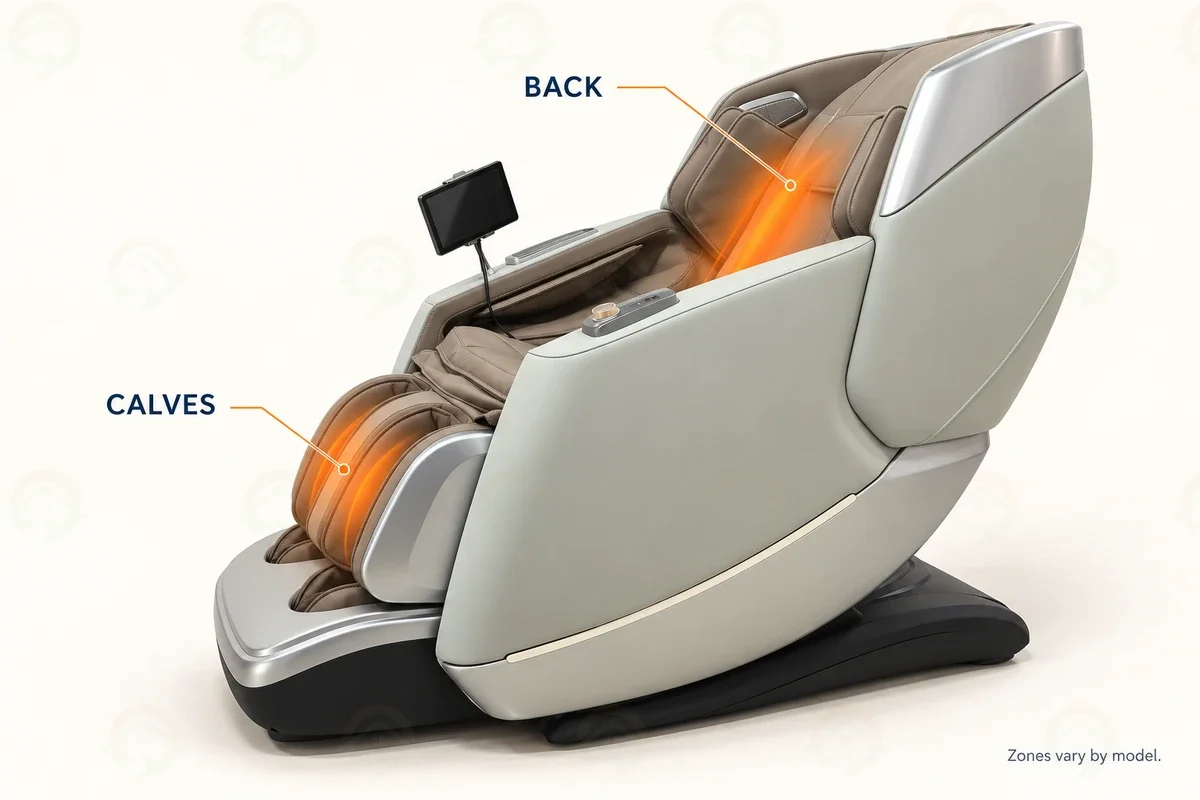
Desk work loads the erector spinae and the muscles around the shoulder blades, while long periods of standing or sitting load the calves. Those two regions hold most of the everyday tension a massage chair is asked to address, which is why they are the zones worth heating first.
Relaxation, not sedation
Continuous gentle warmth is one of the easier sensations to settle into. Buyers consistently report that a heated session feels calmer than the same program without heat, and that they are more likely to run a long, low-intensity cycle than a short, strong one.
Back and Calves: Why These Two Zones Carry the Heat
Spec sheets often list heating zones without explaining the choice. The two zones below are not arbitrary — they follow where the mechanism spends its time and where users report the most stiffness.
The back: where the mechanism spends most of its time
Rollers travel the track for the whole session, so heat here works with the longest-running part of the program. It also covers the largest single area of the body, which is why a back zone is standard on almost every heated model.
The calves: the zone buyers underestimate
Leg rest heating is often treated as a bonus feature, but for anyone off their feet all day it is the zone that decides whether the chair gets used twice a day or twice a month. Airbag compression and warmth together do more for tired calves than either alone.
Constant Temperature vs Cycling Heat
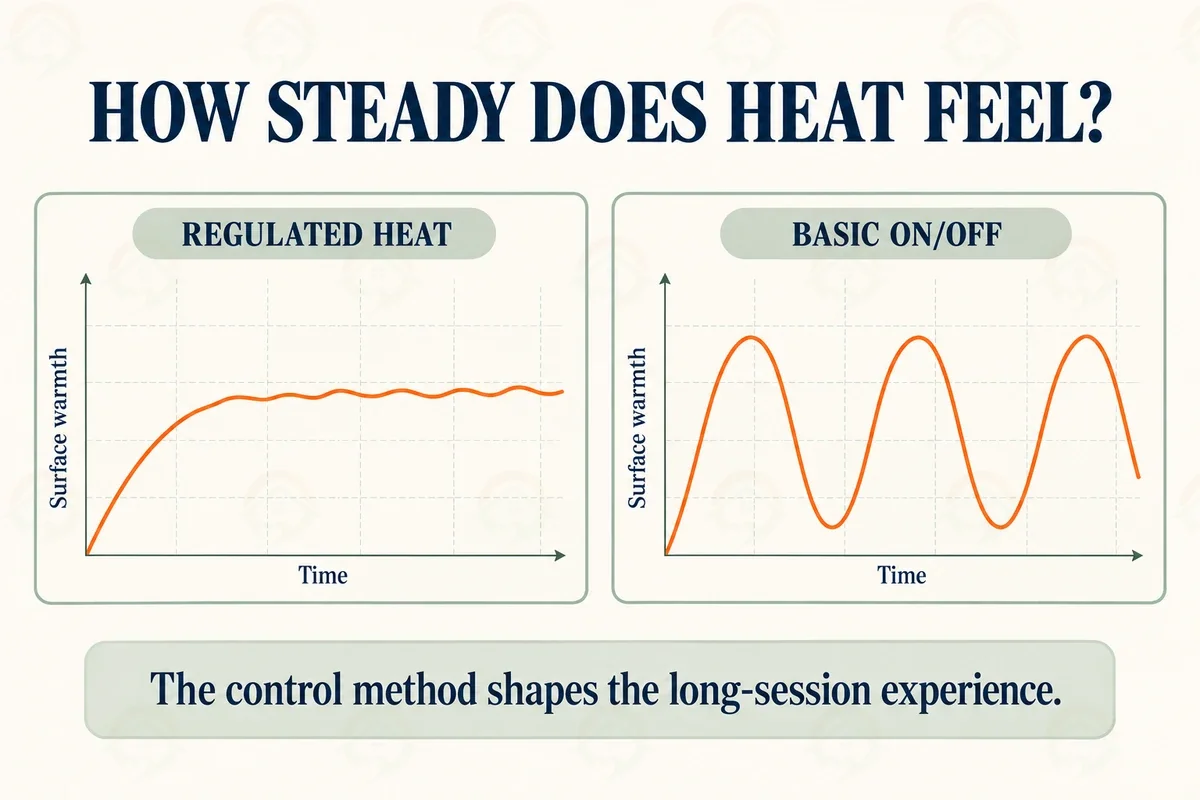
Two chairs can list “heating” on the same line of a specification sheet and behave completely differently in use. The difference is almost never the element itself — it is how the temperature is controlled.
What “constant” actually means in a heating circuit
A constant-temperature circuit measures the surface and adjusts power continuously, holding the set point within a narrow band. A basic circuit switches the element on and off between a floor and a ceiling, so the surface rises and falls through the session.
On a fifteen-minute program the two feel similar. On a thirty-minute program, or on a chair used twenty times a day, the regulated circuit keeps a steady feel while the basic one is already past its most comfortable point.
Why the difference matters more in commercial use
Commercial settings run long duty cycles: office wellness rooms, hotel lounges and self-service areas rarely get the fifteen-minute session a home user runs. Steady regulation reduces the peaks that drive wear, and it is friendlier to the surrounding upholstery and electronics.
| Aspect | Regulated constant-temperature heat | Basic on/off heating |
|---|---|---|
| Surface feel over a long session | Stable; holds one comfortable level | Rises and falls; warmest early on |
| Behaviour on a 30-minute program | Comfortable throughout | Noticeably uneven after 15 minutes |
| Commercial duty cycle | Better suited to repeated daily use | Best limited to short, occasional cycles |
| Service pattern | Fewer thermal peaks; simpler diagnosis | More cycling; element and wiring wear faster |
| Documentation | Control loop and cut-off testable in the compliance file | Cut-off only; regulation not stated |
| Best fit | Offices, wellness rooms, hotels, high-use homes | Entry-level home models, short sessions |
Thermal Protection and Compliance
Heat is the one function on a massage chair that touches both comfort and electrical safety. That is why a heated model should arrive with a thicker compliance file than an unheated one, and why the paperwork is worth checking before the order is placed.
What the safety layer has to do
The duty-cycle question almost nobody asks
Ask what happens when the heating circuit runs at the top setting for an hour, and how the cut-off behaves if the chair is used continuously through a working day. The answer tells you whether the model was designed for a home or for a commercial floor.
It is also the fastest way to separate two suppliers quoting the same unit price. The chair with a documented cut-off and a regulated loop costs the same to quote and much less to service.
Who Gets the Most Out of a Heated Massage Chair
- Desk-based users — heat on the back and calves after a long seated day, usually on a short daily cycle.
- Offices and wellness rooms — a foldable unit such as the L3 office massage chair with heat therapy fits a small room and a fixed break schedule.
- Spas, hotels and lounges — a heated session reads as a premium tier and is the easiest add-on to sell to guests.
- Older users and cold-sensitive users — warmth makes a short, low-intensity program far more appealing than a strong mechanical one.
Where the whole program needs to work as one system — track, rollers and heat together — a full-body SL-track model such as the C20 is the usual starting point in our own range.
Specifying Heat for Your Market
Voltage, frequency and plug type
Heating circuits are more sensitive to supply than motors are, so voltage and frequency have to be fixed for the destination market before production starts.
What to put in the inquiry
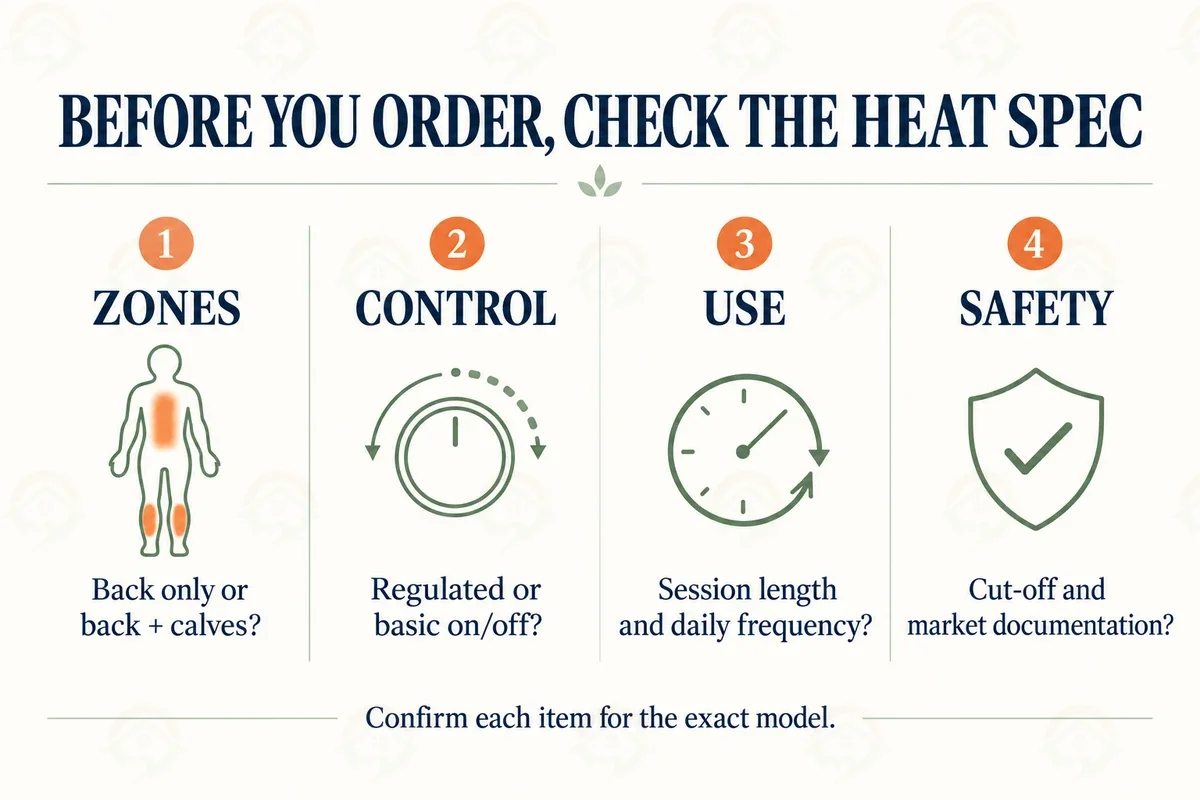
- Heating zones required: back only, or back plus calves.
- Control type: regulated constant temperature or basic on/off.
- Session length the chair will run in normal use, and how many times per day.
- Destination market, voltage and frequency, and the safety documentation you need.
- Whether after-sales spares for the heating circuit are required as a stock item.
Where heat earns its cost back
On a dealer floor, heat is one of the few features a customer can feel in a two-minute trial. It justifies a step up in retail price more easily than a higher roller speed, and it gives the sales floor a function that can be demonstrated without a script.
Key Takeaways
- Heat is a supporting layer: it softens tissue so the mechanism works more comfortably, rather than doing the work itself.
- Regulation, not the element, decides how heat feels in year three — ask for constant temperature if sessions are long or frequent.
- Back and calves are the two zones that carry the benefit in real use; leg rest heating is not a bonus feature.
- For background reading, start with our history of the massage chair and the zero gravity mode guide.
Buying the function as part of a full range? Our massage chair vs massage sofa comparison covers how a heated chair line sits beside a sofa line on the same floor.
Questions Buyers Ask About Heated Massage Chairs
Is there a full body massage chair with heat?
It depends on the model, not the category: some full-body chairs are specified with heat, others heat the back only or add the leg rest and calves. Tell us the model you are considering and the heating zones come back to you in writing, before the order.
Does the heat stay on for the whole session?
On a regulated model, yes: the loop holds a target temperature and the thermal cut-off acts as a backstop. On a simple cycling model the element switches on and off, so warmth rises and falls. Ask which behaviour your model uses if sessions run long or the chair works commercially.
Does a heated model cost much more than the same chair without heat?
The increment depends on two things: how many zones heat, and whether the loop is regulated or cycling. Ask for it as its own line in the quotation so the cost is visible rather than folded into a bundle price. Heating is specified at build stage, so settle it with the order — not afterwards.
Quick audit: is your heating spec complete?
1. Heating zones and control type named for your exact model?
2. Duty-cycle behaviour confirmed for commercial use?
Two or more unchecked? Send us your current spec sheet and we will annotate it line by line — before your next production slot is confirmed.
Cindy
Sweet Home Technical Team
Part of Sweet Home’s in-house technical team. Cindy writes our knowledge explainers — how massage chair functions actually work, what the terms on a spec sheet mean, and where buyer expectations meet real hardware — built on our export order data and after-sales records.
Disclosure: Sweet Home is the manufacturer behind these chairs, and the heating and service details in this article come from our own production line and repair records — shared so buyers can judge a heating feature on evidence, not on a brochure line.