
Zero gravity mode is the most advertised feature on a massage chair, and the one most often used incorrectly. In the fit and after-sales issues we see on export orders, the mechanism is rarely the problem.
This guide covers what zero gravity mode actually does, how one, two and three stages differ in hardware, the four-step routine for using it correctly, and the lines an importer should confirm in writing.
If the chair also has to fit a specific room, pair this with our installation and space clearance guide — zero gravity is the most space-demanding position in the recline cycle.
What Zero Gravity Mode Actually Does
Zero gravity is a body position, not a technology. The chair reclines until the torso and thighs form a wide angle, the seat surface tilts back so the hips sit lower than the knees, and the leg rest rises until the calves reach heart level.
The NASA Origin Story, Corrected
The name comes from research rather than a product. Photographs taken on the Skylab station in the 1970s formed the first version of what NASA calls neutral body posture, published in NASA Standard 3000 in the late 1980s and revisited during the 1993 Space Shuttle mission STS-57.
One correction to the marketing version: NASA’s own account of that work describes a range of postures, with commonalities in joint angles, rather than one universal angle that every body takes. The later standard, NASA-STD-3001, reflects the range.
The posture data is a published design reference that manufacturers have applied to seating of every kind, including the zero gravity setting on a massage chair. NASA did not design one, which is why no single degree value is “the NASA angle”.
What the Reclined Position Does — and Does Not Do
The effect most often described is load rather than therapy. A 2023 review of lumbar intradiscal pressure studies in the peer-reviewed journal PeerJ found that supported, reclined sitting postures reduce the load on the lower spine compared with upright unsupported sitting.
The second effect is mechanical and easy to explain at the point of sale: with the legs elevated above heart level, gravity is no longer working against the return of blood from the legs. Users commonly describe that as relieving heavy legs at the end of the day.
None of this is a treatment. Zero gravity may help a user relax, and many people find the position comfortable for long sessions — but a massage chair is not a medical device, and it does not treat a diagnosed spinal condition.
The engineering version of the same idea: the position only exists when the whole assembly moves. A chair that tilts the backrest while the seat stays level and the legs stay down is a recliner, not a zero gravity position.
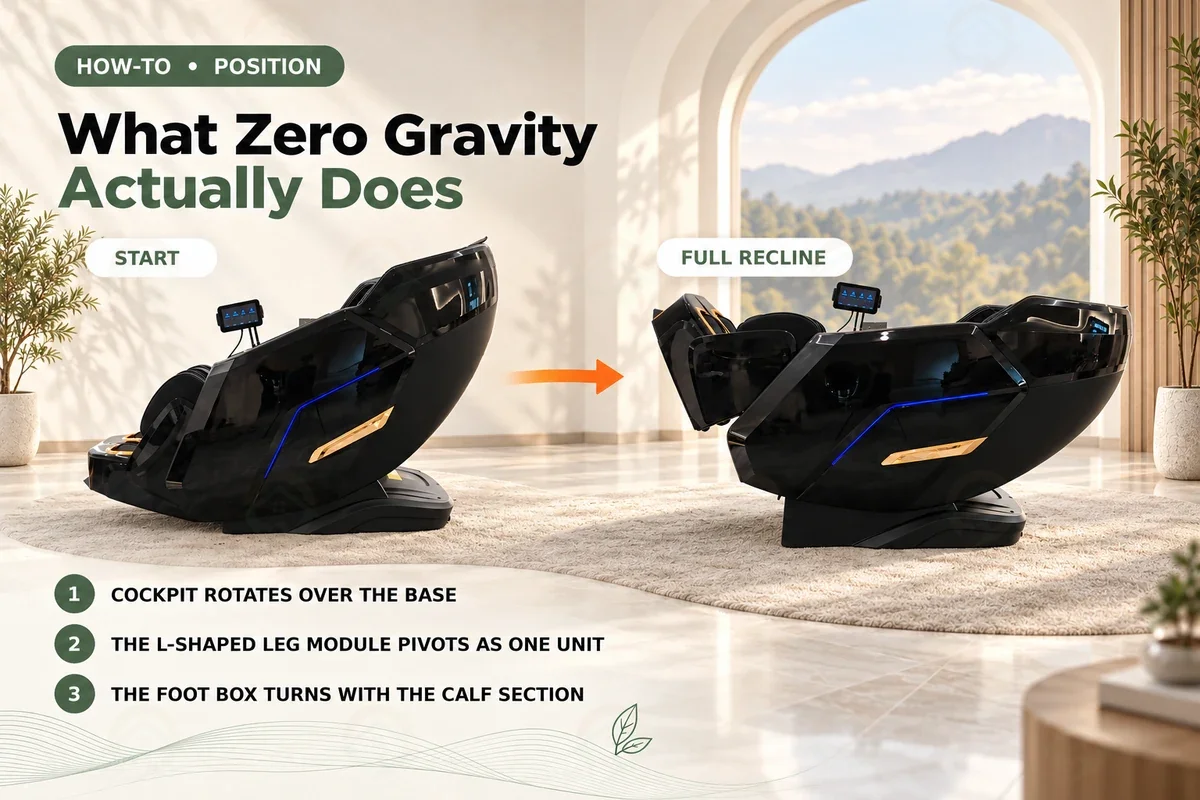
Why the Angle Is an Engineering Number, Not a Marketing Word
In the drive train, those angles are set by hardware.
The worm drive is self-locking, so the chair holds its position with the motor off. Stroke length then sets how far each stage can travel: on the 63TG-series actuators we build against, a 63TG300-135 moves 135 mm and a 63TG390-175 moves 175 mm.
Two chairs can carry the same three-stage label with entirely different travel, because the label describes the control program, not the geometry. If a preset is tuned too shallow for the average user height in your market, no amount of marketing produces the position they came to feel.
One, Two or Three Stages: What Actually Changes
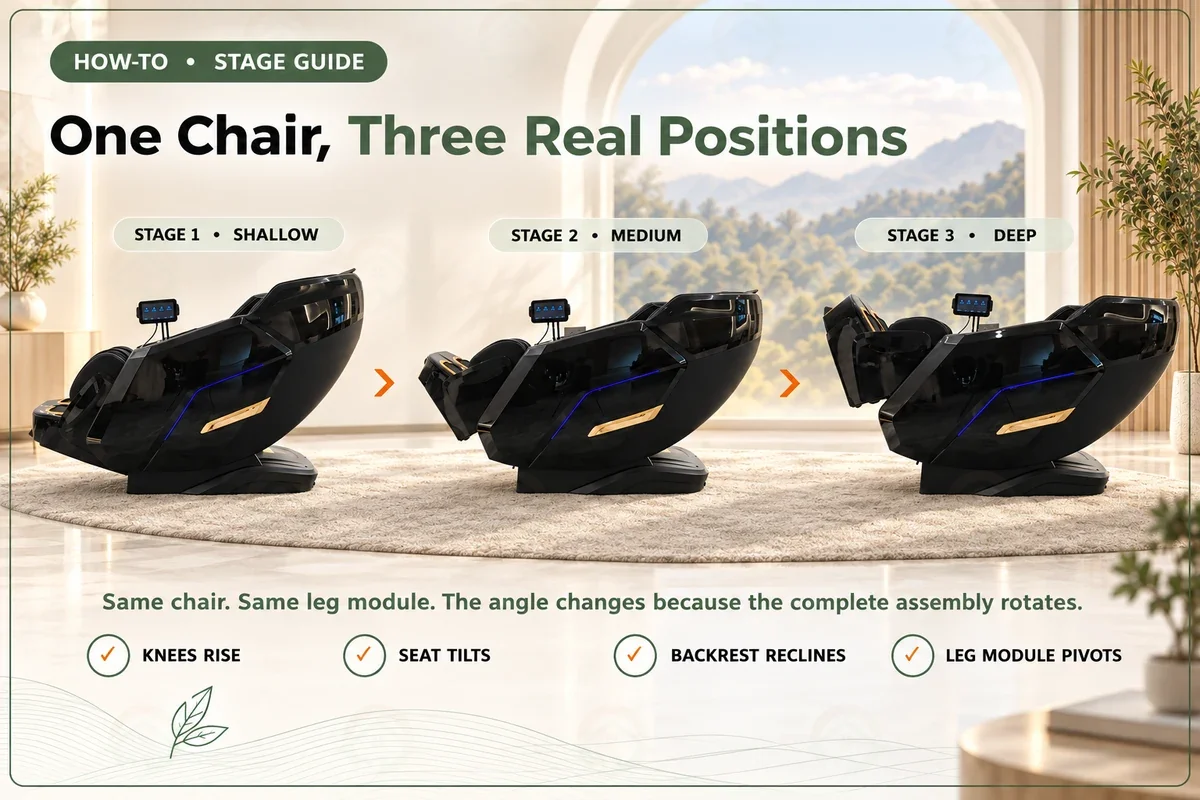
Stage count is the number of preset positions the controller will hold, not the number of motors. Every stage moves the same assembly to a deeper geometry.
| Stage | Typical torso-to-thigh angle | What the mechanism does | Typical user |
|---|---|---|---|
| Single stage | approx. 115–130° | One preset: backrest reclines, seat tilts, leg rest rises to heart level | Daily home, hotel and spa use |
| Two stage | stage 1 as above, stage 2 approx. 135–145° | A second, deeper preset with more seat tilt and longer actuator travel | Shared households — two heights, two presets |
| Three stage | adds a third, deeper preset | Usually labelled light, medium and deep; sometimes a longer leg rest travel | Buyers who want a selectable range; senior users tend to stay on the shallowest |
Angles are typical published ranges rather than fixed figures. Confirm the angle, the stage count and the clearance for the exact model you are shipping against its spec sheet.
Why the Deepest Stage Is Not Automatically the Best
Deeper is not better, for three practical reasons. First, most users do not need it: the position starts working from the point where the knees clear heart level, and past that the returns flatten quickly.
Second, deeper stages demand more space. Recline travel sends the backrest further back and the seat further forward, so a room that takes stage one may not take the deepest preset. That is a measurement, not a preference.
Third, a deeper angle does not suit every body. Users with limited hip mobility, or those who sit shorter in the chair than the preset was built for, feel strain in the lower back instead of relief. When that happens, change the stage rather than the chair.
The 30-Second Position Test
With the user seated and the chair settled, check four things: knees at or above heart level, one full and easy breath, shoulders and jaw relaxed, and no strain in the lower back. Strain means the stage is too deep — step back one preset rather than adding a cushion behind the back.
How to Use Zero Gravity Mode: The Four Steps
Controls differ between brands, but the sequence is consistent. In a showroom, the order matters as much as the buttons.
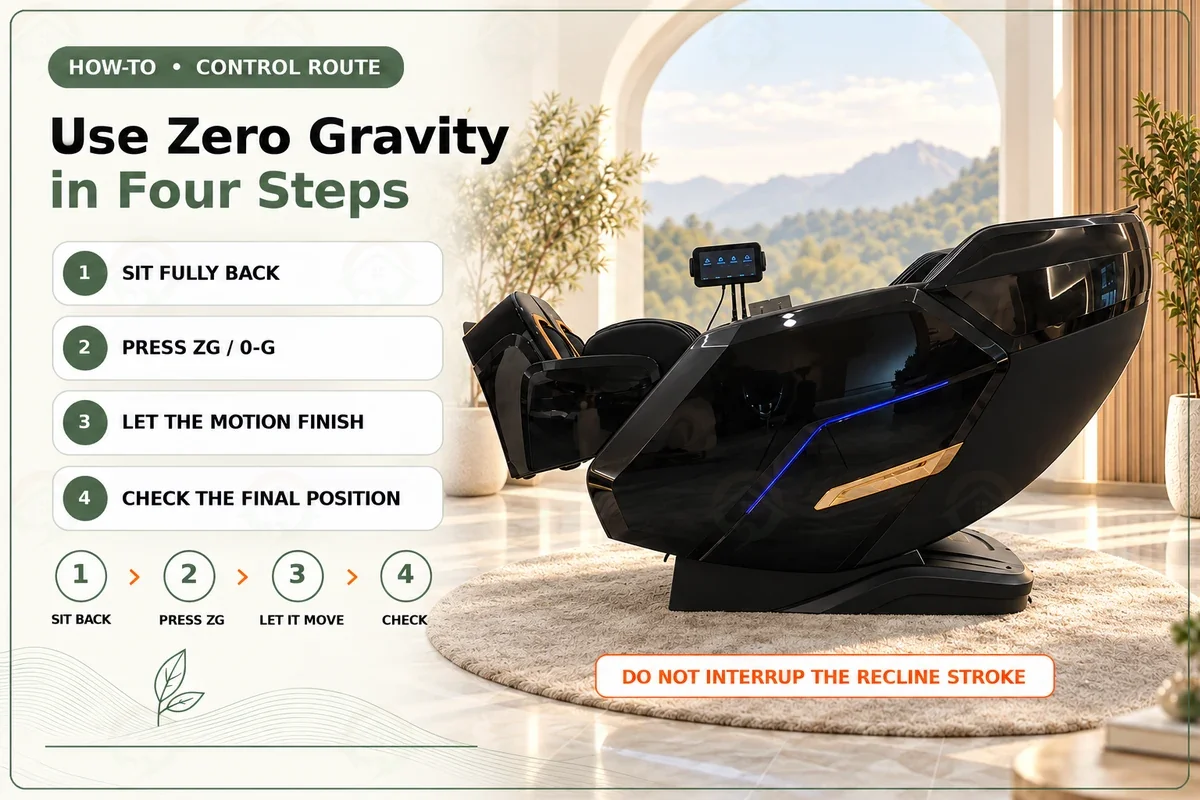
Step 1 — Sit Fully Back Before You Press Anything
Hips to the rear of the seat, shoulder blades against the backrest, feet in the footrest. If the user sits forward, the body scan measures a shorter body and the leg rest is left short, so the legs never reach the elevated position the stage was designed for.
Step 2 — Find the Control Path
- Dedicated button. Labelled Zero Gravity, ZG or 0-G. One press starts the recline cycle; pressing again usually advances to the next stage or returns the chair upright.
- Automatic program. On many chairs the position is folded into a program such as Comfort, Sleep or Full Body, which is why some owners believe their chair has no zero gravity setting at all.
- Touchscreen or app control. Newer models expose the angle as a toggle or slider, letting the user stop between presets instead of taking a fixed stage.
Step 3 — Let the Stroke Finish Before Adjusting
Do not interrupt the recline. On most controllers the stroke is a timed sequence, and stopping it part-way to reverse can leave the mechanism short of its limit position. On some boards an incomplete cycle is logged as a drive fault.
Step 4 — Run the Position Check, Then Start the Program
Position first, program second, airbags last. The order matters mechanically: with the body relaxed and supported, the rollers work against muscle that is no longer bracing, which is why the same program feels different in zero gravity.
Three Mistakes That Cause Most Zero Gravity Complaints
Mistake 1 — “The Flatter, the Better”
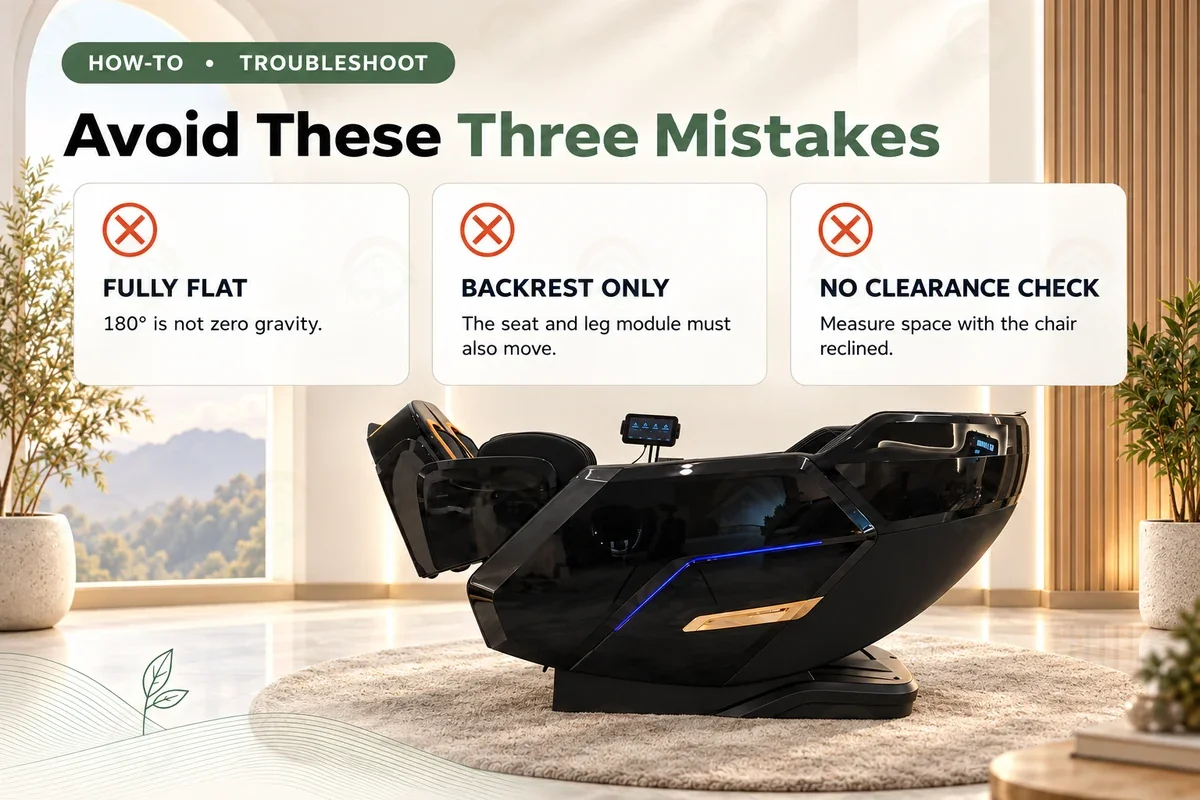
A fully flat position is not zero gravity. At 180 degrees the torso and thighs sit in a straight line, the seat tilt stops mattering, and the V-shaped support that carries the upper body disappears. Past the preset, the leg rest is no longer where the geometry needs it.
Mistake 2 — “All Zero Gravity Modes Feel the Same”
The label is identical, the experience is not. Angle is one variable, and the others matter as much: track design, how far the seat actually tilts, whether the leg rest supports the calf along its length or only the foot, transition speed and how smoothly the chair settles.
A chair that only reclines the backrest can carry the same three-stage label as a chair that moves the whole assembly. The name is the same. The position is not.
Mistake 3 — Discovering a Space Problem on Delivery Day
Zero gravity is the most space-demanding position in the cycle: the backrest travels back, the seat slides forward and the leg rest extends. One clearance figure short, the stroke stops early and motion pauses with the motor still running.
That is how a fit problem gets reported as a defective chair — the most expensive kind of ticket, because nothing is broken. The clearance figure belongs with the reclined footprint, in writing, before the order. Our measurement routine covers the five numbers to take.
What Importers Should Confirm in Writing
Six lines turn zero gravity from a claim into a specification. Five belong on the spec sheet you request from the factory; the sixth is what your sales team needs before the first demo.
- Angle or stage count per preset, in degrees where the supplier can state it — “three stages” on its own is not a geometry.
- Seat tilt travel. This is what raises the knees; a backrest-only recline does not produce the position.
- Leg rest elevation and support: how high it rises, and whether the calf is supported along its length or only the foot.
- Recline clearance at each stage, next to the reclined depth and the total footprint.
- Actuator specification: thrust rating, stroke per function, screw type (self-locking or not) and the limit switches that define the presets.
- Whether the presets can be re-tuned for a market or an OEM programme, and who documents the final values in the manual.
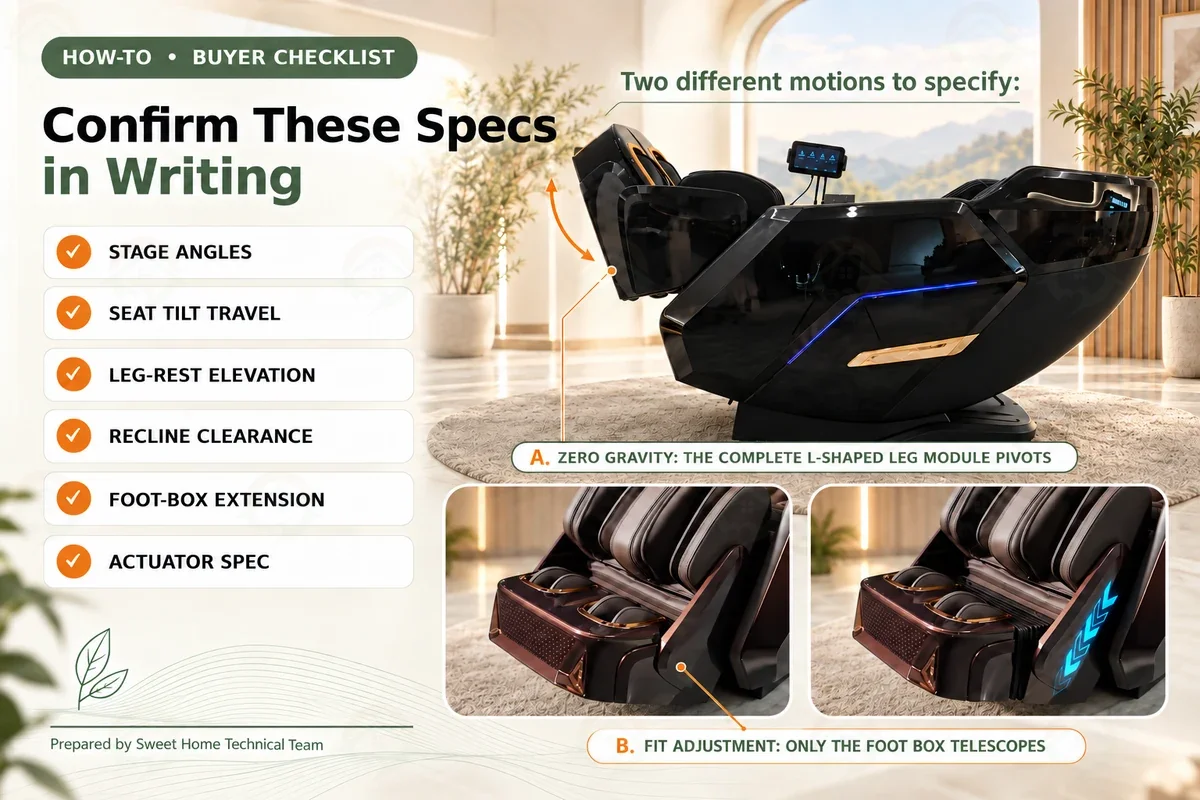
The numbers behind those lines are covered in EP10.0: the zero gravity recline mechanism and in our track selection guide, which explains how the rail inside the chair limits the travel you can specify.
The Showroom Demo Script (60 Seconds)
- Press the preset with the customer seated and their hips back, and let the stroke finish.
- Point at the knees relative to heart level instead of describing degrees.
- Run one stage deeper, then back to the shallowest, and let them choose.
- Step out and check the rear clearance with the chair still reclined, not with it upright.
Chairs that generate complaints are usually the ones where nobody measured the space and nothing about the position was explained. Both are preventable at the point of sale, which makes zero gravity a specification conversation rather than a comfort conversation.
FAQ
How do I turn on zero gravity mode on a massage chair?
Press the button labelled Zero Gravity, ZG or 0-G, or select the automatic program that includes the position, such as Comfort, Sleep or Full Body. Let the recline finish before you adjust it. On touchscreen models the angle is often a toggle or a slider rather than a fixed stage.
Is zero gravity mode on a massage chair the same as the NASA posture?
The position is based on NASA’s neutral body posture research, which describes a range of joint angles rather than one universal position. Manufacturers apply that range to seating. The chair is not NASA hardware, and the name describes a posture, not a technology.
What angle is zero gravity on a massage chair?
Most chairs implement it between roughly 115 and 130 degrees of torso-to-thigh angle, with deeper stages beyond that. Published figures vary by model, so confirm the exact angle, the stage count and the clearance for the chair you are shipping against its spec sheet.
Is the deepest stage the best one?
No. The position works from the point where the knees reach heart level, and most users stop at the shallowest stage that achieves it. Deeper stages need more room behind the chair and are not comfortable for every body type.
Can a user stay in zero gravity mode for a long session?
Many users do, and the position is generally described as comfortable because the body is supported instead of braced. It is not a treatment, and anyone with a diagnosed spinal or circulatory condition should follow their clinician’s advice rather than a chair specification.
Do all massage chairs have zero gravity mode?
No. It is standard on full-body chairs and common on massage recliners and sofas, but the geometry behind the label differs widely. Check the seat tilt travel and the leg rest elevation, not only the name of the program.
Get the Recline Numbers Before Your Next Order
Zero gravity comes down to four numbers: an angle, a stage count, a stroke length and a clearance figure. Ask for all four in writing, and the feature stops being a catalogue claim and becomes something a distributor can demonstrate and a service team can support.
Send us the market, the price band and the showroom or room you are working with, and we will return the stage angles, the reclined footprint and the clearance figure for the models you are considering — the same numbers that go on the spec sheet.
Sweet Home is a massage chair manufacturer in Fujian, China, supplying importers, distributors and commercial operators with OEM programmes. Once the chair is installed, our cleaning and maintenance routine is written to be handed to the end customer.
Tommy
Sweet Home Technical Team
Part of Sweet Home’s in-house technical team. Tommy writes our How-To guides for importers and distributors — installation, floor planning, recline settings and after-sales checklists — built on our export order data and after-sales records.
Disclosure: Sweet Home is the manufacturer behind the chairs discussed in this guide, and the recline and fit patterns come from our own export orders and service records — shared so buyers can specify zero gravity correctly before a container is booked.
Quick audit: does the zero gravity setting you are quoting hold up as a specification?
1. Stage angle or stage count stated in writing? 2. Seat tilt travel and leg rest elevation confirmed? 3. Recline clearance measured against the reclined footprint?
Two or more unchecked? Send us the model and the market — we will return the recline numbers and a stage recommendation.
Related product pages