
A customer sits down at a vending massage chair, chooses ten minutes, reaches for a phone—and finds a coin slot. The chair may work perfectly. The sale is already walking away.
Payment hardware looks like a small part of a vending massage chair, but it controls the first few seconds of the customer experience. It also creates a long list of operational questions: network coverage, transaction fees, cash collection, refunds, remote reporting, jams, and downtime.
The obvious question is: Which payment method has the biggest market share? The honest answer requires one important distinction.
There is no public U.S. market-share study for vending massage chairs alone
The percentages often repeated online are usually borrowed from general vending, unattended retail, or consumer-payment research. Those datasets are useful signals, but they are not a direct measurement of massage-chair transactions.
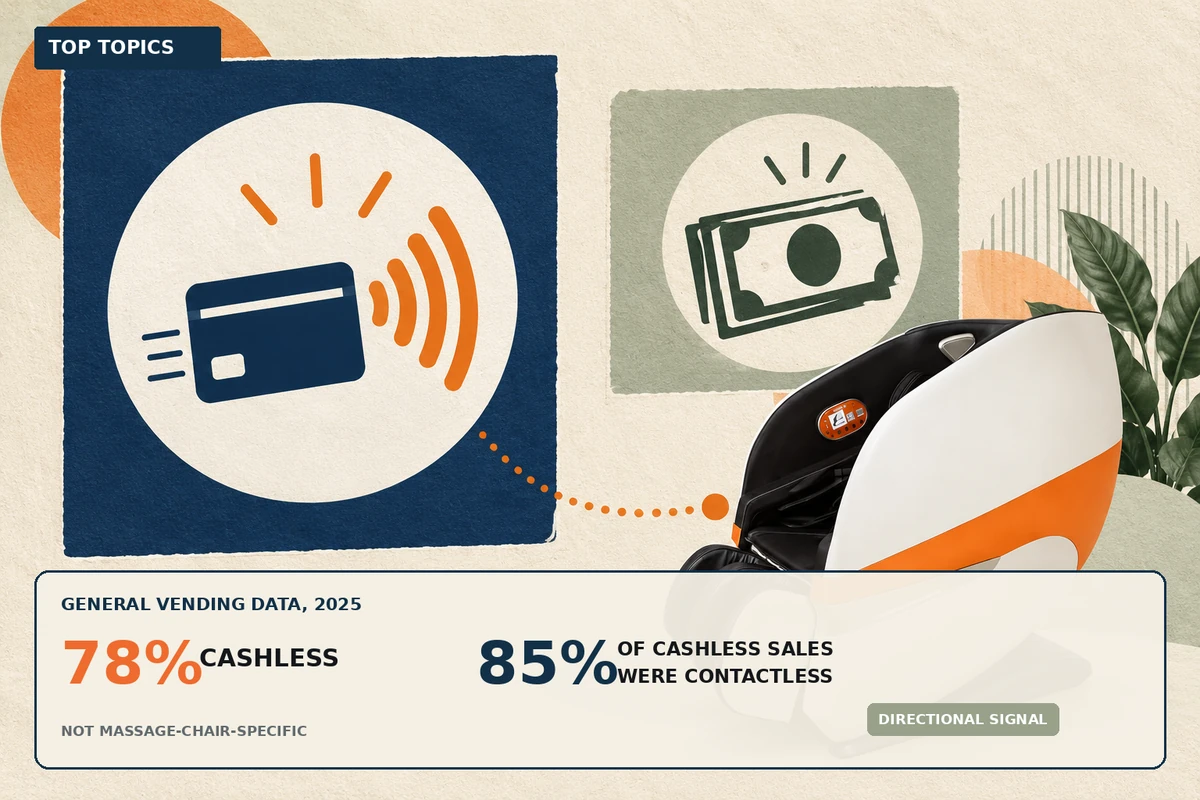
For general U.S. vending, Cantaloupe’s 2026 Micropayment Trends Report says cashless payments represented 78% of food-and-beverage vending sales in 2025. It also reports that contactless methods accounted for 85% of cashless vending sales.
At the same time, cash has not disappeared. The Federal Reserve’s 2026 Diary of Consumer Payment Choice reports that four out of five U.S. consumers used cash during the previous 30 days, and 90% plan to keep using it.
These sources point in the same practical direction: cashless acceptance is increasingly expected, but a cash option can still matter. Your own chair, location, session price, and customer mix determine the right combination.
Five payment methods—and what each one actually solves
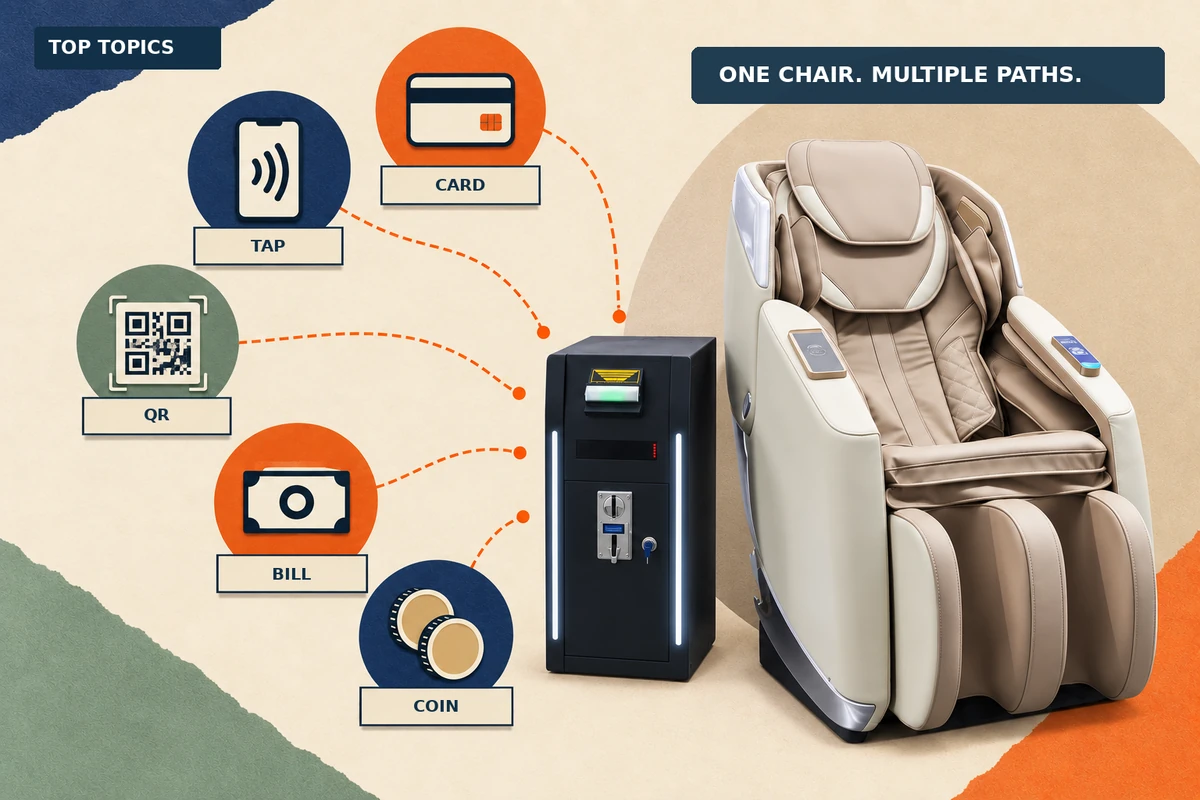
1. Contactless cards and mobile wallets
Tap-to-pay gives users a familiar action: tap a card, phone, or watch and start the session. It can reduce friction in airports, modern malls, office districts, and other locations where customers already expect contactless checkout.
Before selecting a reader, check processor support, cellular or Wi-Fi requirements, transaction fees, settlement timing, remote status reporting, and what happens when the connection fails.
2. Inserted or swiped credit and debit cards
A physical card reader remains useful for customers who do not use a mobile wallet. In the United States, debit and credit cards together account for most consumer payments, according to Federal Reserve research.
The hardware should clearly indicate accepted card methods. A screen that says “card accepted” while the chair does nothing is not a payment feature; it is a support ticket.
3. QR-code payment
QR payment can be useful when it connects to a clear, mobile-friendly checkout flow or an operator’s existing platform. It can also support promotions, membership, or location-specific pricing.
However, a printed QR code is not automatically convenient. Test the number of screens, language, payment choices, mobile signal, session activation, and refund path. If the customer has to create an account for a ten-minute massage, the chair is asking for a relationship before the first date.
4. Paper currency
A bill acceptor provides a familiar fallback and can be valuable in family entertainment centers, highway locations, mixed-income neighborhoods, and sites with unreliable connectivity.
Cash adds maintenance: bill jams, full cash boxes, collection schedules, reconciliation, and security. The acceptor also needs to match the chair’s price logic and local denominations.
5. Coins
Coins may still make sense for existing fleets, very low session prices, or locations built around coin-operated equipment. For new deployments, operators should compare the extra collection and jam risk with actual local demand rather than keeping coins simply because the previous machine had them.
Choose the payment mix by location
A national average cannot tell you what happens beside one chair on the third floor of one mall. Location matters because it changes dwell time, customer age, connectivity, session price, and the availability of cash.
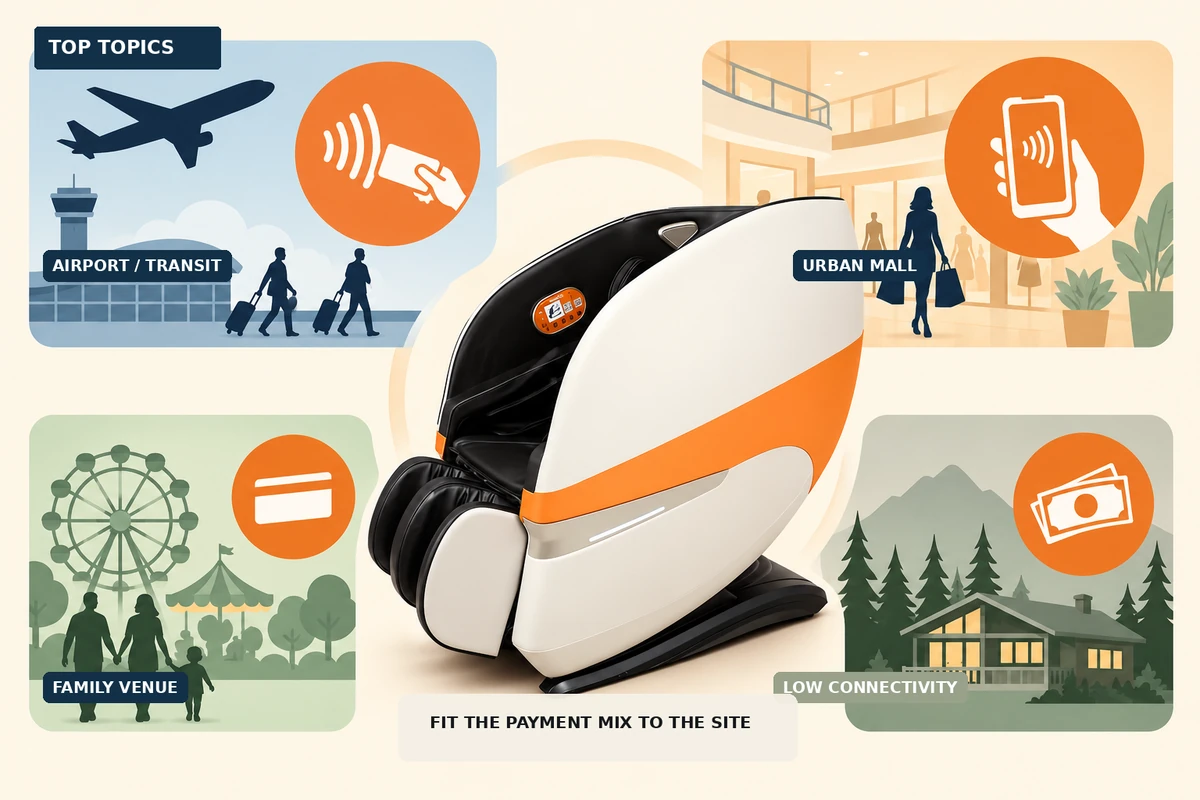
Airports and major transit locations
Prioritize fast contactless and card acceptance, clear English instructions, remote monitoring, and a simple refund process. Travelers may not want to download an app or search for change.
Urban malls and office districts
Contactless and cards should normally be central to the test plan. QR may add value if it offers a genuinely short checkout path. The placement must also make the payment device visible before the customer sits down.
Family entertainment and mixed-payment locations
A dual setup—cashless plus bills—can serve a wider customer mix. Coordinate with the venue’s existing payment habits. If every other attraction uses a venue card or token, an isolated payment experience may confuse customers.
Suburban, highway, or lower-connectivity sites
Do not assume a digital-only chair will remain usable. Test cellular coverage at the exact placement, including busy periods. If the reader cannot process offline transactions safely, a bill acceptor may protect uptime.
Hotels, offices, and member environments
Payment may not need to happen at the chair. Room billing, employee access, prepaid codes, or an operator dashboard may create a cleaner experience. Start with the business model, then choose the hardware.
Cashless changes more than checkout
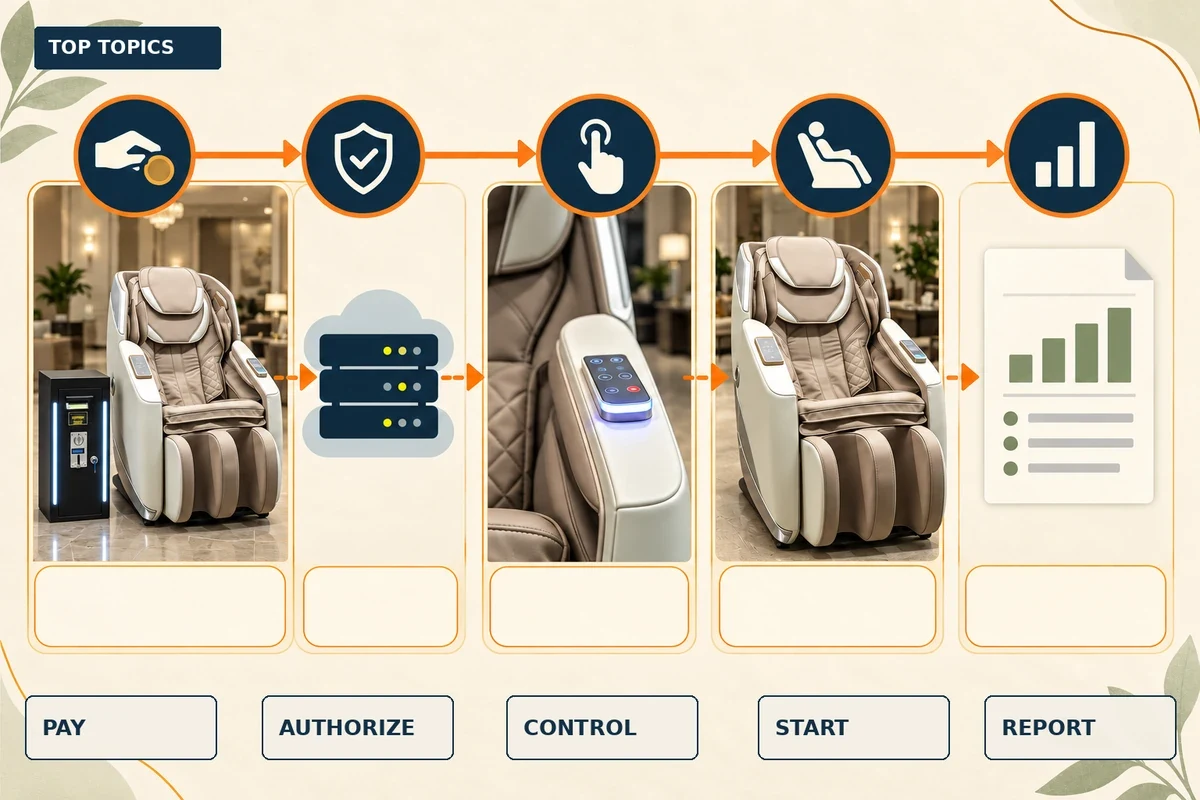
Connected payment can give operators transaction records, remote status information, pricing control, and faster visibility into underperforming locations. Those benefits depend on the payment and control systems being integrated correctly.
A useful system should answer:
- Did the payment succeed?
- Did the chair receive the start command?
- Which session length was activated?
- Can the operator see the chair online?
- What happens if payment succeeds but activation fails?
- Can a refund be issued without visiting the location?
- Are pricing and firmware changes logged?
This is why a card reader should not be evaluated as a decorative box attached to the armrest. It is part of a chain: user interface, payment authorization, controller signal, session timer, chair operation, reporting, and service.
In the payment-integrated vending units we ship and service, the most common field issue is not the massage mechanism—it is a payment that cleared but never started the session. That is why we test the full authorization-to-activation loop before a unit leaves the factory.
Cash has its own operating system—people
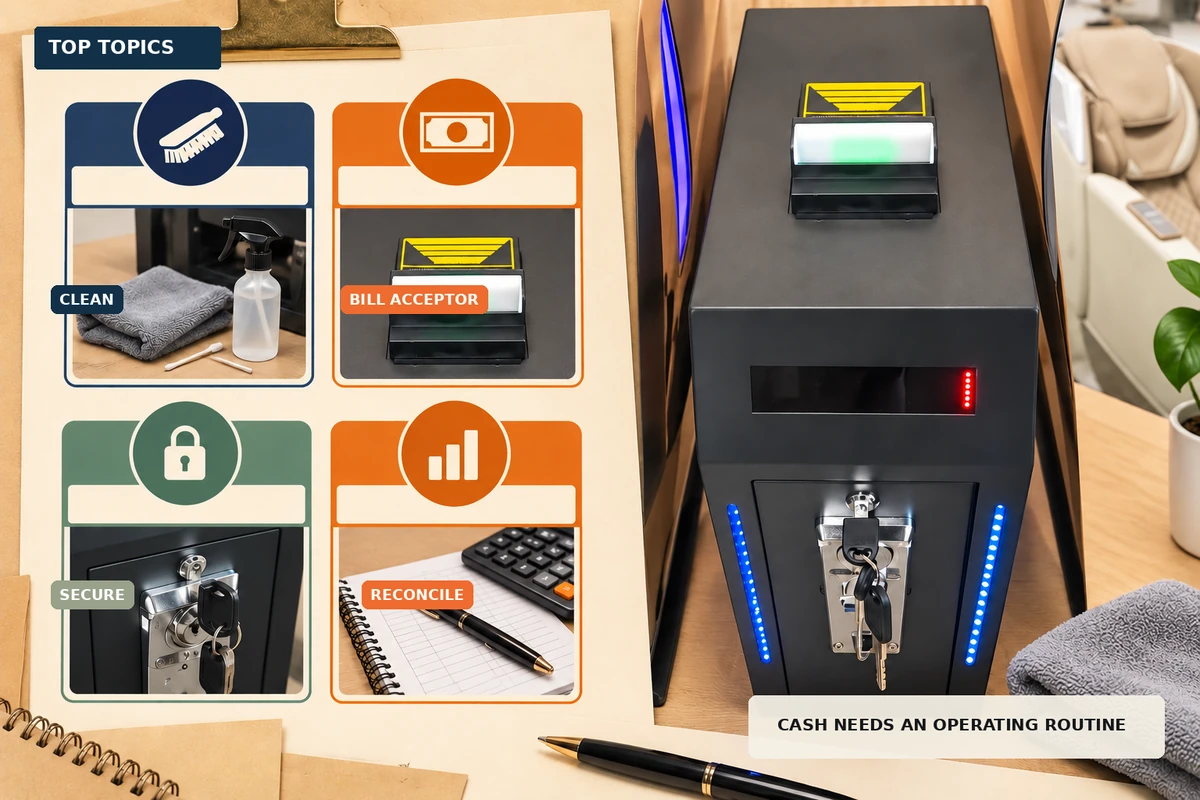
A bill acceptor can keep a chair earning when a customer prefers cash or connectivity fails. But it creates physical work that digital reports cannot remove.
- Inspect and clean the bill path.
- Set a collection schedule based on real use.
- Secure the cash box and access door.
- Reconcile collected cash with recorded sessions.
- Keep common wear parts available.
- Train venue staff to recognize a jam without dismantling the chair.
The payment box must also be proportioned and mounted correctly. It should be easy to find and service without becoming an oversized obstacle beside the customer.
A smarter fleet test: measure before you standardize
Instead of deciding the entire fleet from one industry percentage, run a controlled test across a few different locations.
Track at least:
- transactions by payment method;
- successful payments versus successful chair activations;
- revenue per operating day;
- refund and payment-support requests;
- reader offline time and connection quality;
- bill or coin jams;
- cash-collection time and travel cost;
- session length and repeat use where privacy rules allow.
After 30 to 60 days, compare locations rather than averaging everything together. An airport and a community shopping center may need different hardware even when the chairs are identical.
Questions to ask before ordering payment hardware
- Which countries, processors, card networks, wallets, and currencies are supported?
- Does the system use cellular, Wi-Fi, Ethernet, or more than one connection?
- Who owns the merchant account and transaction data?
- What are the hardware, platform, SIM, and transaction fees?
- How does the reader communicate with the chair controller?
- How are session prices and durations configured?
- What happens during a network or power interruption?
- Can the operator issue refunds remotely?
- Which parts can be replaced at the location?
- Can the payment enclosure, interface, and reporting system be customized?
Frequently Asked Questions
What is the most popular payment method for vending massage chairs?
No public dataset isolates U.S. vending massage chairs. General vending data shows cashless payments are now the majority, with contactless methods leading cashless activity. Operators should use this as a directional signal and validate it against their own locations.
Should a new chair accept both cash and cashless payments?
Often, but not always. Dual payment can widen access, while digital-only may suit highly connected locations with customers who expect tap-to-pay. The choice should include collection cost, network reliability, fees, and local payment habits.
Is QR payment the same as contactless card payment?
No. QR payment usually opens a mobile checkout flow, while contactless card or wallet payment communicates with a payment terminal using near-field technology. They require different user actions and may use different processors.
Can cashless payment increase vending revenue?
General vending studies associate cashless acceptance with higher average ticket values, but that does not guarantee the same result for every massage-chair location. Revenue also depends on visibility, price, session quality, uptime, and foot traffic.
What is the biggest payment-system risk?
The worst failure is not simply a declined payment. It is an approved payment that does not start the chair. Test the complete authorization-to-activation loop and define a refund process before deployment.
The winning payment method is the one that starts the chair
Market data says customers increasingly expect cashless convenience. Consumer data says cash still matters. Operations data should tell you how to combine them at each location.
Sweet Home manufactures vending massage chairs with configurable payment enclosures and control integration for B2B operators and private-label programs. To discuss a project, contact us with the destination market, location type, preferred payment methods, session logic, and expected order volume.
You can also explore the vending massage chair collection or browse the full product catalog.
Joe Fan
Manufacturing & Product Development Manager · Sweet Home
Sweet Home has manufactured massage chairs since 2013, drawing on in-house R&D and quality control for massage chairs and wellness equipment. Joe leads the product and market strategy behind Sweet Home’s OEM export business — the orders, showroom feedback and after-sales records behind our product guides.
Disclosure: Sweet Home is the manufacturer behind the commercial massage chairs and payment enclosures discussed here, and the payment and service patterns in this guide come from our own control integration, field support and export orders — shared so operators can choose payment hardware before buying a fleet.
Quick audit: can your payment system start the chair?
1. Matched the payment mix to each location? 2. Tested the full authorization-to-activation loop? 3. Defined cash collection, refunds and remote reporting?
Two or more unchecked? Send us your location type, preferred payment methods and session logic.
Related product pages
Cashless Payment Vending Massage ChairOEM Commercial Vending Massage Chair