
Massage chair after-sales terms are the part of a sourcing deal that gets decided last and disputed first. Every question on this page is one an importer, distributor or private-label brand has sent us before signing — not after the first breakdown.
FUJIAN SWEET HOME CO., LTD is a massage chair manufacturer in Fujian, China, running OEM programmes for international distributors and private-label brands.
We sell through dealers, so the terms below are written from the dealer's side of the table, where an after-sales clause is a procurement line rather than a promise.
Each answer states plainly whether a figure is published, fixed in the order documents, or still open for you to negotiate — so you can compare suppliers on the clauses that decide your cost in year three instead of on the sentence that sounds best in a quotation.
Where we cannot yet put a number in writing, this page names it as a clause to settle in the order rather than inventing one.
after-sales coverage: What to Lock In Before You Sign
1. How long is the after-sales coverage, and where should that number live?
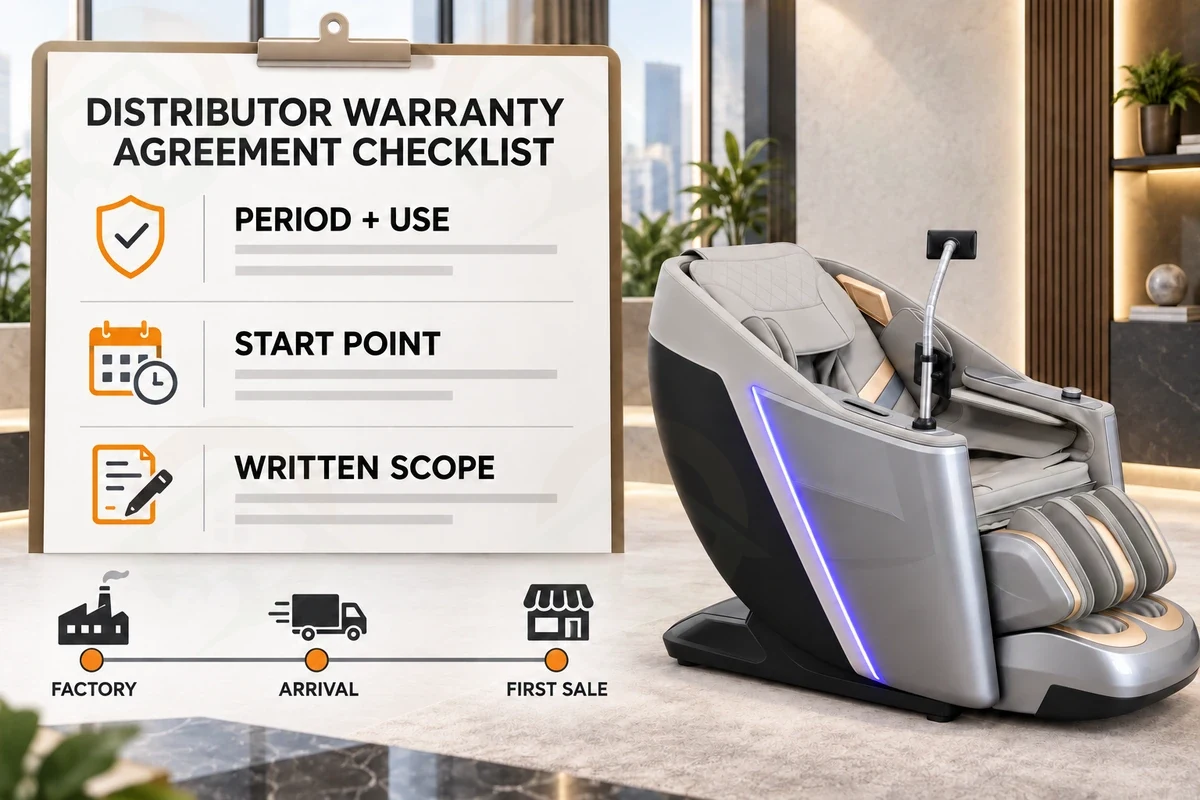
Ask for two things, not one: the period, and the usage that period is scoped to. The retail after-sales coverage you can find online are written for a single end user in a home, where the chair runs an hour a day.
A dealer placing fifty units needs the same term scoped to commercial duty cycle, because that is the load the mechanism, air pump and control board will actually see.
Our published figure: massage beds carry a standard one-year after-sales coverage, stated on the massage bed product pages. For chair models, the period is set per product family and confirmed in writing with your order, because it differs by mechanism type, payment hardware and destination market.
The rule we would give any buyer: the after-sales coverage period (confirm in the contract) belongs in the quotation and the order documents, per model, before price becomes the conversation. A period quoted verbally in a chat window is not a after-sales coverage term.
2. When does the after-sales coverage period (confirm in the contract) start — ex-works, on arrival, or at first sale?
There are three common anchors, and they can sit months apart. Ex-works starts the clock while the container is still at sea. Arrival starts it when the goods reach your warehouse — which for a dealer can be long before the chair reaches a customer.
First sale starts it when your own customer buys the unit.
The anchor decides whether a unit that sat in your stock through a slow season is still covered. It is also the most frequently disputed line in after-sales arguments, precisely because it is usually left out rather than negotiated.
Do not accept "after-sales coverage: one year" with no anchor. Ask the supplier to name the trigger event in the order documents, and to state whether the period pauses while stock is unsold.
after-sales scope (confirm in the PO/contract), exclusions and the claim procedure are confirmed in writing with your order — the start point belongs in that same document.
If you resell into the EU, keep two clocks apart. The legal guarantee your end customer holds runs against you as the seller, not against the manufacturer.
That obligation is separate from the commercial after-sales coverage you are negotiating here — the EU's rules on guarantees for consumers set out how it works.
3. What does the after-sales coverage cover, and what does it exclude?
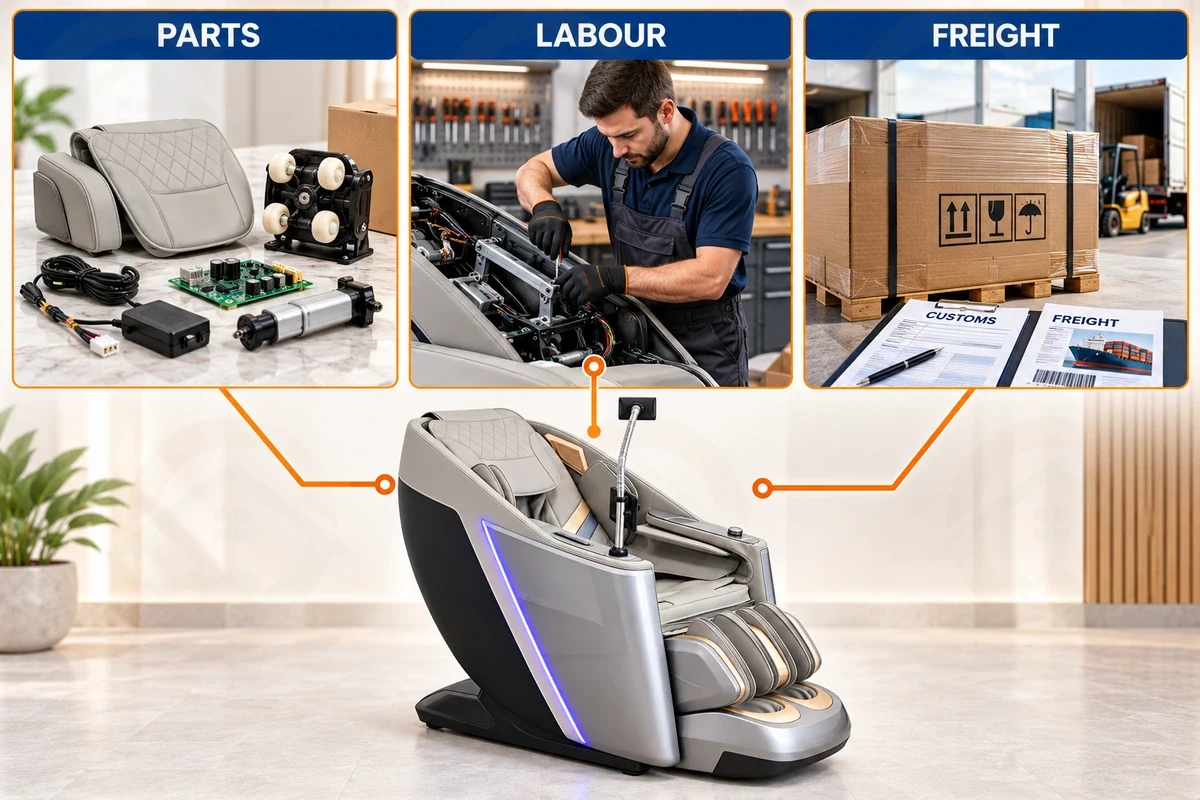
Split coverage three ways in writing: parts, labour and freight. Most disputes are not about the failed part itself — they are about who pays the two lines around it.
What we can state publicly about our own units: complete machines are tested to appliance safety test documentation — the appliance safety standard published by the IEC and applied to products of this class through qualified laboratories. EU-bound orders ship with compliance documentation marking documentation.
Production runs under an quality-system documentation 9001 quality management system, with compliance documentation, restricted-substance documentation and radio/EMC documentation documentation available for the markets that require them.
after-sales scope (confirm in the PO/contract), exclusions and the claim procedure are confirmed in writing with your order. Before you sign that document, read three lines: how wear parts are treated (upholstery, filters, hose sets), how consumables are treated, and how transit damage is treated.
Those three exclusions explain most of the claims a dealer believes are covered and finds out are not.
4. Does opening the unit or servicing it myself void the after-sales coverage?
Unauthorised opening of the unit usually voids the after-sales coverage. That is the normal position across the category, and it is a real constraint for a dealer who keeps a service bench and a technician who could have closed the job in twenty minutes.
The practical fix is to negotiate the exception in advance rather than argue about it at the failure.
Ask for field-service authorisation in writing, limited to named procedures — air-path cleaning, filter replacement, module swap — so approved bench work keeps the after-sales coverage intact while unapproved teardown remains the thing the exclusion targets.
When a Unit Fails in the Field
5. A chair fails at my customer's site. What is the claim procedure?
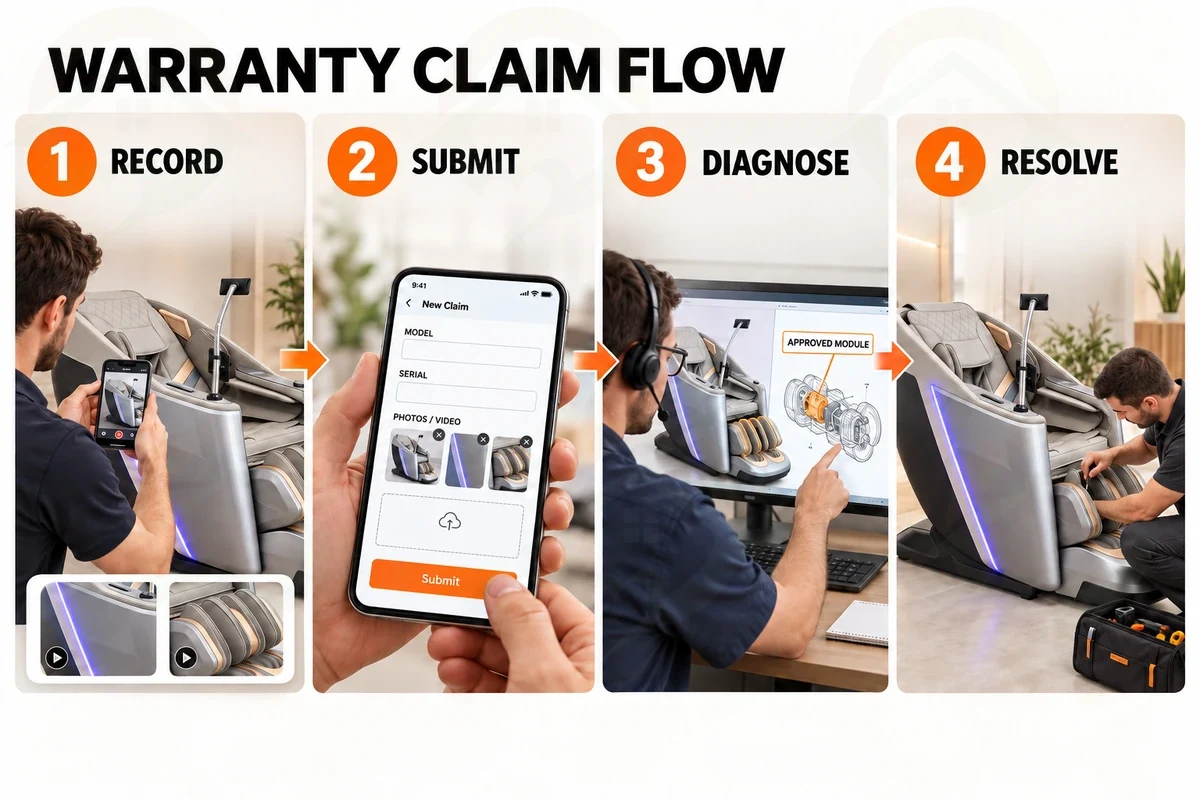
Four things decide how that claim goes: who you contact, the window in which the claim must be raised, the evidence the supplier accepts, and the response time you are promised.
Settle all four in the order documents — a claim raised outside an undefined window is a claim the supplier can decline without bad faith.
What ships with an OEM order from our factory: a care sheet as standard, together with the spare-parts list and the service contact.
Your service team therefore starts with an escalation path and a parts reference rather than a general inbox — which matters on the day a customer is standing next to a silent chair.
after-sales scope (confirm in the PO/contract), exclusions and the claim procedure are confirmed in writing with your order.
In our experience the dealers who recover cost fastest are the ones who wrote a claim window and an evidence standard into that document, because the conversation at the failure is then about a record rather than about goodwill.
6. Which failures are actually accepted as after-sales claims?
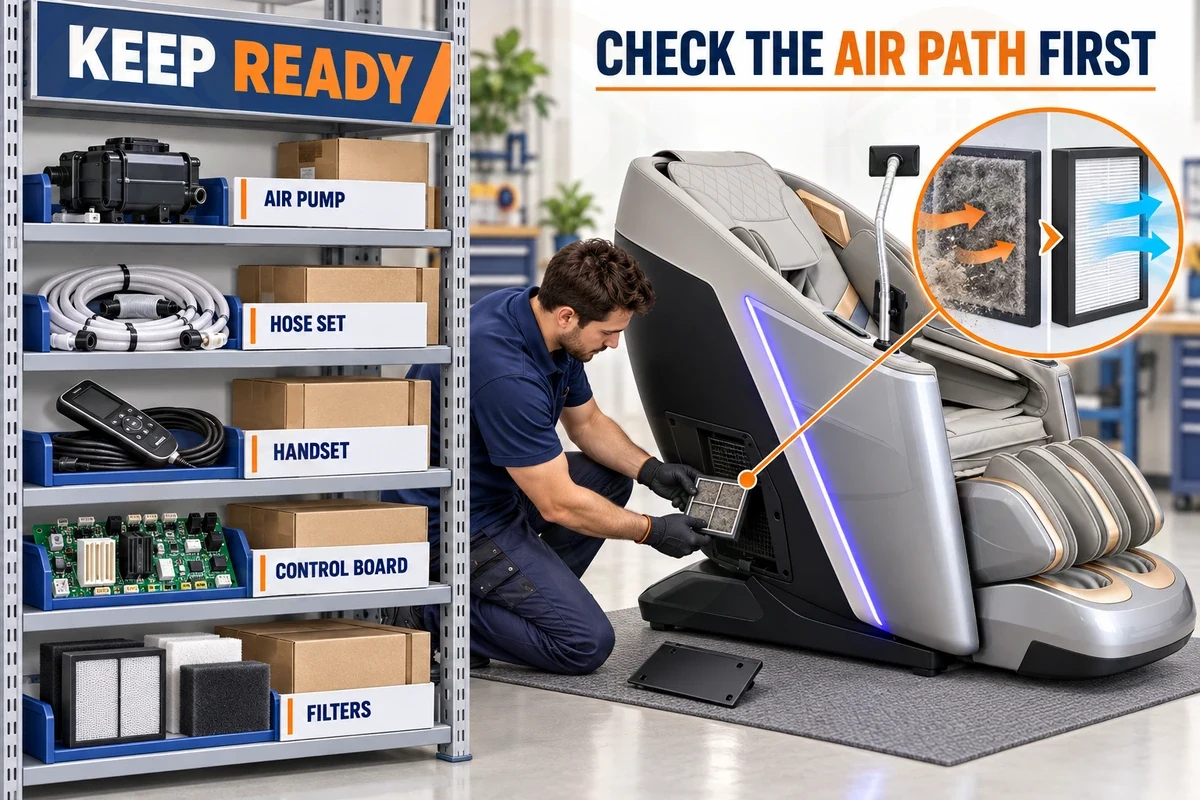
This is the most useful thing we can tell you from our own service records. The single most common "motor failure" claim on a massage chair comes back, once the unit is opened, as a clogged air-pump intake. The pump has not failed.
It is starved of air, the air circuit never reaches pressure, and the customer describes a chair whose motor has died.
That distinction is where a dealer's after-sales budget is actually lost. Shipping the unit back means paying container or air freight on a chair to replace a part that was never broken.
A technician who checks the air path first — intake filter, intake port, hose set — closes most of these calls at the customer's site with a cleaning and a hose inspection.
For what a contaminated air path does to the air bags, valves and pump over time, see our breakdown of massage chair air pump problems.
The claims that genuinely end up as after-sales coverage work are elective component failures: control board, power supply, handset and pump. Those are the parts worth holding on the shelf.
7. Who pays freight on a after-sales coverage part?
Almost no supplier publishes this, and it is the clause that decides whether a one-year after-sales coverage costs you money or saves it.
Answer three questions in the order: who pays the freight on the failed part coming back, who pays the freight on the replacement going out, and who pays duty in both directions.
There is a threshold question underneath it. Many suppliers absorb freight above a value or quantity threshold and leave the rest to the dealer. That is a legitimate commercial position — it simply has to be a named number in the document instead of a surprise in month eight.
Our own freight and duty terms are fixed per order, which is why we tell buyers to settle this line at the same time as the price — not after the first claim. Our standard shipping port is Fuzhou, with FOB, CIF and DDP terms available.
For how landed cost is built on this product, see our notes on commercial massage chair bulk pricing.
8. Can we repair on site instead of shipping the unit back?
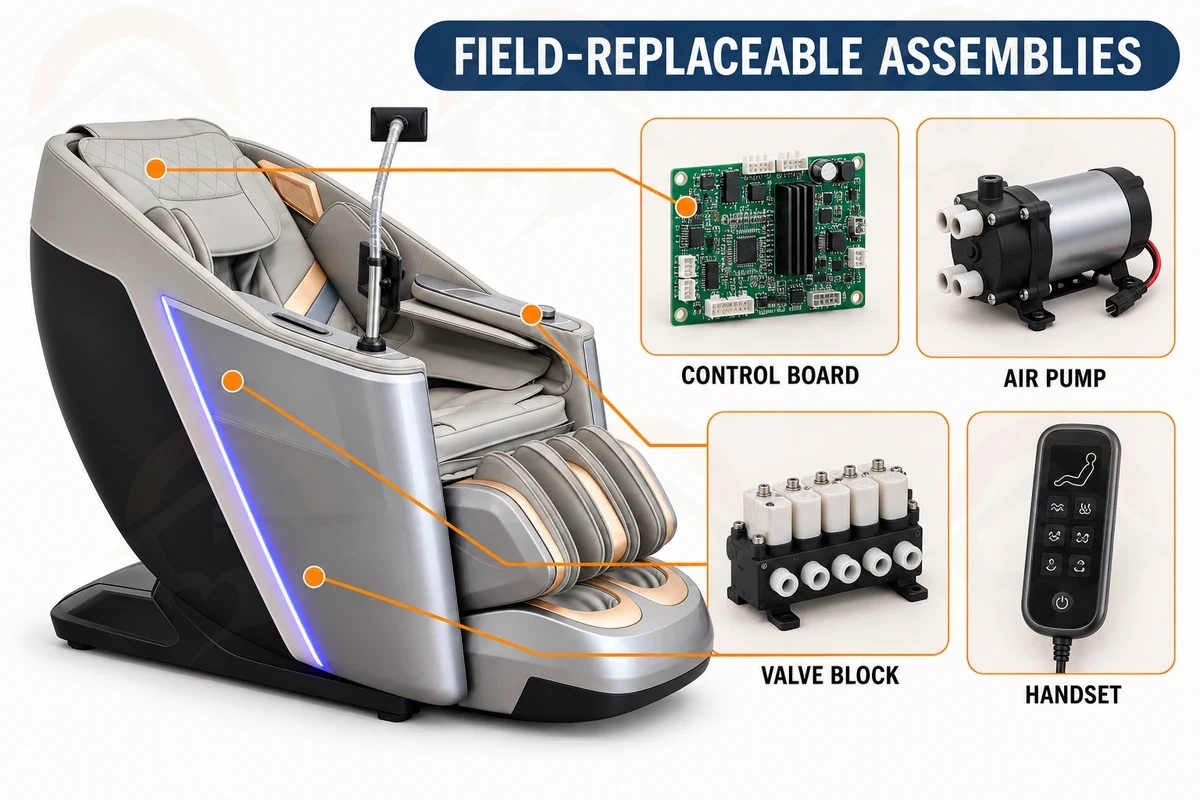
In most cases yes, and that is the argument for buying a chair designed around field-replaceable assemblies.
A control board, air pump, valve block or handset that can be swapped on site turns a after-sales coverage event into a service visit instead of a return shipment — and a chair is one of the more expensive things to move twice.
Two conditions keep the cover valid.
The work has to sit inside the field-service authorisation you agreed in question 4, and the parts have to come from the manufacturer's supply rather than a generic substitute.
A third-party board fitted into a covered unit will usually end the cover on the electrical system, whatever its specification says.
When you specify the order, ask which assemblies are field-replaceable and get the list in writing; that list is what your service team quotes from. Background on how the electrical side fails, and what protects it, is in our control board series — starting with no power vs no response.
Spare Parts: the Clause Nobody Reads Until Year Three
9. Which spare parts should I keep on the shelf?
Two groups: parts that fail electively, and parts that get blocked, worn or lost.
From our side of the line, air pumps, hose sets, remote handsets and controller boards are the components we hold for years after a model ships — and in practice they are the four categories a dealer should stock for any fleet.
Consumables belong on the same shelf: intake filters and the cleaning items the care sheet calls for. A filter that costs almost nothing and is not in stock becomes a service call; the same filter on the shelf becomes a five-minute visit.
Size the shelf against your visit economics, not against a rule of thumb: compare the fully loaded cost of one return shipment in your market against the cost of holding the parts. For most dealers the parts are the cheaper side of that equation by a wide margin.
10. Does a first order include a spare-parts kit?
What ships with an OEM order from our factory is a care sheet as standard, together with the spare-parts list and the service contact. A physical kit — parts travelling in the container — is a separate commercial line, and it is worth specifying rather than assuming.
The economics are simple: a kit added to a container costs almost nothing to move, while the same parts air-freighted after a failure cost multiples of their value. If you want one, put part numbers and quantities in the order.
If a supplier will not commit parts to the first container, treat that as information about how they will handle the second one.
11. How long can I still get parts after a model is discontinued?
The answer most manufacturers give is "years", which is not a number you can plan with. Convert it into one.
Ask for a stated parts-availability period per model, written into the order, and for a last-time-buy notice before the model is retired so you can take a final stock position while it is still cheap to do so.
Our position: air pumps, hose sets, remote handsets and controller boards are held for years after a model ships.
If you need a firm figure for your own planning — how much stock to carry, how long to keep a service line open — fix it in the order documents rather than relying on the general statement.
12. Do you support our own service technicians?
Support runs through the service contact that ships with the order and the parts reference that goes with it. Beyond that, what a dealer needs varies by market: a service manual, exploded part diagrams, video guidance for a specific procedure, or factory training for a bench team.
We do not publish a support package we have not agreed with you.
Tell us which of those you need at the order stage and put it in the documents — in our experience a parts list using the correct part names is worth more to a technician than a training day, because it removes the guesswork from the repair order.
The Most Common After-Sales Issue — and How to Avoid It
13. What is the most common after-sales issue you see, and how do buyers avoid it?
The clogged air-pump intake described in question 6. It arrives as a motor complaint, it is a maintenance failure underneath, and it costs a dealer a return shipment the moment it is treated as one.
The protocol that prevents it is short. Keep the care sheet with the unit from installation rather than in the box. Clean the intake filter on the interval the sheet gives, not when the customer complains. Have the technician verify the air path before anything is opened.
And if the unit does have to be opened, do it under field-service authorisation so the after-sales coverage stays intact.
Our massage chair cleaning and maintenance guide covers the intervals and the parts involved — it is the document we point buyers to when they ask what to do between orders.
The pattern across all thirteen answers is the same: after-sales cost is set at the order stage, in clauses, not after the failure.
Buyers who treat after-sales terms (confirm in the PO/contract), freight responsibility, parts availability and field-service rights as procurement lines — rather than as promises — are the ones whose second container is easier than their first.
More Questions, Coming
This page is a working document rather than a finished one. We add questions as buyers send them, and the ones we are asked most often get answered here — so if your question is not on this page yet, ask it directly and we will answer it, and it may well end up above.
If you are evaluating several suppliers at once, the pre-sale side of the same conversation — factory capability, order quantity, production schedule and quotation structure — is covered in our massage chair buyer FAQ.
Mia
Sweet Home Technical Team
Part of Sweet Home’s in-house technical team. Mia writes our FAQ content — the questions importers, distributors and private-label brands send us, answered with the numbers our production, export and after-sales records use.
Disclosure: Sweet Home is the manufacturer behind the products discussed here. The after-sales practice described on this page comes from our own service records and order documents, published so buyers can evaluate us before booking a container — where a clause is not yet fixed, this page says so instead of quoting a figure we cannot sign.
Want the after-sales terms (confirm in the PO/contract) and spare-parts list before you commit?
Send us the model or the product family you are sourcing. We will return the after-sales terms (confirm in the PO/contract), the field-replaceable assembly list and the service contact in writing, so you can compare us on paper.