
Published: July 23, 2026 | By: Sweet Home Technical Team | Series: Track System Deep Dive
Introduction
Over the past three episodes we have looked at track shape (EP5.1), track length (EP5.2), and the position-sensing switch (EP5.3) as three separate specifications.
In practice, none of them are chosen in isolation — a distributor speccing a chair for a specific market needs to decide on all three together, and the right combination depends heavily on price tier and target buyer.
This closing episode puts the pieces back together into a single reference: four spec tiers, and a second table mapping those tiers to the markets Sweet Home works with most.
Real scenario — Reddit buyer frustration: A 6'2" massage chair buyer on r/massagechairs posted: The rollers stop at my mid-back. I'm 6'2". What did I buy wrong?"
The answer: the track was a short SL (43 inches) paired with an S-track marketing label — and no Hall-effect sensor meant the calibration couldn't compensate for the user's height.
The thread had 40+ comments from users with identical complaints across different brands. The problem wasn't the chair model — it was a spec-tier mismatch to the buyer's body type and market expectations.
Source: Reddit r/massagechairs discussion on SL-track coverage vs. user height
The Three Specs, Recapped
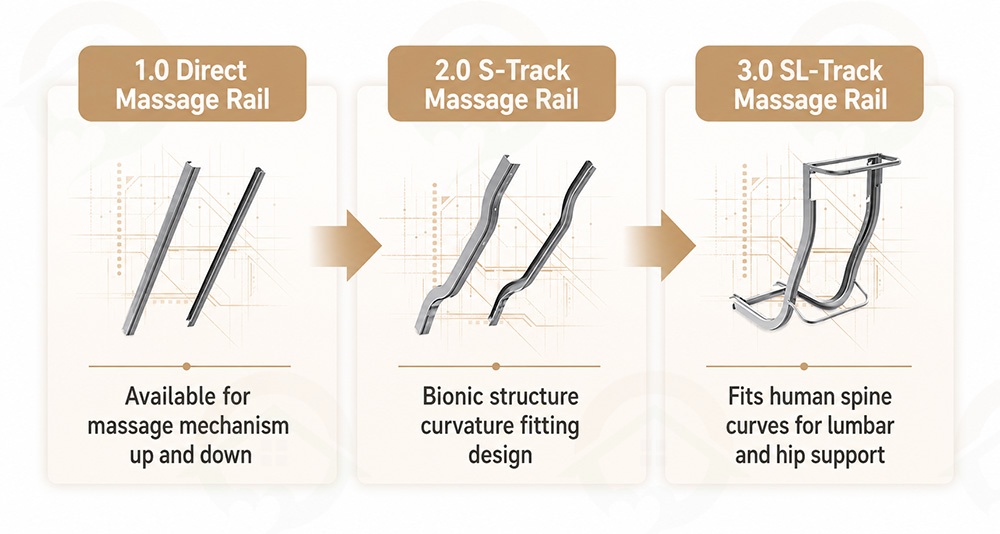
Track shape (EP5.1): straight, S, or SL — determines where on the body the rollers can reach. SL-track is now the mainstream standard for full-body coverage; S-track remains a legitimate, lower-cost choice for upper-back-focused entry models.
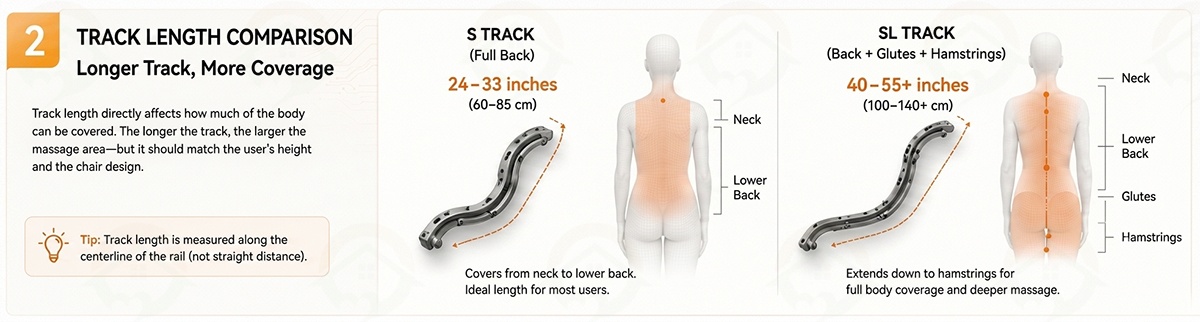
Track length (EP5.2): typically 24-33 inches for S-track and 40-55+ inches for SL-track — must be matched to footrest extension and target user height, not chosen on the number alone.
Four Spec Tiers
Combining the three specs into coherent tiers makes it easier to have a spec conversation with a buyer, rather than negotiating each component separately.
The Four Tiers at a Glance
Matching Tiers to Target Markets
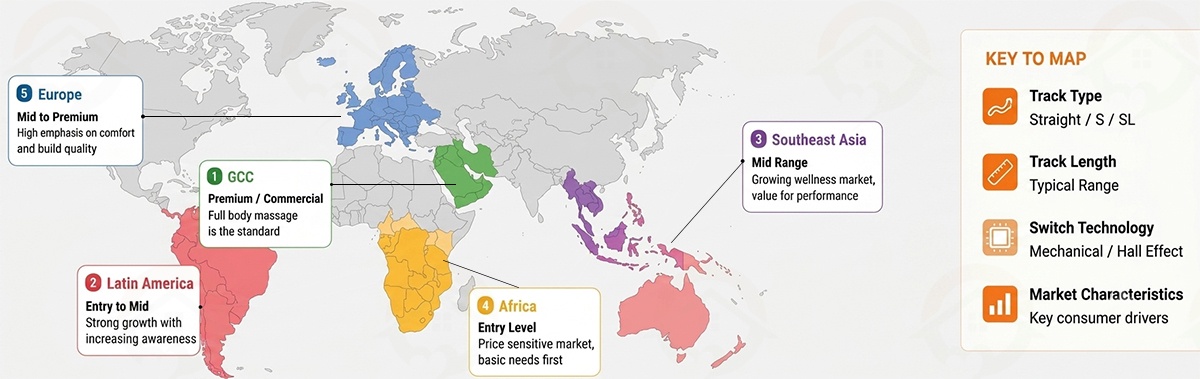
Buyer priorities differ enough across regions that the same spec tier does not always map to the same market position.
What Each Region Actually Buys
A few patterns worth noting for distributors sourcing across GCC, Latin American, and other markets:
| Market Region | Dominant Tier | Track Preference | Key Driver |
|---|---|---|---|
| GCC | Premium / Commercial | SL 51-55 in, Hall-effect | Showroom-driven retail; taller avg. user height |
| Latin America | Entry + Mid (2-tier) | S-track entry, SL mid | Needs entry SKU for landed-cost competition + upgrade path |
| Southeast Asia | Mid | SL 47-51 in, Hall-effect | Price-sensitive but expects full-body coverage |
| Africa | Entry | S-track, mechanical switch | Cost-sensitive; after-sales infrastructure limited |
The GCC pattern is largely driven by two factors: showroom-driven retail (where full-body coverage and quiet, precise operation are part of the sales demonstration) and a taller average user height, which favors longer SL-tracks — a pattern supported by the global adult height dataset (NCD-RisC).
Latin American distributors, by contrast, more frequently need a tiered product line — an entry SKU that competes on landed cost, and a mid-tier SKU that can be positioned as the upgrade option in the same showroom.
Real Cases from the Field
Real case — distributor in Dubai: A massage chair distributor serving GCC hotels and showrooms initially sourced a 47-inch SL-track chair with mechanical switches.
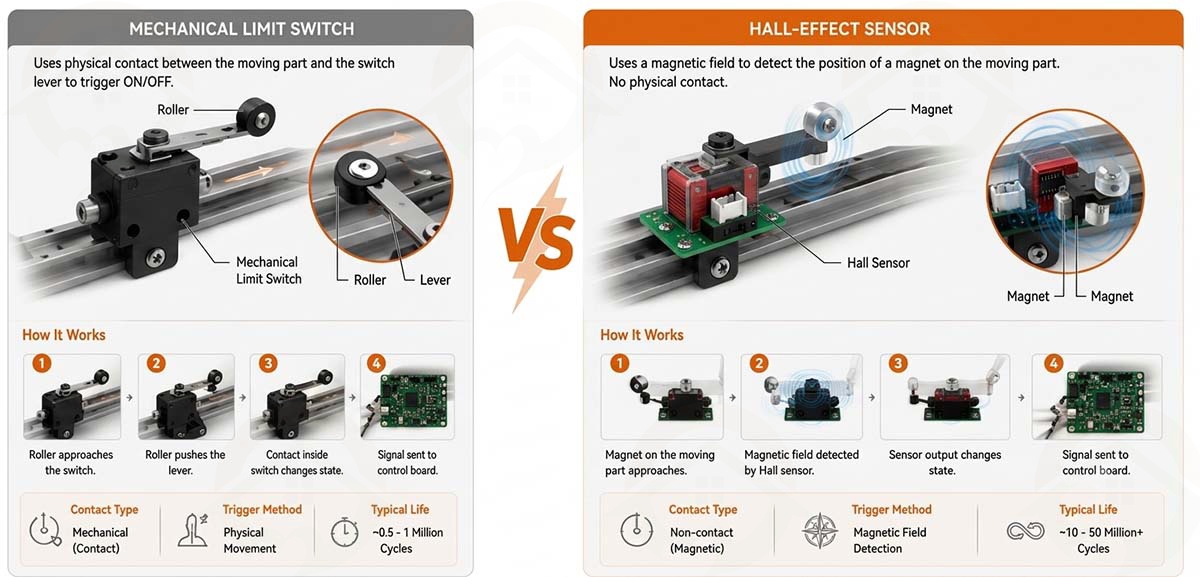
Within 6 months, the maintenance team had logged 14 field service calls for track-related issues — most of which were limit-switch failures on chairs running 8+ cycles per day in hotel lobbies.
The distributor switched to a 53-inch SL with Hall-effect sensing for all new orders. The replacement rate dropped to near zero in the first year, and the higher unit cost was offset entirely by the elimination of after-sales truck rolls.
Source: GCC massage chair distributor interview, reported on LinkedIn industry group
A Practical Way to Use This Guide
For an OEM conversation with a new buyer, the three-spec framework from this series translates into three direct questions worth asking early:
Three Questions to Ask a New Buyer
1. Track shape and length
What track shape and length does your target customer expect, based on what is already selling in your market?

3. User height considerations
Does your buyer base skew toward a specific height range that should set the minimum track length?
Getting these three answers up front avoids the more common problem of specifying a chair, receiving field complaints, and only then working backward to figure out which of the three components was mismatched to the market.
Real case — European importer: A Germany-based importer brought in 500 units of an SL-track chair for the DACH market. Within 8 months, the return rate hit 11%.
The fault tracking showed that 7 out of 10 returns were track-related: either the rollers did not reach tall users' shoulders (track too short) or the position sensor had drifted (mechanical switch degradation).
The importer replaced the stock with a longer SL-track and Hall-effect spec. Return rate stabilized at 2.3%.
Source: European massage chair distributor case study, IFD (International Furniture & Design) trade report
Series Wrap-Up
Track shape, track length, and switch technology are three of the specifications most likely to get compressed into a single marketing label — "SL-Track 4D" — that hides real differences in coverage, fit, and reliability.
Buyers who understand the three components separately are in a stronger position to compare suppliers on substance, and suppliers who can speak fluently about all three tend to build more durable buyer relationships than suppliers who lead with spec-sheet numbers alone.
That is the throughline across this series, and it is a useful frame for the product content that follows it.
Track System Deep Dive Series
This is Episode 5.4. Read the other episodes:
Joe Fan — Manufacturing & Product Development Manager
Sweet Home has manufactured massage chairs since 2013, with R&D, production, and export quality-control experience — including SL-track systems, 4D mechanisms, and zero-gravity engineering.
Disclosure: Sweet Home is the manufacturer behind these chairs, and the service data throughout this series comes from our own repair logs and production line — shared so buyers can recognize these failure patterns before they reach a container.
Quick audit: is your track selection spec complete?
1. Track tier matched to your target market? 2. S vs SL trade-offs explained? 3. Sample testing before bulk order?
Two or more unchecked? Send us your current spec.