
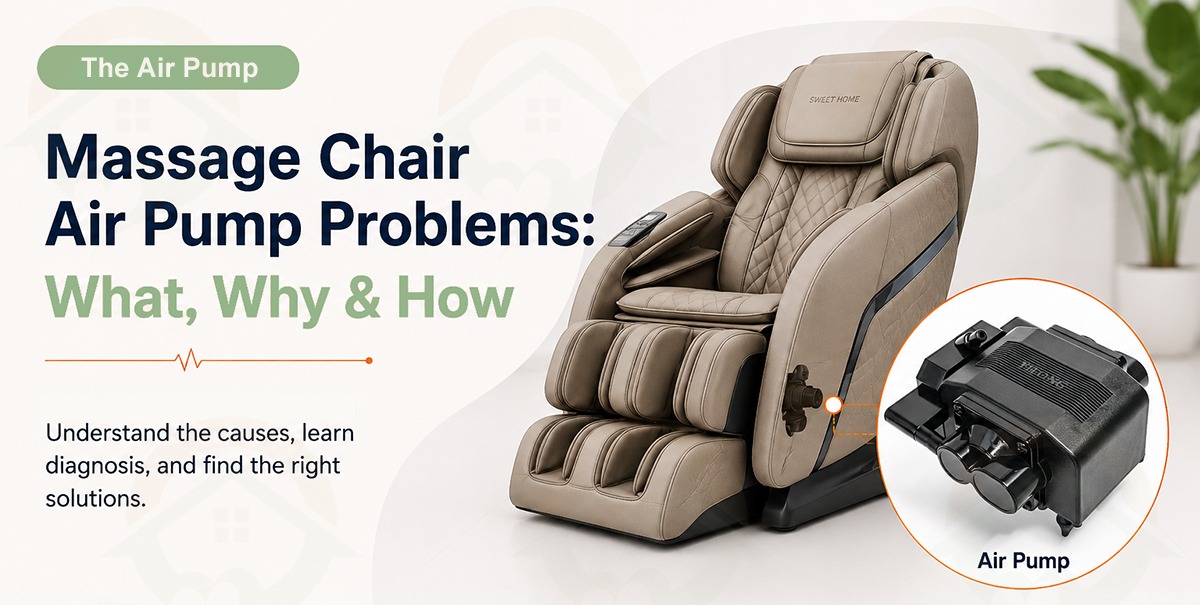
This is Episode 4.1 of our Air System Deep Dive series.
Every air pump problem in a massage chair starts the same way: airbags that should press firmly inflate weakly, take too long, or never move at all.
This guide follows the structure of our air-pump infographic series: WHAT problems happen, WHY they happen, and HOW to diagnose and fix them.
The Air Pump & the Air System
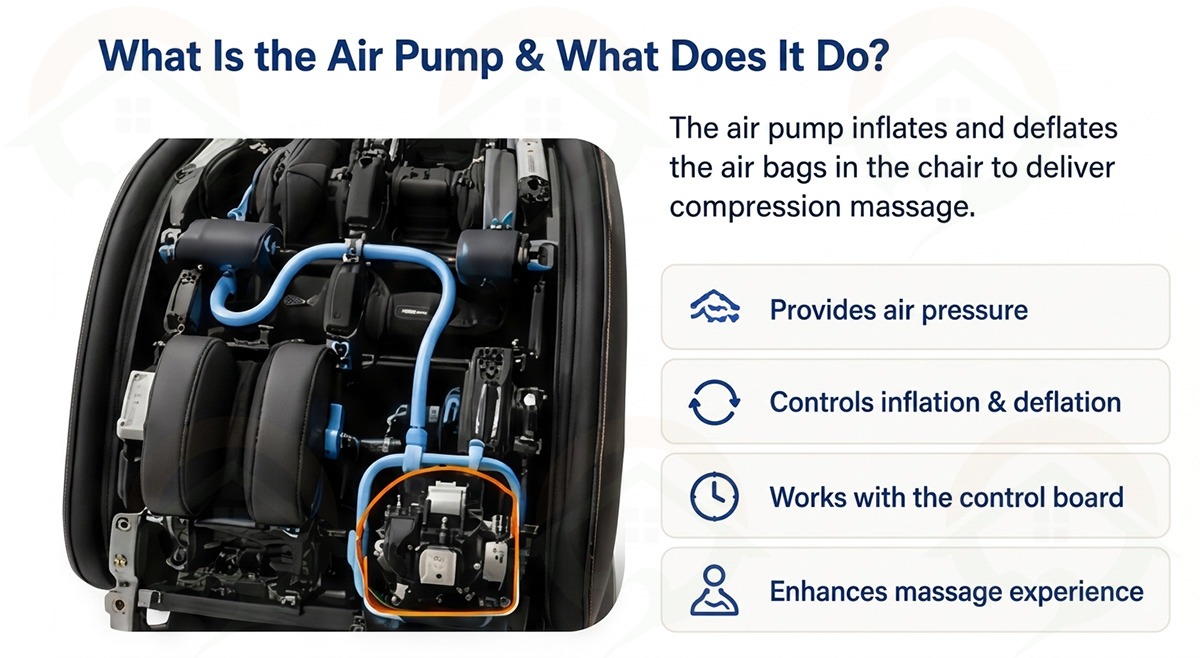
The air pump inflates and deflates the air bags in the chair to deliver compression massage. It is the component that turns electrical power into the air pressure your end customer feels as a firm, rhythmic squeeze.
- Provides air pressure — builds the force that fills every air bag in the system.
- Controls inflation & deflation — cycles air in and out to create the massage rhythm.
- Works with the control board — receives timing commands for each program step.
- Enhances massage experience — smooth pressure changes are what separate a premium chair from a toy.
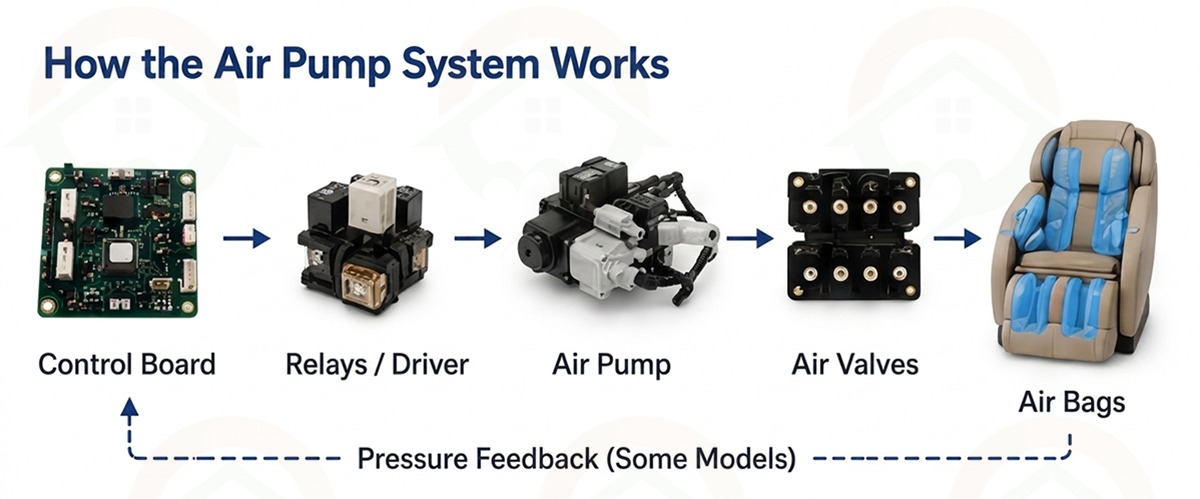
The chain is short but every link matters: the control board sends a signal to the relays/driver, which powers the air pump. The pump pushes air through the air valves, which route it into the correct air bags.
On some models a pressure feedback loop returns data to the control board so inflation timing can be adjusted in real time.
When one link in that chain degrades — a weak pump, a sticking valve, a kinked tube — the symptom shows up at the air bag, but the cause may live several components upstream. That is why diagnosis has to follow the system, not the symptom.
What Problems Happen? — The 5 Most Common Air Pump Problems
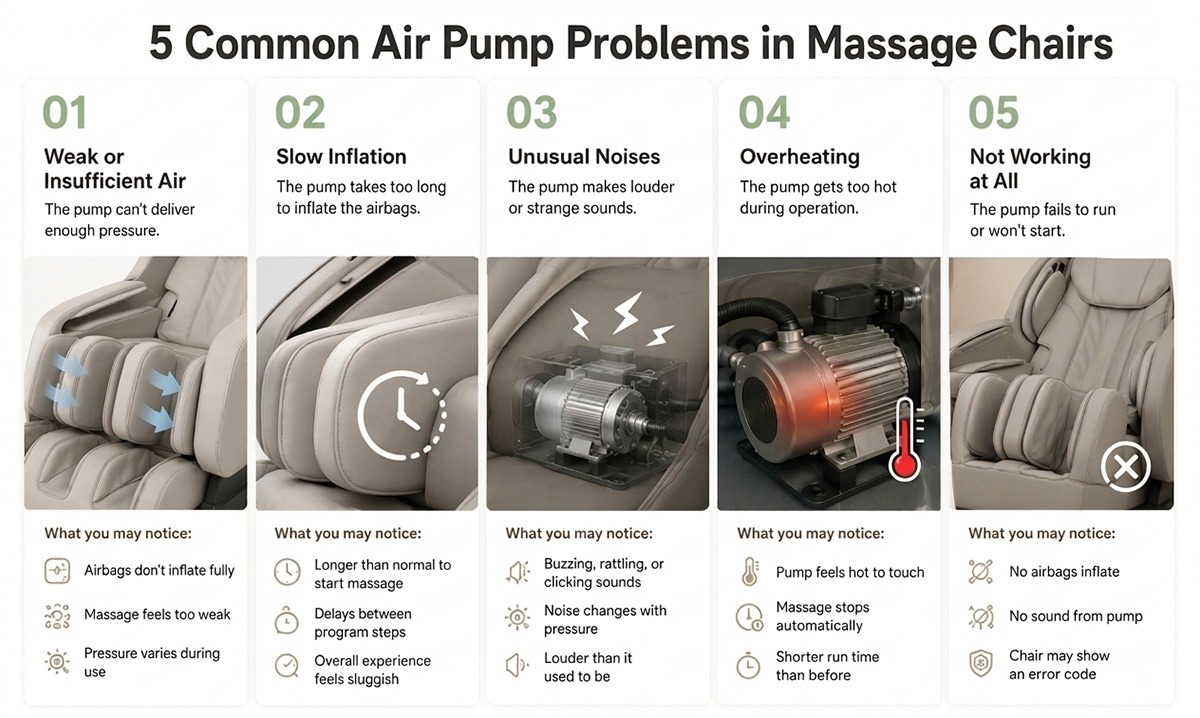
They appear in the order your customers are most likely to report them.
Problem 1: Weak or Insufficient Air
The pump cannot deliver enough pressure, so the air bags never reach full firmness. On the production bench this usually means the pump is rated too small for the air-bag volume, or a filter and tube restriction is starving it.
What you may notice:
- Airbags don't inflate fully
- Massage feels too weak
- Pressure varies during use
Problem 2: Slow Inflation
The pump runs, but it takes too long to fill the air bags. In our bench tests, a healthy pump fills a standard calf air bag in a few seconds; when inflation drags on, the usual causes are a worn diaphragm, a clogged intake filter, or a slow leak bleeding pressure while the pump works.
What you may notice:
- Longer than normal to start massage
- Delays between program steps
- Overall experience feels sluggish
Problem 3: Unusual Noises
A healthy pump hums at a steady pitch. Buzzing, rattling, or clicking usually points to a loose mounting, a dry bearing, or debris caught in the diaphragm chamber — and noise that changes with pressure is a strong signal the pump is working harder than it should.
What you may notice:
- Buzzing, rattling, or clicking sounds
- Noise changes with pressure
- Louder than it used to be
Problem 4: Overheating
The pump gets too hot during operation. Most massage-chair pumps are rated for intermittent duty, not continuous running; when a chair runs back-to-back long programs, or the pump is undersized for the air-bag load, thermal protection kicks in and the chair stops mid-massage.
What you may notice:
- Pump feels hot to touch
- Massage stops automatically
- Shorter run time than before
Problem 5: Not Working at All
No air bags inflate and no sound comes from the pump. In the tickets we log, a completely dead pump is usually an electrical failure — a blown fuse, a failed relay on the control board, or a disconnected pump harness — rather than a mechanical one.
What you may notice:
- No airbags inflate
- No sound from pump
- Chair may show an error code
Why Do Air Pump Problems Happen?
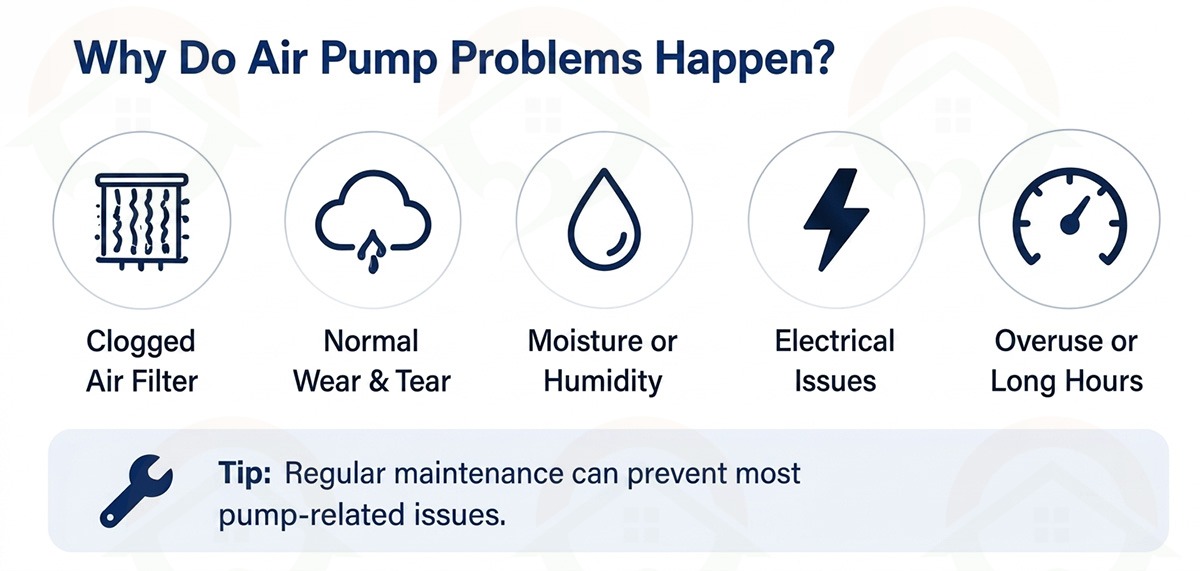
Each of the five problems above maps to a root cause. Understanding the cause is what turns a repair into a design decision.
Clogged Air Filter — the most common cause of weak air and slow inflation. The intake filter keeps dust out of the diaphragm chamber; when it clogs, the pump works against a partial vacuum and loses flow. On chairs with a serviceable filter, cleaning it every few months restores performance.
Normal Wear & Tear — diaphragms, check valves, and seals are consumables. In the service tickets we log, pumps on high-use chairs typically start losing pressure after roughly 18–24 months of daily use, well before the pump stops outright.
Moisture or Humidity — humid air condenses inside the pump and accelerates corrosion of the motor and degradation of the diaphragm. Coastal markets and bathrooms see measurably shorter pump life for exactly this reason.
Electrical Issues — a failed relay, a blown fuse, or a loose harness connection kills the pump instantly. In the tickets we log, roughly 7 out of 10 completely-dead pumps trace back to the relay or the fuse rather than the motor itself.
Overuse or Long Hours — intermittent-duty pumps pushed into continuous service overheat, which accelerates wear and triggers thermal cutout. If your channel sells to showrooms or massage studios, duty-cycle rating matters more than peak power.
Tip: Regular maintenance can prevent most pump-related issues — clean the filter, keep the chair dry, and respect the duty cycle.
Those numbers are why a pump that passes the bench can still fail in the field: duty cycle, not peak power, is what the spec sheet has to answer for.
On the bench, airflow and pressure tell you whether the pump is healthy. In the chair, the same pump lives inside a sealed cavity with a filter, tubes, and a duty cycle your customer may push far past the datasheet — which is why the maintenance schedule below matters as much as the spec.
How to Diagnose Air Pump Problems?
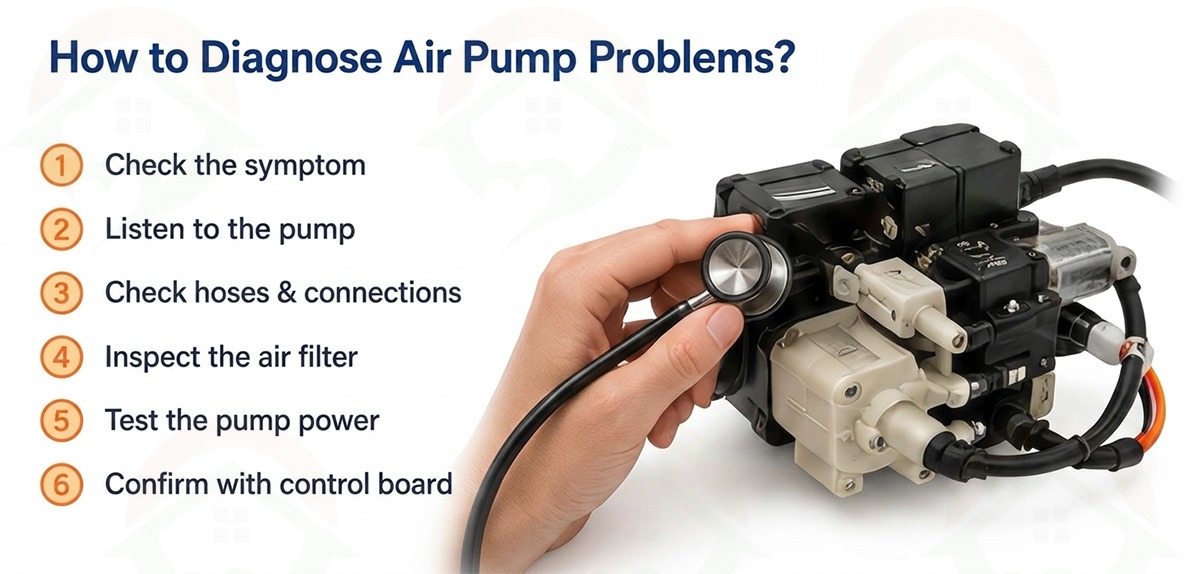
Follow the system, not the symptom. This six-step sequence is the same one our service team runs before opening a pump.
1) Check the symptom — weak air, slow inflation, noise, heat, or a dead pump each point to a different part of the chain.
2) Listen to the pump — is it running at all? A healthy hum means the motor is powered; silence means check the electrical path first.
3) Check hoses & connections — a kinked tube or a popped fitting can bleed the whole system even when the pump is fine.
4) Inspect the air filter — the single most common fixable cause of weak or slow inflation.
6) Confirm with control board — if the pump is powered but the air bags don't move, the fault may be downstream in the valve or a missing command signal.
How to Fix Air Pump Problems?
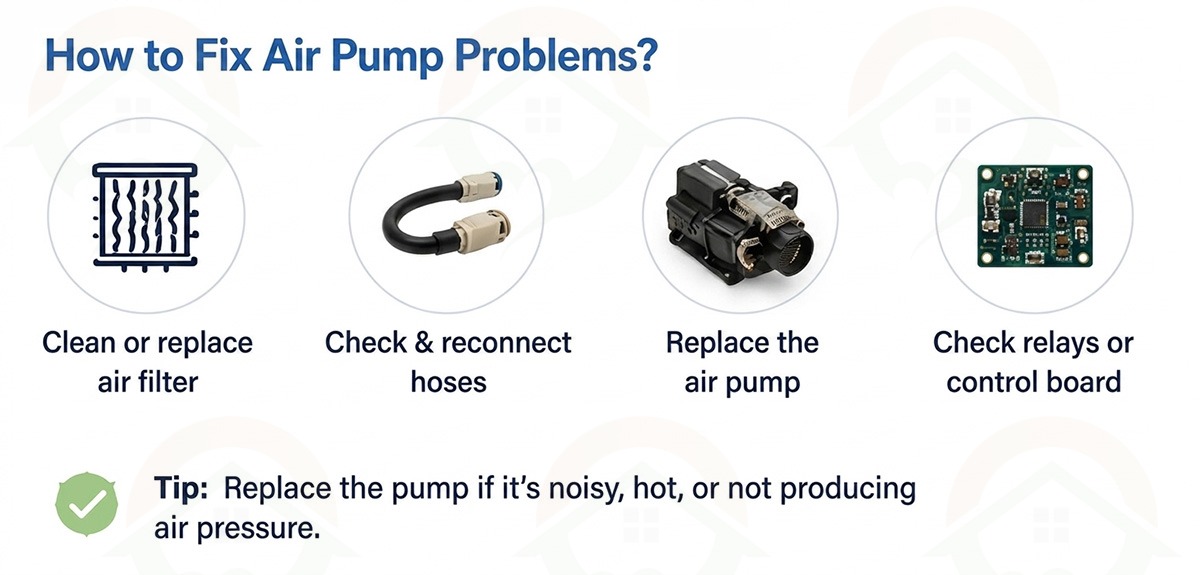
Clean or replace air filter — the fastest, cheapest fix and the one that resolves most weak-air complaints.
Check & reconnect hoses — reseat any loose fittings and straighten kinked tubes before considering any replacement.
Replace the air pump — when a diaphragm is worn or the motor is burnt, replacement beats rebuild on cost and reliability.
Check relays or control board — if the pump never powers up, test the relay and fuse path before assuming the pump itself failed.
Tip: Replace the pump if it's noisy, hot, or not producing air pressure.
Preventive Maintenance Schedule
Most air-pump failures are preventable with a simple schedule. Clean or replace the intake filter every three to six months, and check hoses and fittings for kinks or loosening during the same service visit.
Keep the chair in a dry room — humidity is the silent killer of diaphragms and motors. And respect the pump's duty cycle: if your market runs long programs back to back, spec a pump with thermal margin instead of pushing a marginal one to cutout.
For B2B buyers, the maintenance question is a spec question: can your customer actually reach the filter? On chairs we design, the filter is accessible without removing the pump, because that single decision is what makes preventive maintenance practical in the field.
Final Takeaway
The air pump is the highest-wear component in the pneumatic system, and its failure mode tells you a lot about the supplier who selected it.
When you evaluate a pump, ask for three things: a spec sheet that states airflow, pressure, and duty cycle; a serviceable filter that a technician can actually reach; and electrical protection — relay and fuse sizing — that matches the pump's inrush current.
Diaphragm material also matters — the durability of the elastomer directly drives how long a pump holds pressure, a relationship examined in [published materials research].
For a closer look at what happens after the pump, see our guide to massage chair air valve problems and the airbag materials comparison.
Air System Deep Dive Series
This is Episode 4.1 of our Air System Deep Dive. Read the other episodes:
Joe Fan — Manufacturing & Product Development Manager
Sweet Home has manufactured massage chairs since 2013, with R&D, production, and export quality-control experience — including SL-track systems, 4D mechanisms, and zero-gravity engineering.
Disclosure: Sweet Home is the manufacturer behind these chairs, and the service data throughout this series comes from our own repair logs and production line — shared so buyers can recognize these failure patterns before they reach a container.
Quick audit: is your air pump spec complete?
1. Pump type and pressure rating on the spec sheet? 2. Common pump failure modes disclosed? 3.
Two or more unchecked? Send us your current spec.
Fixed Roller Massage Chair · Massage Bed · Products · Full-Body Massage Chairs · Massage Sofas · Vending Massage Chairs · Massage Recliner Chairs · Foot & Leg Massagers · Cushions & Mattresses