
Part 3 of the Air System Deep Dive series, on the airbag — the bladder that does the squeezing. Read Episode 4.1 (Air Pumps) and Episode 4.2 (Air Valves) first if you haven't — this one closes the loop.
A distributor forwarded us a customer complaint last month: "the arm airbag looks swollen, like it's about to pop, and the chair only squeezes one arm at a time — is this defective?"
It's a fair question, and it points to something worth unpacking. Of the three components in a massage chair's pneumatic chain — pump, valve, airbag — the airbag is the one the end user actually touches, sees, and feels.
When something's wrong upstream in the pump or a valve, the airbag is where it shows up: as a bulge, a slow leak, an uneven squeeze, or silence where there should be pressure.
That makes the airbag the most visible "symptom," even when it isn't the root cause — and it also means airbag quality on its own has an outsized effect on how the whole chair feels to a customer.
This episode covers what the airbag is actually made of, the failure patterns that matter for after-sales planning, and one piece of engineering logic that's easy to mistake for a defect.
The Airbag Is the Terminal Actuator
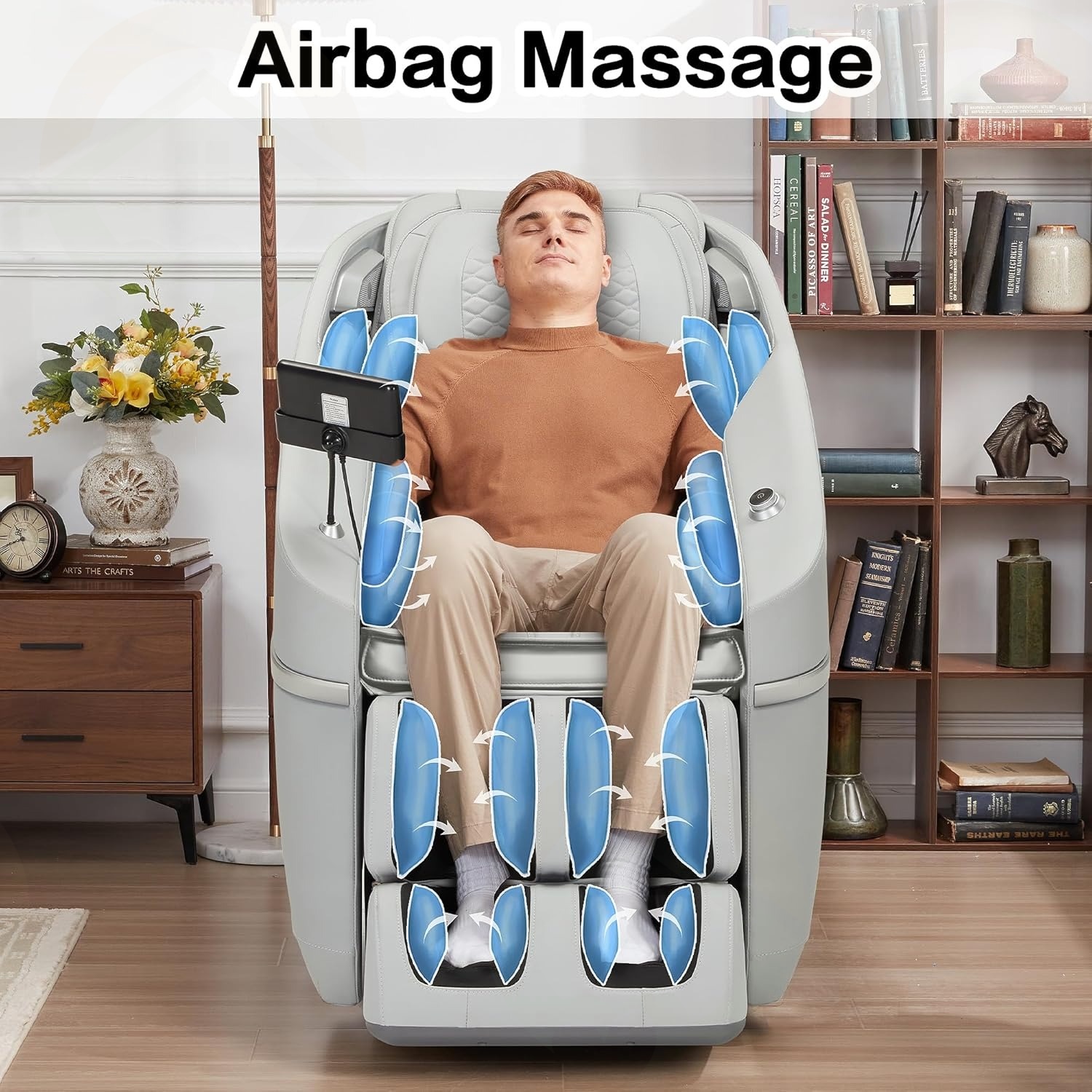
Everything upstream — pump pressure, valve timing, hose routing — exists to do one thing: inflate and deflate a sealed bladder against the user's body at the right moment.
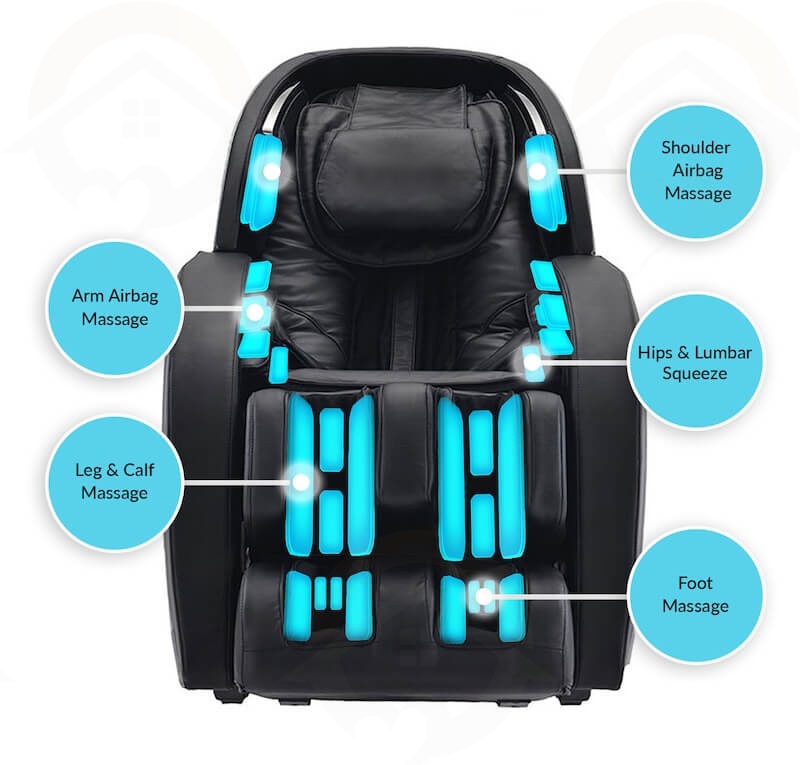
A full-body chair typically carries 20–40 of these bladders across the shoulders, arms, back, hips, calves, and feet.
Unlike the pump (1 unit) or the valve bank (grouped, often swappable as a block), each airbag is an individual wear item sewn or welded into the upholstery, which makes it the hardest part of the system to service and the easiest for a customer to notice.
That combination — highest visibility, lowest serviceability — is why airbag quality deserves as much sourcing attention as the motor or the control board, even though it's a small-ticket component.
Material Comparison: What the Bladder Is Actually Made Of
The Two Film Families: PVC and TPU
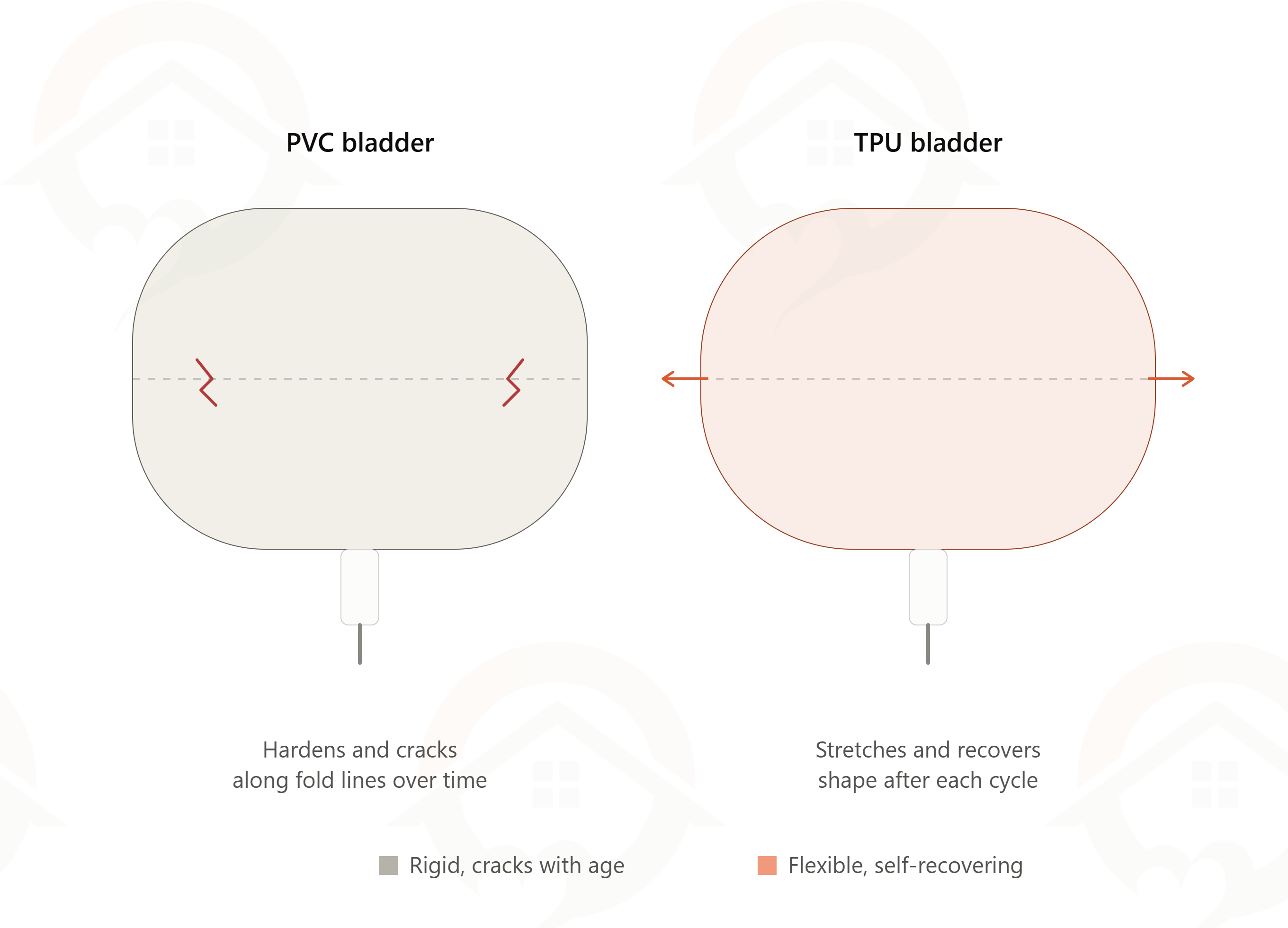
Almost every massage chair airbag on the market today is built from one of two film materials: PVC or TPU (thermoplastic polyurethane).
The mechanical difference between the two is well documented in the polymer literature — see this peer-reviewed comparison of PVC/TPU blend properties for the elongation and cycle-behavior data behind the table below.
A smaller share of premium chairs use reinforced TPU composites (TPU + nylon fabric) for extra puncture resistance in high-flex zones like the shoulders.
Pressure testing standards we use across Sweet Home airbag production: working pressure runs at 20–50 kPa (0.02–0.05 MPa), and factory over-pressure (batch) testing is run at 100–120 kPa (0.1–0.12 MPa) — roughly 2–3× working pressure.
The burst requirement is ≥260 kPa (0.26 MPa) — a safety factor of 5× or more over the operating range. These figures are the industry-wide reference for massage chair airbags, and batch testing on TPU bladders is carried out at the over-pressure level before packing.
Neither material is objectively "wrong" — PVC remains common in entry-level and mid-range chairs precisely because it's cost-effective, and for a chair sold into a climate-controlled retail environment with moderate use, it can perform acceptably for years.
The sourcing question isn't "which material is better" in the abstract — it's "which material matches this shipment's target market and usage pattern."
Common Failure Patterns
Failure Patterns 1–3: Airflow, Assembly, and Seam Integrity
1. Airbag won't inflate (or only one side does). This is the single most common complaint, and — consistent with what we covered in Episode 4.2 — it is very often not the airbag's fault at all.
A kinked, pinched, or not-fully-seated air hose introduced during final assembly is the most frequent root cause.
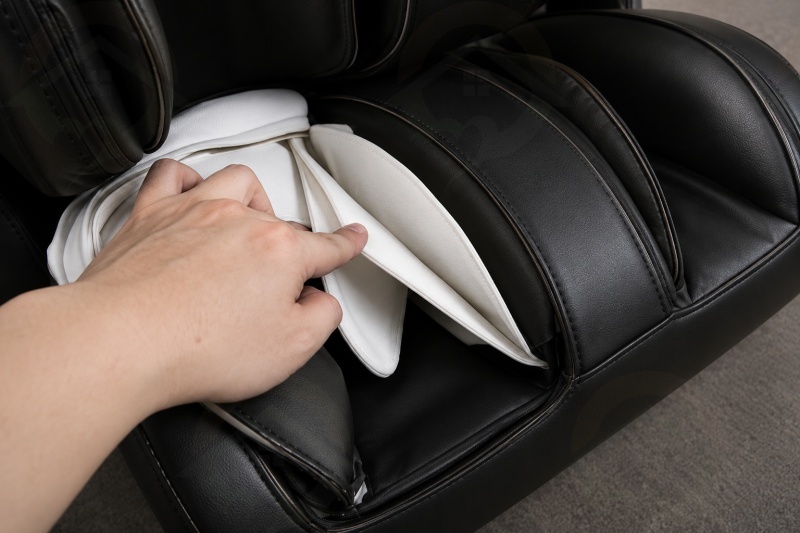
2. Visible bulging or ballooning. A bladder that inflates into an uneven, lopsided shape rather than a controlled, even expansion usually points to a weak seam or weld point giving way under internal pressure — a manufacturing consistency issue rather than a material failure.
This is more common at the start of a new production batch if weld parameters haven't been fully dialed in.
3. Slow deflation or "soft" feel over time. A bladder that used to feel firm but now feels spongy, even though it's still inflating, typically indicates a micro-leak at a seam or a fitting rather than a puncture.
This is the airbag equivalent of the valve leakage issue from Episode 4.2, and it's often diagnosed the same way — by isolating the bladder and checking for pressure decay over a fixed interval.
Failure Patterns 4–5: Aging and Environmental Stress
4. Cracking, hardening, or a fold line that "remembers" its shape. This is aging, not damage — the plasticizer in PVC bladders migrates out over years of heat cycling, and the material becomes brittle at the fold lines that see the most repeated flex.
It shows up faster in hot climates and faster still in chairs that sit in direct sun (showroom windows, uncovered vending installations).
5. Odor. A chemical smell on first unboxing is common and usually fades within days to weeks of ventilation — this is off-gassing from the film and adhesives, not a defect.
A smell that persists for months, or that's accompanied by visible film discoloration, is worth flagging back to the supplier for material batch verification.
The "One Side at a Time" Question
This one comes up often enough to deserve its own section, because it looks like a defect but isn't one.
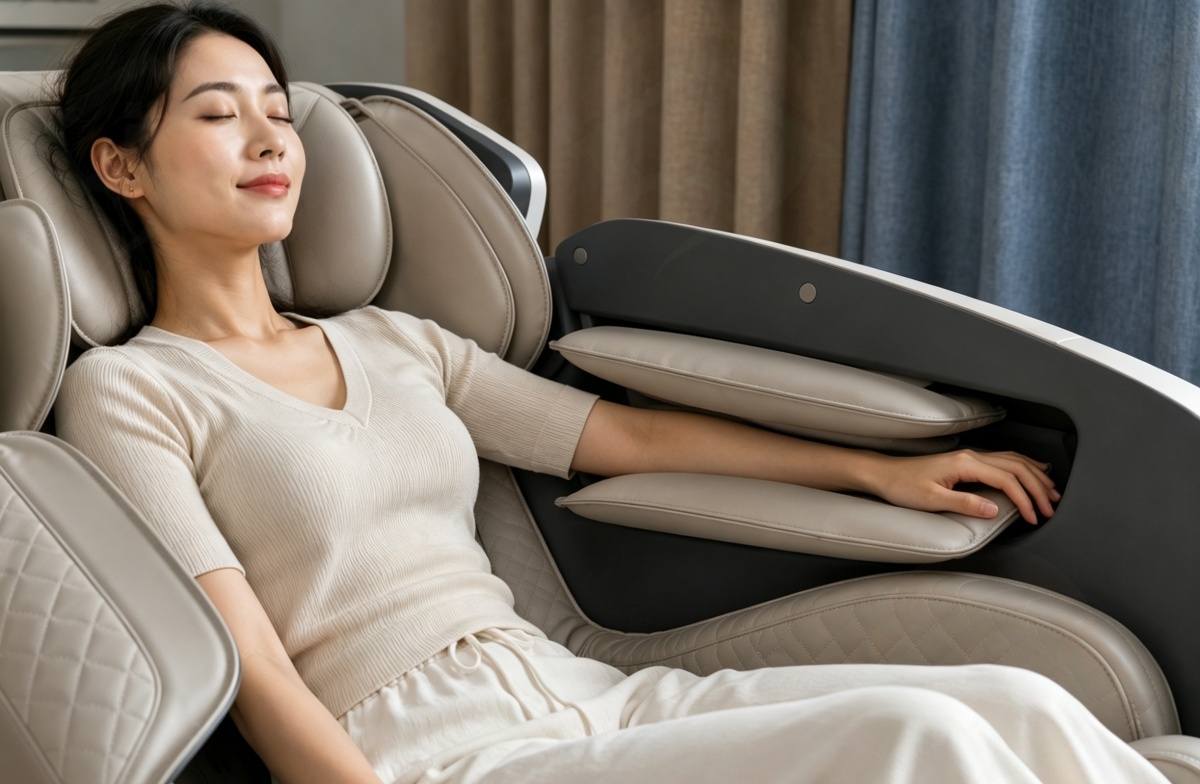
On most massage chairs, the left and right arm airbags inflate in sequence rather than simultaneously — first one arm compresses, then the other.
Customers occasionally report this as a fault ("only one arm is working"), but it is a deliberate safety design shared across nearly the entire industry.
If both arms were gripped tightly at the same time and the user needed to reach the remote for an emergency stop, having both arms restrained would make that meaningfully harder. Sequencing the arms means one hand is always free.
Shoulder, back, hip, and calf airbags — which don't restrain a limb the same way — typically do inflate together.
This is a useful line to have ready for after-sales teams and end customers alike: sequential arm inflation is standard behavior, not a symptom of a bad airbag or valve.
Climate Considerations for Export Markets
for the EU:
Middle East / GCC: Sustained high ambient heat, and units placed near windows or in semi-outdoor retail displays, accelerate PVC plasticizer migration — the hardening and cracking failure mode described above.
For showroom or vending placements with direct sun exposure, a TPU bladder or a UV-stabilized PVC formulation is worth specifying up front.
Latin America (coastal/tropical): Sustained high humidity affects adhesive and seam integrity over time more than it affects the film itself. Requesting seam/weld QC data — not just film material specs — is the more relevant question for this market.
High-duty-cycle commercial/vending placements (either region): Cycle count matters more than climate here.
A chair running 30+ sessions a day puts tens of thousands more inflate/deflate cycles per year on each bladder than a residential unit, which is exactly the scenario where the TPU cycle-life advantage pays for itself.
Buyer Due-Diligence Checklist
What to Verify Before You Commit to a Batch
✅ Confirm bladder material (PVC / TPU / TPU-nylon composite) per model, not just per product line — mixed materials across configurations of the "same" chair is common and easy to miss.
✅ Ask for cycle-life test data specific to the bladder, not just the valve — these are tested separately and a strong valve rating doesn't guarantee bladder durability.
✅ Confirm the batch burst-pressure spec against the industry reference — working pressure 20–50 kPa (0.02–0.05 MPa), factory over-pressure test at 100–120 kPa (0.1–0.12 MPa), burst requirement ≥260 kPa (0.26 MPa), a 5× safety factor.
✅ Request seam/weld QC method (RF welding vs. adhesive bonding) and whether every unit or only a sample is pressure-tested before packing.
✅ For hot-climate or direct-sun deployments, confirm UV stabilization or specify TPU.
✅ Clarify off-gassing expectations so your customer service team can set the right expectations with end buyers on unboxing day.
✅ Verify the arm-sequencing behavior is documented in your product manual — it deflects a surprising share of "defective unit" complaints before they become returns.
Closing the Air System Series
Across all three parts of this series, one pattern holds: most field complaints in the pneumatic system trace back to assembly consistency — hose routing, seam quality, batch-to-batch variation — rather than a fundamentally flawed component.
Pump, valve, and airbag are all inexpensive, well-understood parts.
That's really what this series has been about.
Joe Fan — Manufacturing & Product Development Manager
Sweet Home has manufactured massage chairs since 2013, with R&D, production, and export quality-control experience — including SL-track systems, 4D mechanisms, and zero-gravity engineering.
Disclosure: Sweet Home is the manufacturer behind these chairs, and the service data throughout this series comes from our own repair logs and production line — shared so buyers can recognize these failure patterns before they reach a container.
Air System Deep Dive Series
This is Episode 4.3 of our Air System Deep Dive. Read the other episodes:
Quick audit: is your airbag spec complete?
1. Airbag material (PVC/TPU) specified? 2. Airbag leak and pressure test data available? 3.
Two or more unchecked? Send us your current spec.