
A massage chair can be a genuinely useful comfort tool if you live with back pain — and a genuinely bad idea in six specific situations. Whether it helps or hurts comes down to why your back hurts, which programme you run, and how long you stay in the chair.
This guide answers the three questions we get asked most by distributors, retailers and their end customers: when a massage chair helps with back pain, when it should be avoided, and how to use one safely step by step.
It closes with the warning signs that mean stop and see a doctor, plus the spec lines a B2B buyer should put in writing before booking a container.
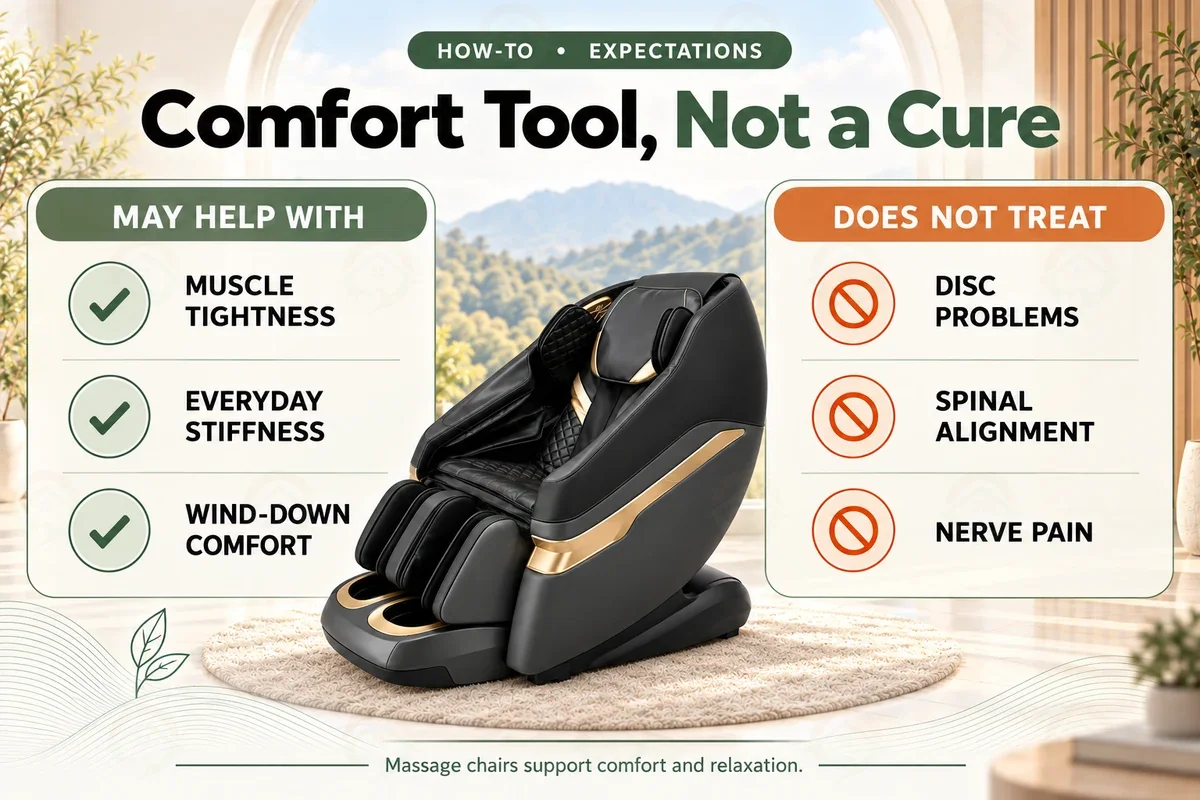
One thing to get out of the way first: a massage chair is not a medical device. It does not treat the cause of back pain, disc problems or sciatica.
Everything below is general product-use information, not medical advice — if you have a diagnosed condition, a recent injury, or you are pregnant, talk to a doctor before using any massage device.
What a Massage Chair Can and Cannot Do for Back Pain
Most everyday back discomfort that responds to a massage chair is muscular: tissue that has been held in one position too long and has gone stiff. That is a mechanical problem with a mechanical response, which is why gentle, rhythmic massage feels good.
What it cannot do is change a structural problem.
Where a chair usually helps
- Muscle tightness and stiffness after long hours of sitting — desk work, long drives, long-haul flights.
- Everyday soreness linked to posture, a commute, or a physically repetitive job.
- Mild, non-specific back strain that has no structural injury behind it.
- Wind-down comfort at the end of the day, where the goal is relaxation rather than correction.
Mechanically, this is simple. Sustained tension keeps a muscle short and sore; slow kneading and rolling at low intensity gives it a reason to lengthen and settle.
Researchers and clinicians describe massage therapy as a comfort and relaxation measure with reported short-term relief for low back discomfort, not a treatment for the underlying condition — the framing used by the US National Center for Complementary and Integrative Health.
Heat works on the same logic. A warmed contact surface makes a session feel more comfortable, which is why heated massage chairs are the fastest-growing sub-category in most of the markets we ship to.
On a chair, the two features that matter most for a lower-back user are a lumbar-focused programme and an intensity range that starts genuinely low — not a chair whose weakest setting is already strong.
What no chair can do
A massage chair cannot decompress a disc, realign a spine, or fix an inflamed nerve root. If your pain is radiating, shooting, or accompanied by numbness, the chair is irrelevant to the problem and can make it worse — see the warning signs section below.
It also cannot substitute for the strength and mobility work that actually addresses recurring back pain.
When You Should Not Use a Massage Chair for Back Pain
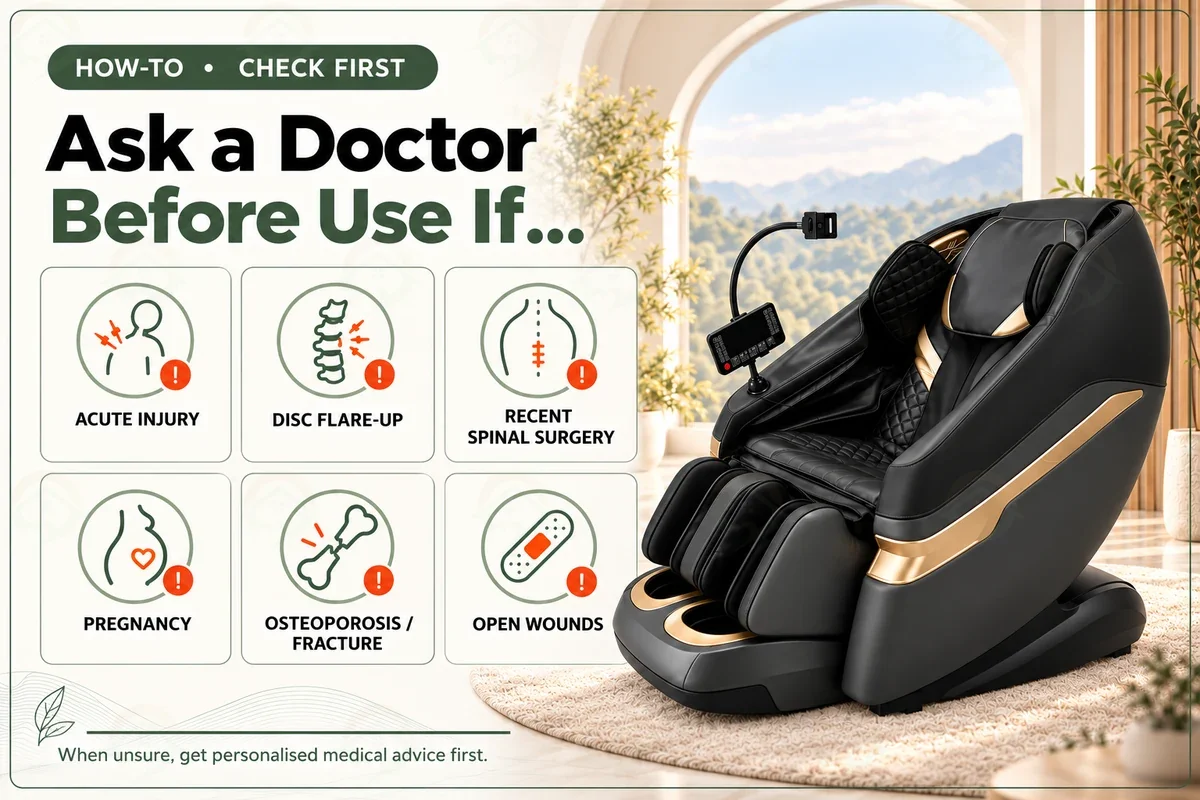
This is the most important section in this guide. If any of the following applies, do not use a massage chair unless your doctor has clearly said it is fine. A short conversation with a clinician is worth far more than a painful mistake.
1. Acute injury or sprain (the first 48 hours)
In the early stage the body is in a protective, inflammatory phase. Massage adds mechanical load to tissue that is actively swollen, which tends to make pain and swelling worse rather than better.
2. An active flare-up of a herniated disc
When a disc issue is actively irritated, pressure and vibration can increase pain instead of easing it. This is also the situation where a strong percussion programme does the most damage in the shortest time.
3. Not yet recovered from spinal surgery
Post-surgical tissue needs time to heal, and mechanical pressure across an incision site or a fused segment can interfere with that process. Only the surgeon can clear you for this.
4. Pregnancy, especially the first trimester or a high-risk pregnancy
The lower back and abdomen are sensitive areas during pregnancy, and some massage techniques and intensities are not considered safe. Heat adds a second consideration: core temperature. This group needs personalised advice, not a general guide.
5. Osteoporosis or an unhealed fracture
When bone is fragile, roller pressure that is harmless for most users can pose a real risk. The same applies to any condition that weakens bone structure.
6. Broken skin, wounds, or unhealed surgical incisions
Pressure and heat over an open or healing area slow recovery and raise the risk of irritation.
If you are not sure which category you fall into, treat that uncertainty itself as a reason to ask a doctor first. For a plain-language overview of what low back pain usually is and when it needs attention, MedlinePlus is a reasonable starting point.
How to Use a Massage Chair Safely with Back Pain: Step by Step
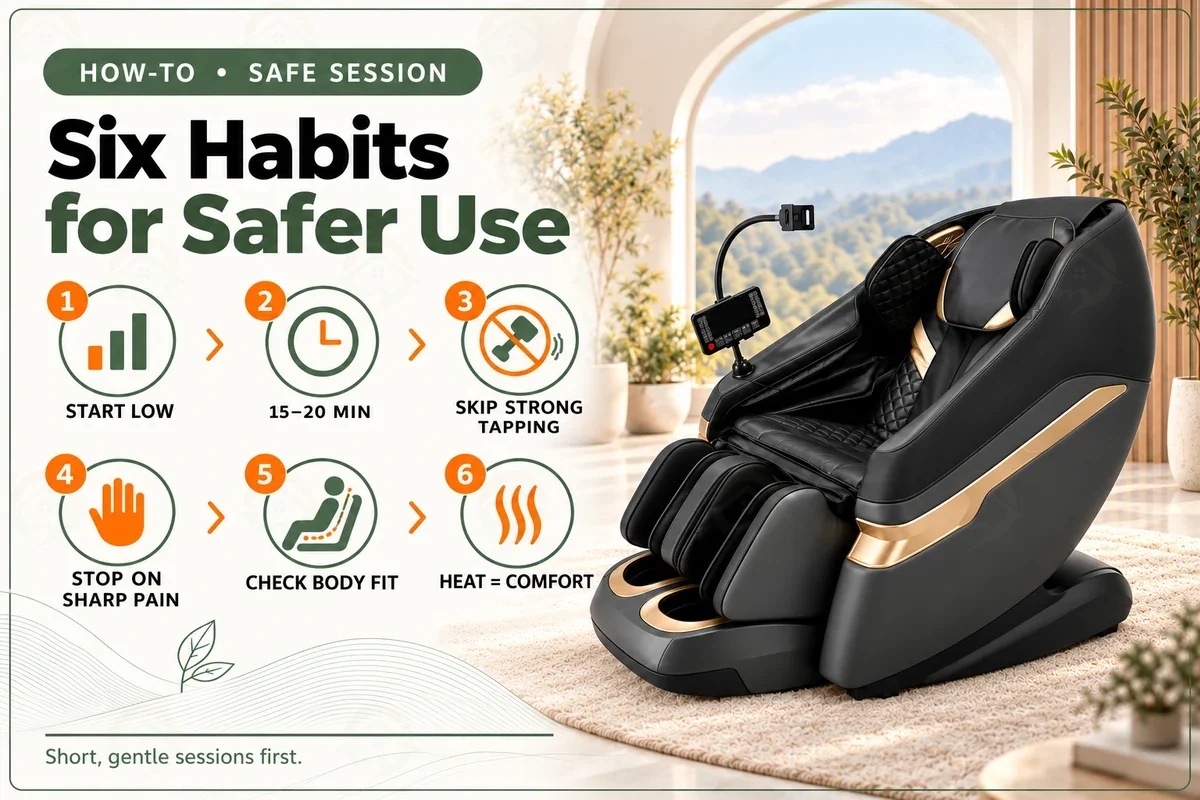
If a chair is appropriate for your situation, these six habits get you the most comfort with the least risk. They also happen to be the six points we walk through most often with partners fielding after-sales questions.
Step 1: Start at the lowest intensity, in the lowest programme
On your first session, pick the gentlest setting and a short duration. Judge the result the next day, not during the session. A common first-session mistake is choosing "strong" to feel like the chair is doing something.
Step 2: Keep sessions short — around 15 to 20 minutes
Longer is not better. Avoid back-to-back sessions and avoid falling asleep in the chair: two hours of continuous roller pressure on the same tissue is not a stronger version of a 20-minute session, it is a different and worse experience.
Most chairs ship with a 15–20 minute auto-off timer for exactly this reason.
Step 3: Avoid strong tapping or percussion over an acutely painful area
Deep, forceful tapping is the mode most likely to feel jarring, and the one most likely to aggravate an irritated area. Gentle kneading or rolling is usually tolerated far better.
If your chair lets you choose roller speed independently of intensity, slow the rollers before you reduce intensity — slower contact is what most users actually respond to. The mechanics behind those programme names are broken down in our 2D / 3D / 4D mechanism guide.
Step 4: Stop immediately if you feel sharp pain or your symptoms worsen
Discomfort that increases during use is a signal, not a challenge. Get out of the chair, and do not try again the same day. Improving comfort and worsening pain are two different outcomes; only one of them means the chair is working for you.
Step 5: Match the chair to your body before you use the programme
Two physical mismatches cause a large share of the complaints we log: the roller track is too short for the user's torso, so lower-back coverage is thin, and the reclined footprint does not clear the wall behind it, so the user never reclines fully.
Track length is covered in our track length guide, and the space requirement in the installation clearance guide. Both are worth checking before a first session, not after.
Step 6: Use heat as comfort, not as treatment
Gentle warmth makes a session feel more soothing and helps a stiff back let go. Keep heat on the lower-back zone only, keep it within the chair's built-in timer, and treat it as an add-on to a short session rather than a way to extend one. The reasoning is in our heat therapy guide.
Two situations deserve a doctor's sign-off even though the chair is otherwise fine for you: being older, pregnant or post-surgical, and having any diagnosis on the list above. These groups have the least margin for error and the most to gain from personalised advice.
Warning Signs: Stop Using the Chair and See a Doctor
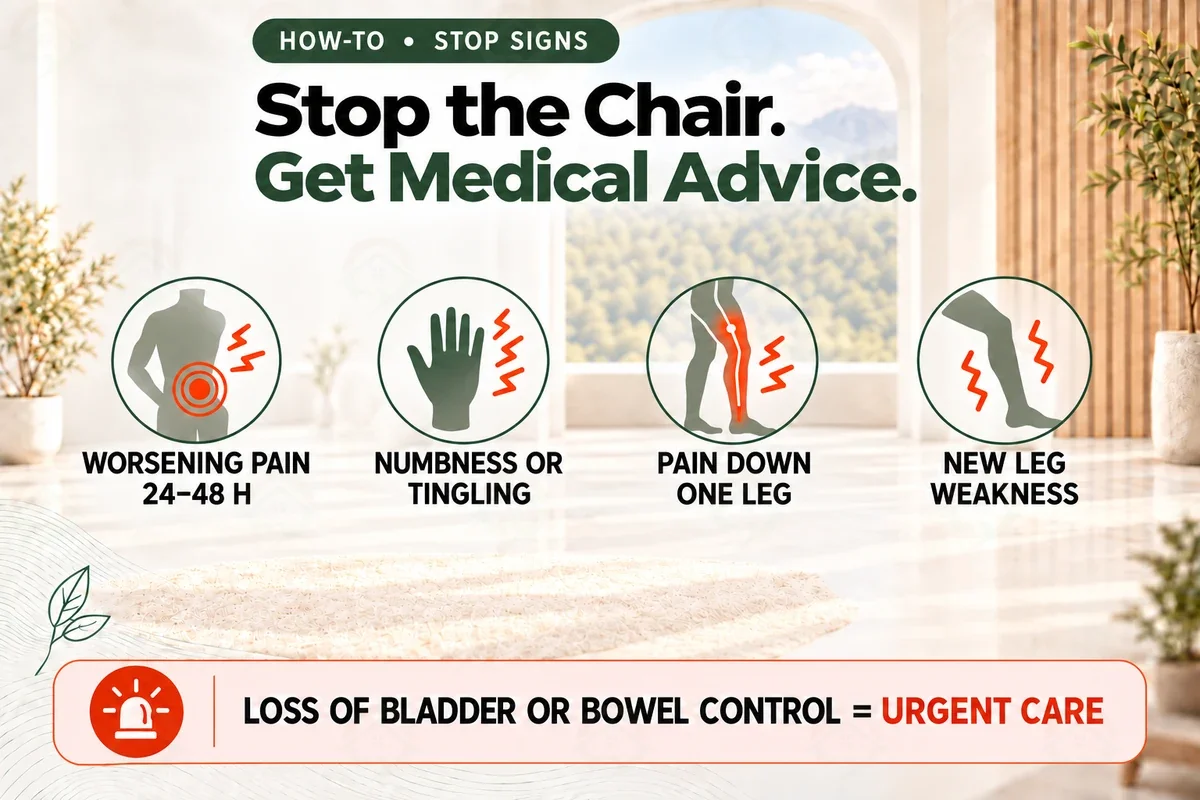
A massage chair should leave you feeling relaxed, not worse. Seek medical attention if you notice any of the following:
- Pain that keeps getting worse for more than 24 to 48 hours after use.
- Numbness, tingling, or pain radiating down a leg — a sign that a nerve is involved.
- Existing symptoms clearly worsening instead of settling down.
- New weakness in a leg or foot, or loss of bladder or bowel control — this needs urgent care, not a chair adjustment.
None of these necessarily means something serious has happened. They do mean the chair is not the right tool for your situation right now, and a clinician is the person who can tell you what is going on.
The US NIAMS summary of back pain is a useful, non-commercial reference for what different symptom patterns usually indicate.
For B2B Buyers: What to Put in Your Purchase Spec
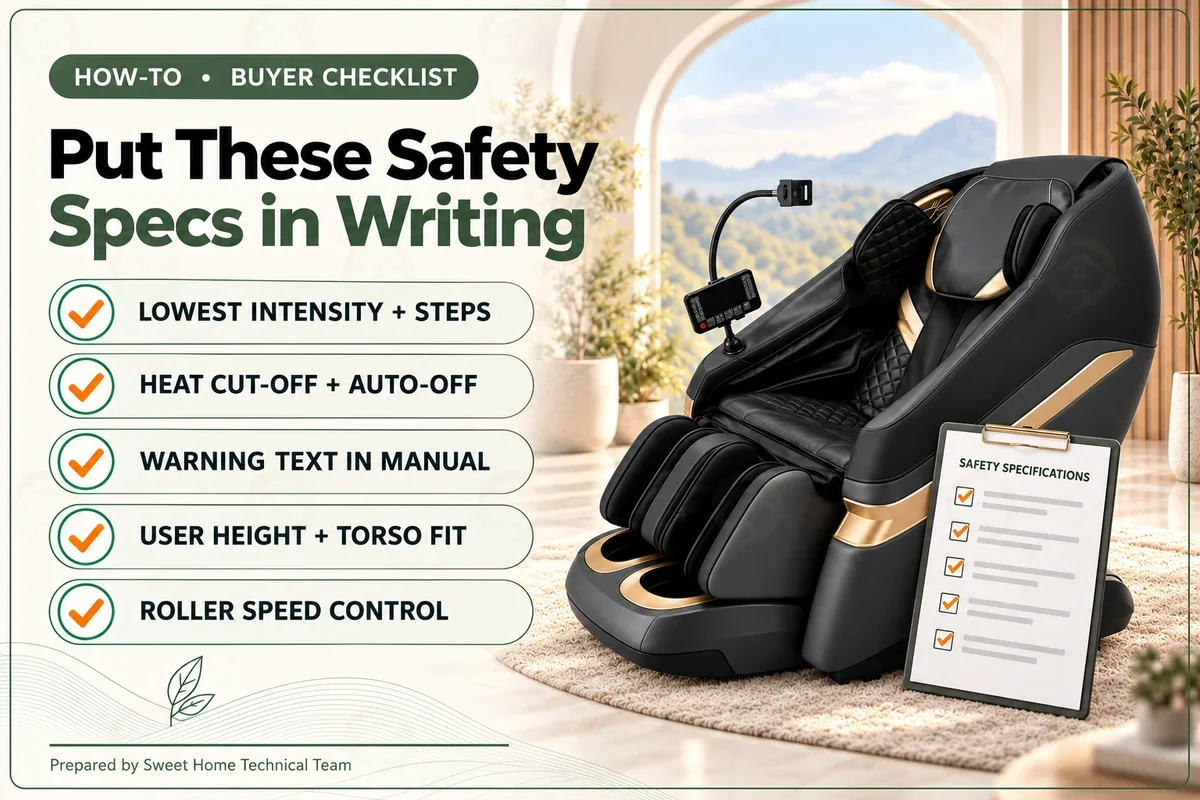
Every claim in the sections above becomes a spec line when you sell these chairs.
In the markets we export to, back-pain and safety questions are the most common pre-purchase enquiry a retailer's inbox receives — and the most common after-sales ticket that a factory can prevent at order time for almost nothing.
From our side of the line: across the export orders we handle, safety-related after-sales tickets rarely come from a broken component. They come from a customer who was never told how long to sit, which programme to avoid, or who could use the chair at all.
Almost all of it is documentation, not hardware — and it is cheap to fix before the container ships, expensive to fix after.
The five spec lines worth writing down
| Specify in writing | Why it matters | Where it shows up |
|---|---|---|
| Lowest intensity level and step count per programme | A weak first step is what makes a chair usable for a sensitive user; the top setting is marketing | Pre-sale questions, product-page copy |
| Contraindication and warning text, in the shipped manual | Converts a liability question into a printed instruction the customer received | After-sales disputes, market compliance review |
| Minimum user height and torso fit range | Fitter customers report the chair works; a mismatched track length reads as a defective chair | Returns and fit complaints |
| Roller speed separately adjustable from intensity | Speed is what sensitive users actually adjust first | Product differentiation in a crowded range |
Spec items above are the checks we recommend to buyers; exact values and timings vary by model and programme.
Compliance is the other half of the brief
For a back-pain-positioned model, the parts of the standard that buyers ask about most are temperature rise limits and the requirements around unattended operation — both of which sit on the electrical side, not the upholstery side.
Two practical steps before you sign off a bulk order. First, ask for the current certificate that names your exact model, not the family sheet.
Questions Buyers and Their Customers Ask
Is it safe to use a massage chair every day if you have back pain?
For everyday muscular stiffness, daily short sessions of around 15 to 20 minutes are common practice and are what most programmes are designed around. Daily use is not the risk; long, unsupervised or high-intensity use is. If pain increases day over day, stop and get it looked at.
Can a massage chair make sciatica worse?
It can. Sciatica is a nerve symptom, not a muscle one, and pressure or vibration near an irritated nerve root can intensify it. Radiating pain down a leg is one of the situations where a chair should not be used until a clinician has cleared it.
Which programme is safest for a sensitive lower back?
A slow kneading or rolling programme at the lowest intensity, on the lower-back zone, for a short session. Avoid percussion and tapping modes, and avoid programmes that work the whole back at high pressure.
If your chair has a stretch or zero-gravity programme, the reclined position itself is generally comfortable for a stiff lower back — our zero-gravity mode guide explains what the position does and does not change.
Should a chair be sold as a back-pain solution?
No, and buyers should push back on that framing. A chair is a comfort and relaxation product. Marketing it as a treatment creates both a compliance problem in most markets and an after-sales problem for your team.
The strongest positioning we see working is honest comfort language plus clear usage instructions.
Disclaimer: This guide is general product-use information, not medical advice, and it is not a substitute for professional diagnosis or treatment. A massage chair is not intended to diagnose, treat, cure or prevent any disease.
If you have a pre-existing back condition, have recently had surgery, are pregnant, or are unsure whether a massage chair is suitable for you, consult your doctor before using one. Individual results vary.
Tommy
Sweet Home Technical Team
Part of Sweet Home’s in-house technical team. Tommy writes our How-To guides for importers and distributors — product-use guidance, factory checklists, and order-time pitfalls — built on our export order data and after-sales records.
Disclosure: Sweet Home is the manufacturer behind the chairs discussed in this guide, and the after-sales patterns come from our own orders and repair records — shared so buyers can brief their retail and commercial customers accurately.
Quick audit: is your back-pain model specced for safe use?
1. Intensity range documented per programme? 2. Heat cut-off temperature and auto-off timer in writing? 3. Contraindication and warning text included in the manual you ship?
Two or more unchecked? Send us your current spec sheet and get a line-by-line reply from our technical team.