
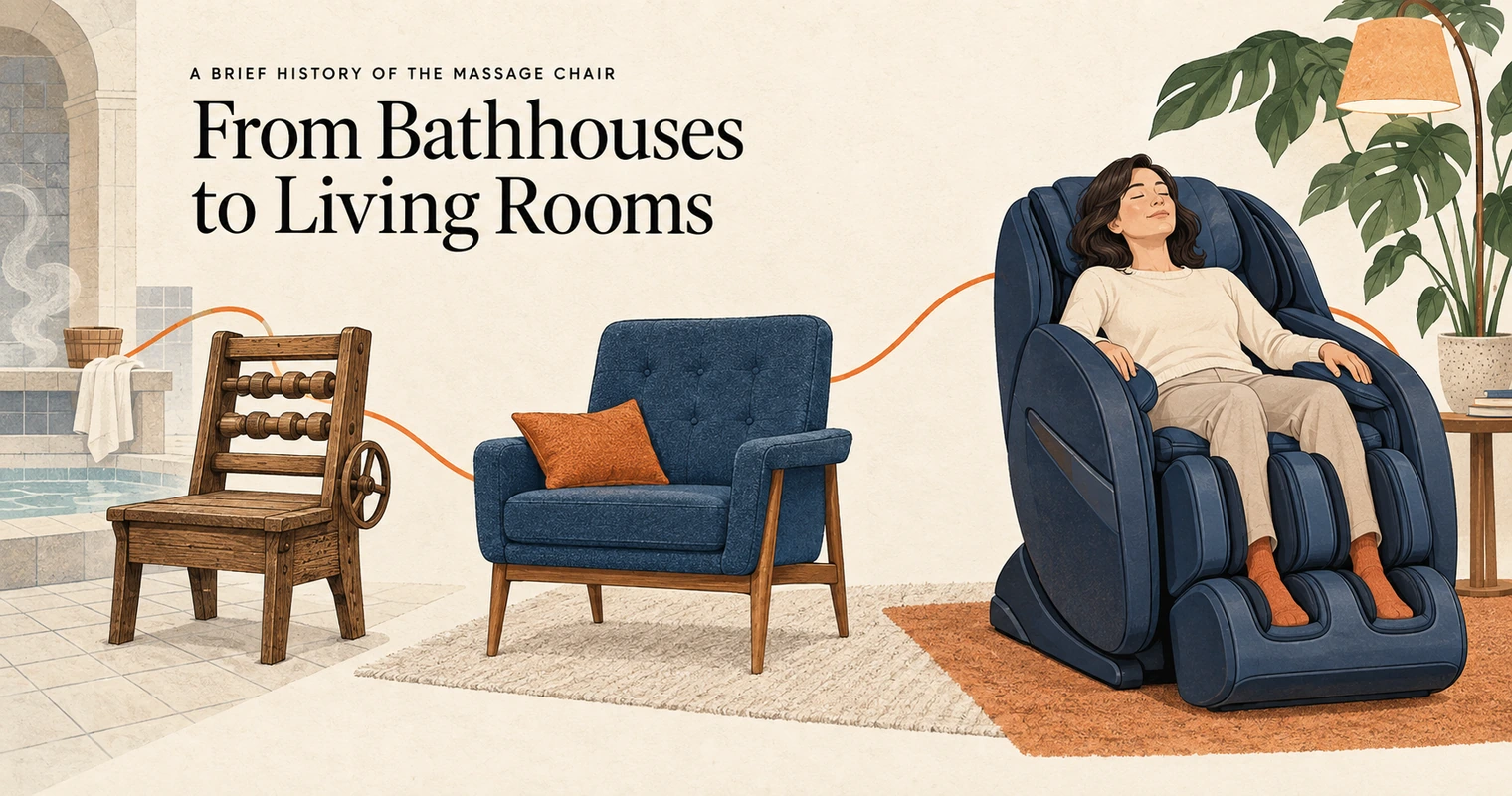
Before massage chairs had touchscreens, they had bicycle chains.
That is not a metaphor. Wood, rubber balls and bicycle chains were among the materials used in the experiments that led to Fujiiryoki’s first mass-produced massage chair in 1954. Today, you can recline, choose a program and let a chair work on your back while your phone sits unanswered.
Getting from one scene to the other took more than a bigger motor.
The history makes more sense when you follow the problems designers were trying to solve: make massage possible in a chair, make that chair welcome at home, then make the experience fit the person sitting in it.
1954: A practical idea in a Japanese bathhouse
Picture the changing area of a public bath in postwar Osaka. People have finished bathing and are taking a moment before heading home. Fujiiryoki founder Nobuo Fujimoto saw an opportunity in that pause: could a machine offer a back massage while someone sat down?
According to Fujiiryoki’s account of its original machine, repeated experiments with salvaged materials led to the first mass-produced model in 1954. It offered kneading, with a handle at the side to move the massage balls up or down.
No body scan. No playlist. Just a mechanical answer to a familiar wish: “A little higher. Yes, there.”
“First mass-produced massage chair” is the useful historical distinction. It identifies the commercial milestone without claiming that nobody had ever attempted a mechanical massage seat before.
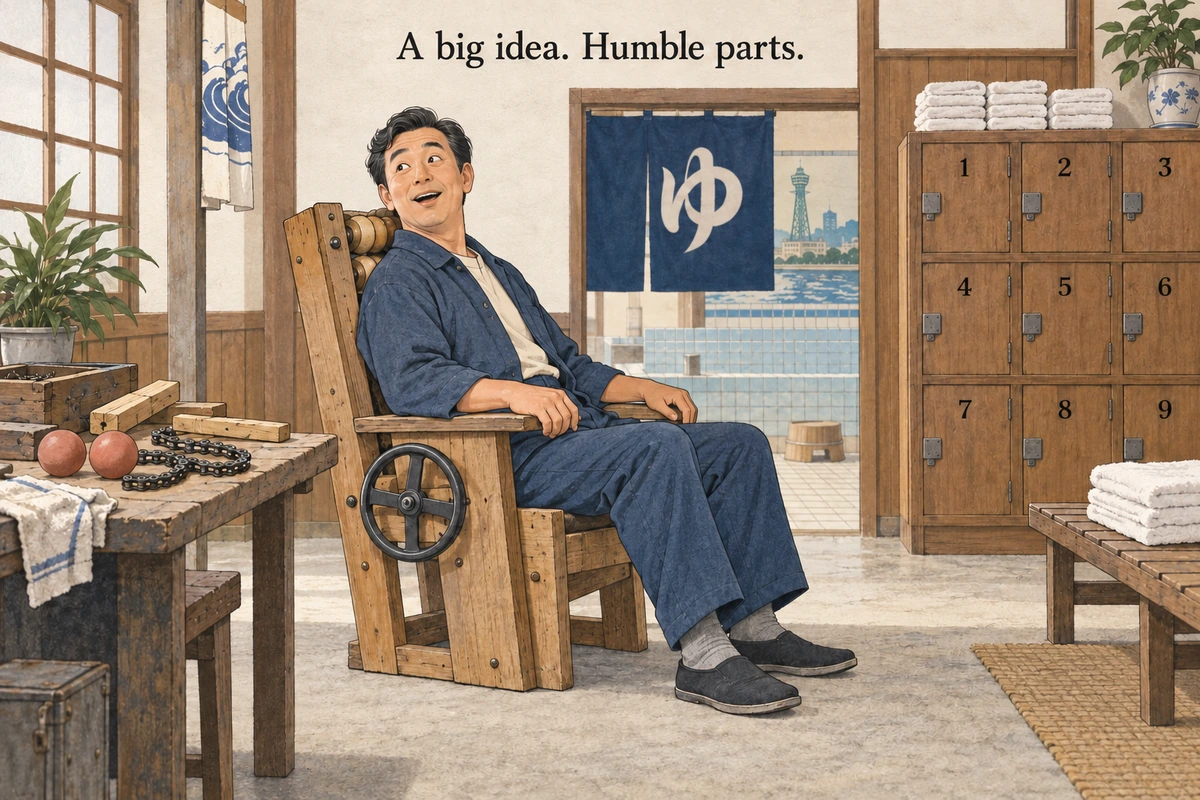
Humble materials helped start a new product category. Conceptual illustration, not a reconstruction of the 1954 model.
1960s–1980s: The chair earns a place at home
Once the basic idea worked, users wanted more choice. Fujiiryoki’s product archive records a kneading model in 1965, a tapping model in 1967, and a chair that switched between the two in 1975. Roller massage and adjustable reclining followed in its late-1970s and 1980s range. See the historical models.
But better movement was only part of the job. A machine could look perfectly acceptable beside a bathhouse changing room and still look rather strange beside the family sofa.
Fujiiryoki’s company history describes growing home demand from the 1970s and designs adapted for domestic interiors. People who had enjoyed a chair at a bathhouse or inn wanted that experience at home. Upholstery, appearance and everyday usability became part of the product.
This is an easily overlooked chapter. The massage chair had to become furniture people would live with, as well as a machine they would use.
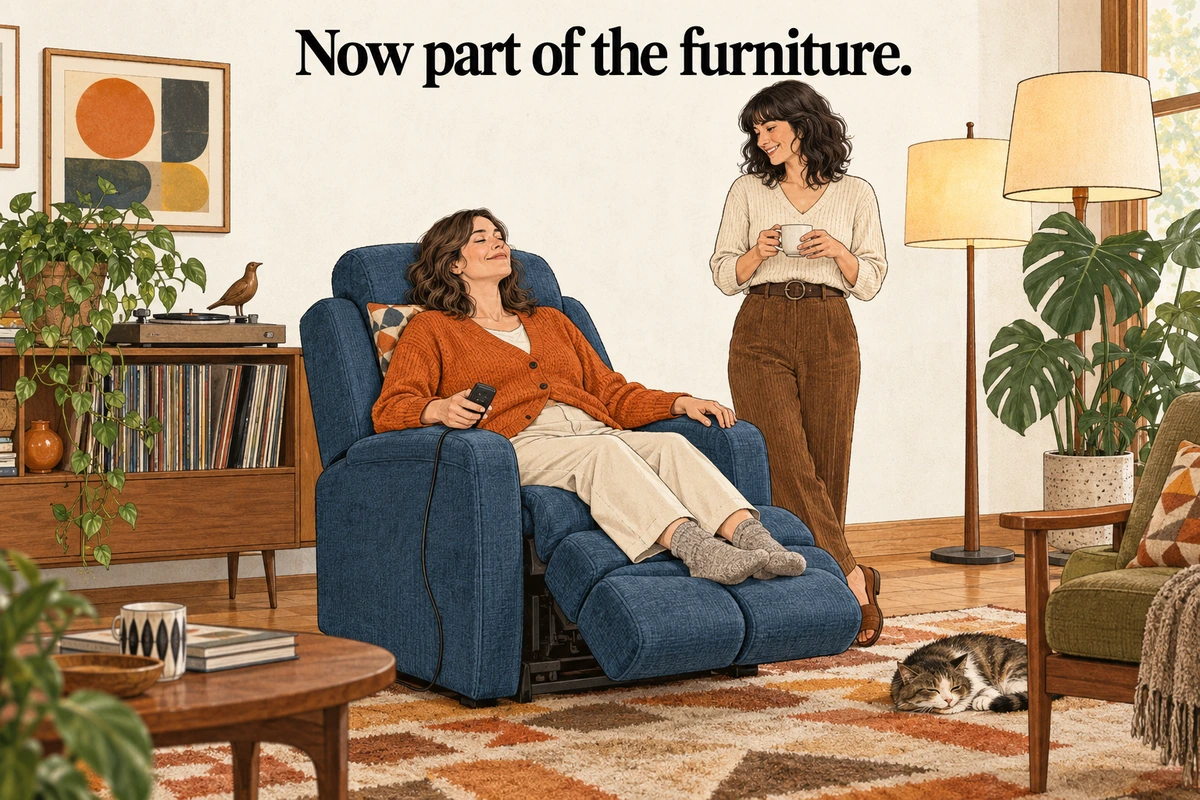
To earn a place at home, massage chairs needed to suit the room as well as the user. Conceptual period-inspired scene.
1990s–2000s: The legs finally get invited
For early chairs, the back was the main event. Airbags helped broaden the experience. These cushions inflate and release to apply a squeezing action, giving designers a different way to massage areas such as the calves and thighs.
A documented milestone is Fujiiryoki’s 1995 Royal Chair MC-133, which used airbag massage. Its 2000 AS-777 then combined airbags and massage balls in one chair. That combination helped establish the familiar modern approach: different mechanisms doing different jobs. Source: Fujiiryoki’s product history.
The next challenge was fit. A tall person and a shorter person do not bring their shoulders to the same place. In 2001, Fujiiryoki’s AS-001 introduced its 3D Point Navigation System, using sensing to adapt the massage to the user’s back.
The company also records three-direction roller movement on that model. Source: Fujiiryoki’s development history.
In plain English, the engineering was moving toward a chair that could adjust to you, instead of asking you to keep shuffling until the rollers found the right spot.
The modern chair: More reach, better timing, fewer adjustments
Several developments explain why modern chairs look and feel so different from those early seats.
- Longer, shaped tracks: an SL-style track combines a curved back route with an extension beneath the seat. It can carry the rollers toward the buttocks and upper thighs, depending on the design. Our straight, S and SL track guide explains the shapes.
- More control over the touch: depth adjustment changes how far the rollers move toward the body. Timing control changes how the movement speeds up, slows down or pauses. Fujiiryoki documents this timing development in its 2012 4D mechanism.
- A different resting position: reclining systems change the relationship between the backrest, seat and leg support. “Zero gravity” describes a reclined posture in this context; the chair stays firmly on the floor. See our recline mechanism guide.
More recently, manufacturers have added features marketed as AI, alongside voice control and connected functions. Fujiiryoki’s archive lists a 2019 model with its 5D-AI mechanism.
These names deserve a closer look: ask what a particular chair actually senses and adjusts, and which settings remain under the user’s control. A longer feature list does not tell you how pleasant the session will feel.
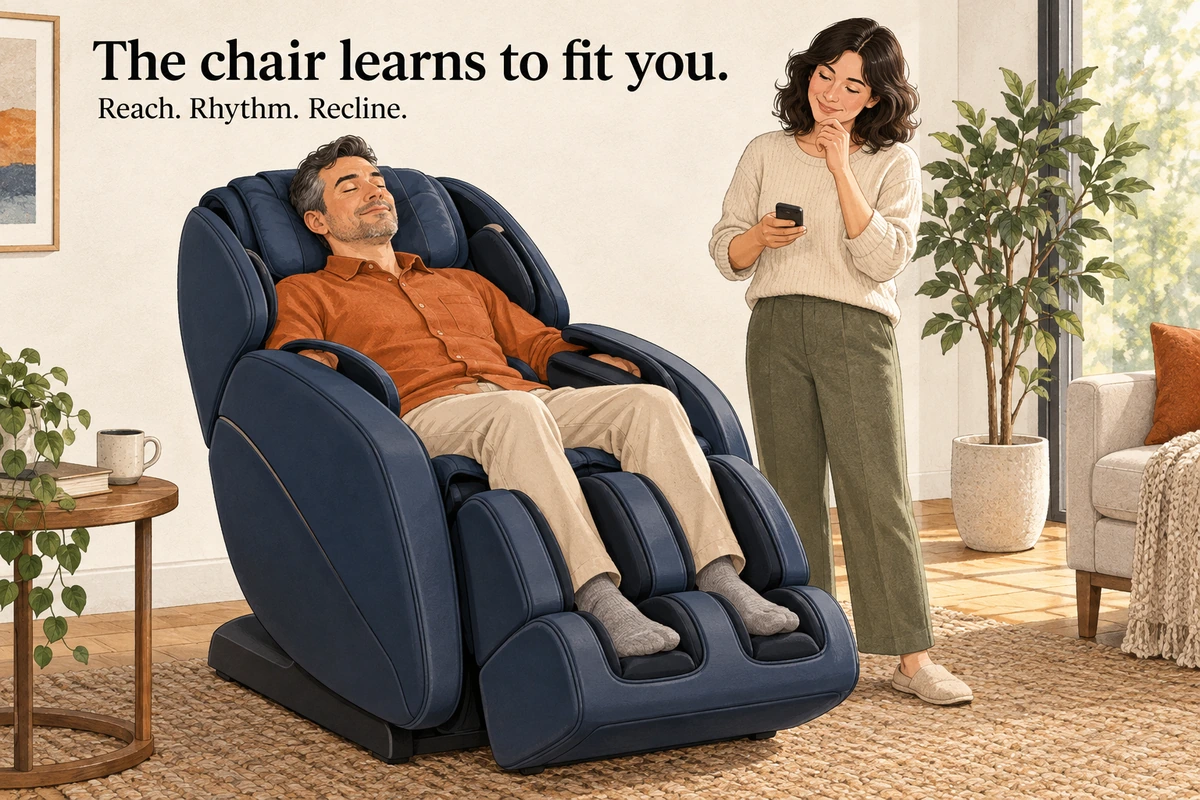
Modern development brings together reach, rhythm and recline. The actual fit and adjustment depend on the model.
The history in six stops
These are selected documented milestones, mainly from Fujiiryoki’s archives, rather than a complete list of every manufacturer’s inventions.
| Period | What changed | Why a user would notice |
| 1954 | First mass-produced model | A back massage while seated |
| 1960s–1980s | More motions, reclining and home-oriented design | More choice in a chair suited to the living room |
| 1995–2000 | Airbag chairs, then combined airbag and roller models | Massage beyond the back |
| 2001 | Body sensing and 3D movement on the AS-001 | Adjustment to the person in the seat |
| 2012 | Timing control in Fujiiryoki’s 4D mechanism | More variation in the massage rhythm |
| 2019 onward | AI-branded mechanisms and further personalization | More automated choices, depending on the model |
What this means when you are buying for a catalog
For brands, distributors and retailers, the useful lesson is to connect each feature to a customer’s experience. Extra roller reach matters only if it reaches the intended user comfortably. Automatic adjustment matters only if it finds the right position.
A beautiful chair still needs to fit through the door and work in the room.
The supply-chain question matters, too: who engineers and builds the product? When sourcing from a massage chair manufacturer in China, ask for evidence about fit, assembly consistency, testing and service support. A factory address or a “4D” badge answers only a small part of that question.
During a sample review, start with three ordinary tasks: sit down, change the intensity and get out. Then try the chair with users of different heights. The problems you notice there may tell you more about your future customer reviews than another page of features.
Frequently asked questions
Who invented the massage chair?
Nobuo Fujimoto, founder of Fujiiryoki in Osaka, is credited with developing the first mass-produced massage chair in 1954. That wording distinguishes the commercial product from earlier mechanical massage experiments.
When did massage chairs move into homes?
Fujiiryoki records growing home adoption in Japan from the 1970s, after exposure in public baths and inns. Adoption elsewhere followed different timelines.
Is a newer mechanism automatically better?
Try the actual chair. Consider reach, comfortable intensity, body fit, controls and support. Ask the supplier to demonstrate what its mechanism designation means on that particular model.
Prepared by Sweet Home Technical Team
Cindy
Sweet Home Technical Team
Part of Sweet Home’s in-house technical team. Cindy writes our Knowledge content — how massage chairs work, how they evolved, and what to check before you buy — built on our engineering documentation and after-sales records.
Disclosure: Sweet Home is the manufacturer behind the massage chairs described here, and the technical explanations in this article come from our own engineering and production experience.
Quick audit: is your next model backed by real engineering?
1. Mechanism history documented, not just a “4D” badge? 2. Fit tested across the heights you sell to? 3. Test and service evidence available on request?
Two or more unchecked? Send us your current spec.