
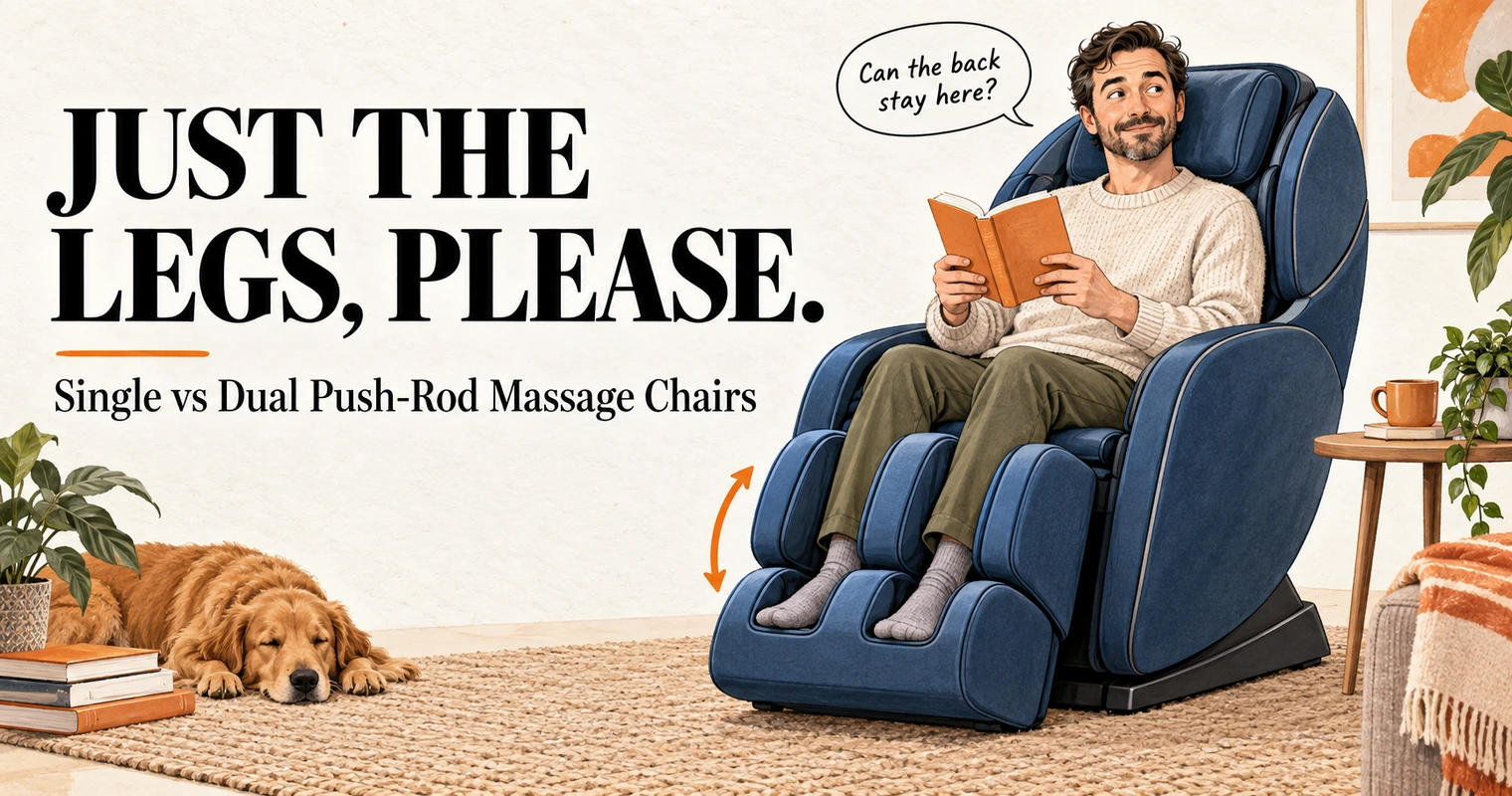
You settle into a massage chair with a book. Your back feels comfortable, but you want your feet a little higher. You press the button. Up go your legs. Down goes your back. Now you are reading toward the ceiling.
Nothing may be broken. The chair may simply have a linked recline system.
That small moment explains the difference between single and dual push-rod massage chairs better than a long list of features. For importers, it also raises a useful question: which movements can the customer actually control separately?
1. What is a push-rod motor?
A push-rod motor, usually called a linear actuator, extends and retracts a rod to move part of the chair. In a typical electromechanical actuator, a motor drives a screw mechanism that turns rotation into straight-line movement.
In this comparison, we are talking about the actuators that adjust the backrest and leg rest. These are different from the motors that knead or tap your back. A chair can have one recline actuator and several other motors doing completely different jobs.
2. Single vs dual: follow the movement
A single push-rod linked system uses one actuator and a mechanical linkage to coordinate the backrest and leg rest. You choose a point along the movement path designed into the chair.
Depending on the linkage, the movements may happen together or in a set sequence; they are not freely adjustable as two separate functions.
A dual push-rod independent system typically assigns one actuator to the backrest and another to the leg rest. With suitable controls, you can adjust one without automatically moving the other. A more upright back with raised legs becomes possible within that chair’s designed range.
The second actuator gives the designer another adjustment to work with. It does not promise every imaginable pose. Frame geometry, control software and movement limits still decide what is available. Ask for a demonstration of the exact model.
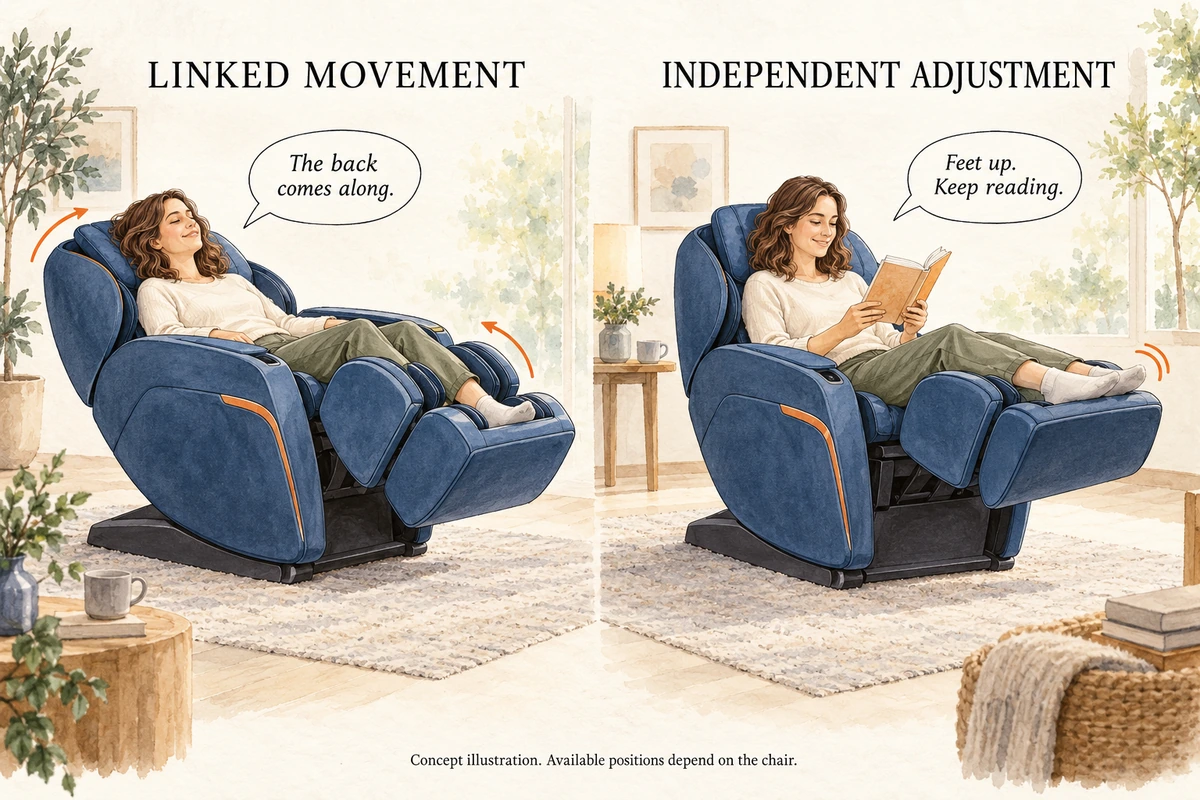
A linked system follows its designed movement path. Independent adjustment lets the user change one section separately, within the chair’s limits.
What the two architectures mean for the buyer
| Question | Single push-rod, linked | Dual push-rod, independent |
| How do back and legs move? | Along one coordinated path | Separately, within the permitted range |
| What is the customer benefit? | Straightforward recline adjustment | More choice of back and leg positions |
| What hardware is involved? | One actuator plus the linkage | Two actuators, their mounts, wiring and control channels |
| What needs attention after sale? | Actuator, pivots and linkage wear | Both actuators, wiring, controls and mechanical joints |
| Who may value it? | Buyers happy with a simple recline path | Buyers who want to fine-tune their posture |
3. “Dual motor” is not a complete specification
A quotation that says “dual motor” still owes you an explanation. It might mean two recline actuators, two massage mechanisms, or separate kneading and tapping motors. “Lifting motor” can also be shorthand for an adjustment actuator; it does not establish that the chair helps someone stand up.
Ask the factory to list the motors by function: backrest adjustment, leg-rest angle, leg-rest extension and massage mechanism. Then request the actuator model and quantity for each powered adjustment. Do not assume a model-number suffix is a stroke measurement unless the supplier’s datasheet confirms it.
A useful quotation makes the relationship explicit: “Backrest: one actuator; leg-rest angle: one actuator; independent manual control available.” Model numbers and ratings should follow. A quick video showing each function separately will make that wording much easier to check.
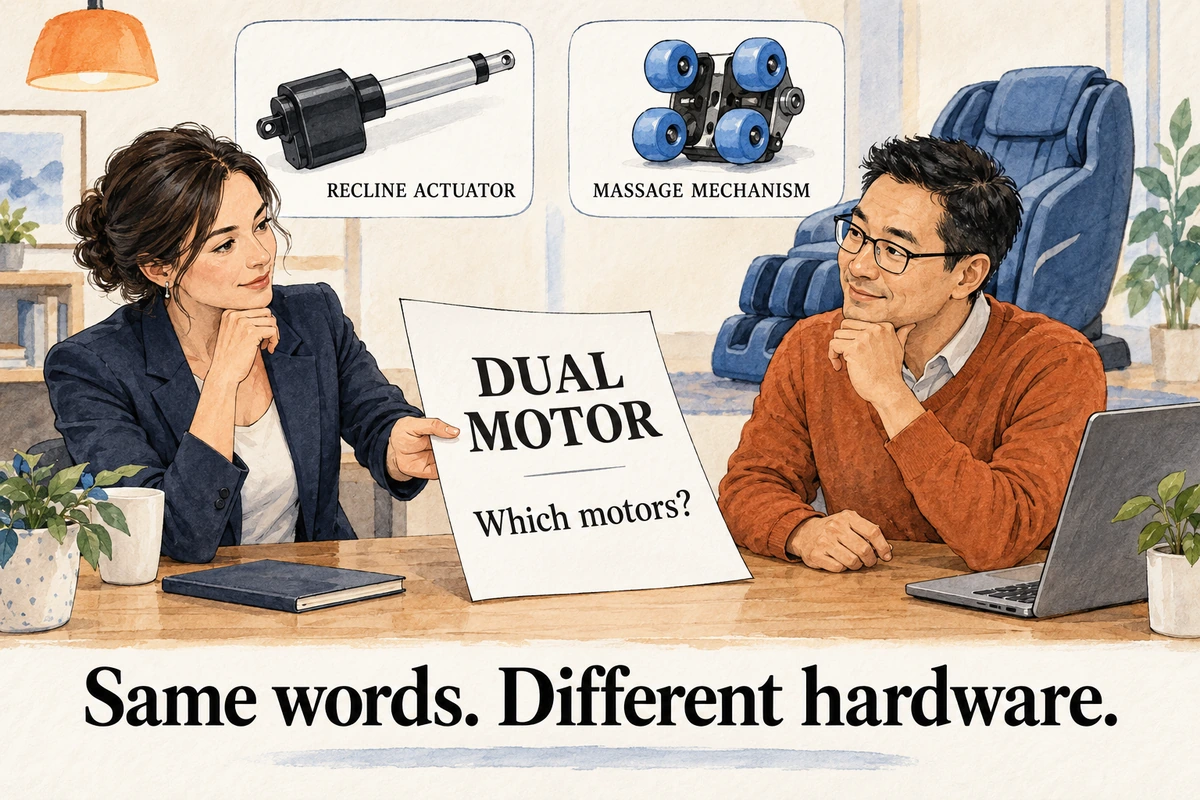
Specify the function behind each motor count before comparing quotations. Component sketches are conceptual.
4. Three shortcuts that lead to the wrong chair
“Dual push-rods mean better massage.”
They describe positioning hardware. Massage feel also depends on the roller mechanism, its control, the track and how the user fits the chair. Test the massage and the recline as separate parts of the experience.
“Zero gravity requires two actuators.”
A linked mechanism can be designed to reach a preset reclined position with elevated legs. Independent actuators add adjustment options; their number alone does not establish the final posture or a smoother transition. For the structural side, see our zero-gravity recline mechanism guide.
“Independent leg control solves tall-user fit.”
Raising the leg rest and extending it are different movements. A tall user may need more leg-rest extension, not a higher angle. Check the usable length and fit on the sample instead of treating “dual motor” as a sizing promise.
5. Check these specs before comparing prices
Request the actual actuator datasheets and test reports for the chair being quoted. The following checks turn a vague feature into something you can evaluate.
Questions for the supplier
| Check | What to ask |
| Function and control | Which actuator moves which part? Can the user operate each adjustment separately? |
| Stroke and installation | What is the travel in millimetres, the mounting arrangement and the actual chair-angle range? |
| Force and holding | What are the rated push/pull and static holding loads? How were they selected for this chair? |
| Electrical match | What voltage and current does the actuator require, and can the power supply and controller support the intended operation? |
| Movement under load | How fast and smoothly does it move with a user, including starts, stops and reversals? |
| Protection | How are end-of-travel, overload and trapping risks addressed and verified? |
| Endurance and duty cycle | What load, movement range, rest periods and pass criteria were used in testing? |
Keep force, travel and user weight separate. An actuator rated at 4,000 N does not make the chair suitable for a 400 kg user. The force needed depends on the chair’s geometry and leverage throughout its motion.
Likewise, a longer actuator stroke does not automatically mean a flatter chair when comparing different mechanisms.
Position holding also needs a specific rating. Self-locking depends on the actuator design; some systems use brakes. It cannot be established by the words “worm drive” alone. LINAK explains how spindle design affects self-locking and describes different position-holding methods.
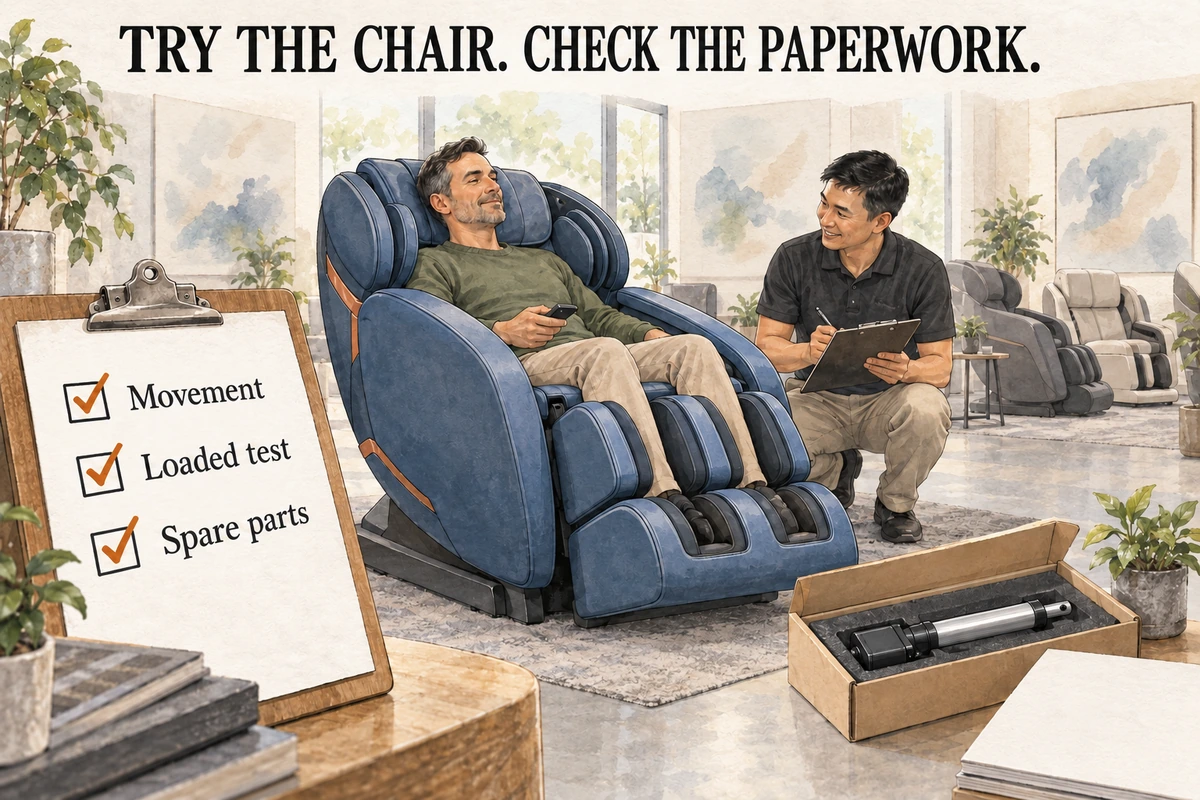
Review the actual movement alongside load-test evidence and the replacement-parts plan.
6. Choose the upgrade your customers can notice
For a value-focused product, a well-executed linked system may provide all the adjustment the buyer wants. For a product sold around reading, watching TV or finding a particular resting posture, independent back and leg adjustment gives the sales team something concrete to demonstrate.
Two actuators add hardware and control requirements, but the final cost difference depends on the complete design. Compare the actual quotation, packed dimensions, gross weight, container loading and spare-parts plan.
An extra motor does not, by itself, tell you the freight cost or the retail premium your market will accept.
There is no durability winner based on motor count alone. Look at the actuator sizing, joints, wiring, protection and test evidence. A second actuator is a feature to validate, not a quality certificate.
For your next sample review, try one request: “Raise the legs while keeping the back where it is.” Then check whether that movement is useful, comfortable and easy to control. You will have a much clearer reason to pay for it, or to keep the simpler configuration.
Quick buyer questions
Does every dual push-rod chair offer independent control?
Do not assume so. Confirm what each actuator drives and what the remote and software allow. Two actuators on a parts list are not enough to prove independent back and leg adjustment.
Does a recline actuator make a massage chair a lift chair?
No. Assisted standing is a separate function that must be designed and specified. Ask what “lifting” means on that particular quotation.
Can Sweet Home help specify either architecture?
We work with brands, distributors and OEM buyers on single and dual push-rod configurations. Send Sweet Home your target price band, customer profile and required positions so we can discuss the configuration and supporting specifications for your project.
You can also explore our full-body massage chairs and OEM capabilities.
Prepared by Sweet Home Technical Team
Kimi
Sweet Home Technical Team
Part of Sweet Home’s in-house technical team. Kimi writes our product comparison guides — single vs dual actuator layouts, spec-sheet wording and which configuration belongs on a dealer’s floor — built on our export order data and after-sales records.
Disclosure: Sweet Home is the manufacturer behind the massage chairs compared here, and the engineering patterns in this guide come from our own orders and production records — shared so buyers can compare quotations with clear eyes.
Quick audit: can your quotation prove what “dual motor” drives?
1. Every powered adjustment listed with its own actuator and model number? 2. Independent back and leg control demonstrated on the sample? 3. Force, stroke and test data on the actual chair?
Two or more unchecked? Send us your current spec.
Related product pages