
Read enough massage-chair threads on Reddit and you will see the pattern. Buyers are not arguing about whether a 2D, 3D, or 4D massage chair feels better. They are arguing about whether the 4D premium is worth the money at all.
One r/Costco owner wrote that he “can’t really tell 3D from 4D massage programs” and called the upgrade “a bit of a marketing gimmick” — worth “maybe a few hundred” dollars more, “definitely not several thousand.”
A user on r/spinalfusion put it more bluntly: “3D and 4D are definitely the same stuff.”
Those complaints are not about bad chairs. They are about how the D-number is used on quotations.
When a distributor stocks three models labeled 2D, 3D and 4D from three factories, each factory may mean something different by the label — and the price gaps between tiers are far larger than the mechanism gaps behind them.
This guide looks at 2D vs 3D vs 4D massage chairs from the buying side: what each number physically means, what it should cost you on a quotation, where the real differences show up in use, and when the 4D premium is not worth carrying in your lineup.
1. What the D numbers actually describe
The D number describes how many directions the roller mechanism can move while it travels along the track. It says nothing about the track, the frame, the airbags, the motor quality or the body-scan accuracy.
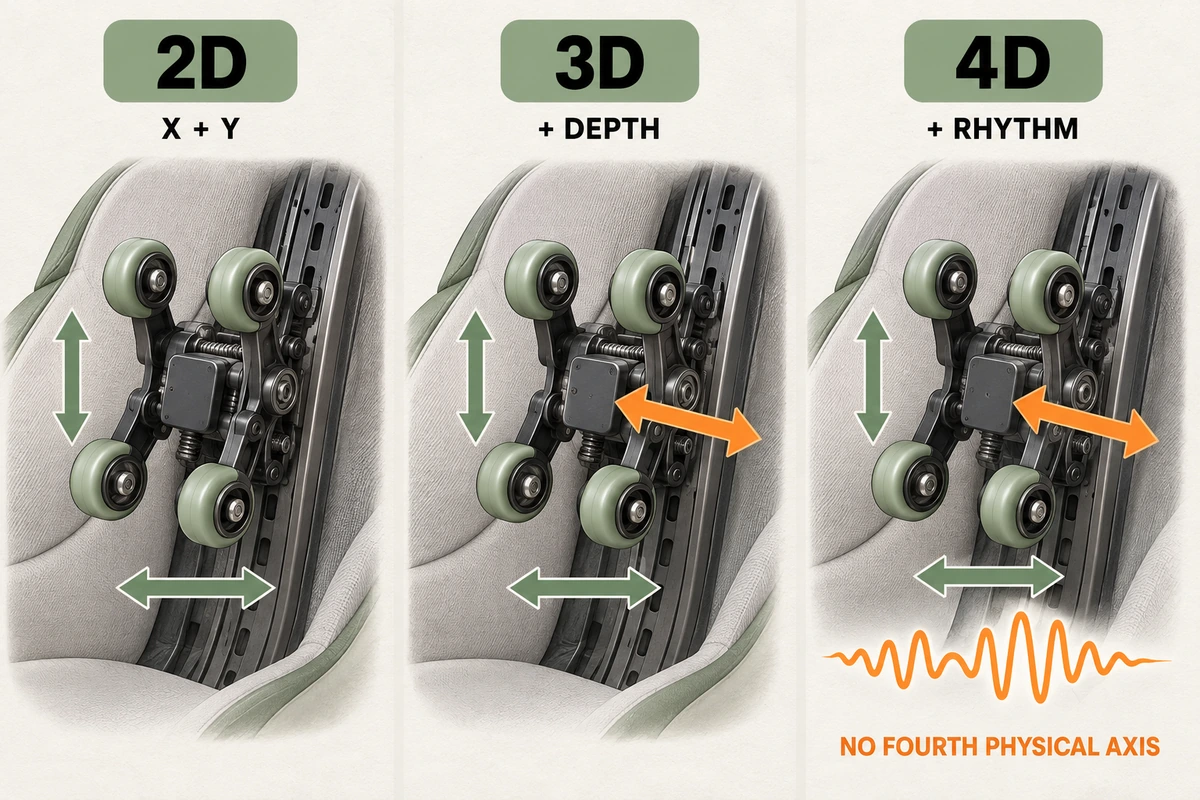
A 2D mechanism moves its rollers up and down and left and right. The roller pressure is fixed by the design. Everything under the skin of a 2D chair — a carriage, guide wheels, drive motors and an S- or L-shaped rail — is the same basic structure used in more expensive chairs.
A 3D mechanism keeps all of that movement and adds one feature: the rollers can push outward from the track and pull back, under your control or the chair’s. That third axis is depth.
It is why a 3D chair can press into a tight shoulder or soften for a lighter touch, and why the same chair can serve two users who want different pressure.
A 4D mechanism is mechanically the same carriage as a 3D unit, with speed and rhythm variation added to the massage programs. The rollers change pace during a session — slowing to linger on a tight spot, speeding up on a looser area — without the user touching the remote.
There is no fourth physical axis. Our factory teardown of these mechanisms goes deeper in EP3: Massage Chair Mechanism — 2D vs 3D Truth.
If you hear “5D”, “6D” or “8D”, ask which physical axis was added. Above 4D, most claims describe software modes, marketing naming or, in a few documented cases, dual independent roller systems — not a new dimension of roller movement.
2. Side by side: what each upgrade adds
The table below compares typical US retail price bands reported by specialty retailers in 2026, with the mechanism and cost factors that matter to an importer. Retail numbers are indicative, not quotations.
| Decision factor | 2D | 3D | 4D |
| Roller axes | Up/down, left/right | + depth (in/out) | Same 3 axes + speed/rhythm variation |
| Pressure control | Fixed | Adjustable depth | Adjustable depth + automatic pace |
| Best-fit buyer profile | First chair, light relaxation, price-driven markets | Mainstream: most households, multiple users, muscle tension | Premium: daily users who notice rhythm and feel |
| Main extra hardware | Baseline carriage | Protrusion mechanism, one motor + rack | Same mechanism + control-board channel and firmware |
| What a customer can feel | Surface massage, even pace | Deep, targeted pressure on demand | More lifelike rhythm; pressure equal to 3D |
Typical values reported by US specialty retailers; exact pricing varies by brand, track type and market.
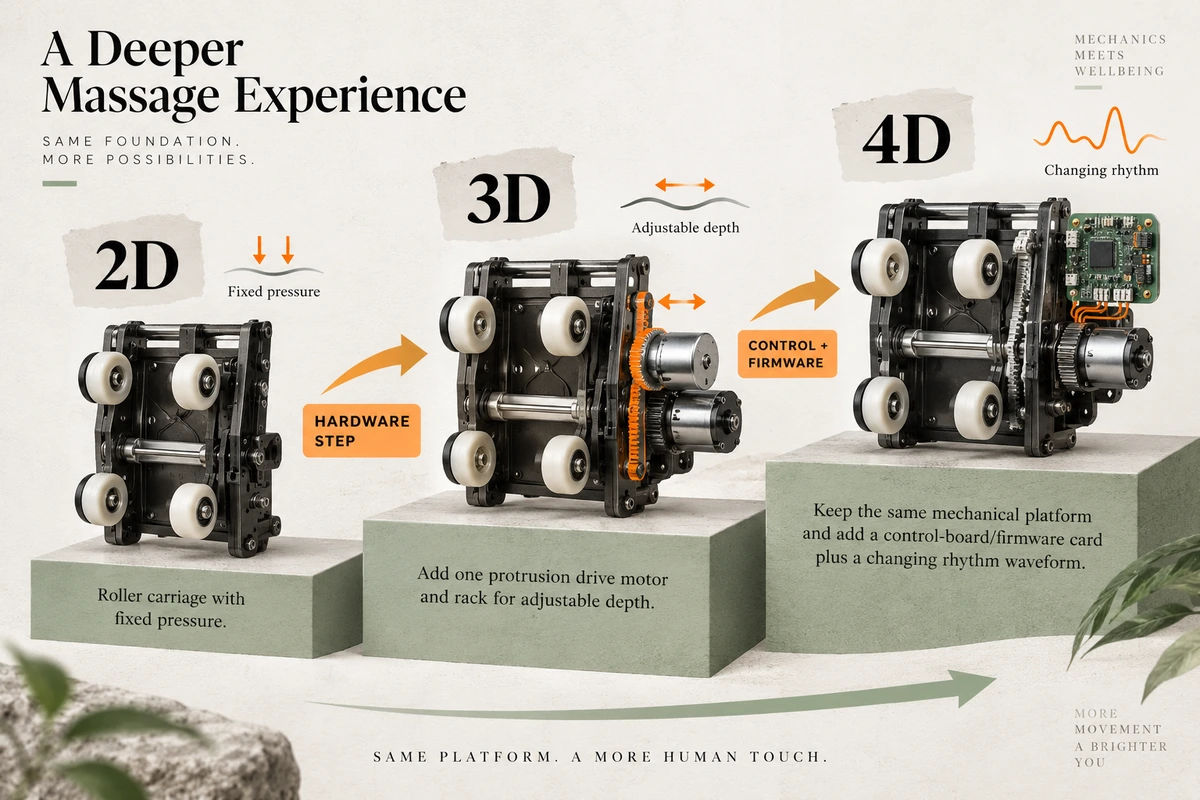
Two details matter for your margin planning. First, the jump from 2D to 3D changes the hardware: the mechanism gains a protrusion drive and the control system gains another channel. That is a real cost step, and it delivers a difference customers can feel in the first minute.
Second, the jump from 3D to 4D is mostly firmware and control sophistication on the same mechanical platform — which is exactly why the retail premium is driven by positioning, brand and other features, not by a parts-cost gap of the same size.
3. Why some buyers cannot feel the difference
The Reddit complaints above are not outliers. In a r/fatFIRE thread about high-end chairs, one owner reported that the “4D settings was only for 2 massage routines” and that he “couldn’t tell the difference between 3D and 4D.”
There are three reasons this happens, and only one of them is a bad chair:
Reason 1: the 4D feature is buried in the programs
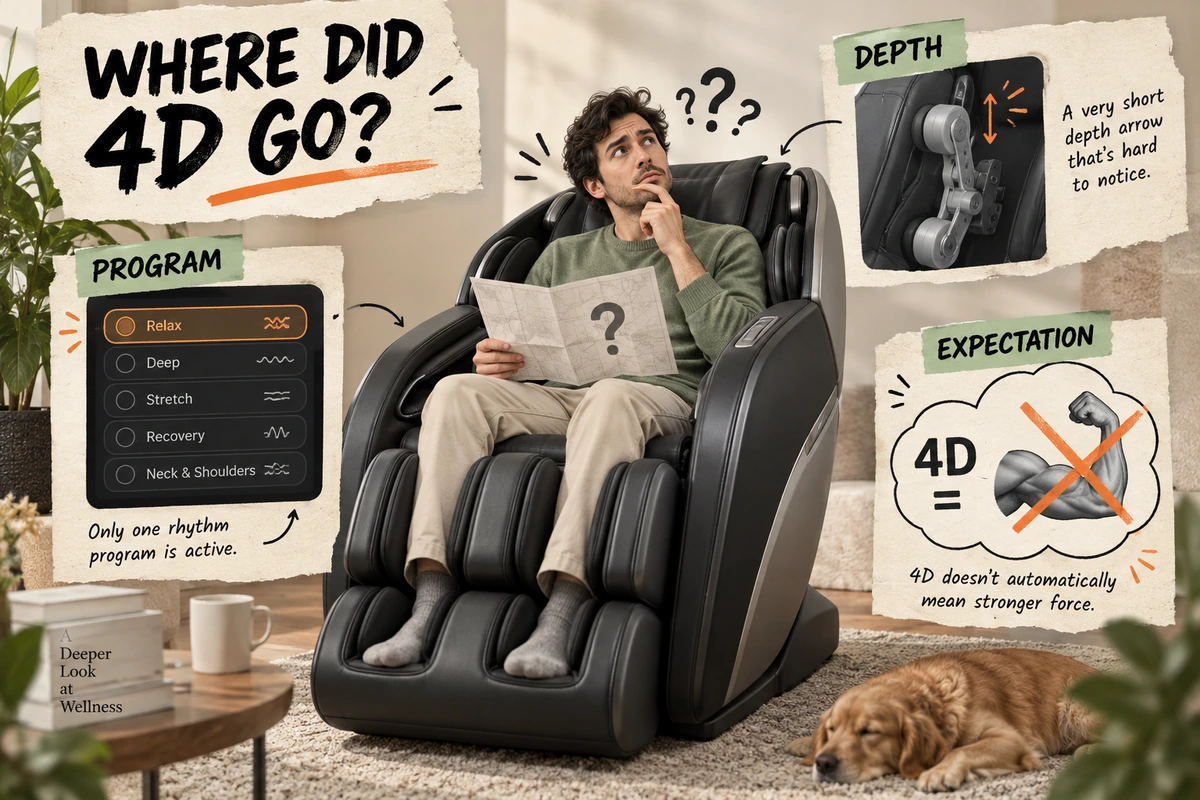
Some chairs apply automatic rhythm variation in only one or two auto programs. In knead, tap or manual modes, the 4D channel never engages. A buyer who tests the default program may be sitting on a 4D chair feeling a 3D massage.
When you evaluate samples, ask which programs use the speed-variation feature and try one of them directly.
Reason 2: the 3D depth range is too small to notice
A genuine 3D mechanism should change pressure clearly between its lightest and deepest settings. If the protrusion travel is short or the motor is weak, depth adjustment becomes cosmetic. Ask for the mechanism’s protrusion range in millimetres and test the strongest setting on a tense area.
From our side of the line: across the export orders we handle, the spec line buyers most often under-spec on a 3D/4D quotation is protrusion travel — cheap to confirm in millimetres on paper, expensive to fix after a container lands.
Reason 3: expectations were set by the label, not the ride
A buyer who expects 4D to feel dramatically stronger than 3D will be disappointed, because 4D changes timing, not force. If your sales team tells customers “4D presses deeper”, the return rate will punish that message.
The honest pitch: 4D feels more natural and varied over a long session; 3D delivers equal pressure.
The same distinction applies between 2D and 3D. The difference there is real and immediate: fixed pressure versus pressure you can choose. A customer who wants deep tissue work on a budget should sit in a 3D chair, not a larger 2D model with more airbags.
4. What each mechanism should cost on your quotation
When comparing like-for-like quotations, isolate the mechanism line to see what the D-number is really adding.
As a rule of thumb across the export orders we quote: the mechanism itself steps up in cost from 2D to 3D by roughly one additional drive assembly, and from 3D to 4D by control electronics and firmware rather than heavy mechanics.
That is why two chairs with the same mechanism number can sit in very different price bands when the supplier attaches the label to a differently equipped model. Always compare the complete spec sheet, not the D in the model name.
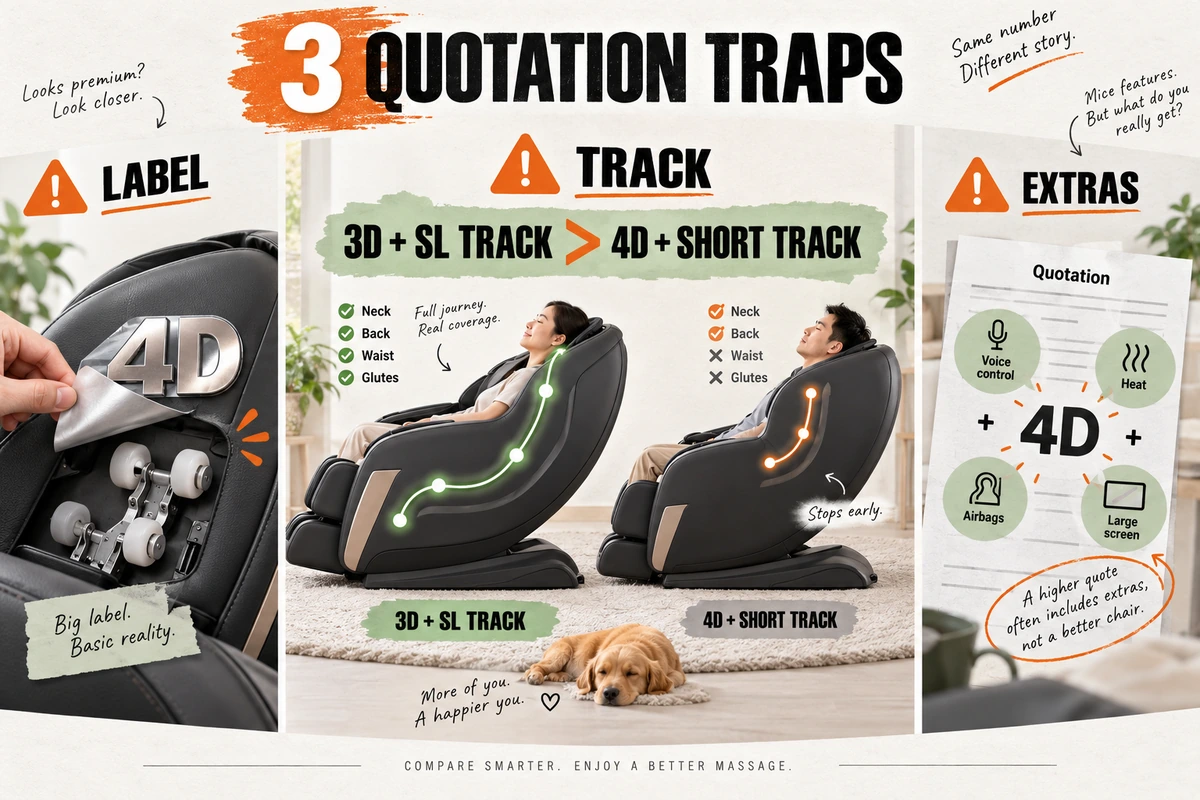
Watch for these three quotation traps:
Trap 1: “4D” on a 3D mechanism
Some listings label any chair with speed-adjustable programs as 4D even when the mechanism has no protrusion control at all. Check the mechanism spec: a true 4D unit is built on a 3D platform with depth control plus rhythm variation. If depth is not listed, the chair is 2D with program tricks.
Trap 2: mechanism number, not track, carrying the premium
Track type shapes the massage more than the D number does. A 3D chair on a long SL-track reaches from neck to glutes and follows the spine’s curve; a 4D chair on a short L-track cannot reach the same area. For many customers, 3D on an SL-track beats 4D on a shorter track.
When budgets are tight, tell your supplier which of the two upgrades matters more for your market.
Trap 3: premium features added to justify the number
A high D number is often bundled with voice control, graphene heat, extra airbags and a larger screen. Those features have their own cost and failure points.
Decide whether your customers pay for the extras or only for the mechanism label; if the latter, the bundle raises your landed cost without adding sellable value.
5. Which mechanism belongs in your lineup
For importers, the D-number decision is a lineup decision. Here is how the tiers map to typical channel positions:
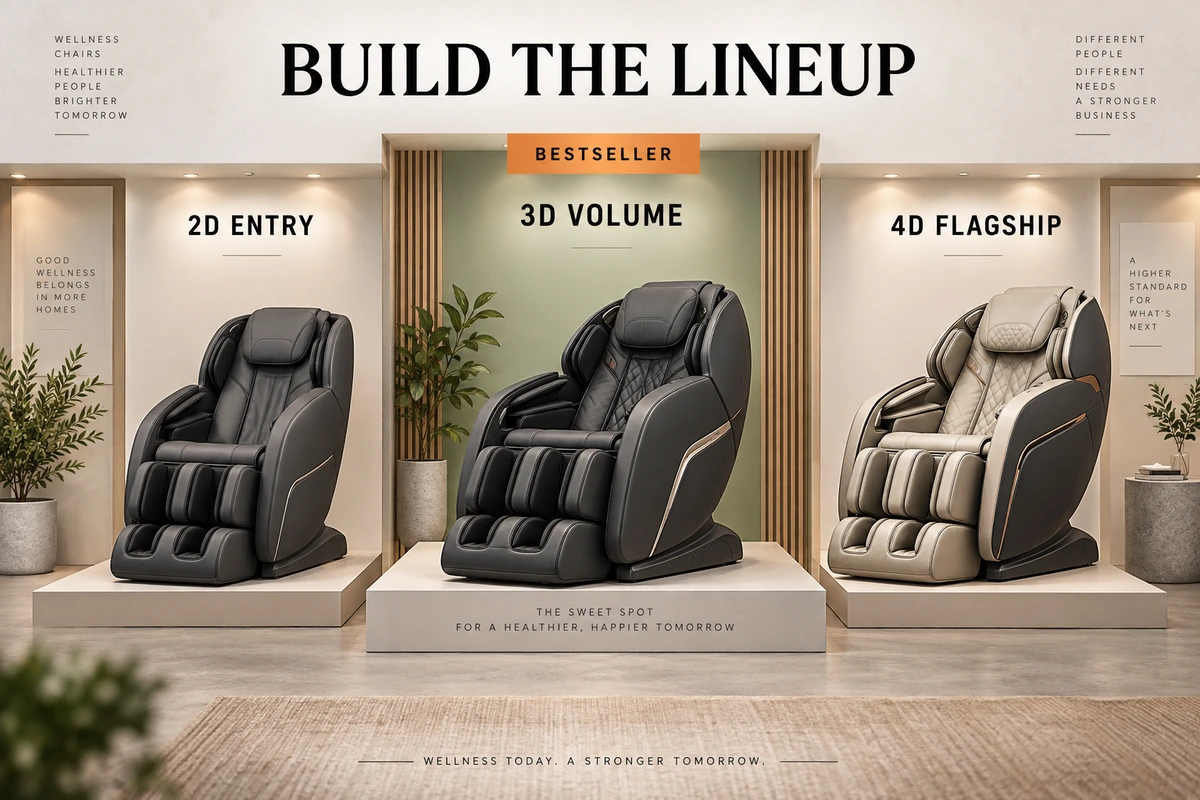
Carry 2D for entry price points
2D chairs belong in markets and price bands where the buying decision is dominated by budget — first-time buyers, gift purchases, price-competitive regions.
Do not oversell 2D as therapeutic; position it as relaxation and let customers upgrade later.
Make 3D the volume product
Industry reviews and our own order mix agree: 3D on an SL-track is where most chairs are sold and where most buyers should look. It serves multiple users with different pressure needs, handles real muscle tension, and gives the sales floor a feature that can be demonstrated in seconds.
If you stock only one serious massage tier, this is it.
Reserve 4D for the premium shelf
4D earns its place with customers who use a chair daily and notice rhythm and realism over long sessions. It also matters as a flagship model that signals your brand can carry the top tier.
For occasional users and price-sensitive buyers, the money buys more value in a longer SL-track, stronger frame or better body scan. Stock 4D deliberately, not as the default “best” option.
If you are building a full lineup, the classic structure is: one 2D entry chair, one 3D SL-track volume model, and one 4D flagship — with a clear story for the sales team about who should buy which.
6. Ask for this before you compare quotations
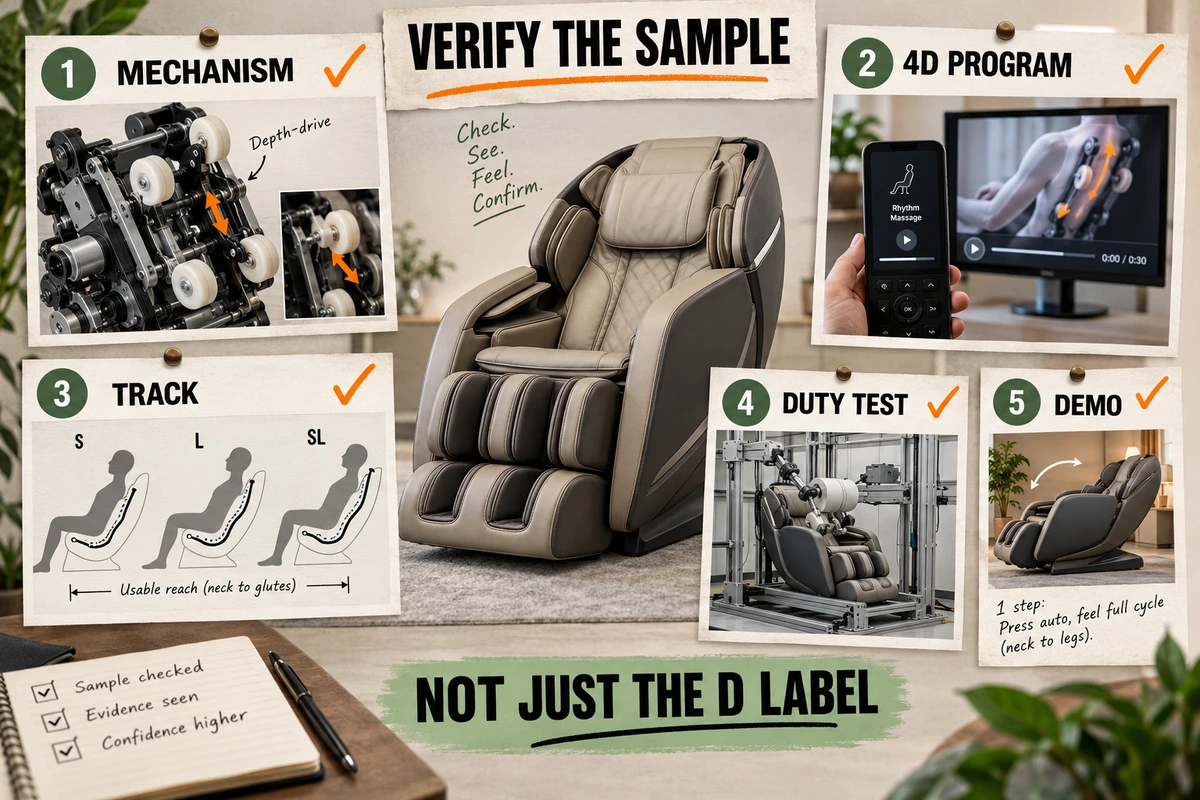
The following five checks turn “3D” or “4D” on a spec sheet into something you can verify on a sample.
Questions for the supplier
| Check | What to ask |
| Mechanism drawing | Does the 3D/4D unit include a depth-protrusion drive? Ask for the mechanism photo and the protrusion range in millimetres. |
| 4D program coverage | Which programs use automatic speed/rhythm variation? Ask for a video of one, with the remote visible. |
| Track type and length | What track (S, L or SL) and what usable length? Compare this before the D number on two quotations. |
| Mechanism duty rating | What lifetime or aging-test result does the mechanism carry? How many daily sessions is it designed for? |
| Demo instructions | Which single demo shows the difference your sales team should use on the floor? |
For your own sample review, run one test on every chair regardless of the label: put the rollers on a tight shoulder area and change the depth setting from lightest to deepest. If you cannot feel the pressure change clearly, the chair is not earning its 3D premium.
Then run a full auto program and watch whether the pace varies. If it does not, the 4D channel is not working as marketed.
Quick buyer questions
Is a 4D massage chair always stronger than a 3D chair?
No. 4D adds timing and rhythm variation, not force. Pressure comes from the depth range of the mechanism and the chair’s motor strength, which are shared with 3D. A strong 3D chair can press harder than a gentle 4D chair.
Which is the bigger upgrade: 2D to 3D, or 3D to 4D?
2D to 3D is the bigger mechanical and felt upgrade, because it adds adjustable depth. 3D to 4D is a refinement of pace and realism on the same mechanical platform. For a buyer on a budget, the 3D tier delivers most of the therapeutic value.
Why do some 4D chairs cost far more than others?
Compare complete spec sheets and the same feature set before assuming one brand is overpriced.
Can Sweet Home help me build a 2D/3D/4D lineup?
We manufacture massage chairs with 2D, 3D and 4D mechanisms and work with brands, distributors and OEM buyers on lineup planning. Send Sweet Home your target price bands and customer profile so we can match mechanisms, tracks and features to each tier you plan to carry.
You can also explore our full-body massage chairs and our OEM capabilities, or read how the mechanism inside compares in our 2D vs 3D mechanism teardown.
Prepared by Sweet Home Technical Team
Kimi
Sweet Home Technical Team
Part of Sweet Home’s in-house technical team. Kimi writes our product comparison guides — 2D vs 3D vs 4D mechanisms, actuator layouts and which configuration belongs on a dealer’s floor — built on our export order data and after-sales records.
Disclosure: Sweet Home is the manufacturer behind the massage chairs compared here, and the engineering patterns in this guide come from our own orders and production records — shared so buyers can compare quotations with clear eyes.
Quick audit: can your quotation prove what its D number does?
1. Depth-protrusion drive shown in the mechanism spec? 2. 4D rhythm demonstrated in a program on video? 3. Track type and length compared before price?
Two or more unchecked? Send us your current spec.