
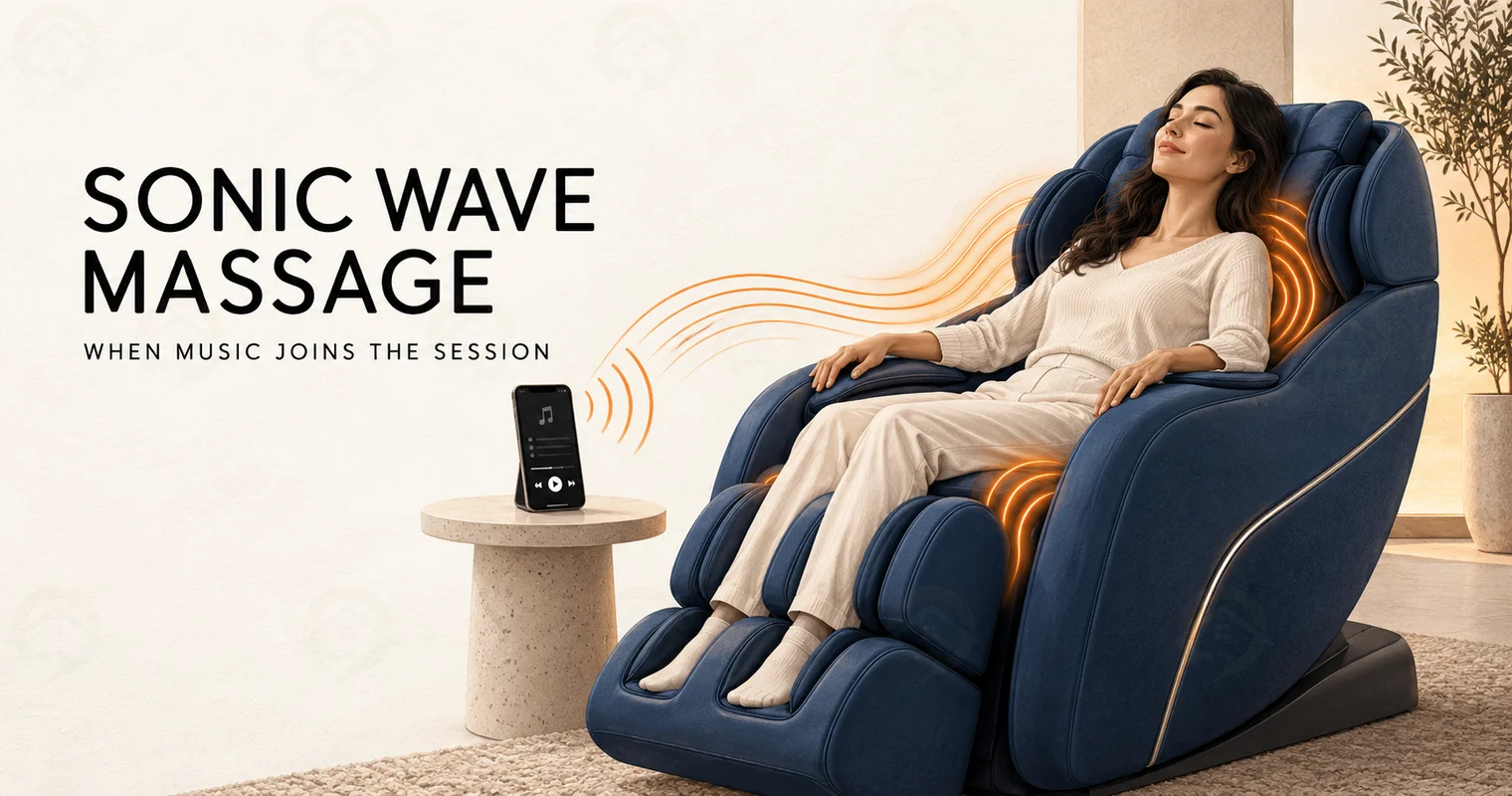
Most massage chairs can play music. A sonic wave massage chair tries something more interesting: it lets the chair respond to it.
Press play on a slow ambient track and the sensation can settle into a gentle pulse. Switch to a stronger beat and the rhythm changes with it. The music is no longer just background sound; it becomes part of what the user feels.
That is an easy idea to demonstrate, but a surprisingly useful one for brands, distributors, and retailers.
The important question is not whether the chair has speakers. It is whether the audio signal actually changes the tactile response—the brain naturally links sound and touch, as peer-reviewed multisensory research shows.
What Is Sonic Wave Massage Technology?
In simple terms, sonic wave massage uses an audio signal to influence vibration or tactile movement inside the chair. Music enters through a wired or wireless connection—including Bluetooth LE Audio wireless links, which use the low-latency LC3 codec.
The control system interprets the changing signal, then drives transducers or vibration units installed around the back, seat, or other contact areas.
Think of it as the difference between a metronome and a drummer. A conventional vibration program may repeat the same pulse at the same interval. A music-synced system has a changing input, so the response can rise, fall, pause, or intensify with the track.
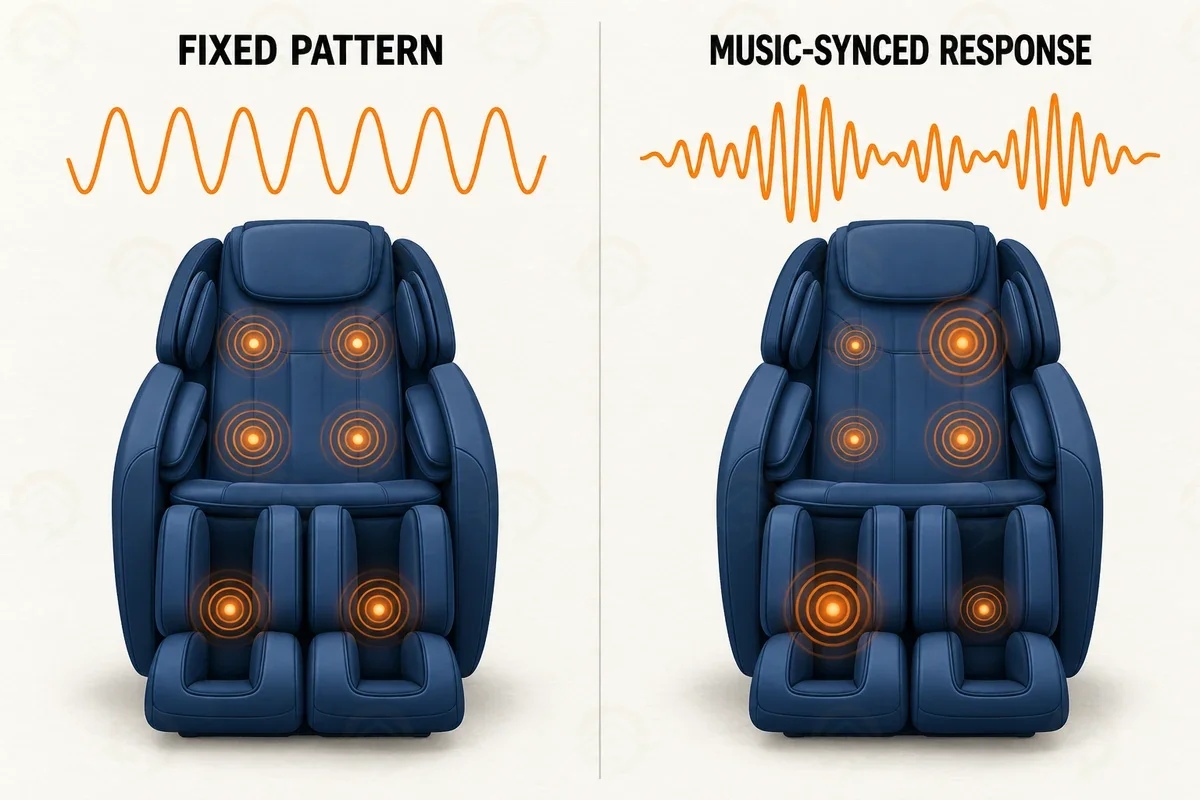
A fixed program repeats. A music-synced response changes with the audio input.
This does not mean every roller movement follows every note, and it should not be presented as magic.
The exact behavior depends on the hardware, signal processing, control logic, upholstery, foam, and how the vibration units are positioned. Two chairs can both use the phrase “music vibration” and still feel very different.
What Is Happening Inside the Chair?
The user experience may feel simple, but several parts have to cooperate:
- Audio input: Music arrives from a phone, built-in player, or another supported source.
- Connection: The chair receives the audio through Bluetooth or a wired interface, depending on the design.
- Signal control: The electronics translate changes in the audio into output commands.
- Tactile output: Transducers or vibration units turn those commands into movement the user can feel through the chair.
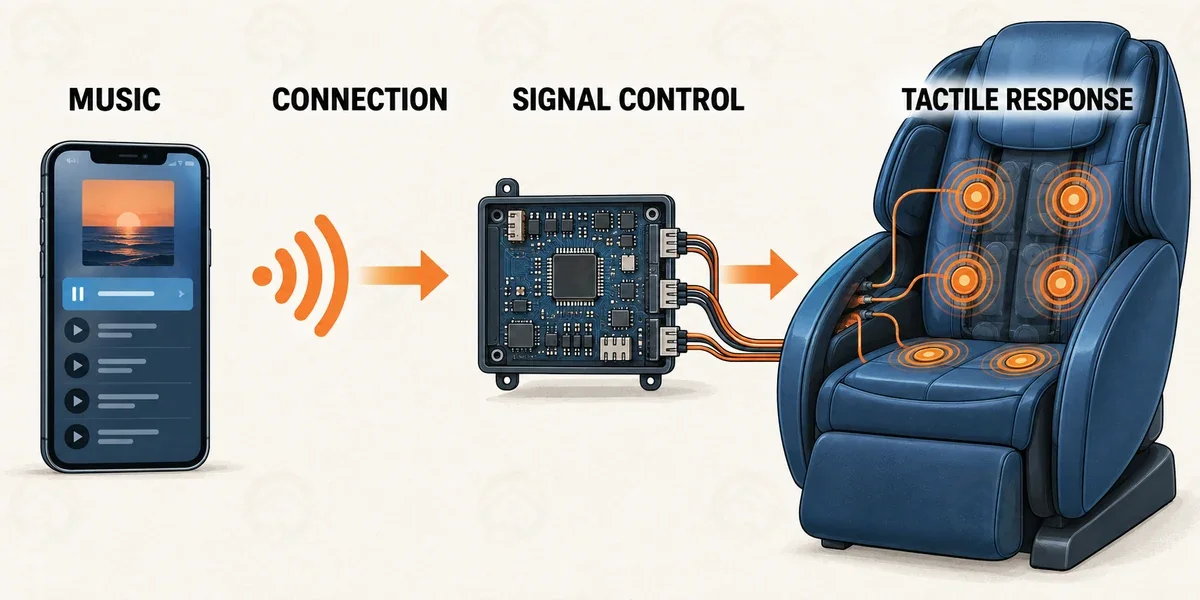
The basic path: music input, connection, signal control, then tactile response.
Placement matters. A powerful unit in the wrong location may create noise or an annoying buzz. A well-positioned unit can spread a cleaner sensation through the backrest or seat. Cushion thickness matters too: too little damping can feel harsh, while too much can swallow the effect.
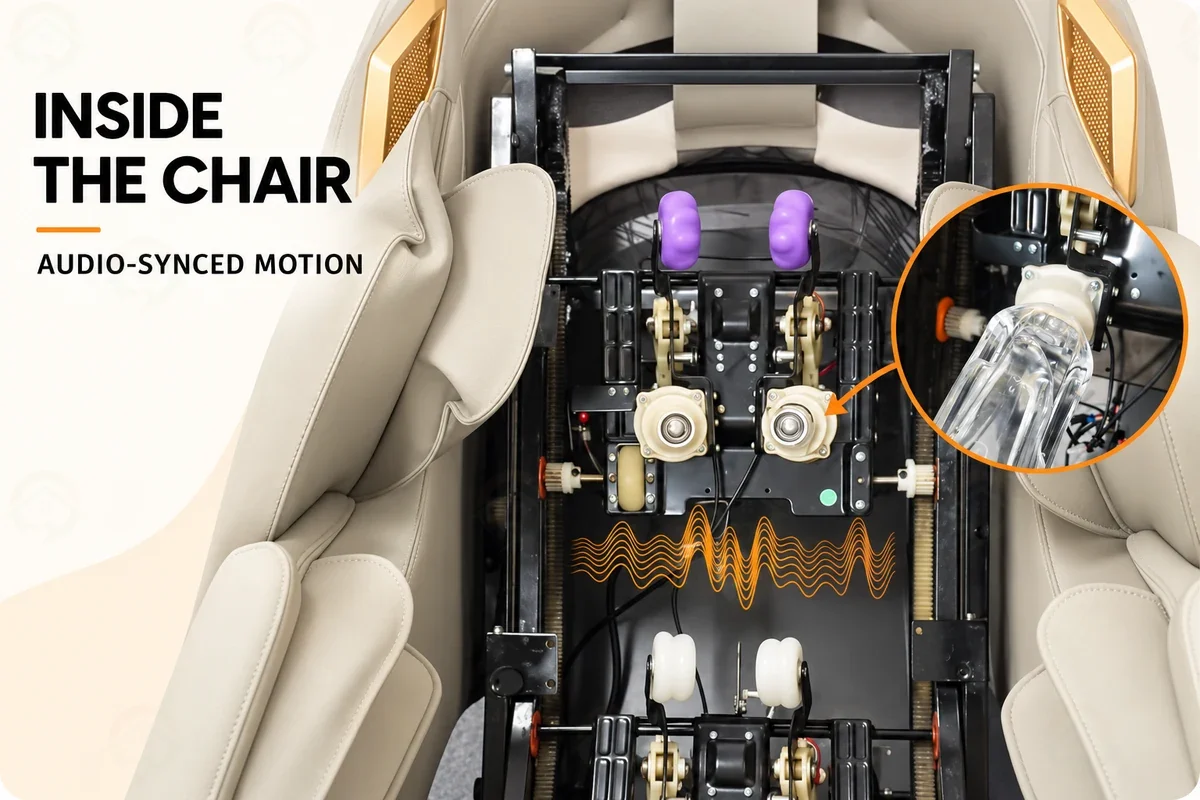
A real internal chair view, restyled for clarity. The final sensation depends on how the motion hardware, frame, padding, and control system work together.
How Is It Different From Ordinary Vibration Massage?
Ordinary vibration is not automatically inferior. A stable, well-tuned pattern may be exactly what a user wants. The difference is interaction.
With a fixed program, the chair decides the pattern in advance. With a music-responsive system, the chosen track becomes another control input. That can make repeated demonstrations feel less repetitive and gives the user a simple way to personalize the session without learning a complicated menu.
It is also important to separate three ideas that are often mixed together:
- Speakers: The chair plays sound.
- Vibration massage: The chair produces a preset vibration pattern.
- Music-synced tactile response: The vibration changes in response to the audio signal.
A chair may have the first two without truly delivering the third. Buyers should test the relationship between the music and the movement rather than relying on a feature name.
Why It Works Well on a Showroom Floor
Many massage-chair specifications are hard to explain in a few seconds. Track geometry, motor control, and foam structure all matter, but they are not always obvious during a quick walk-through.
Music-synced vibration is different. Let a visitor choose a familiar song, sit down, and feel whether the chair follows it. The demonstration is personal, immediate, and easy to remember.
A bass-heavy track may make the response more obvious; a quiet acoustic track may reveal whether the system can stay subtle instead of merely shaking harder.
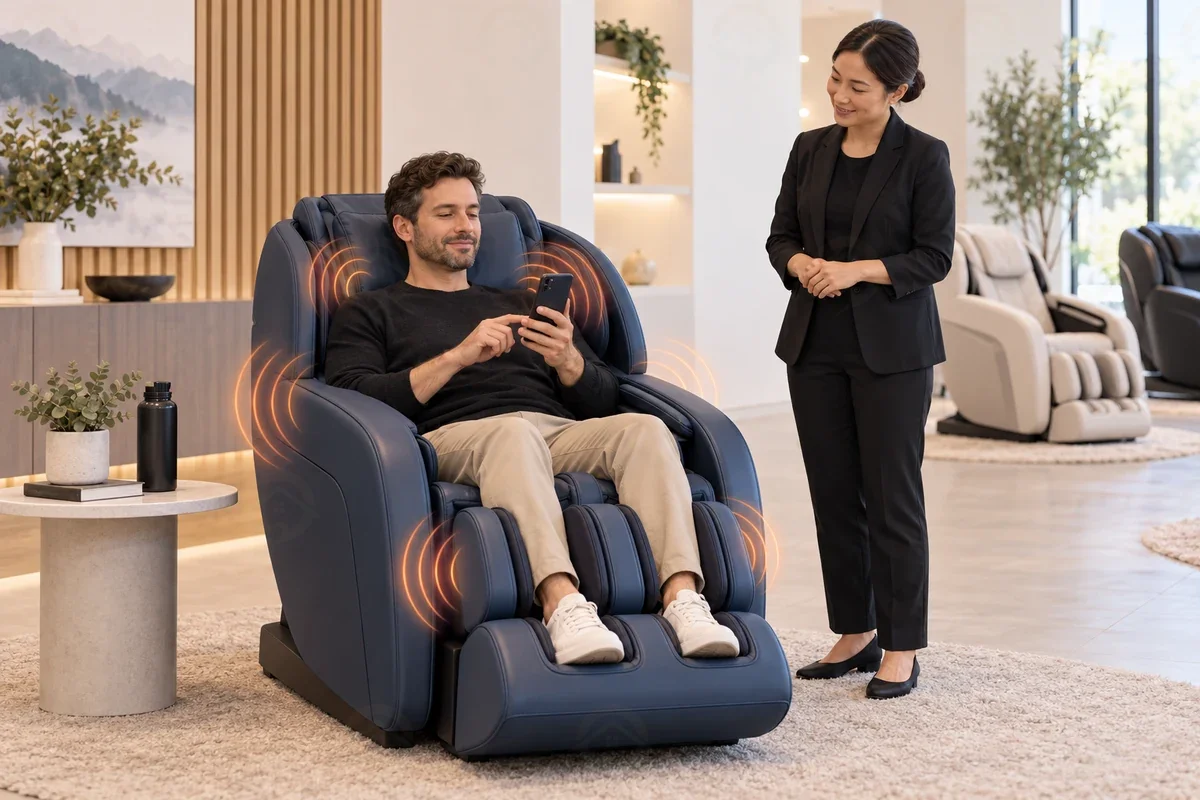
A good showroom test is simple: let the customer choose the music and feel whether the chair responds naturally.
That demo value can suit massage-chair retailers, consumer-electronics stores, home-theater concepts, hospitality spaces, and wellness rooms. The best fit depends on the audience. Some customers will enjoy an energetic, immersive effect; others will prefer a low-intensity background pulse.
Seven Questions B2B Buyers Should Ask
A feature that sounds impressive in a brochure still needs a proper sample test. Before choosing a sonic wave massage chair, ask:
- Is the vibration truly responding to the music? Pause the track, change the tempo, and compare several songs.
- Can the user adjust the tactile intensity separately? Music volume and vibration strength should not be confused.
- Where are the transducers or vibration units located? Check coverage across the back and seat, not just the number of units.
- Does the chair rattle at stronger settings? Listen for panel buzz, loose trim, and vibration transferred into the floor.
- How does the upholstery change the sensation? Test the final production padding and cover material, not only an exposed prototype.
- Can the system be tuned for the target market? Some retail audiences may prefer a stronger effect; hospitality users may want something gentler.
- How is the system serviced? Ask how the modules, wiring, and vibration units can be diagnosed and replaced.
Also confirm the required electrical, wireless, and product certifications for the destination market. Certification scope depends on the final model and configuration, so it should be checked against the exact product being ordered.
The Real Selling Point: A Feature People Can Feel
Sonic wave massage is not valuable because the name sounds futuristic. It is valuable when the connection between music and movement is clear, comfortable, and easy to control.
For a B2B buyer, the smartest evaluation is wonderfully low-tech: bring a phone, play three very different tracks, and sit in the chair.
If the experience changes with the music without becoming noisy or harsh, the feature is doing useful work. If every song feels the same, the brochure may be more dynamic than the chair.
Fujian Sweet Home supports OEM massage-chair development for brands, distributors, and retailers. If you are evaluating music-synced tactile features for a new product line, contact our team to discuss the target experience, configuration, and market requirements.
Prepared by Sweet Home Technical Team
Cindy
Sweet Home Technical Team
Part of Sweet Home’s in-house technical team. Cindy writes our Knowledge content — how a massage chair works, what sits inside it, and what to check before you buy — built on our engineering documentation and after-sales records.
Disclosure: Sweet Home is the manufacturer behind the massage chairs described here, and the technical details in this article come from our own engineering and production experience.
Test the sonic-wave demo before you order
1. Vibration follows the music, not just a fixed pulse? 2. Signal-control module and music app documented in the spec? 3. Showroom demo available for your sales team?
Two or more unchecked? Send us your current requirements.
Related product pages