
Published: July 20, 2026 | By: Sweet Home Technical Team | Series: Track System Deep Dive
Introduction
This episode covers the position sensor behind the track: the hall-effect sensor vs mechanical switch. Track shape (EP5.1) and track length (EP5.2) are the specs buyers see and compare first, because they are visible in the product description and easy to demonstrate in a showroom.
Every roller track needs a way to know where the roller carriage physically is, so the control board can stop it at the top and bottom of the rail, calibrate the body-scan starting position, and prevent the motor from driving the carriage into the end of the track.
That job is done by a position-sensing switch, and the two dominant technologies — mechanical switches and Hall-effect sensors — behave very differently over the life of the chair.
How a Mechanical Switch Works
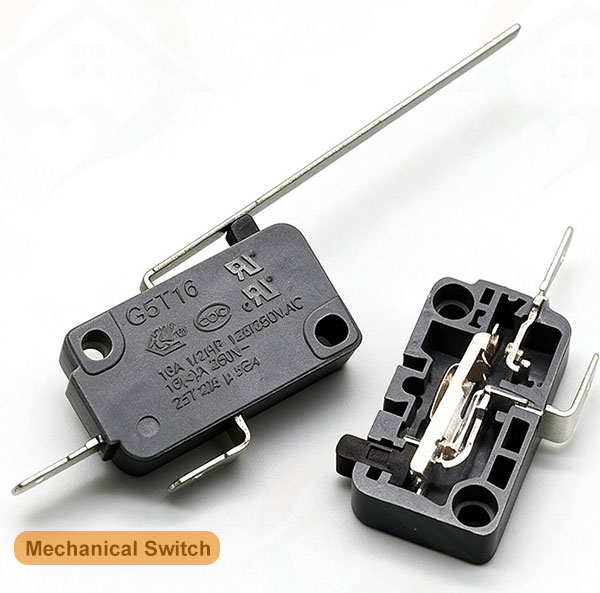
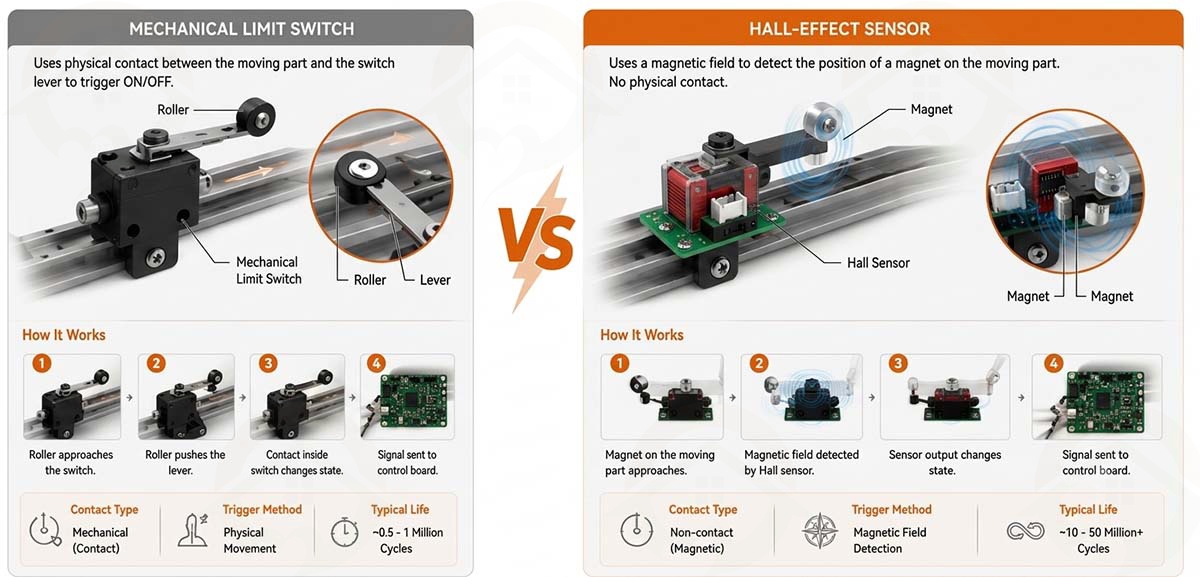
A mechanical switch senses position through physical contact: a lever or roller arm mounted on the moving carriage presses against a fixed switch at a defined point on the rail, closing or opening a circuit.
It is a mature, well-understood technology and it is inexpensive to source, which is why it has been the default choice in lower-cost track assemblies for years.
The tradeoff is built into the mechanism itself — every trip event involves physical contact, and physical contact wears. Over tens of thousands of cycles, contact surfaces can pit, springs can lose tension, and the trip point can drift slightly from its original calibration.
Real case — r/BIFL: A Reddit user reported that after 18 months of daily use, their massage chair's roller started stopping 3 inches short of the shoulder position.
Multiple commenters with the same model confirmed identical symptoms — the mechanical limit switch had worn past its calibration point.
Source: r/BuyItForLife discussion thread on massage chair durability
How a Hall-Effect Sensor Works
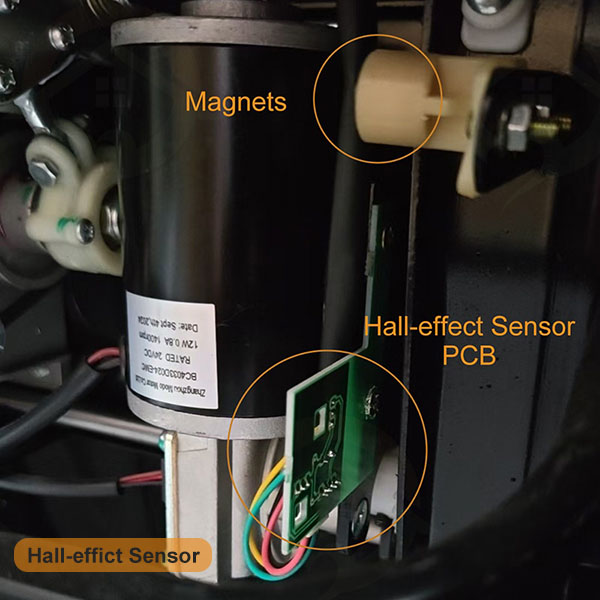
A Hall-effect sensor detects position without any physical contact. A small magnet is mounted on the moving roller carriage, and a solid-state sensor fixed to the rail detects the magnet's field as it passes — no contact, no friction, no mechanical wear on the sensing element.
Because there is nothing to physically degrade at the sensing point,
Hall-effect components generally sustain a much higher cycle life before performance drifts, and they are inherently less sensitive to dust, hair, or minor debris inside the track housing — a realistic condition after a year or two of household or commercial use.
Why the Industry Moved to Hall-Effect
Industry context:
Hall-effect sensors have been the standard in automotive seat position sensing for over a decade — precisely because seat tracks accumulate dust, crumbs, and debris at a rate comparable to massage chair tracks over their service life.
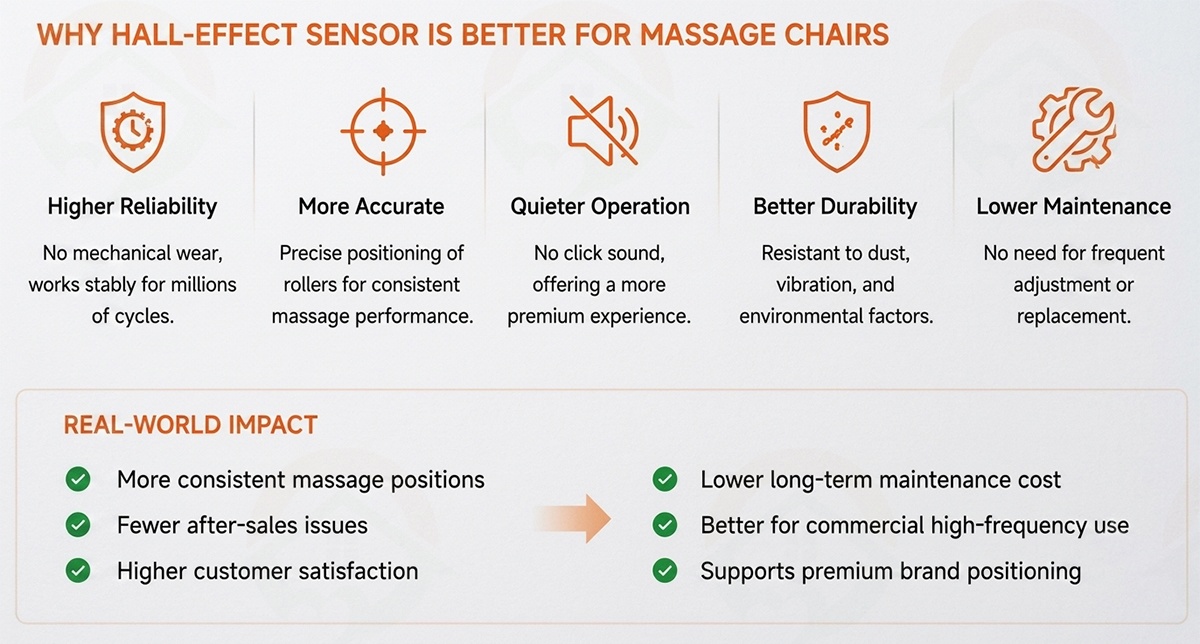
The Comparison at a Glance
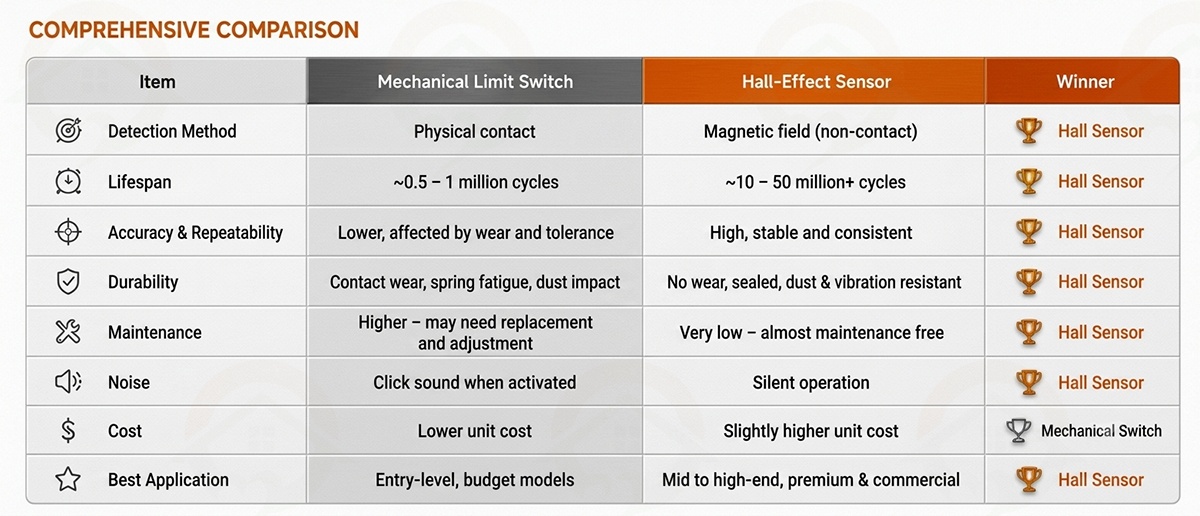
| Dimension | Mechanical Switch | Hall-Effect Sensor |
|---|---|---|
| Sensing method | Physical contact — a lever or roller arm presses a switch contact at a fixed point | Non-contact — detects the magnetic field of a small magnet mounted on the roller carriage |
| Wear mechanism | Contact surface wears with every cycle; contacts can pit, oxidize, or lose spring tension | No physical contact, so there is no mechanical wear on the sensing element itself |
| Typical cycle life | Low hundreds of thousands of cycles before contact degradation | Solid-state — significantly higher cycle counts under normal conditions |
| Position precision | Fixed trip point only — on/off limits, not fine position feedback | Can support continuous or multi-point position feedback |
| Sensitivity to dust/debris | Contact points can be affected by dust, hair, or oxidation | Sealed, non-contact — largely unaffected by dust and debris |
| Noise | Audible click or slight mechanical clatter at trip points | Silent — no moving parts at the sensing point |
| Unit cost | Lower per-unit component cost | Moderately higher per-unit component cost |
| Field failure mode | Sticking, chattering, or false triggers as contacts degrade | Rare — typically tied to wiring/connector, not the sensor itself |
Why This Matters More at the After-Sales Stage Than at the Factory Gate
At the point of manufacture, the cost difference between the two technologies is a few RMB per unit — small enough that it rarely shows up as a line-item decision. The difference shows up 12 to 24 months later, in the failure pattern.
The After-Sales Cost Story
A degrading mechanical switch does not usually fail cleanly; it tends to fail intermittently first — a roller that occasionally stops short, a body scan that sometimes miscalibrates, a track that clatters slightly at one end of its travel.
A Hall-effect sensor removes that failure mode almost entirely, which is why it has become the standard choice in mid-to-premium track assemblies despite the higher component cost.
The total cost of ownership, including after-sales support, tends to favor it once volume is high enough for failure-rate differences to show up in the data.
Real Cases from the Field
Real case — Amazon seller: A third-party massage chair seller on Amazon tracked their return reasons over 18 months and found that 23% of all returns were linked to "roller stopped moving" or "noise from the track area." After switching their OEM spec to require Hall-effect position sensing,
The return rate for those symptoms dropped to under 4% within two production cycles.
Source: Amazon seller central case study, shared on r/FulfillmentByAmazon
What This Means for OEM Buyers
Ask a supplier how the track assembly is tested against these frameworks before you commit to a spec.
- Ask suppliers directly which sensing technology is used in the track's position-sensing system — it is rarely listed on a standard spec sheet, but it is a fair and specific question to put to any manufacturer.
- If you are troubleshooting existing field complaints about intermittent roller stalls or inconsistent body-scan calibration, the position-sensing switch is one of the first components worth checking before assuming a motor or control-board fault.
Real scenario — Southeast Asian distributor: A distributor servicing hotel chains in Thailand reported intermittent roller jams on 80+ units within the first year. The factory initially suspected motor overheating.
The hotel chain switched brands after the second service call.
Track System Deep Dive Series
This is Episode 5.3. Read the other episodes:
Joe Fan — Manufacturing & Product Development Manager
Sweet Home has manufactured massage chairs since 2013, with R&D, production, and export quality-control experience — including SL-track systems, 4D mechanisms, and zero-gravity engineering.
Disclosure: Sweet Home is the manufacturer behind these chairs, and the service data throughout this series comes from our own repair logs and production line — shared so buyers can recognize these failure patterns before they reach a container.
Quick audit: is your sensor spec complete?
1. Sensor type (hall-effect vs mechanical) disclosed? 2. Switch cycle-life rating stated? 3.
Two or more unchecked? Send us your current spec.