
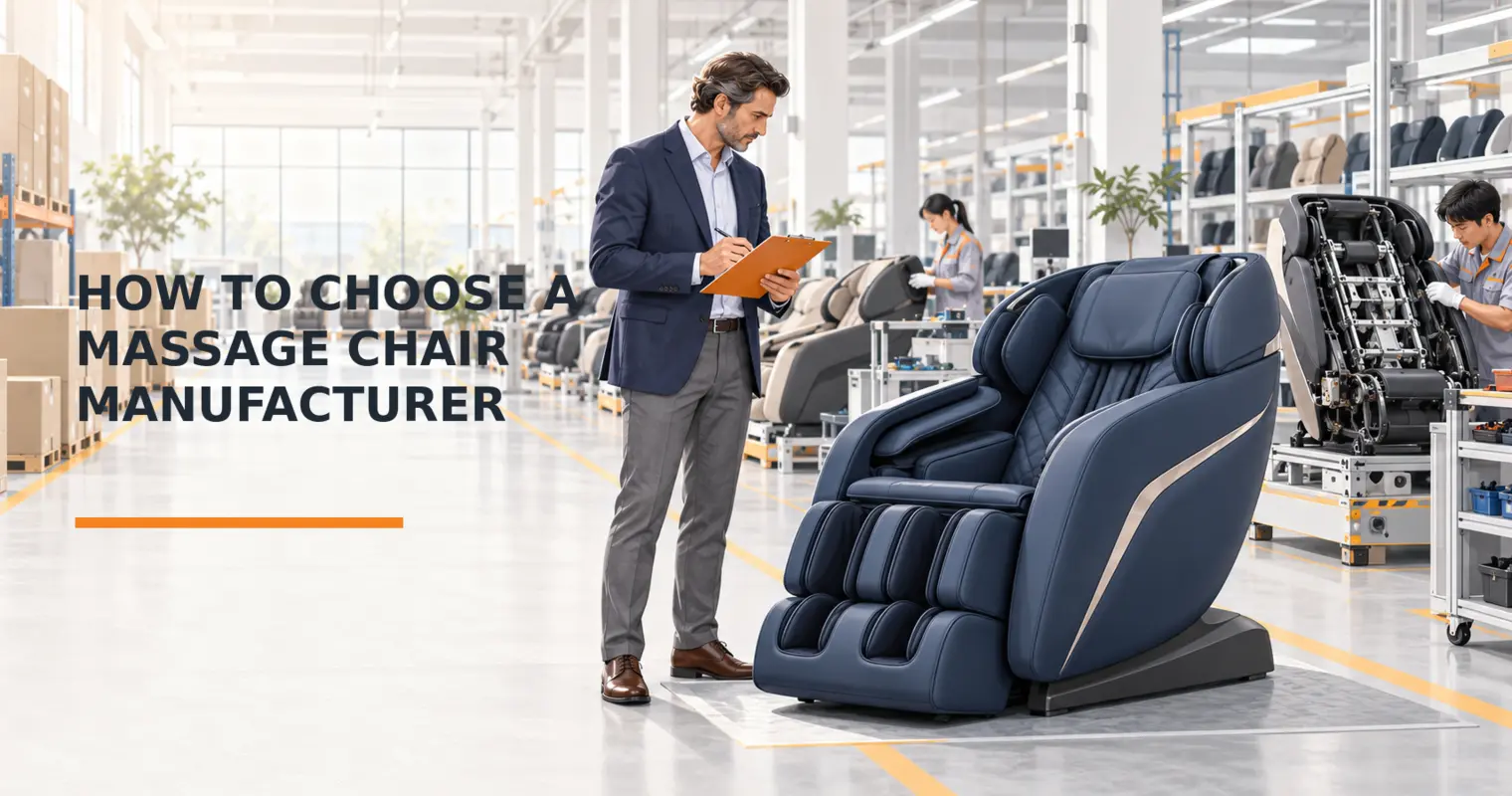
Choosing a massage chair manufacturer is not a beauty contest and not simply a race to the lowest quotation.
A glossy sample can sit beautifully in a showroom. Your real supplier test begins when 200 more chairs must feel, sound, look, and arrive like the first one.
You do not need to become a massage-chair engineer; you need to ask for the right evidence. This guide turns supplier evaluation into seven practical steps you can use before a bulk order. If you are starting from zero, our full-body massage chair lineup shows how a complete specification sheet should read.
1. Define the Order Before You Judge the Factory
Write the Sourcing Brief First
A manufacturer cannot be "reliable" in the abstract. It must be reliable for your product, market, volume, and service model. Start with a short sourcing brief that answers:
- Which countries will receive the chairs?
- Is the product for retail, distribution, hospitality, an office program, or another commercial setting?
- What functions and price band are essential?
- Which plug, voltage, language, packaging, logo, color, and manual versions are required?
- What is the expected first order and realistic annual volume?
- Who will handle installation, customer support, repairs, and spare parts?
This prevents a common mistake: comparing quotations for products that look similar but include different specifications, testing, packaging, parts support, or commercial terms.
In our own export orders, the buyers who write this brief down before contacting factories receive more useful quotations than those who ask three suppliers to "send your best price."
2. Treat the Sample as the Start of the Investigation
A good sample matters, but a sample is one chair prepared under maximum attention. Bulk procurement asks a harder question: can the factory reproduce it consistently?
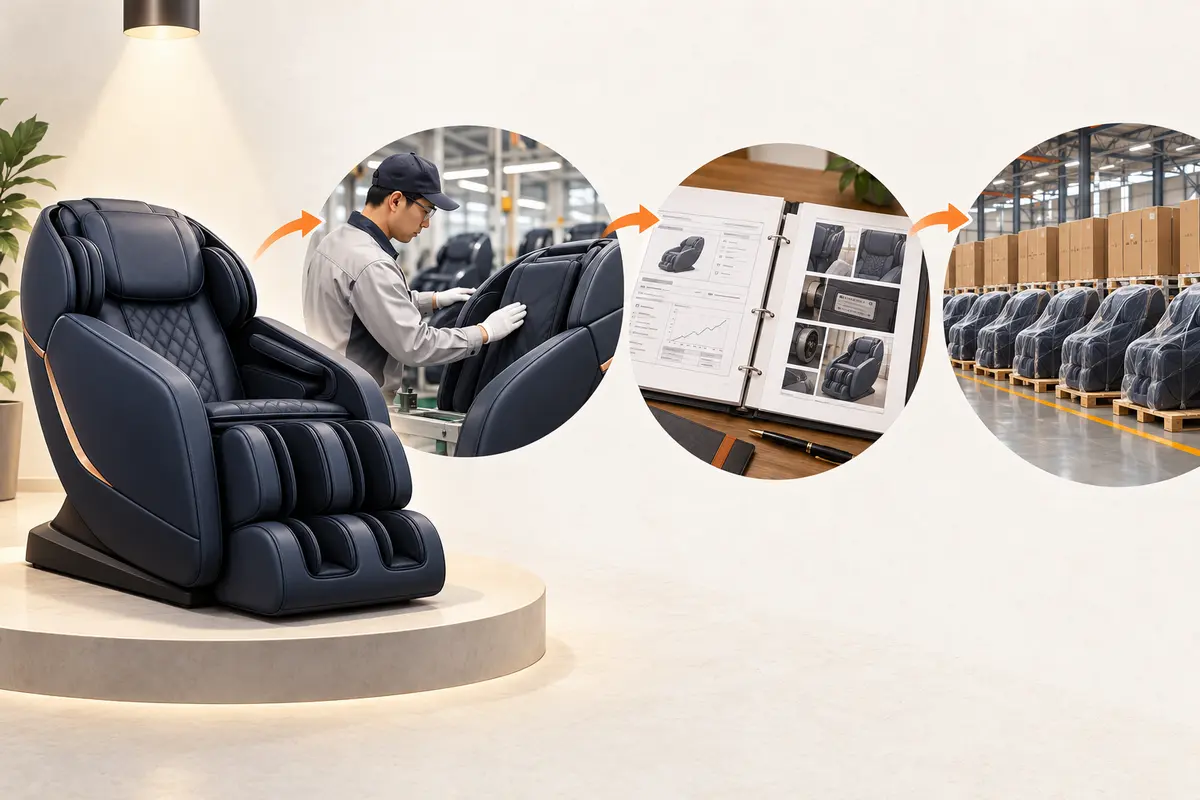
During sample evaluation, record the exact model and configuration. Check upholstery fit, stitching, noise, massage movement, recline, airbags, foot rollers, heating, controls, cable routing, odor, and packaging.
Then ask how those same points are controlled on the production line. Useful evidence includes inspection sheets, component specifications, traceable batch information, defect-handling records, and photos or video of the relevant model in production. A polished showroom photo proves very little about repeatability.
This is why, when we prepare a sample for a new OEM buyer, we attach the same batch records we would keep for a production run. The sample is only meaningful if the line can reproduce it, and a factory that cannot show that connection on request will rarely deliver it consistently in a container.
3. Verify the Company Behind the Sales Conversation
Years in business can be helpful, but the number alone is not proof of capability. Confirm the legal company name, factory address, business scope, export experience, ownership of the production site, and the role of any trading company involved.
During a physical or live video audit, ask to see the areas connected to your order: incoming inspection, frame or mechanism work, electronics, upholstery, assembly, testing, finished-goods storage, and spare-parts management. A factory tour should follow the product flow, not only the cleanest corridor.
Also ask who will own your project after the salesperson wins the order. You should know the people responsible for engineering confirmation, quality, production, shipping documents, and after-sales support. A reliable massage chair factory can name these roles without checking with the sales manager first.
4. Match Compliance Evidence to the Exact Product and Market
Do not buy a wall of certificate logos. Buy evidence that applies to the exact model and destination.
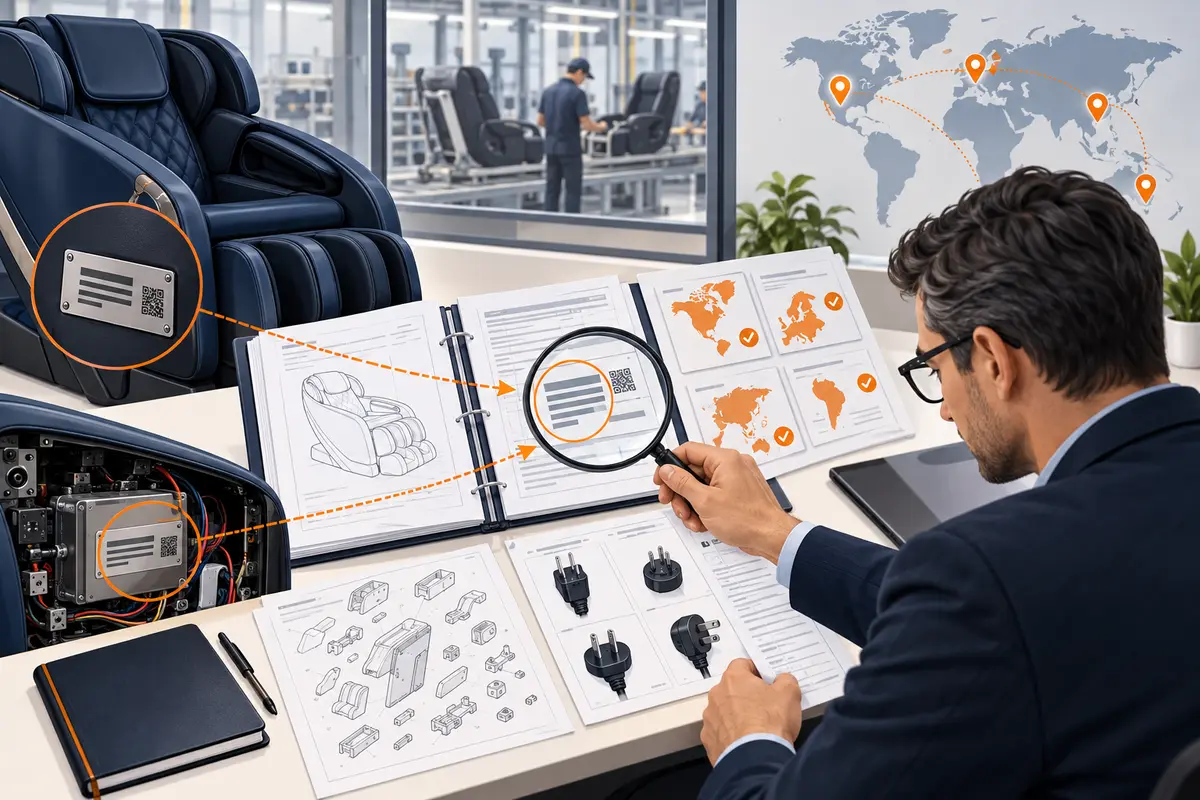
Requirements vary by market and configuration. Depending on the product and destination, buyers may need evidence relating to electrical safety, electromagnetic compatibility, restricted substances, radio functions, energy rules, labeling, or other local requirements.
A report for a different model, power supply, control board, or wireless module may not cover the chair you are importing.
What to Verify on Every Document
Ask the supplier to provide the relevant declaration, certificate, or test report and then verify:
- The manufacturer and applicant names
- The exact model numbers and product description
- The standards and markets covered
- The laboratory or issuing organization
- The issue date, validity, and any amendments
- Whether your customized components change the compliance basis
5. Audit Process Control, Not Just Factory Size
A large building is impressive. A controlled process is useful.

Look for clear checks at incoming materials, subassembly, final assembly, functional testing, appearance inspection, packaging, and shipment release. Ask what happens when a unit fails. Is it separated and recorded? Is the cause investigated? Is the correction checked on the rest of the batch?
On our own line, the answer to "what happens when a unit fails" separates the factories that improve between batches from those that quietly rework.
Massage chairs combine frames, motors, mechanisms, electronics, airbags, upholstery, software, and moving structures. A change to one part can affect noise, fit, function, durability, or compliance. The supplier should therefore explain how component substitutions and engineering changes are approved and communicated.
In-house production of important parts can improve response time and control, but "we make it ourselves" is not a quality system.
6. Test Whether OEM Support Goes Beyond a Logo
Meaningful product customization begins when your request affects more than the badge. It may involve upholstery, color, control language, function combinations, user interface, packaging, manuals, spare-parts lists, carton marks, or product structure.
Before committing to volume, agree on a written specification and a golden sample.
In our own OEM projects, the golden sample and the revision log are the two documents that prevent most disputes later; a supplier who resists writing them down is usually the supplier who will resist change control during production.
A capable supplier should also challenge requests that create risk. "Yes" is easy. Explaining why a feature conflicts with space, power, structure, software, or compliance is often a better sign of engineering maturity.
7. Compare Total Cost, After-Sales Support, and Delivery Risk
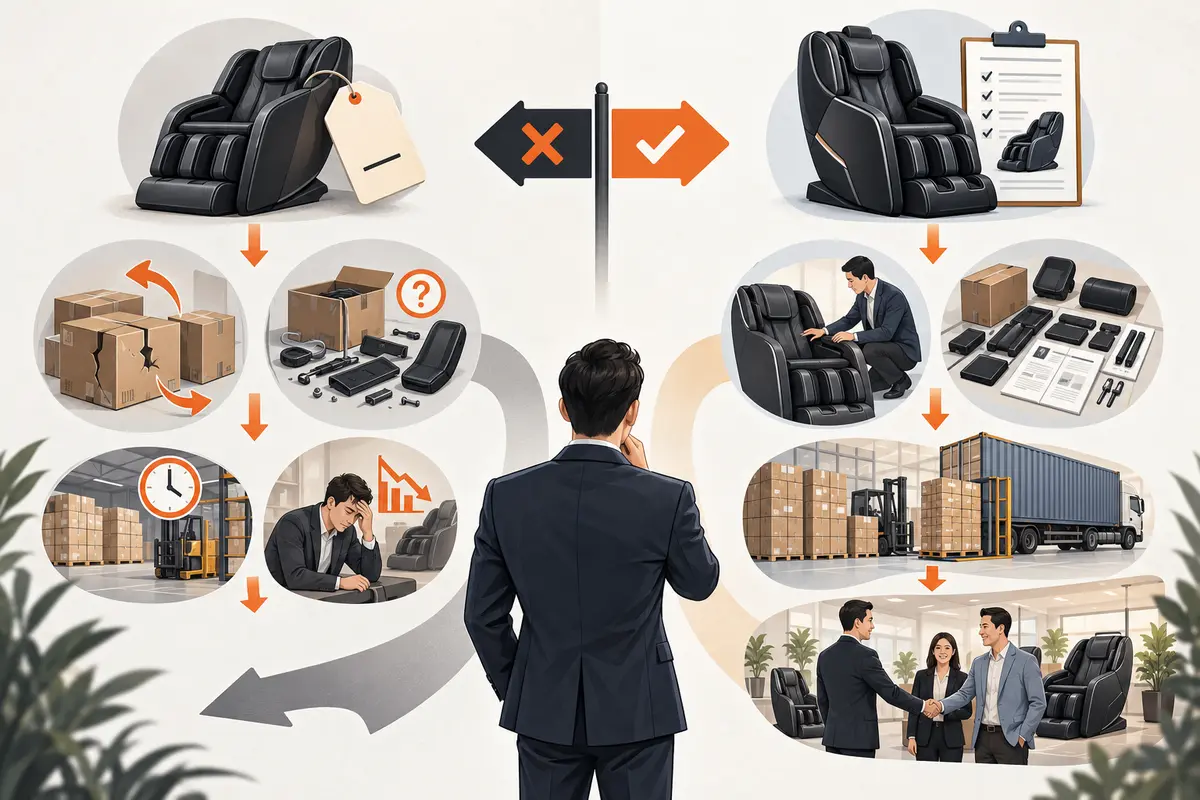
The lowest unit price can become expensive after you add unclear specifications, late changes, damaged cartons, missing spare parts, difficult repairs, repeated returns, or slow technical answers.
A Practical After-Sales Test
Then test the support system with a realistic question: "If a chair in our market develops an intermittent foot-massage fault, what information do you need, how will you diagnose it, and what parts or instructions can you provide?" The quality of the answer reveals much more than the phrase "good after-sales service."
A Simple Manufacturer Scorecard
Use the same evidence-based scorecard for every candidate. Weight the categories according to your business rather than awarding points for a persuasive presentation.
| Area | Evidence to Request | Warning Sign |
|---|---|---|
| Product fit | Written specification and evaluated sample | Quotation remains vague about configuration |
| Company identity | Legal records, address, responsible project team | Names or locations change between documents |
| Compliance | Model-specific, current documents for the market | Only logos or unrelated reports are shown |
| Process control | Inspection flow, records, failure and change handling | No clear answer when a unit or component fails |
| OEM execution | Revision control, approved sample, ownership and timeline | Every request receives an instant "yes" without review |
| Total cost | Comparable quotation and agreed shipping scope | A low headline price hides major exclusions |
Reduce Risk with a Staged Decision
You do not have to discover everything after the container door closes. Use stages: sourcing brief, supplier screening, document review, sample test, factory audit, final specification, pilot order, corrective review, and then scale-up.
No factory is perfect. The strongest signal is not the absence of every problem; it is whether the supplier can make the problem visible, trace its cause, correct it, and stop it from quietly returning in the next batch.
Kimi
Sweet Home Technical Team
Part of Sweet Home’s in-house technical team. Kimi writes our supplier-selection guides — sample evidence, compliance documents, process control, OEM scope and total cost — built on our export order data and after-sales records.
Disclosure: Sweet Home is the manufacturer behind this guide, and the export and after-sales patterns above come from our own orders and repair records — shared so buyers can evaluate any factory with the same checklist.
Quick audit: is your supplier evidence complete?
1. Model-specific compliance documents for your market? 2. Written specification & golden sample before volume? 3. A clear answer on how failed units are recorded and corrected? 4. A total-cost comparison beyond the unit price?
Two or more unchecked? Send us your current spec.