
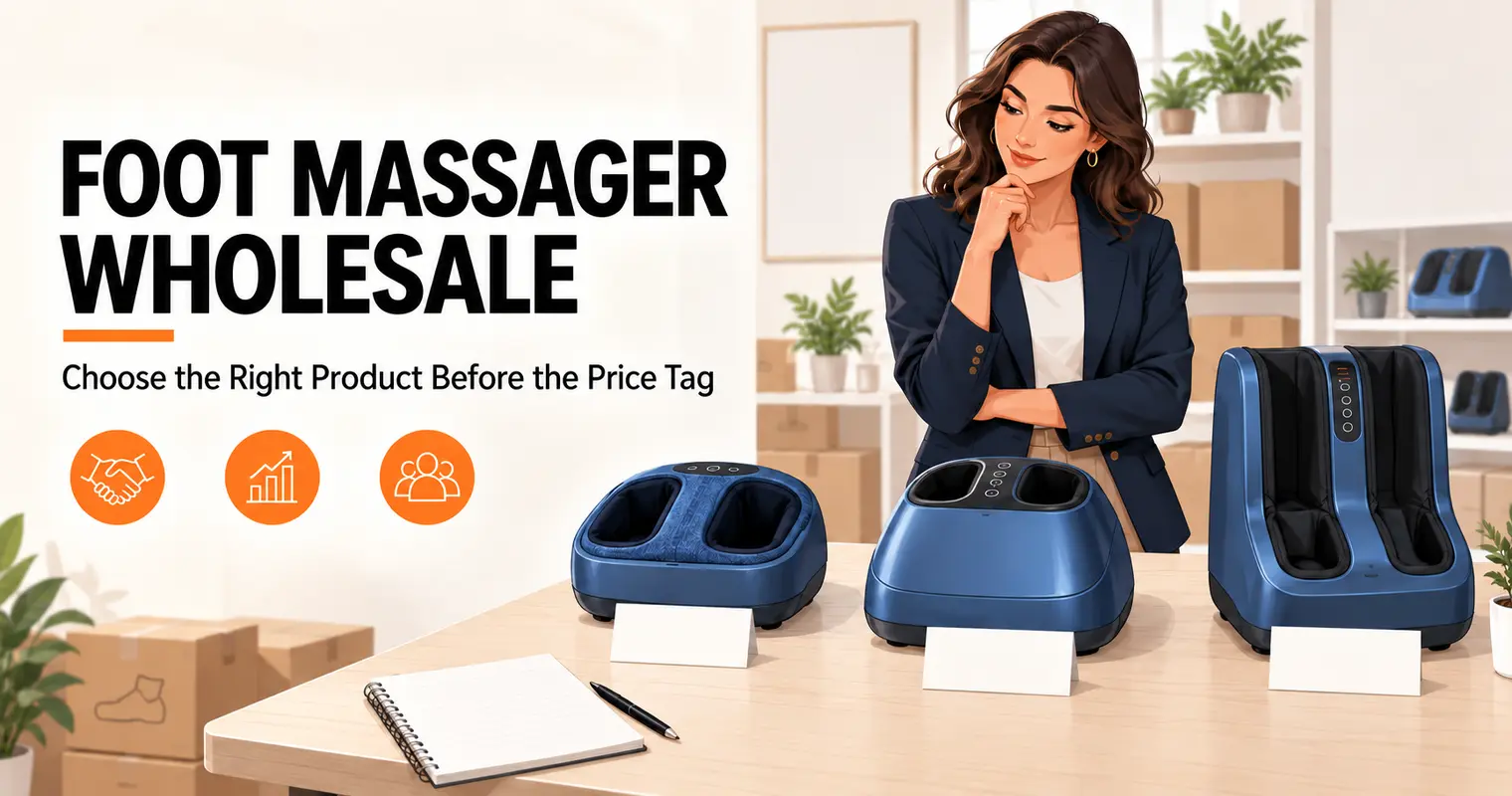
Buying foot massagers for a bulk or channel programme should begin with a simple question: who will use this product, and where will they buy it? Once that answer is clear, product structure, functions, customization, and pricing become much easier to judge.
The cheapest sample on the table can become the most expensive SKU in your warehouse. Not because it stops working on day one, but because customers find it awkward, returns begin to arrive, and your team discovers that the carton, controls, or foot fit were never properly checked.
This guide gives brands, distributors, retailers, and OEM / Private Label buyers a practical way to compare foot massagers without getting lost in feature lists.
1. Start With the Customer, Not the Catalog
A product that looks perfect in a showroom may be wrong for e-commerce. A feature-rich model may impress a buyer but confuse the person who just wants to press one button after work. A larger foot-and-calf unit may deliver a fuller experience, yet its carton size can change storage and freight calculations.
Before requesting quotations, define four things:
- Target user: office workers, older adults, gift buyers, frequent travelers, or hospitality guests?
- Sales channel: online, physical retail, TV shopping, hotel, wellness center, or another route?
- Expected experience: gentle relaxation, firmer kneading, air compression, warming, or broader calf coverage?
- Commercial limits: target retail positioning, carton size, plug standard for your market, after-sales support expectations — confirm on inquiry, and launch date?
This short brief is more useful than asking a factory for "your best foot massager." Best for whom? A good supplier should help narrow the choice instead of simply sending the longest catalog.
2. Three Practical Foot Massager Formats
Retail listings use many names, so it is easier to compare products by physical format and coverage.
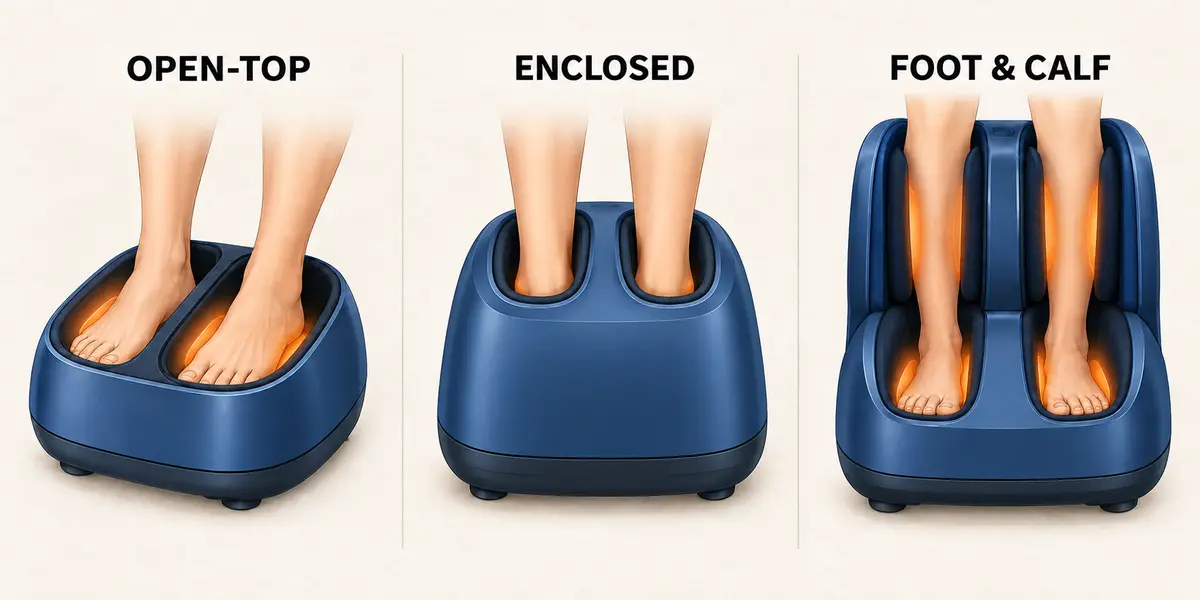
Open-top foot massagers
The user places both feet onto an exposed or lightly recessed massage surface. This format is easy to understand at a glance and can be convenient for quick trials in a store.
It may also suit users who dislike putting their feet into a deep enclosure. For buyers, the key questions are whether the feet remain stable during use, which areas receive contact, and how easily the surface can be cleaned.
Enclosed foot massagers
Each foot enters a padded well. The enclosure can support a more immersive combination of sole rollers, side compression, and warming. It also gives the product a substantial, giftable appearance.
Fit deserves special attention: opening size, internal length, lining thickness, and compression strength all affect comfort. A model that feels excellent to one tester may feel cramped to another, so sampling across several foot sizes matters.
Foot-and-calf massagers
A taller structure extends the experience above the ankles and into the calves. This creates a clearer step-up from a compact foot-only model and can support premium positioning.
The trade-off is equally clear: a larger product usually means a larger carton, more weight, more display space, and a higher logistics burden. Buyers should compare the full landed-cost picture, not only the unit quotation.
3. What Actually Creates the Massage Experience?
Two products can list the same four functions and still feel completely different. The experience depends on how those functions are arranged, timed, and controlled.
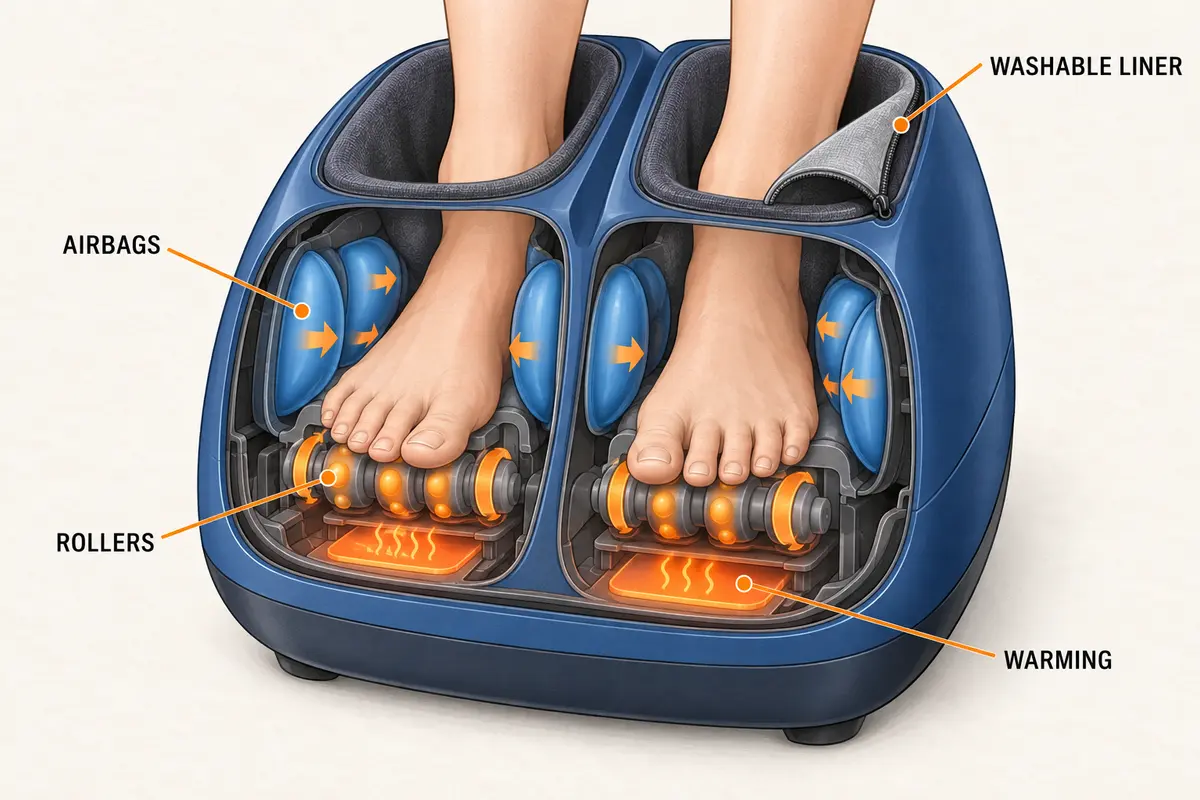
| System | What the buyer should evaluate |
|---|---|
| Kneading or rolling | Coverage along the sole, intensity range, smoothness, and whether pressure feels concentrated in one uncomfortable point. |
| Air compression | Where the airbags contact the foot or calf, how evenly they inflate, and whether the lowest setting is genuinely gentle. |
| Warming | Warm-up behavior, placement, user control, and the safety documentation relevant to the exact model. |
| Vibration or movement | Whether it adds useful sensation or simply adds noise, and whether the product remains stable on the floor. |
| Liner and padding | Skin feel, odor, durability, cleanability, removal method, and how replacement parts will be handled. |
More functions do not automatically create a better product. A well-tuned simpler model can be easier to use and easier to position than a complicated model with ten buttons and no obvious starting point.
When a bulk buyer asks us to add a function, our engineers first check how it behaves with the existing programs; a function that fights the platform rarely ships.
4. Match the Product to the Sales Channel
The right product is the one whose experience, presentation, and operating details fit the channel.
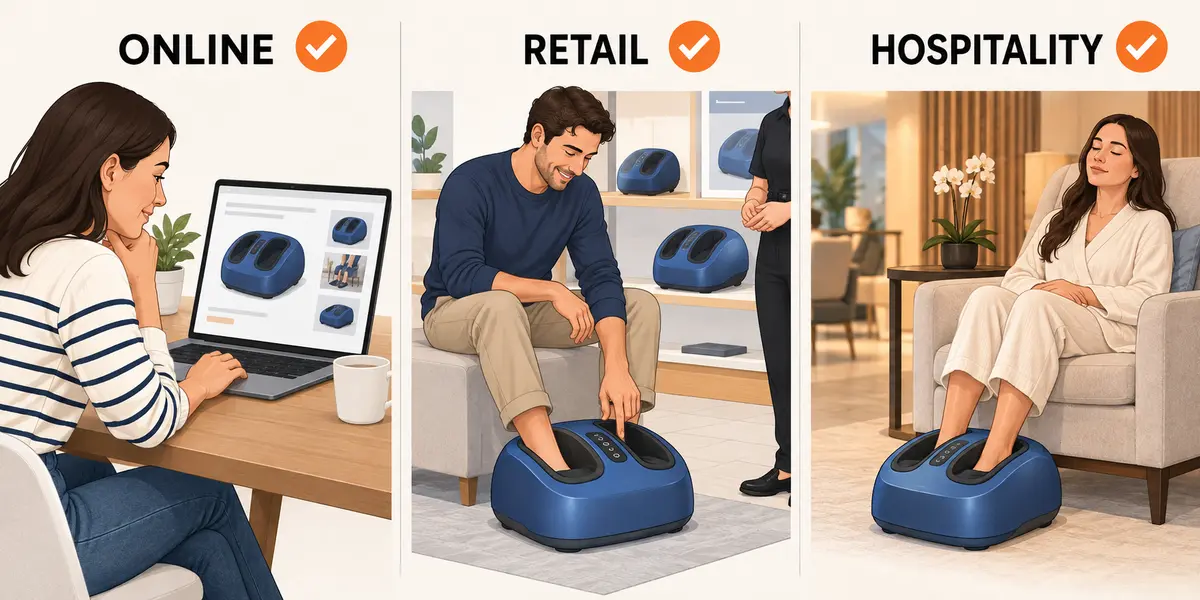
| Channel | Useful priorities | Common buying trap |
|---|---|---|
| E-commerce | Clear visual story, easy controls, manageable carton, strong product video potential, and straightforward setup. | Choosing a large or heavy product before checking fulfillment and return costs. |
| Physical retail | Quick demonstration, intuitive controls, cleanable contact areas, attractive shelf presence, and clear step-up between models. | Comparing specifications but not watching how first-time users interact with the sample. |
| Hospitality or wellness | Simple operation, hygiene workflow, noise behavior, durable contact materials, and easy staff reset. | Buying a consumer model without considering repeated use and cleaning procedures. |
| Gift and promotional programs | Packaging, perceived value, broad fit, simple instructions, and predictable delivery timing. | Spending on extra functions that are difficult to explain on the box. |
5. FOB Quote: Ask What Is Included
A foot massager quotation is not a universal market price. It is the result of a particular structure, order quantity, material choice, control system, packaging method, certification scope, and delivery term. To compare quotations fairly, send every supplier the same request and confirm:
- exact model and function configuration;
- order quantity and color split;
- logo method and artwork requirements;
- plug, voltage, language, labels, and manuals;
- inner protection and master-carton specification;
- spare-parts plan and after-sales responsibility (confirm in the PO/contract);
- applicable test reports or certifications for the destination market and sales channel;
- Incoterm, loading port, production schedule, and payment terms.
A lower number may exclude items that another quotation includes. Until the configuration and commercial terms match, the prices are not truly comparable.
Across the bulk orders we handle, the most common price surprise is a quotation that excludes packaging artwork, plug variants, or a test report the destination requires.
6. OEM and Private-Label Options
Customization is not one big switch marked "OEM." It is a ladder. Each step adds differentiation, but it can also add development work, minimum quantities, tooling, and validation.
- Branding: logo, rating label, manual, color box, and shipping marks.
- Appearance: shell color, fabric color, finish, button graphics, and packaging design.
- Experience: program sequence, intensity levels, timing, warming behavior, and control logic, where the platform supports changes.
- Structure: material changes, component changes, or a new enclosure and tooling.
For a first launch, an existing validated platform with thoughtful branding and packaging is often the fastest route. Structural changes make more sense when the commercial reason is clear and the expected volume supports the work.
7. The Sample Review That Prevents Expensive Surprises
Review the sample as a customer, a service team, and a logistics manager, not only as a purchasing department.
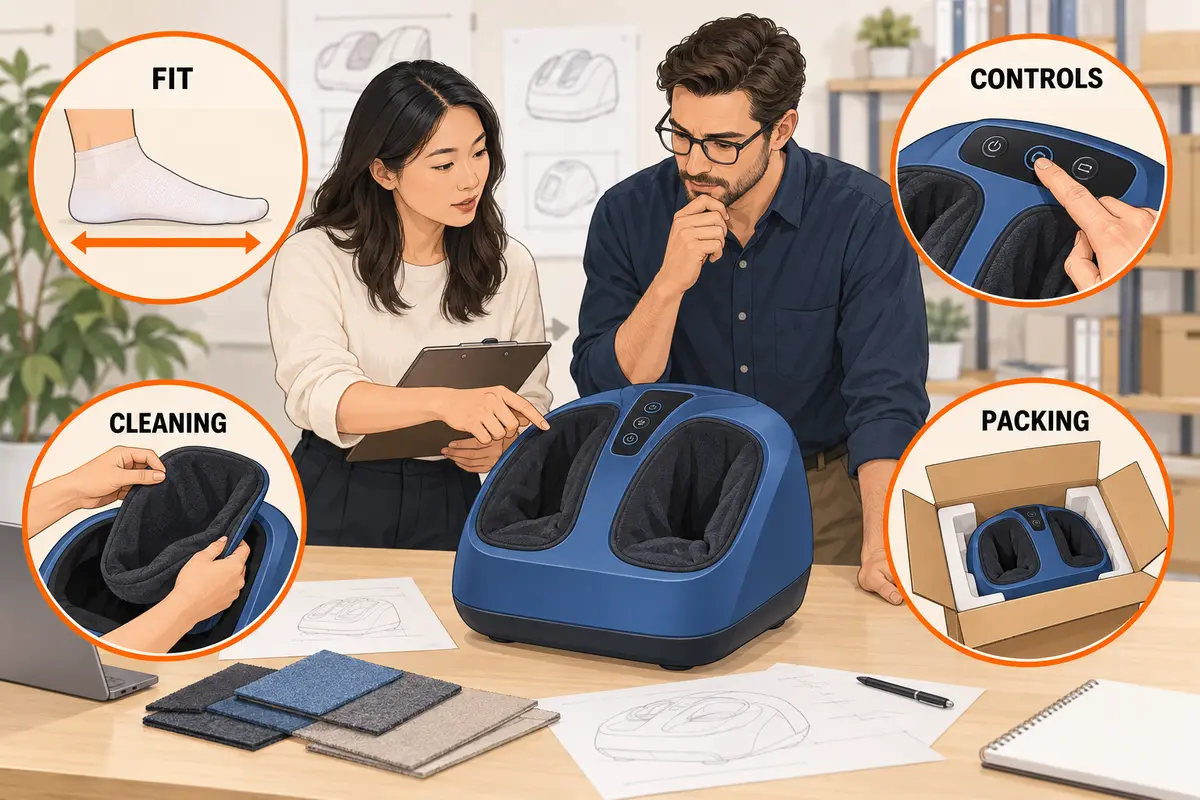
Run the sample through real scenarios. Use several foot sizes. Try it without reading the manual. Ask someone unfamiliar with the product to start, adjust, and stop it. Remove the liner. Clean the contact surfaces. Carry the carton. Open and repack it. Then record the findings in one shared checklist:
- Fit: openings, internal space, calf width, and comfort across intended users.
- Experience: coverage, intensity range, program transitions, noise, and stability.
- Controls: button clarity, remote storage, indicators, timer behavior, and restart logic.
- Cleaning: liner removal, washable parts, surface access, drying, and replacement availability.
- Quality details: seams, gaps, odor, cable routing, plug, finish, and moving parts.
- Packaging: protection, carton handling, accessories, manual, labels, and unboxing sequence.
Approve a clearly identified final sample before mass production. If a color, program, component, label, or package changes afterward, document the change instead of relying on a chat message from three weeks ago.
Before we offer a new platform for bulk programmes, we run the same sample review internally, including several foot sizes, liner removal, and a carton open-and-repack, because problems found at the sample stage cost cents compared with problems found after shipment.
8. Compliance Is Model-Specific
Requirements vary by destination, voltage, wireless functions, product claims, and sales channel. A logo on a brochure is not enough.
Ask which exact model and configuration a report covers, who issued it, whether it is current, and whether your final plug, adapter, labels, manual, and electronic functions are included.
For European retail, verify the compliance marking marking and the technical documentation behind it. For North America, confirm the applicable applicable electrical safety testing. Where the destination restricts substances, check restricted-substance documentation coverage on the exact model and configuration.
Retail platforms and major chains may also have requirements beyond basic legal compliance. Confirm these before packaging artwork and production begin. When in doubt, review the final configuration with a qualified compliance partner in the destination market.
9. Questions to Ask a Foot Massager Supplier
- Which product format best fits our user and channel, and why?
- What changes between the entry, mid-range, and premium versions?
- Which parts are removable, washable, or replaceable?
- What is included in this quotation, and what would change the price?
- Which parts of the product can be customized without new tooling?
- Which documents apply to the exact model we will order?
- How are approved samples and production changes controlled?
- What spare parts, service information, and after-sales support are available?
Final Takeaway
foot massager bulk buying buying becomes much simpler when the order of decisions is right: choose the user, choose the channel, choose the product format, test the experience, define the OEM scope, and only then compare price.
If you are planning a foot massager line, Sweet Home can help you compare available platforms, customization options, and sample requirements for your market. Explore the foot massager range or contact the Sweet Home team with your target channel, destination, expected functions, and estimated quantity.
Kimi
Sweet Home Technical Team
Part of Sweet Home’s in-house technical team. Kimi writes our bulk-buying and product-selection guides — foot massager formats, channel fit, margin per carton, and which features survive real use — built on our export order data and after-sales records.
Disclosure: Sweet Home is the manufacturer behind the foot massagers discussed here, and the buying patterns in this guide come from our own export orders and repair records — shared so buyers can compare products before booking a container.
Quick audit: is your foot massager lineup decision complete?
1. Sample tested across several foot sizes? 2. Compliance documents for the exact model and destination? 3. Quotation compared on carton, plug, and Incoterm? 4. OEM scope defined (branding vs new tooling)?
Two or more unchecked? Send us your current spec.
Related product pages
C1 Open-Type Electric Foot MassagerC2 Full-Automatic Foot Massager